Buyer Fit Snapshot
| Best fit | Wholesale Custom Printed Brand Sleeves for Packaging projects where brand print, material claims, artwork control, MOQ, and repeat-order consistency need to be specified before quoting. |
|---|---|
| Quote inputs | Share finished size, material target, print colors, finish, packing count, annual reorder estimate, ship-to region, and any compliance wording. |
| Proofing check | Approve dieline scale, logo placement, barcode or warning zones, color tolerance, closure strength, and carton packing before bulk production. |
| Main risk | Vague material claims, crowded artwork, missing packing details, or unclear freight terms can make a low unit price expensive after revisions. |
Fast answer: Wholesale Custom Printed Brand Sleeves for Packaging should be specified like a repeatable production item. The safest quote records material, print method, finish, artwork proof, packing count, and reorder notes in one written spec.
Production checks before approval
Compare the actual filled-product size with the drawing, then confirm tolerance on folds, seals, hang holes, label areas, and retail display edges. Reserve space for logos, QR codes, warning copy, and material claims before decorative graphics fill the panel.
Quote comparison points
Review material grade, print process, finish, sampling route, tooling charges, carton quantity, and freight assumptions side by side. A quote is only useful when the supplier can repeat the same color, closure quality, and packing count on the next order.
Wholesale Custom Printed brand sleeves are a practical fix for the all-too-common packaging problem where the box already does its job, yet the outside still looks unfinished. I see that situation a lot in retail and fulfillment packaging. The structure may fit the product properly, ship without drama, and stack well in a warehouse, but the surface presentation still feels plain. A sleeve changes that without asking for a full structural rebuild. It adds branding where people actually notice it first, at the shelf, during unboxing, or while the package is sitting in a display tray.
That is why wholesale custom printed brand sleeves tend to make sense for teams that need visual impact without blowing up the budget. You can keep the inner carton, tray, or mailer stable and update the outer layer instead. The result is a packaging system that looks planned rather than patched together. For subscription kits, private-label launches, seasonal bundles, and retail products that need a cleaner first impression, the sleeve is often the smartest place to spend the money.
From a buyer’s perspective, the appeal is pretty straightforward. You get a tighter cost profile, faster turnaround, and fewer structural decisions to manage. Instead of redesigning an entire box, you focus on the part of the package that carries the logo, the product name, the campaign message, and the shelf-facing side. That makes wholesale custom printed brand sleeves especially useful when a launch is moving quickly or a product line is still being tested and nobody wants to get locked into a heavy custom carton spec too early.
Why Wholesale Custom Printed Brand Sleeves Beat Reboxing
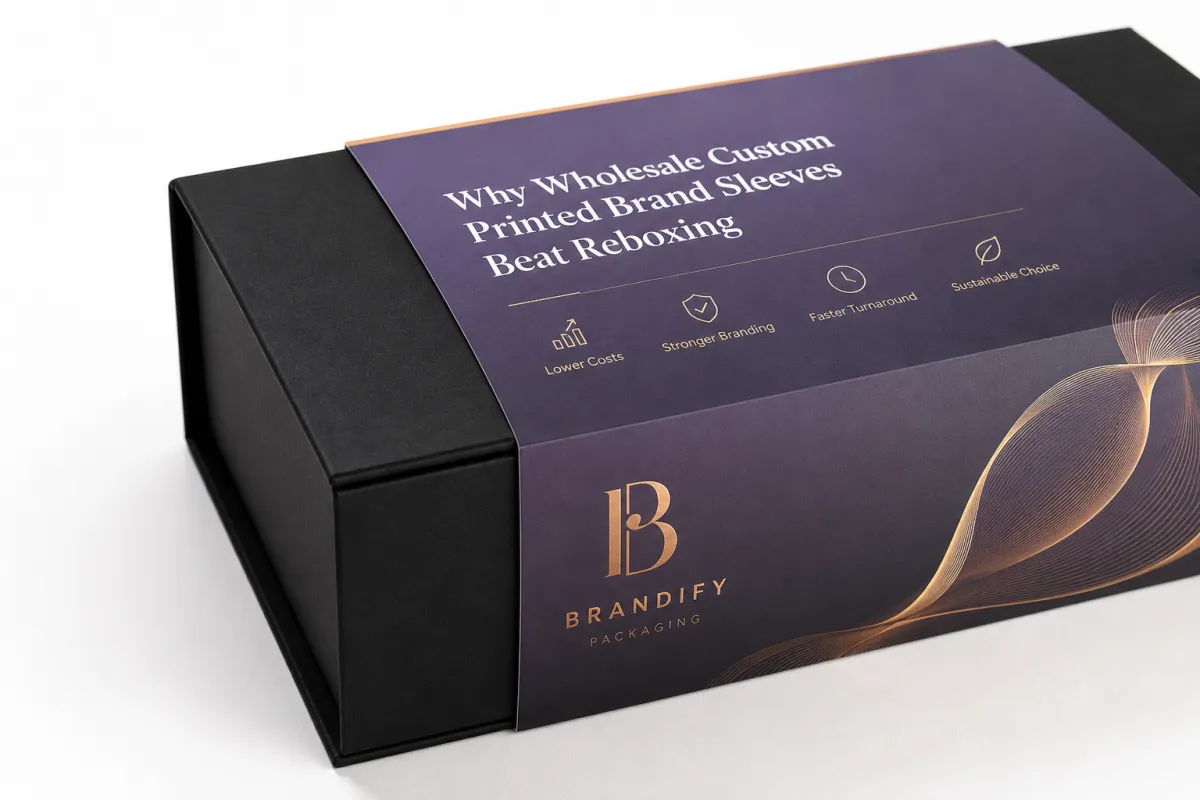
The biggest reason wholesale custom printed brand sleeves get approved so often is that the base package already works. If the insert holds the product, the closure behaves the way it should, and the carton survives transit, there is not much value in paying for a new structure just to improve the outside. A sleeve adds a branded outer layer and changes the customer’s first impression immediately. That is a much smaller investment than a full rebox, and in many categories it delivers the largest visual return for the least amount of structural risk.
Cost control matters too. A full custom carton usually brings more drawing time, more sample rounds, more structural testing, and more chances for the project to drift. Wholesale custom printed brand sleeves cut a lot of that out. They sit over the package you already have, which lets the budget focus on the surfaces that matter most: the front panel, the logo, the product story, the variant callout, and the side that gets seen in retail or on camera. A plain carton can look considered and brand-ready with the right sleeve, and the whole project stays a lot more manageable.
Speed is another reason sleeves win. Seasonal releases, event kits, promotional packs, and subscription updates rarely need a brand-new box specification. A sleeve allows the inner pack to stay fixed while the artwork changes around it. That helps when a retail window is already open, a campaign has a hard launch date, or the team needs to get a test run out before the buying cycle closes. In practice, wholesale custom printed brand sleeves are often the cleanest option for soft launches because they let brands test visual direction and messaging before committing to a permanent packaging system.
They also lower the risk of getting stuck with the wrong format. If the color palette, layout, or campaign direction misses the mark, it is usually far easier to update the sleeve art than to scrap a structural run. That flexibility protects cash flow, even if it does not sound flashy. A sleeve is easier to revise, easier to reprint, and easier to phase in across a set of SKUs or short seasonal runs. For a lot of packaging teams, that flexibility is the whole point.
"If the carton already fits, do not pay for a new carton just to fix branding."
Wholesale custom printed brand sleeves are not the right answer in every case, though. If the package needs stronger protection, a different insert, better tamper resistance, or a new internal fit, then a sleeve only solves part of the problem. It does not fix crush damage. It does not strengthen weak board. It does not replace transit testing. If the product needs structural help, the packaging system itself needs a review before anyone starts talking about graphics.
There is also a category where sleeves are especially effective: cosmetics, candles, gift sets, apparel accessories, seasonal releases, and private-label goods that already have a stable base pack. In those lines, wholesale custom printed brand sleeves let the brand feel premium without locking the business into a hard-to-change custom carton. That is a practical decision, not presentation for its own sake.
I have seen teams spend months debating whether they need a new carton when the better answer was sitting in plain sight. If the mechanics are sound, add the branding layer and move on. That is the kinda decision that keeps a launch from getting bogged down.
Product Details for Wholesale Custom Printed Brand Sleeves
Wholesale custom printed brand sleeves are printed wraps that fit over an existing box, tray, pouch, or carton to add branding, product information, and a clearer visual hierarchy. They are the face of the package rather than the structural shell. Their job is to present the product better, organize the front panel, and create a quicker path to branded packaging without changing what is already inside.
Most buyers start with one of four formats. An open-end sleeve is the simplest and works well for sliding over a box or tray. A wrap sleeve covers more of the package and gives a larger print area. A tuck sleeve closes at one end and creates a more finished look. A die-cut sleeve adds windows, tabs, or custom cut lines so the product or insert can show through in a controlled way. Wholesale custom printed brand sleeves can be built in any of those forms, but the right structure depends on how the box opens, how the product sits, and how much of the package should remain visible.
They show up often in cosmetics, candles, apparel, food kits, gift sets, mailers, and promotional packaging because those categories rely heavily on presentation. A sleeve can make a plain carton feel like part of a designed system instead of a generic shipping container. It can also carry information that would crowd the main panel: ingredients, scent notes, seasonal copy, QR codes, limited-edition language, or compliance details that deserve space but do not belong on the primary box graphics.
Print coverage changes the result more than many buyers expect. Full-color exterior printing gives the strongest shelf presence. Interior printing adds a second reveal during opening, which makes the unboxing feel more deliberate and gives the package a stronger rhythm. Spot logos, restrained patterns, or minimal linework can work very well for premium goods, especially when the rest of the structure stays clean. Wholesale custom printed brand sleeves do not need to be loud to succeed. They need to be aligned, readable, and consistent with the rest of the packaging.
One detail gets missed often: a sleeve built for presentation is not the same thing as a sleeve built for protection. Most wholesale custom printed brand sleeves are designed to improve the appearance of the pack first. They can help with containment a little, but if the package needs rigidity or impact resistance, the inner carton and insert must be specified correctly. Buyers who care about sustainability often ask for FSC-certified board or recycled stock, which is a sensible starting point. The coating system, ink coverage, and adhesive choices still need review if recyclability is part of the brand promise, because a paper label or sleeve does not automatically make the whole pack recyclable.
For buyers who want broader context on packaging materials and sustainability standards, the FSC site is a useful reference for certified paper sourcing, while packaging.org offers industry education on packaging formats and material choices.
Specifications for Wholesale Custom Printed Brand Sleeves
Any usable quote for wholesale custom printed brand sleeves starts with clear specs. Begin with finished dimensions, not a rough guess at the box size. Measure the actual outside dimension after the sleeve folds and wraps around the pack. Then list the substrate, print method, quantity, coating or lamination, and whether the design needs a window, tab, score line, or locking feature. Suppliers can only price what they can build, and incomplete information usually leads to back-and-forth that slows the job down.
Material choice affects the feel more than logo placement does. SBS and coated paperboard are common because they print cleanly and hold bright color. Kraft board gives a more natural appearance and can support a stronger eco-forward message. Recycled stocks are useful when the brand wants a lower-impact profile, although brightness, ink holdout, and coating behavior may vary from one stock to another. Heavier board makes the sleeve feel more substantial, though it also raises cost and can complicate folding if the dieline is tight. Wholesale custom printed brand sleeves are often best in the 14pt to 24pt range, depending on size and the amount of stiffness needed.
Finishing choices shape perception quickly. Matte finish reads calm and modern. Gloss is sharper and more reflective. Soft-touch gives a muted premium feel, though it adds cost and can show handling marks more easily. Spot UV creates contrast on a logo or pattern. Foil, embossing, and debossing work especially well for premium retail packaging, but each one introduces setup requirements and more chances for misalignment if the artwork is not prepared correctly. Lamination can improve durability, though the impact on recyclability depends on the board, adhesive system, and overall construction. The strongest wholesale custom printed brand sleeves balance appearance with the real demands of storage, shipping, and handling.
Tolerance matters more than first-time buyers usually expect. A sleeve that is too tight can buckle or crush the edges. A sleeve that is too loose can shift during packing and look cheap in the hand. A good supplier will ask for finished pack dimensions, board thickness, and assembly method so the dieline is built around the real object instead of an approximation. Small fit errors show up immediately. The sleeve sits crooked, the print looks off-center, and a decent design suddenly feels rushed.
Artwork should be prepared for production, not just for presentation on a screen. Vector files in AI, EPS, or print-ready PDF are the safest place to start. The dieline, bleed, safe area, barcode placement, and Pantone references should be included if color consistency matters. If a barcode or regulatory panel has to land in a fixed position, tell the supplier before proofing begins. Wholesale custom printed brand sleeves often run into trouble when the artwork looks fine in a mockup but does not account for fold lines, trim variation, or the actual movement of the sleeve around the box.
If your sleeves will move through distribution centers or retail channels with strict handling requirements, it helps to review ISTA test procedures so the packaging spec aligns with real transit conditions. That kind of review is a basic safeguard, not an extra luxury.
Quick Spec Checklist
- Finished sleeve dimensions and sample box measurements
- Board type, caliper, and any recycled or FSC requirements
- Print coverage, colors, and whether interior printing is needed
- Finish: matte, gloss, soft-touch, UV spot, foil, emboss, or lamination
- Artwork files, dieline approval, bleed, and safe area
- Quantity, version count, and barcode or regulatory placement
Use that checklist before requesting quotes for wholesale custom printed brand sleeves. It saves time, and it keeps the supplier from filling in gaps with assumptions that cost money later.
Pricing and MOQ for Wholesale Custom Printed Brand Sleeves
Pricing for wholesale custom printed brand sleeves comes down to a handful of variables that make sense once you stop treating “custom” as one giant category. Size matters. Material matters. Print coverage matters. Finish matters. Dieline complexity matters. Quantity matters most of all. Smaller runs usually carry a higher unit price because setup costs are spread over fewer pieces. Larger orders reduce the cost per sleeve quickly. That is how print production behaves, even when the quote language tries to make it sound mysterious.
For basic sleeves on standard board with straightforward full-color printing, buyers often see rough pricing in the $0.18-$0.45 per unit range at higher quantities, depending on size and finishing. More premium builds with specialty coatings, heavier board, foil, or multiple print versions can move into the $0.45-$1.20 range or beyond. Those figures are not promises. They are practical ranges that reflect how production usually pencils out. If a supplier gives one flat number without breaking down the details, they are hiding the variables instead of explaining them.
MOQ depends on the job as well. Many wholesale custom printed brand sleeves begin around 500 to 1,000 pieces, though some suppliers will ask for more if the size is unusual or the print method carries a higher setup burden. Other suppliers can go lower for simple test runs or prototype campaigns, although the unit price will usually climb. If you need more than one artwork version, ask whether the minimum applies to each version or to the order as a whole. That small detail changes the math quickly.
Prototype, sample, plate, and setup charges can appear as separate line items. In some cases they are credited back when the production order is placed. In other cases they are not. Ask directly. Do not assume anything. The same is true for proofing, die charges, packing, and freight. A low unit price that leaves out setup and shipping is not a real price. It is a teaser.
| Option | Typical Use | Approx. Unit Cost | MOQ | Lead Time |
|---|---|---|---|---|
| Basic open-end sleeve | Simple box branding, seasonal promos | $0.18-$0.35 | 500-1,000 pcs | 10-15 business days after proof |
| Full wrap sleeve with color printing | Retail packaging, gift sets, private label | $0.25-$0.60 | 1,000+ pcs | 12-18 business days after proof |
| Premium sleeve with foil or spot UV | Cosmetics, candles, premium branded packaging | $0.45-$1.20+ | 1,000-3,000 pcs | 15-25 business days after proof |
Ask for a landed-cost quote, not only a print quote. Production, finishing, packing, and freight should be included or itemized clearly. If you are comparing wholesale custom printed brand sleeves from more than one supplier, landed cost is the number that matters. Everything else is just decoration on the estimate.
There is a useful buying rule here: if the sleeve is replacing a full box redesign, compare the total spend against the cost of new custom printed boxes, not only against another sleeve quote. In many projects, wholesale custom printed brand sleeves win because they create a better balance between brand impact and total packaging spend.
Process and Timeline for Wholesale Custom Printed Brand Sleeves
The normal workflow for wholesale custom printed brand sleeves begins with a brief. That brief should include dimensions, quantity, target finish, artwork files, and the intended use of the sleeve. Once the supplier has that information, they can quote with confidence instead of guessing. After the quote comes dieline confirmation. If the dieline is wrong, the rest of the process wastes time and creates avoidable rework.
A practical timeline usually looks like this: quote turnaround in 1-3 business days, proof revisions in 1-5 business days depending on how complete the artwork is, production in 7-18 business days after proof approval, and shipping time on top of that. Straightforward jobs move faster. Special finishes, custom cuts, or imported paper can extend the schedule. Wholesale custom printed brand sleeves do not slow down because the printing itself is difficult; they slow down when approvals are incomplete or the specs keep changing after the proof stage.
- Brief and quote: confirm size, stock, quantity, and finish.
- Dieline and artwork setup: align the design to the actual sleeve structure.
- Proof approval: check colors, copy, barcode placement, and bleed.
- Production: print, cut, score, fold, and finish.
- Quality check and packing: inspect fit and visual consistency.
- Shipping: add transit time based on freight method and destination.
The biggest bottlenecks are usually the familiar ones. Missing dieline information. Low-resolution artwork. Late copy changes. Finishes that need extra setup. If you want wholesale custom printed brand sleeves to arrive on time, the job has to stay stable once proof approval begins. Every late change adds time, and sometimes it adds cost as well.
Rush production can be possible, but only on the right kind of job. If the sleeve uses standard stock, a simple dieline, and a clean art file, some suppliers can compress the schedule. If the sleeve needs special tooling, custom coating, or unusual material lead times, the room to move gets smaller. That is why launch planning needs buffer time. Do not build the calendar around a perfect handoff. That is how teams end up asking for miracles late in the week.
For packaging that will be shipped through retail or direct-to-consumer channels, it is smart to confirm whether the sleeve design can handle insertion, stacking, and transit without scuffing or shifting out of alignment. Wholesale custom printed brand sleeves are usually presentation-first, but the final pack still has to arrive intact.
Why Choose Us for Wholesale Custom Printed Brand Sleeves
Custom Logo Things is built for buyers who want direct answers. No fluff. No vague language. If you need wholesale custom printed brand sleeves, the conversation should start with fit, printability, finish, and real cost. That is how packaging should be sold. A good sleeve project lives somewhere between design, production, and practical judgment, and we stay on the useful side of all three.
Consistency matters a great deal in wholesale custom printed brand sleeves because small errors stand out quickly. If the color shifts from one run to the next, if score lines drift, or if the cut is loose on the box, the batch looks uneven even before it reaches the shelf. Quality control is not optional here. Clear communication matters just as much. We keep the checks visible so buyers know what is being reviewed before production moves ahead.
We also help with artwork and dielines, which saves time for teams that have strong branding but no in-house packaging engineer. That matters more than people admit. A marketing team can produce a beautiful design and still miss fold behavior, safe area, or barcode placement. A packaging supplier should catch those issues before they become expensive. That is one reason many buyers prefer working through structured programs like our Wholesale Programs and browsing fit options through our Custom Packaging Products pages before placing a run.
If you want to see how different jobs have been handled, our Case Studies page gives you a clearer picture of the kinds of packaging problems we solve. Not every project needs the same stock, finish, or structure. That is the point. Wholesale custom printed brand sleeves should fit the brand and the budget, not push the other way around.
We also keep pricing transparent. That means the quote should make sense the first time you read it. What is included, what is optional, where the setup fees sit, and what changes the final unit price should all be obvious. Buyers do not need sales theater. They need a usable number and a clear path to proof approval. Wholesale custom printed brand sleeves work best when nobody has to decode the quote.
"A sleeve should make the box look intentional, not crowded."
That line describes the standard we use. The goal is not to cover every surface with ink. The goal is to make the package feel designed, aligned with the brand identity, and ready for the shelf or the shipment.
In real packaging work, the best sleeve is usually the one that disappears into the system. It fits cleanly, prints accurately, and does not create new headaches for packing teams. That sounds simple, but it takes a fair amount of discipline to get right.
Next Steps to Order Wholesale Custom Printed Brand Sleeves
If you are ready to request wholesale custom printed brand sleeves, gather the basics before you ask for a quote. Send the box dimensions, target quantity, artwork files, preferred finish, deadline, and intended use. If the sleeve has to line up with a window, barcode, or label, say that at the start. The cleaner the brief, the faster the quote moves. Packaging projects are much easier to handle when the information is real and complete.
Ask for a sample or prototype before approving a full run if the fit is tight or the alignment matters. That is especially true for sleeves with windows, tuck ends, or printed elements that have to land precisely on the front panel. A prototype costs far less than a reprint. That should be obvious, yet it still gets skipped in plenty of projects.
Compare suppliers on more than unit price. Review substrate options, proofing support, response time, and whether the team can explain tradeoffs clearly. A supplier who cannot discuss finishing, board caliper, or production timing is not helping you buy well. Wholesale custom printed brand sleeves are a packaging purchase, not a guessing exercise.
- Confirm MOQ and tiered pricing at multiple quantities
- Ask about setup, proof, and freight charges
- Check the exact lead time after proof approval
- Verify stock type, finish, and any FSC or recycled requirements
- Request a sample or digital proof before production starts
That checklist keeps the decision grounded. It also makes it easier to compare wholesale custom printed brand sleeves against custom printed boxes, labels, or other branded packaging options without getting distracted by a single line on a quote sheet. The right choice is the one that fits the pack, the launch schedule, and the actual use case.
If you want a clean result, move from estimate to proof with one clear brief. Wholesale custom printed brand sleeves perform best when the dimensions are settled, the artwork is ready, and the approval chain is not improvising in the middle of production. Get those pieces right and the sleeve does what it should: make the package look sharper without forcing a full rebuild.
A good final check is simple: hold the finished pack in your hand and ask whether the sleeve makes the product feel more intentional, more readable, and easier to ship. If the answer is yes, you are probably on the right track. If not, revisit the fit and the finish before you print a large run.
FAQs
What is the minimum order for wholesale custom printed brand sleeves?
MOQ usually starts around 500 to 1,000 pieces, though the real minimum depends on size, material, and print complexity. If you need multiple versions, each artwork set may carry its own minimum. Ask for tiered pricing so you can see how the unit cost shifts between a test run and a larger wholesale order.
How much do wholesale custom printed brand sleeves cost per unit?
There is no honest one-size-fits-all answer. Unit price depends on dimensions, stock, ink coverage, finish, and quantity. Smaller runs usually cost more per sleeve because setup is spread across fewer pieces. Always ask for a quote that includes production, setup, finishing, packing, and freight.
What artwork files do you need for custom printed brand sleeves?
Vector files such as AI, EPS, or print-ready PDF are the safest starting point. You should also provide the dieline, bleed, safe area, and clear notes for copy, Pantone colors, and barcode placement. If your file is not packaging-ready, ask for template support before approvals slow the job down.
How long does production take for wholesale custom printed brand sleeves?
Typical lead time includes proofing, production, finishing, and shipping, so the full timeline is longer than the print run itself. Simple jobs may move faster, while special finishes, custom cuts, or artwork changes add time. In practice, the biggest delay is usually approval, not printing.
Can wholesale custom printed brand sleeves replace a full custom box?
Yes, if the inner box already works structurally and the main goal is stronger branding, shelf impact, or campaign messaging. No, if you need major protection, a new closure, or a different internal fit. Wholesale custom printed brand sleeves are strongest when you want faster branding without committing to a full box redesign.

