Buyer Fit Snapshot
| Best fit | Wholesale Frosted Mailing Bags projects where brand print, material claims, artwork control, MOQ, and repeat-order consistency need to be specified before quoting. |
|---|---|
| Quote inputs | Share finished size, material target, print colors, finish, packing count, annual reorder estimate, ship-to region, and any compliance wording. |
| Proofing check | Approve dieline scale, logo placement, barcode or warning zones, color tolerance, closure strength, and carton packing before bulk production. |
| Main risk | Vague material claims, crowded artwork, missing packing details, or unclear freight terms can make a low unit price expensive after revisions. |
Fast answer: Wholesale Frosted Mailing Bags: Specs, Pricing, Process should be specified like a repeatable production item. The safest quote records material, print method, finish, artwork proof, packing count, and reorder notes in one written spec.
Production checks before approval
Compare the actual filled-product size with the drawing, then confirm tolerance on folds, seals, hang holes, label areas, and retail display edges. Reserve space for logos, QR codes, warning copy, and material claims before decorative graphics fill the panel.
Quote comparison points
Review material grade, print process, finish, sampling route, tooling charges, carton quantity, and freight assumptions side by side. A quote is only useful when the supplier can repeat the same color, closure quality, and packing count on the next order.
Wholesale frosted mailing bags have one job, and they need to do it well: look clean on the packing table, then hold up as a real shipping mailer once the seal is closed, the label is on, and the parcel starts moving through the carrier network. Brands keep choosing wholesale frosted mailing bags because they deliver that polished look without forcing the order into rigid cartons or fussy custom packaging that slows the line down.
From a packaging buyer's angle, the appeal is pretty obvious. A semi-opaque surface gives privacy, the frosted finish looks sharper than a plain glossy poly mailer, and pack-out stays fast. Apparel, accessories, and other soft goods usually fit this format well. Wholesale frosted mailing bags often land in the sweet spot between presentation and speed, which is exactly where most fulfillment teams want to live.
I’ve watched a lot of brands overthink mailers. They’ll spend weeks debating box inserts and decorative tissue, then ship a folded tee in a bag that looks cheap and tears too easily. That is a weird place to save money. A good frosted mailer does the opposite: it makes the order feel considered without turning the process into a hassle.
What Wholesale Frosted Mailing Bags Solve for Shipping Teams
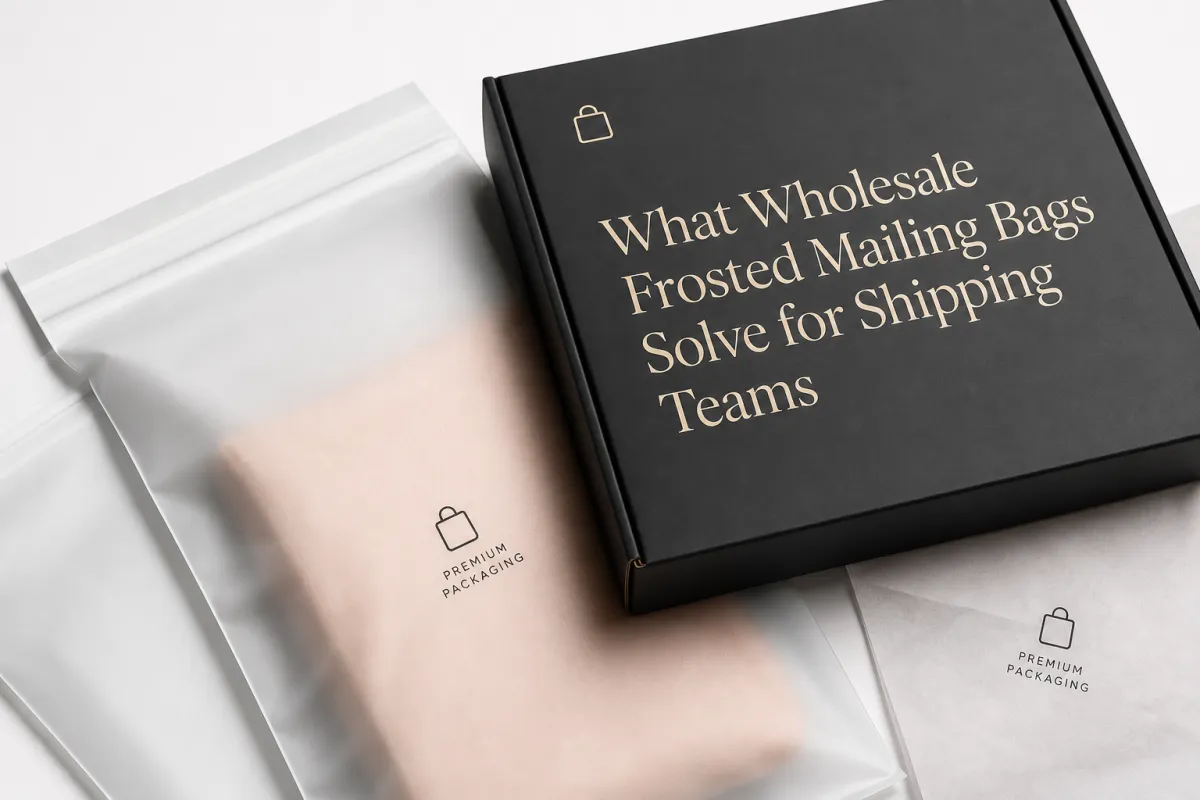
Shipping teams do not need packaging that acts precious. They need a bag that moves fast, protects the product, and still makes the order feel deliberate when the customer opens it. Wholesale frosted mailing bags handle that balance nicely. They keep the basic format of a poly mailer, but the frosted surface adds a more refined look that reads as intentional instead of purely utilitarian. That matters when the shipment is a folded garment, a soft accessory bundle, or lightweight merch that does not need a carton.
Speed is the real win. A good frosted mailer loads by hand without fighting the product, holds its shape long enough to seal cleanly, and stacks neatly on the bench. Fewer touches usually means fewer mistakes. That's not packaging theory. That's what happens when a packed order has to move through a line all day. Wholesale frosted mailing bags make sense for folded tees, soft sets, and items that do not need corrugate protection but still deserve better presentation than a plain plastic bag can give them.
The branding side gets overlooked more than it should. Frosted film softens the look of the package, which makes logos and simple graphics feel more considered. Heavy decoration is not required. In many cases, a one-color logo or a restrained mark placed cleanly on the bag looks better than a crowded design trying too hard. That lighter touch can make wholesale frosted mailing bags feel more premium than the unit cost suggests, which is why ecommerce brands use them to improve unboxing without setting money on fire.
There is also a practical reason they keep showing up in fulfillment rooms. Frosted bags hide small variations better than clear poly, and they do not scream every crease, fold mark, or dust speck. That sounds minor until you have 2,000 orders moving in a day. Then it is kind of a big deal.
If you are comparing flexible packaging formats, our Custom Poly Mailers page is a useful place to see how frosted mailers sit beside other mailer styles. Pick the format that fits the product, the packing flow, and the customer expectation. Not the one that looks prettiest in a mockup and falls apart in fulfillment.
A frosted mailer should improve the unboxing moment without slowing the line. Pretty packaging that creates pack-out friction is just a fancy problem.
Wholesale Frosted Mailing Bags: Material, Finish, and Print Options
Wholesale frosted mailing bags are usually made from polyethylene film, most often LDPE or LLDPE blends that keep the bag flexible while still resisting tears. The frosted look comes from the film formulation and surface effect, not from stuffing in extra thickness just for aesthetics. That difference matters. The finish changes how the package looks, but the real performance still comes from gauge, seal quality, and how the bag is built.
Thickness is where buyers usually misjudge the spec. A thinner bag can save money, but it can also feel weak once a larger garment or heavier accessory goes inside. A thicker bag, often in the 1.5 mil to 3 mil range depending on size and use, tends to offer better puncture resistance and a fuller hand feel. Thicker is not automatically better. It just needs to match the product and the shipment. A soft tee in a 1.5 mil bag has one set of needs. A sweater set or a bundled order has another.
Printing on wholesale frosted mailing bags can stay simple or go more detailed, depending on the artwork and the print method. One-color logos are common because they stay crisp on a semi-opaque surface and keep setup costs under control. Full coverage artwork can work on some constructions, but buyers should ask how the frosted finish will affect ink opacity, registration, and contrast. On translucent or semi-opaque film, a sharp logo with strong edges usually performs better than a design that depends on delicate tonal shifts.
Common print and fabrication choices include:
- One-color logo printing for cost-conscious branding and repeat orders.
- Multi-color artwork when the brand system needs more visual presence.
- Permanent adhesive strips that seal quickly and resist peel-back during transit.
- Tear strips for easier opening at delivery, especially on apparel shipments.
- Custom sizing so the bag matches the packed item rather than forcing product to stretch or bunch.
- Header holes if the bags need hanging, merchandising, or organized storage before pack-out.
Those details matter as much as the print. A bag can look strong on a spec sheet and still cause headaches if it opens awkwardly, seals unevenly, or shows up in the wrong size for the product. Wholesale frosted mailing bags work best when finish, seal, and dimensions are chosen together. Split decisions usually create split results.
One thing I tell buyers all the time: do not let the word “frosted” do all the work for you. Ask what the film actually is, ask how the seal is made, and ask whether the supplier has tested the bag with a real packed sample. A finish is not a substitute for structure. Never has been.
For buyers who want a grounded reference point, the broader packaging education resources at packaging.org can help when comparing terminology, construction styles, and material expectations across different flexible packaging formats.
Specifications That Affect Fit, Strength, and Presentation
The spec sheet is where wholesale frosted mailing bags either make sense or fall apart. Buyers should confirm the actual width, length, gusset depth, film thickness, seal strength, and finish consistency before asking for pricing. A size on paper can look fine. Then the product gets folded differently, an insert gets added, or a return slip goes inside, and suddenly the bag is too tight. That's how a mailer that looked right in theory starts stressing seams in practice.
Size selection should start with the packed item, not the raw product dimensions. A folded hoodie may need a wider mailer than a similarly priced flat-knit tee because the bulk lands differently. Accessories can be trickier. A small, dense item may fit physically, but hard edges can punch through a thin film if the gauge is too light. Wholesale frosted mailing bags should be chosen from the shipping reality outward, not from the marketing name inward.
Durability is not just a thickness question. Seal reliability matters during sorting, stacking, and conveyor handling, because weak adhesive or uneven seam formation can trigger failures after the bag leaves the pack station. Puncture resistance matters too, especially for orders that might rub against carton edges, barcode labels, or other parcels in transit. If a buyer expects normal parcel handling, the bag should be tested against that level of abrasion and pressure, not just given a quick squeeze and a thumbs-up.
A practical quality-check routine usually includes three pieces:
- Sample review to verify fit, feel, and actual opening size.
- Print proof inspection to check logo placement, color contrast, and legibility on the frosted surface.
- Finish review to confirm the frosted effect is even across the run and does not shift noticeably from bag to bag.
That last point gets missed a lot. A frosted film should look consistent enough that the package feels controlled in a stack, in a shipper tote, and in a customer photo. When the finish varies too much, the brand presentation starts to look sloppy. Wholesale frosted mailing bags can absolutely deliver a premium impression, but only if the finish stays stable and the proof matches the run.
I’ve seen a batch of otherwise good mailers get rejected because the frosted appearance drifted just enough between cartons to look off under warehouse lights. Nothing dramatic. Just enough to make the whole order feel a little cheap. That is the sort of detail buyers only catch when they ask for a real sample and check it in the same lighting the pack team uses.
For buyers who want a reference on transport testing and distribution handling, ista.org is worth a look. ISTA testing language helps frame the conversation around drops, vibration, compression, and the general abuse parcels face before delivery. Not every mailer needs formal testing, but the mindset is useful whenever value or transit distance starts climbing.
Wholesale Frosted Mailing Bags: Pricing, MOQ, and Order Size Effects
Pricing for wholesale frosted mailing bags follows the usual flexible packaging math: bag size, film thickness, number of colors, print coverage, order quantity, and any setup work required for the run. Bigger bags use more material. Thicker bags use more resin. Full-coverage printing takes more time and more quality control than a small logo. Once buyers understand those levers, quote comparisons get a lot less messy.
Minimum order quantities can catch new buyers off guard. For custom printed bags, MOQs often start around 1,000 to 5,000 pieces, although the exact threshold depends on the supplier, the print method, and the bag dimensions. Lower quantities usually carry a higher unit price because setup costs get spread across fewer pieces. That is not a penalty. It's just how custom production works. Wholesale frosted mailing bags become more economical as quantity rises, as long as the spec stays the same across the comparison.
Here is a practical pricing view for common buyer scenarios. These ranges are directional, not promises, because freight, print coverage, and size can shift the numbers quickly.
| Option | Typical MOQ | Common Use | Indicative Unit Cost | Notes |
|---|---|---|---|---|
| Plain frosted mailer, stock size | 1,000-5,000 | Fast-moving apparel and accessory shipments | $0.08-$0.18 | Lowest setup burden; good for brands that want the frosted look without custom print. |
| Custom printed frosted mailer, one color | 3,000-5,000+ | Branded ecommerce orders | $0.12-$0.28 | Usually the best balance of brand impact and cost control. |
| Thicker-gauge custom mailer with more coverage | 5,000+ | Heavier garments, bundled sets, and premium presentation | $0.18-$0.35 | Better feel and durability, but more material and print complexity raise cost. |
That table helps only if the buyer compares the same spec on both sides. Some quotes hide freight. Some include setup and some do not. Some cover samples, others bill them separately. When reviewing wholesale frosted mailing bags, ask for the landed picture: unit price, plate or setup charges, sample policy, freight estimate, and any extra cost for color matching or reproofing. The lowest number on paper can turn into the worst total cost if half the charges are sitting off to the side.
A common mistake is choosing the cheapest spec and paying for it later in damaged product, weak presentation, or a mailer that never fit correctly. Total value matters more than unit price alone. If a slightly heavier mailer cuts damage, speeds packing, or gives the customer a better first impression, it can be the better buy even with a higher per-unit cost. Wholesale frosted mailing bags do their best work when cost, fit, and appearance line up.
Some brands split their packaging mix, using one mailer for standard orders and a slightly upgraded version for launches, influencer kits, or limited drops. That keeps margins in check while protecting the first impression where it counts. If your packaging program includes more than one flexible format, the Wholesale Programs page is a useful place to organize volume buying across multiple items and packaging tiers.
Production Process and Lead Time Expectations
Once a buyer asks for pricing, the process usually follows the same path: inquiry, spec review, artwork check, proof approval, production, and shipment. It sounds simple. It rarely is if the early information is vague. Wholesale frosted mailing bags move faster when the supplier gets exact dimensions, order quantity, print files, and a realistic delivery window at the same time. Leave one of those out and the order slows down with clarification emails and revised proofs.
The most common delays happen before production starts. Artwork files may be low resolution. Dimensions may be based on the product itself instead of the packed size. The requested bag may be too small for the actual folded item. Sometimes the final logo color gets approved late because someone wants to compare it against a Pantone reference or an old run. None of that is rare. It still costs time, and custom print work does not start until the proof is right.
For planning, many custom bag orders need roughly 12 to 18 business days after proof approval before they are ready to ship, though larger runs, complex print jobs, or imported inventory can extend that timeline. After production, freight time depends on destination and shipping method. Domestic ground shipping is easier to forecast than mixed freight or ocean transit, but even local routes can shift when carrier volume spikes. Wholesale frosted mailing bags are not the kind of item you want to source at the last minute if the launch date is fixed.
A buyer should have the following ready before asking for a firm quote:
- Quantity target with a preferred backup quantity if the price breaks at a higher volume.
- Flat dimensions for width and length, plus gusset depth if the bag needs extra volume.
- Artwork files in vector format when possible, so the logo stays clean at print size.
- Color references if the brand needs a specific ink tone, not a generic close match.
- Delivery window so the supplier can judge whether the lead time fits the launch or reorder schedule.
If the shipment carries real value or travels a long distance, ask whether the sample should reflect the handling expectations tied to ISTA-style parcel testing. The point is not to turn a simple package order into a science project. The point is to avoid assumptions. Wholesale frosted mailing bags that look fine on a desk but fail in distribution are not a good value, no matter how attractive the first quote looked.
One more practical thing: if your team changes artwork late, tell the supplier immediately. A small revision can be harmless. A last-minute revision with a tight ship date can turn into a mess fast. No drama, just reality.
Why Choose Us for Wholesale Frosted Mailing Bags
A good packaging supplier does more than toss out a number. It should help the buyer choose a bag that fits the product, the pack line, and the customer experience without guesswork. That is the standard we apply to wholesale frosted mailing bags. The focus stays on consistent construction, practical print guidance, and honest feedback when a requested spec would create more trouble than value. If the bag needs a different seal margin, a thicker film, or a slightly larger flat dimension, that should be said before production starts.
Clear communication matters because wholesale orders usually involve more than one stakeholder. Brand teams care about color and appearance. Operations care about pack speed and seal reliability. Purchasing cares about landed cost. The supplier has to handle all three. In a strong account relationship, the quote should spell out what is included, what is not included, and which details lock in after proof approval. That kind of clarity cuts down on surprises and makes repeat ordering a lot easier.
Repeatability matters too. Wholesale frosted mailing bags should not look great on the first order and drift on the second. The approved sample, the print proof, and the production run should line up closely enough that a reorder does not create a brand-new packaging debate every time. That matters even more for weekly volume, because small shifts in film feel, seal behavior, or print contrast show up in fulfillment performance fast.
Buyers should get practical guidance, not packaging jargon. If the bag is for lightweight apparel, say that. If the product ships with a folded insert, say that too. If privacy matters more than deep color coverage, the spec can stay simpler and cheaper. If the brand wants more visual presence, then the print area and ink choice can be adjusted with that in mind. Wholesale frosted mailing bags work best when the packaging decision reflects the product and the route, not just the design file.
There is also a trust piece here that gets ignored too often. If a bag spec is not right for the product, a decent supplier should say so. Not every order needs the thickest film or the biggest print area. Sometimes the smarter answer is a simpler construction That Ships Better and costs less. That honesty saves everybody from a packaging headache later.
For teams that want to scale packaging across multiple order types, wholesale buying works best through a structured account approach. Our Wholesale Programs page is where that broader buying conversation belongs, especially if the order mix includes mailers, branded inserts, or other custom packaging items that need to move together on a schedule.
Next Steps for Ordering Wholesale Frosted Mailing Bags
The fastest way to get a useful quote is to send a clean spec sheet instead of a vague request. Start with the packed product size, quantity, artwork, and target delivery date, then ask for a recommendation on film thickness and bag dimensions. That saves time because wholesale frosted mailing bags can only be quoted accurately when the supplier knows what the bag needs to hold and how the order will be used.
- Measure the packed product, not just the product itself, and note any inserts, folds, or extra items inside the mailer.
- Decide whether you want a plain frosted finish or a branded print, then confirm the logo file is clean and scalable.
- Ask for a sample if the order will be used in regular fulfillment, because real handling always reveals more than a spec sheet does.
- Compare the quote on a landed basis, including freight, setup charges, and any sample cost.
One simple rule helps here: if the bag feels tight in the sample stage, it is gonna feel tighter in production once the pack team is moving at speed. That is why test fit matters so much. Wholesale frosted mailing bags should close without strain, present evenly on the shelf, and survive normal parcel handling without drama.
The fastest quote comes from one clean spec sheet: size, quantity, artwork, and delivery target. Give those four items up front and the rest of the process gets much easier.
If you want a straightforward spec review, a sample recommendation, or a quote for wholesale frosted mailing bags, send the product details and let the packaging work around the real shipment needs. That is the most reliable path to a bag that looks good, packs fast, and keeps repeat orders simple.
Actionable takeaway: lock your packed dimensions, pick the lightest gauge that still survives normal transit, and request one physical sample before you approve print. That single step catches most problems early and saves a lot of back-and-forth later.
FAQ
What are wholesale frosted mailing bags used for?
They are commonly used for apparel, soft goods, accessories, and ecommerce orders that need lightweight shipping with a cleaner, more premium presentation. The frosted finish helps create a branded look while still keeping the package semi-opaque for privacy. They work well when you want poly mailer efficiency without the flat, glossy look that many brands are trying to move away from.
How do I choose the right size for wholesale frosted mailing bags?
Measure the packed product first, not just the product label size, and leave enough room for a flat fit without overstretching the seams. Account for thickness, folded garments, inserts, or boxes placed inside the mailer. If the order will be used for repeat fulfillment, ask for a sample because real-world fit matters more than a size chart alone.
Do wholesale frosted mailing bags support custom printing?
Yes, many frosted mailing bags can be printed with logos, patterns, or simple brand marks, depending on the film and print method. The print area, number of colors, and ink opacity should be checked before final approval. A proof or sample is the safest way to confirm the artwork looks sharp on the frosted surface and that the brand color reads correctly.
What affects the price of wholesale frosted mailing bags most?
The biggest price drivers are size, thickness, print complexity, and order quantity. Setup charges, freight, and any tooling or plate costs can also change the final landed price. Higher quantities usually lower the per-unit cost, but the best quote should always be compared with the same spec sheet so the numbers are actually comparable.
How long does it take to receive wholesale frosted mailing bags?
Lead time depends on whether the bags are stock or custom printed, plus how quickly artwork and proofs are approved. After production, shipping time depends on destination and freight method. The fastest path is to submit quantity, size, artwork, and delivery date together at the start so there is less back-and-forth before the order moves into production.
Are wholesale frosted mailing bags good for returns?
They can be, if the seal style and bag size support the return flow you need. Some brands use the same mailer for outbound and return use, while others keep returns separate to avoid confusion at fulfillment. If the bag needs to be reopened and resealed, ask whether the adhesive strip still performs after one opening. That detail matters more than people think.
Can wholesale frosted mailing bags be stored flat before use?
Yes, and that is one of the practical reasons they are popular. Flat storage saves room in the warehouse and keeps pack stations cleaner than bulky cartons. Just keep them dry, away from direct heat, and out of heavy compression so the seal edge and film finish stay in good shape before use.


