Buyer Fit Snapshot
| Best fit | Wholesale Mailer Cartons for Ecommerce projects where brand print, material claims, artwork control, MOQ, and repeat-order consistency need to be specified before quoting. |
|---|---|
| Quote inputs | Share finished size, material target, print colors, finish, packing count, annual reorder estimate, ship-to region, and any compliance wording. |
| Proofing check | Approve dieline scale, logo placement, barcode or warning zones, color tolerance, closure strength, and carton packing before bulk production. |
| Main risk | Vague material claims, crowded artwork, missing packing details, or unclear freight terms can make a low unit price expensive after revisions. |
Fast answer: Wholesale Mailer Cartons for Ecommerce: Specs, Cost, Process should be specified like a repeatable production item. The safest quote records material, print method, finish, artwork proof, packing count, and reorder notes in one written spec.
Production checks before approval
Compare the actual filled-product size with the drawing, then confirm tolerance on folds, seals, hang holes, label areas, and retail display edges. Reserve space for logos, QR codes, warning copy, and material claims before decorative graphics fill the panel.
Quote comparison points
Review material grade, print process, finish, sampling route, tooling charges, carton quantity, and freight assumptions side by side. A quote is only useful when the supplier can repeat the same color, closure quality, and packing count on the next order.
Wholesale mailer cartons for ecommerce look simple until the numbers start arguing back. Save three cents on the box and you can lose far more in damage claims, packing rework, and customer complaints. I have seen brands chase the cheapest carton, only to spend the savings on tape, void fill, and replacement shipments two weeks later. A carton that dents in transit, slows the team at the packing bench, or fits the product badly does not stay cheap for long. Wholesale mailer cartons for ecommerce only earn their place when the structure matches the product, the board spec survives handling, and the order quantity fits the business instead of the fantasy.
Packaging buyers rarely need the fanciest carton on the market. They need a carton that moves quickly through fulfillment, protects the product in transit, and still gives the customer a box worth opening. That means reading the carton as an operating tool, not just a container. The real questions are plain: what wholesale mailer cartons for ecommerce should do, what they cost, how they are built, and which mistakes keep showing up in purchase orders.
If you are comparing options for a launch or replacing a box that keeps failing, start with fit, board strength, and print requirements. Then check minimum order quantity, lead time, and freight. Brand details matter after the carton actually performs. A pretty mockup that collapses in shipping is only pretty on the screen.
A cheap carton is expensive the moment it adds rework, needs extra void fill, or turns into a damage claim. The bill arrives after the parcel leaves the dock.
Why Wholesale Mailer Cartons for Ecommerce Win
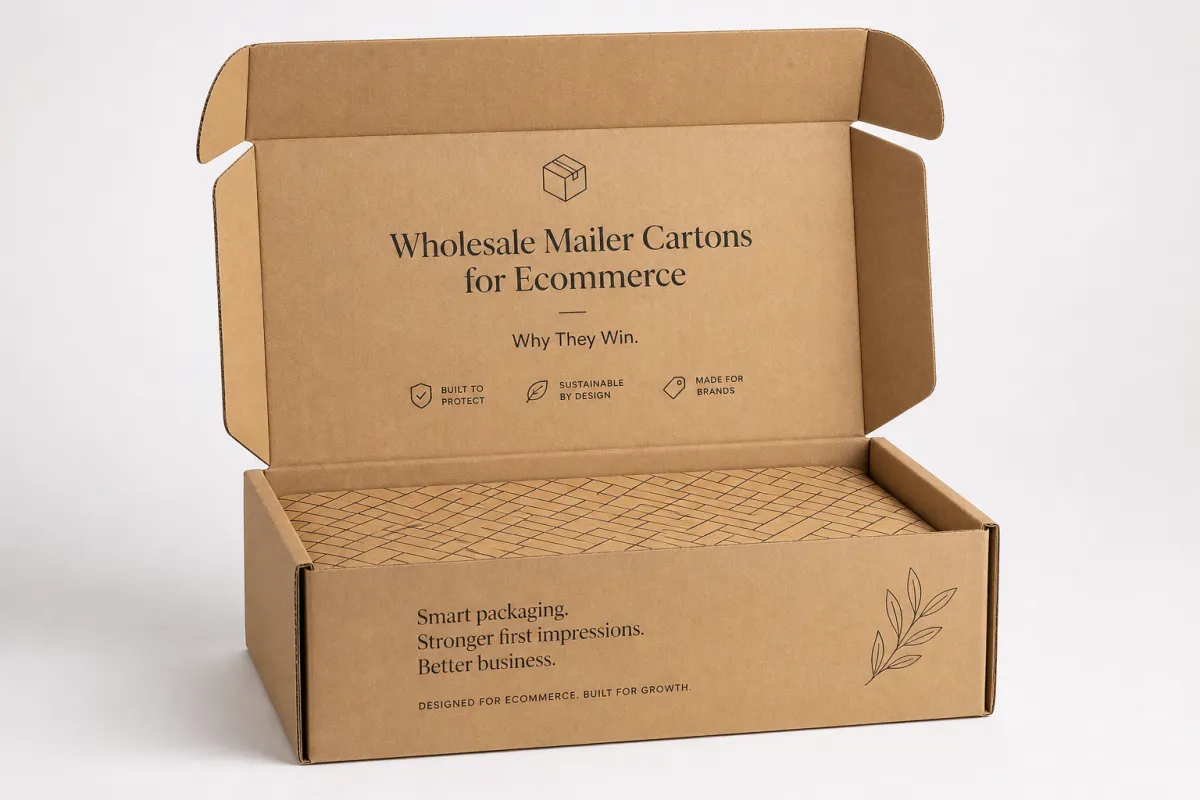
Wholesale mailer cartons for ecommerce are built around how online orders actually move. They are not just packaging. They affect pick speed, packing consistency, shelf-ready appearance, and damage rates. That matters more once a brand ships dozens or thousands of parcels a week. At that scale, a carton that opens cleanly and holds its shape can save hours every month. A carton that bows, collapses, or needs extra tape becomes a daily annoyance.
The lowest-price carton usually looks fine on a quote. The problems show up in the warehouse. Corners crush in transit. Product shifts because the internal size is sloppy. Packing staff add extra paper or air pillows because the box is too loose. Returns rise because the customer sees scuffed packaging before they touch the product. None of that is mysterious. It is the predictable result of treating carton design like a line item instead of a system.
Wholesale mailer cartons for ecommerce reduce three hidden costs at once: labor, damage, and presentation cleanup. Faster packing is the first gain. A carton that self-locks or folds without a fight keeps the line moving. Cleaner presentation is the second. A well-printed carton creates a more deliberate unboxing moment without needing a rigid premium box. Less void fill is the third. If the carton is sized correctly, empty space stops draining money from every shipment.
There is also a branding effect that people tend to undercount. The mailer carton is often the first physical touchpoint after checkout. A flimsy box tells a customer the brand is flimsy. A crisp carton with a clean print and an easy open feels considered. That does not mean overbuilding every order. It means matching the carton to the product and the shipping lane.
For brands that are scaling, wholesale mailer cartons for ecommerce usually beat random off-the-shelf shipping boxes. Stock boxes can carry a temporary operation, but once repeat SKUs, steady volume, and predictable product sizes enter the picture, custom or semi-custom mailers usually make more sense. They pack faster, present better, and can be ordered in quantities that support a sane reorder cycle.
The business case is plain and useful. If a better carton cuts ten seconds from packing time, reduces one damaged shipment in twenty, and trims void fill, the math starts leaning hard toward the upgrade. That logic fits apparel, skincare, accessories, subscription kits, and light hardgoods. These products are not heavy enough to need a full shipping case, but they still need structure and a retail-ready feel.
There is another comparison worth making. On a 5,000-order month, a 2% damage rate means 100 parcels need attention. Even a small improvement in carton spec can keep a warehouse from paying for those mistakes twice: once in replacement product, again in labor and customer service time. Few packaging decisions have that kind of pull over operations.
Product Details
Not every mailer carton behaves the same way. That sounds obvious, which is why buyers still get caught by it. Wholesale mailer cartons for ecommerce usually fall into a few structure families, and each one handles production, assembly, and shipping differently.
Tuck-top mailers are common for lighter products and presentation-focused shipments. One flap tucks into another, which makes them quick to assemble and easy to close. They suit apparel, stationery, small cosmetics, and gift sets where the unboxing experience matters, but the product does not need heavy crush resistance.
Crash-lock base mailers bring more strength at the bottom and a faster set-up once the fold pattern is understood. They fit products with more weight or items that rest low in the box, such as candle sets, small accessory bundles, or light hardgoods. They save time on the packing bench because the base locks into shape instead of needing tape on every seam.
Self-locking cartons and reinforced designs come into play when the box needs more rigidity, better stacking strength, or greater resistance to transit abuse. That can matter if the product has corners, delicate surfaces, or an insert that depends on the carton staying square. The extra board costs more, yet that cost can be smaller than the damage claims it prevents.
Material choice matters as much as structure. Most wholesale mailer cartons for ecommerce use corrugated board with a kraft or white outer liner. Kraft liners bring a natural look and hide scuffs well. White liners suit print-heavy branding and cleaner color contrast. A minimalist brand often looks more confident on kraft. A color-forward brand usually benefits from white, because the graphics stay sharper.
Board grade is where the practical conversation begins. Single-wall corrugated is common for light and medium shipments. E-flute is popular for fine print detail and a slimmer profile. B-flute brings a little more crush resistance. Some higher-volume wholesale mailer cartons for ecommerce orders use board specs around 200-350 gsm liner combinations or corrugated grades chosen for product weight and shipping risk. The exact number depends on the supplier's board system, but the principle stays the same: match strength to use, not ego.
Finishing sits in the same category. A matte aqueous coating, gloss varnish, or soft-touch laminate can improve appearance and scuff resistance, but finish is not a substitute for structure. A weak carton with a beautiful coating still fails as a carton. It just fails in nicer lighting.
Wholesale mailer cartons for ecommerce are used across a wide range of product types:
- Apparel: folded clothing, knitwear, socks, and small accessories that need a clean presentation and a flat ship profile.
- Cosmetics and skincare: kits, serums, and smaller bottle sets that benefit from inserts and a tight internal fit.
- Accessories: jewelry, belts, sunglasses, watch boxes, and small leather goods.
- Subscription kits: sample packs, curated monthly boxes, and promotional bundles.
- Light hardgoods: chargers, desk items, home accessories, and other products that need a structured carton without shipping a huge air pocket.
If flexible packaging already covers some SKUs, it helps to compare the carton strategy with options like Custom Poly Mailers. Poly mailers are lighter and cheaper for certain products, but they do not replace a carton when the product needs stiffness, presentation, or corner protection. Different jobs. Different tools.
Specs That Matter
If the dimensions are wrong, nothing else matters much. That is the part buyers skip when they get pulled in by a pretty mockup. For wholesale mailer cartons for ecommerce, the first thing to confirm is the internal size, not just the outside dimensions in a quote. Internal size controls fit. Outside size controls shipping charges and pallet efficiency. Mixing those up creates expensive surprises.
Start with the product's actual packed dimensions. Measure the item with any insert, sleeve, tissue, or protective wrap that will be used in the final pack. Then add only the clearance needed for assembly and removal. A carton that is too tight slows packing and crushes corners. A carton that is too loose lets the product slide, rattle, and forces the team to add padding. Neither outcome helps.
For weight and strength, buyers usually hear terms like ECT, burst strength, and flute type. Those are not decorative. They describe how the carton behaves under stacking and transit stress. ECT, or Edge Crush Test, helps describe stacking resistance. Burst strength helps describe resistance to puncture and pressure. Flute type affects thickness, rigidity, and print surface. E-flute is thinner and smoother. B-flute is thicker and more protective. For many wholesale mailer cartons for ecommerce orders, the right spec depends on product weight, shipping route, and whether the box will sit in warehouse stacks before it ships.
Real-world examples make the tradeoff clearer. A light apparel box may perform well with a slimmer E-flute structure, while a heavier skincare bundle or a set of fragile accessories may justify a stronger B-flute or reinforced setup. If the order ships through multiple handling points, faces humidity, or travels long distances, the safer spec often pays for itself. That is especially true for products with polished surfaces or fixed corners that show damage quickly.
Print specifications deserve the same scrutiny. A box can be structurally correct and still look off if the artwork is handled poorly. Keep an eye on these details:
- Ink coverage: heavy solid areas can crack or show board texture more clearly than a lighter layout.
- Color matching: ask how the printer handles pantone references, digital proofs, or production tolerances.
- Bleed and trim: artwork should extend correctly so the final cut does not leave white edges.
- Corrugation direction: graphic orientation and folding pattern can affect how logos land on corners and seams.
- Surface texture: rough kraft liners will not hold tiny type as cleanly as white-lined or coated stock.
That last point causes more headaches than brands expect. They ask for delicate, high-detail graphics on a board surface that naturally has texture. The result is predictable. Fine type looks softer than it did on screen, and deep colors absorb differently than they do on a proof. If the artwork includes small text, thin rules, or gradients, the carton should be specified with that in mind from the beginning.
Distribution and testing matter too. If the product is fragile or expensive, ask for transit testing aligned with recognized methods such as ISTA procedures, or refer to common packaging test practices associated with ASTM methods. Not every order needs a full lab program, yet the carton should still be evaluated against the real handling conditions it will face. A pretty box that fails in shipping is an expensive regret.
Sustainable sourcing matters as well, but it needs documentation, not slogans. If you want FSC-aligned fiber sourcing, ask for proof instead of vague claims. The FSC framework gives buyers a clear language for responsible fiber sourcing. Good buyers ask for proof. Better buyers ask before the first proof is approved.
From a buying standpoint, the spec checklist for wholesale mailer cartons for ecommerce should include:
- Internal dimensions with tolerance.
- External dimensions for freight and storage planning.
- Board grade and flute type.
- Print method and color targets.
- Finish, coating, or lamination.
- Assembly style and closure method.
- Testing assumptions for weight and transit.
What Should You Check Before Buying Wholesale Mailer Cartons for Ecommerce?
Start with the carton's fit, then work outward. That order matters. For wholesale mailer cartons for ecommerce, the biggest mistakes usually come from guessing the internal size, underestimating board strength, or approving a print spec that does not fit the substrate. A good buy is not the cheapest quote. It is the carton that survives the journey and still looks deliberate when the customer opens it.
Ask four questions before you approve anything: Does the carton fit the product with its inserts? Does the board grade match the shipping route? Does the print method suit the artwork? Does the order quantity make sense for the reorder cycle? If one of those answers is shaky, the quote is not ready. This is the difference between buying packaging and buying a problem.
There is a useful comparison here. A carton that seems oversized by a few millimeters can trigger more void fill, larger freight volume, and slower packing. A carton that feels slightly too small can create crush marks and a packing line that stalls every 20 seconds. Those are not tiny issues. Multiply them across 3,000 orders and they become operational reality. That is the kind of arithmetic that quietly eats margin.
Pricing and MOQ
Pricing for wholesale mailer cartons for ecommerce is driven by a short list of variables, and none of them are especially mysterious once you know where to look. Carton size, board grade, print coverage, finishing, quantity, and whether the carton needs special tooling all shape the unit price. Freight sits on a separate line, which people often forget until the invoice arrives.
Small runs look expensive because setup costs get spread across fewer units. Large runs usually reduce unit cost, but only if the design is stable enough to justify the inventory. That is why MOQ matters. A carton that looks cheap at 10,000 pieces can become awkward at 1,000 if the setup and print prep do not scale down well.
Typical pricing ranges vary by region, board type, and print complexity, but a practical working range for wholesale mailer cartons for ecommerce is below. These figures are planning numbers for common custom packaging projects, assuming standard production conditions and no extreme decoration.
| Option | Typical Unit Price | Common MOQ | Best For | Notes |
|---|---|---|---|---|
| Plain stock mailer carton | $0.38-$0.72 | 500-2,000 | Testing, temporary fulfillment, simple SKUs | Fastest to source, limited branding control |
| Custom printed mailer carton | $0.62-$1.20 | 3,000-10,000 | Branded ecommerce shipping, subscription boxes | Better presentation, setup costs matter |
| Reinforced custom mailer carton | $0.95-$1.85 | 2,500-8,000 | Heavier products, premium unboxing, fragile items | Higher material cost, often worth it for protection |
Those numbers mean very little unless you know what is included. One supplier may quote carton-only pricing. Another may include print, insert, packaging, and pallet prep. Ask whether the price includes samples, tooling, freight, and any finishing like soft-touch lamination or spot varnish. Otherwise you are comparing apples to a forklift.
MOQ is where buyers either save money or create dead inventory. If you are launching a new SKU, testing a size, or running a limited product line, do not force a massive order just because a quote looks better at scale. A smaller pilot run of wholesale mailer cartons for ecommerce may cost more per unit, but it can keep you from committing to the wrong dimensions, the wrong finish, or the wrong closure style. That is a very cheap lesson compared with 8,000 boxes that do not fit the product.
Hidden costs deserve their own line because they always show up, even if the sales sheet pretends otherwise:
- Freight: cartons ship as volume, not just weight, so pallet count matters.
- Tooling or setup: die-cut tooling, print plates, or format prep can add upfront cost.
- Sampling: physical samples, especially pre-production samples, are worth the spend.
- Artwork changes: every revision can affect timing and proofing cost.
- Storage: if cartons arrive before you need them, you pay for warehouse space one way or another.
For buyers comparing wholesale mailer cartons for ecommerce against other packaging types, the right comparison is not only unit price. Compare total landed cost, packing speed, and damage reduction. A slightly pricier carton can lower fulfillment cost enough to justify itself on the next reorder. That is the boring truth most sales decks avoid.
Process and Timeline
The ordering process for wholesale mailer cartons for ecommerce stays simple when the buyer brings clean information. It gets messy when dimensions are guessed, artwork is unfinished, or everyone expects the sample to rescue a bad spec. It cannot. A sample can confirm fit and print quality, but it cannot fix a carton designed around the wrong product measurements.
The usual process starts with an inquiry. The buyer shares product dimensions, expected weight, artwork needs, target quantity, and delivery deadline. Then comes the quote. A usable quote should identify carton structure, board grade, print method, MOQ, estimated unit pricing, and lead time. If that information is missing, the quote is not ready for a decision.
After the quote, spec confirmation matters. This is the stage where internal dimensions, closure style, finish, and print layout get locked down. For wholesale mailer cartons for ecommerce, a supplier should ask enough questions to prevent the usual headaches later: How much room do inserts need? Will the carton be hand-packed or machine-packed? Is the product fragile? Does the box need to fit inside another shipper or go directly to the customer?
Artwork review comes next. Even simple cartons can fail here if the design file is sloppy. The dieline should be checked against the intended print area, seam placement, and fold lines. Keep critical text away from edges. Avoid placing tiny logos across glued or folded panels. If the artwork uses strong color blocks, remember that corrugated texture can soften the final visual effect. That is normal, not a defect.
Sampling saves money. Full stop. A physical sample lets the buyer verify:
- How the carton assembles on the packing line.
- Whether the product fits with the intended insert or padding.
- How the print looks on the chosen liner.
- Whether the carton closes cleanly without bowing.
- Whether stack and crush performance feel right for the load.
For wholesale mailer cartons for ecommerce, a PDF mockup helps, but it is not enough. A screen cannot tell you if the flap is awkward, if the box flexes under product weight, or if the finish dulls the logo more than expected. Physical samples answer the practical questions. Guessing answers none of them.
Production lead times depend on order type. Stock cartons can move quickly, sometimes in a matter of days if inventory is available. Custom printed cartons take longer because proofing, setup, and print scheduling all happen before production starts. A reasonable planning range for many custom wholesale mailer cartons for ecommerce orders is often 12-20 business days after proof approval, with more time needed for complex printing, special finishes, or very large volumes. If someone promises a miracle without seeing the spec, treat that promise like a glossy brochure. It looks polished and says very little.
Delays usually come from the same predictable causes:
- Missing or low-resolution artwork files.
- Unclear dimensions or inconsistent product measurements.
- Late changes after samples are approved.
- Decision lag between departments.
- Freight booking left until the end.
That last one is easy to overlook. Cartons are bulky. Once they are ready, they need moving. Build freight timing into the schedule or the cartons will sit while everyone scrambles to book a truck. Not glamorous. Very real.
For brands already running a broader packaging program, the best move is to align carton ordering with the rest of the packaging stack. If inserts, labels, and mailers already run under one procurement cycle, your Wholesale Programs can keep the process less chaotic. Fewer handoffs. Fewer mistakes. Better reorder discipline.
Why Choose Us for Wholesale Mailer Cartons
Most packaging suppliers can quote a box. Fewer can help a buyer avoid a bad one. That difference matters. At Custom Logo Things, the value in wholesale mailer cartons for ecommerce is not just that the cartons are custom. It is that the process stays centered on practical packaging decisions: fit, strength, print result, and reorder consistency.
Brands do not need fluff. They need packaging that arrives on time, fits the product, and does not create extra work on the packing line. That is where a supplier earns a long-term relationship. Strong quoting, sane minimums, and clear communication matter more than polished language. Anyone can say premium. The box still has to close.
One of the biggest benefits of working with a focused packaging provider is spec discipline. If the product size is off by even a few millimeters, a carton can feel too loose, too tight, or visually awkward. Good support catches that before production starts. In wholesale mailer cartons for ecommerce, that matters because it prevents the two worst outcomes: overbuying the wrong box and paying twice to fix it later.
Another advantage is repeatability. Ecommerce brands reorder. Often. If a carton performs well in one run, the next run should match it closely. Stable sourcing, controlled print standards, and consistent sizing are not glamorous, but they are what keep fulfillment predictable. Buyers should ask about reorder stability, board sourcing, and how the supplier handles spec retention across repeat jobs. If the answer wanders, that is a warning sign.
Support also matters when a brand is choosing between packaging formats. Sometimes the correct answer is a mailer carton. Sometimes it is a different structure. Sometimes a flexible option is the smarter fit for certain SKUs, especially for lighter shipments where weight matters more than rigidity. That is why it helps to compare against other packaging lines, including Custom Poly Mailers, instead of assuming one format solves every shipping need.
For buyers who want a cleaner process, a useful packaging partner should be able to help with:
- Custom sizing for product fit and shipping efficiency.
- Sample support before bulk production.
- Artwork guidance for dielines, bleed, and print placement.
- Simple communication on MOQ, lead time, and freight.
- Reorder consistency for long-term ecommerce growth.
That is the job. Make wholesale mailer cartons for ecommerce easier to buy, easier to approve, and easier to use. If the buyer can move from inquiry to sample to production without drama, the packaging supplier is doing its work.
One more filter helps here: good packaging advice should save buyers from bad assumptions. If a supplier says a carton will work "fine" without asking about product weight, insert thickness, or shipping conditions, that is not advice. That is a guess in a suit.
Next Steps
If you are ready to source wholesale mailer cartons for ecommerce, start with the facts. Product dimensions. Target weight. Insert requirements. Print file status. Quantity range. Delivery date. That is the shortlist that turns a vague idea into a real quote. Without it, you are shopping for opinions.
Before you place an order, compare at least two spec options. One should usually be the more economical choice, and one should be the more protective or presentation-focused choice. That comparison makes the tradeoff visible. Maybe the cheaper carton is enough. Maybe it is not. Either way, you want to see the difference in unit price, lead time, board grade, and transit risk.
If the carton is new, if the product is changing, or if the brand is moving into a higher-value category, order a sample or pilot batch first. That step is cheap insurance. It confirms the fit, the finish, and the assembly flow before you commit to a larger production run. For wholesale mailer cartons for ecommerce, sampling is usually the least expensive mistake-prevention tool on the table.
Use this final checklist before requesting a quote:
- Measure the product with all inserts and protective materials included.
- Decide whether the carton needs a kraft or white liner.
- Choose the print coverage level and finish.
- Confirm the expected order quantity and reorder frequency.
- Set the delivery deadline and freight destination.
- Gather artwork files in the correct format.
Do that, and the buying process gets much cleaner. You will get a quote that actually compares apples to apples, instead of a stack of numbers that mean different things. That is how you buy wholesale mailer cartons for ecommerce without wasting time or money. Request a quote with your specs in hand, and make the supplier prove the carton is right before you commit.
What makes wholesale mailer cartons for ecommerce different from standard shipping boxes?
Mailer cartons are usually designed for faster assembly, cleaner presentation, and tighter product fit. Many use tuck or self-locking structures that reduce packing time and make the box feel more finished at opening. Standard shipping boxes can work, but they are not always built for retail-style presentation or ecommerce workflows. For brands shipping repeat orders, wholesale mailer cartons for ecommerce usually make more sense because they balance speed, protection, and branding in one structure.
What MOQ should I expect for wholesale mailer cartons for ecommerce?
MOQ depends on whether you are buying stock cartons, custom printed cartons, or a fully custom structure. Plain stock options can start lower, while printed and custom-made cartons usually require higher minimums because setup costs need to be spread across the run. If you are testing a product or launch size, ask about pilot quantities or sample-run options first. That is often the smarter move than forcing a large order too early.
How do I choose the right size for mailer cartons?
Start with the product's packed dimensions, then add room for inserts, padding, and easy assembly. Check internal size first. External size matters later for freight, storage, and pallet planning, but fit begins inside the carton. A box that is too large wastes material and shipping volume. A box that is too small creates packing headaches and damage risk. For wholesale mailer cartons for ecommerce, the internal fit is usually the dealbreaker.
How long does production take for wholesale mailer cartons for ecommerce?
Stock cartons usually ship faster than custom printed cartons because the structure already exists. Custom orders need artwork review, sampling, and production scheduling before the first unit is made. A practical lead-time range for many custom projects is often 12-20 business days after approval, though volume, print complexity, and finishing can stretch that. If someone promises a short timeline without checking the spec, be skeptical. Packaging has a way of punishing wishful thinking.
Can I get samples before placing a bulk order?
Yes, and you should if the size, print layout, or board grade matters to the project. Physical samples let you check fit, closure, print behavior, and assembly speed before the full run starts. That is especially important for wholesale mailer cartons for ecommerce because a carton that looks correct on screen can still fail on the packing bench. Sampling is the cheapest way to catch a mistake before it becomes a warehouse problem.
Final takeaway: measure the packed product, request two carton specs, and test a physical sample before you lock the MOQ. That one sequence catches most of the expensive mistakes people make with wholesale mailer cartons for ecommerce, and it keeps the carton doing its actual job instead of creating new ones.


