Buyer Fit Snapshot
| Best fit | Wholesale Poly Mailers for Stores projects where brand print, material claims, artwork control, MOQ, and repeat-order consistency need to be specified before quoting. |
|---|---|
| Quote inputs | Share finished size, material target, print colors, finish, packing count, annual reorder estimate, ship-to region, and any compliance wording. |
| Proofing check | Approve dieline scale, logo placement, barcode or warning zones, color tolerance, closure strength, and carton packing before bulk production. |
| Main risk | Vague material claims, crowded artwork, missing packing details, or unclear freight terms can make a low unit price expensive after revisions. |
Fast answer: Wholesale Poly Mailers for Stores: Film, Print, MOQ, and Carton Packing should be specified like a repeatable production item. The safest quote records material, print method, finish, artwork proof, packing count, and reorder notes in one written spec.
Production checks before approval
Compare the actual filled-product size with the drawing, then confirm tolerance on folds, seals, hang holes, label areas, and retail display edges. Reserve space for logos, QR codes, warning copy, and material claims before decorative graphics fill the panel.
Quote comparison points
Review material grade, print process, finish, sampling route, tooling charges, carton quantity, and freight assumptions side by side. A quote is only useful when the supplier can repeat the same color, closure quality, and packing count on the next order.
Wholesale Poly Mailers for Stores: Smart Buying Guide
Wholesale poly mailers for stores are usually the first packaging upgrade I recommend when a brand ships soft goods at any real volume. They cut carton cost, speed up packing, and keep postage from creeping upward because someone picked a box that was basically a studio apartment for a T-shirt. The right mailer does more than shave a few cents off the order. It changes how your team packs, how the package looks on arrival, and how much waste leaves the dock with every shipment.
For apparel, accessories, and return-friendly e-commerce programs, wholesale poly mailers for stores usually beat small corrugated boxes on labor, weight, and cube. That does not mean boxes are dead. It means the package should fit the product, not the other way around. A clean, properly sized mailer can be the difference between a packing table that moves steadily and one that gets bogged down with tape, void fill, and oversized cartons nobody asked for.
I have watched teams switch from boxes to mailers and cut their pack time enough to notice by lunch. Not magic. Just fewer steps. If your shipment is soft, flat, and not fragile in a crush-test sense, a mailer is often the boring answer that actually works. And boring, in packaging, usually means profitable.
Why Wholesale Poly Mailers for Stores Often Beat Boxes
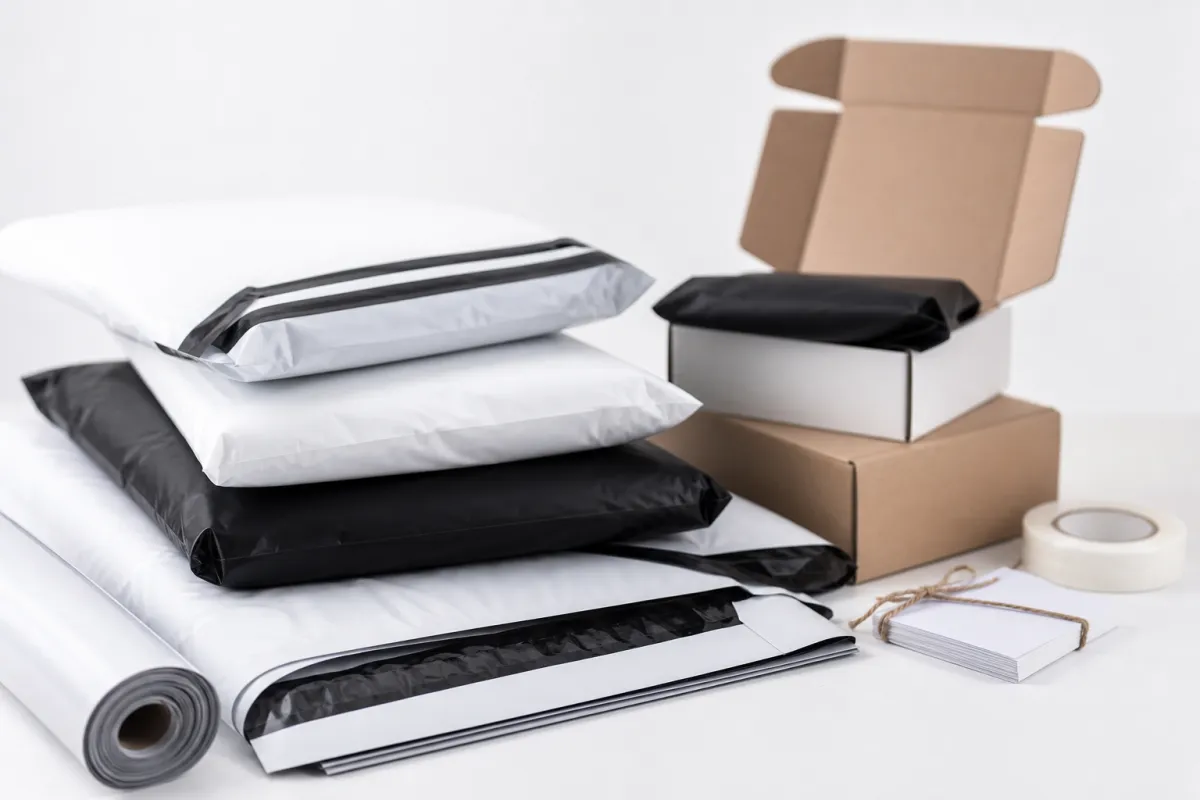
Soft goods make the case pretty quickly. Wholesale poly mailers for stores remove several packing steps at once. No box assembly. No tape gun. No void fill just to stop a folded hoodie from rattling around like loose change. That matters at the table, where every extra motion slows things down. On a busy shipping day, saving 10 to 20 seconds per order is not a rounding error. It is real throughput.
The best-fit categories are obvious once you look at the product. T-shirts, hoodies with modest bulk, leggings, socks, swimwear, scarves, light accessories, and many return shipments pack well in wholesale poly mailers for stores. The common thread is simple: the item needs containment and moisture resistance, not crush protection. If the product folds flat, has soft edges, and does not include a fragile insert, the mailer usually wins on both speed and cost.
Postage matters too. A smaller, lighter mailer can help keep parcel weight down, and it often avoids the dimensional penalty that comes with a carton that is too large for the item. Carrier rules change. The math does not. Less packaging mass usually means less money spent moving packaging instead of product. For brands shipping thousands of units, that difference deserves attention.
Boxes still earn their keep in some cases. Fragile products, rigid trim, gift sets, premium shelf-like presentation, and sharp components that can punch through film all point toward corrugated. Wholesale poly mailers for stores are a strong fit for soft goods, not a cure-all. Treat them like a universal answer and you will eventually get torn bags, crushed add-ons, or customer complaints that could have been avoided with a box.
There is also the labor side, which people love to ignore until the busy season shows up. A box takes hands, tape, storage space, and a little patience. A mailer usually needs one pull, one insert, one seal. That is it. The difference feels small until you multiply it across hundreds or thousands of orders.
A good packaging decision is not the cheapest material on paper; it is the format that ships cleanly, protects the product, and keeps the packing line moving without drama.
Here is a simple comparison buyers can use when choosing between mailers and cartons for wholesale poly mailers for stores programs:
| Option | Typical Unit Cost | Best Use | Operational Notes |
|---|---|---|---|
| Stock poly mailer | $0.08-$0.18 at higher quantities | Basic apparel, socks, light accessories | Fastest to pack, lowest setup, limited branding |
| Custom printed poly mailer | $0.18-$0.32 depending on size and print | Branded apparel and retail mail order | Better presentation, requires artwork and proofing |
| Heavy-duty return mailer | $0.22-$0.40 depending on gauge and closure | Returns, heavier soft goods, frequent reuse | Dual-adhesive or tear-strip options improve usability |
| Corrugated box | $0.40-$0.90 plus tape and filler | Fragile, premium, or structured items | More protection, more labor, more storage footprint |
If your store is building a broader packaging lineup, the Custom Packaging Products catalog can help you compare mailers, labels, and inserts in one place. For apparel brands specifically, Custom Poly Mailers are usually the most direct starting point when the goal is to ship quickly without making the package look like an afterthought.
Wholesale Poly Mailers for Stores: Product Details That Matter
Not all wholesale poly mailers for stores are built the same. Buyers who focus only on the outer look usually miss the details that decide whether the bag performs or annoys everyone on the packing line. The core construction is a multilayer film, often polyethylene-based, designed to balance flexibility, puncture resistance, and moisture barrier. “Plastic mailer” is the kind of label that sounds fine until the wrong bag splits at the seal.
Opacity matters more than many first-time buyers expect. If contents show through the film, the package can look inconsistent and expose product color, logos, or return labels. A good opaque mailer handles privacy and presentation at the same time. For wholesale poly mailers for stores, seal quality matters just as much. The adhesive strip should close cleanly under normal pressure and stay shut through rough handling, light moisture, and the general chaos of parcel sorting.
Closure style is another real decision point. Peel-and-seal strips are common and easy for staff to use. Tamper-evident adhesives give the customer visible proof that the package was opened. Dual-adhesive return designs work especially well for stores handling exchanges and clothing returns, because the customer can reseal the same mailer without hunting for extra packaging. Small feature, big difference. That is the sort of thing that keeps support tickets from multiplying.
Branding deserves its own conversation. Some stores want plain stock colors for speed and lower cost. Others want full custom print coverage for stronger shelf presence and a cleaner unboxing moment. With wholesale poly mailers for stores, even a simple one-color logo can build recognition if the size, placement, and contrast are done well. Full coverage print is louder, but it also demands tighter artwork control and a more careful proofing process.
Sustainability gets talked about in giant sweeping statements, which is mostly useful for conferences and not much else. Buyers should keep it practical. Recycled-content film, downgauged material, and right-sized formats can reduce waste without hurting performance, if the spec still protects the product. I am not going to pretend recycled content solves everything. It does not. It still has to survive transit, seal properly, and hold up to the way your team actually handles it.
If you are pairing the mailer with paper inserts or labels, check whether those components are FSC-certified. For general packaging education and transit performance references, the Institute of Packaging Professionals and the International Safe Transit Association are useful places to start.
One mistake shows up again and again: assuming thicker is automatically better. A heavier film can help with sharp corners, bulky folds, or rough handling, but overspecifying the bag raises cost without necessarily adding value. For wholesale poly mailers for stores, the better answer is usually the lightest construction that still passes your fit and handling test. That is the line between sensible packaging and paying extra for a number on a spec sheet.
Another thing buyers miss is surface feel. A slicker film can speed up packing because it slides into place easier. A softer matte finish can improve the unboxing feel, but it may not pack quite the same. Neither one is right or wrong on its own. You have to match it to how your team works and what the customer expects.
Sizes, Film Gauge, and Print Specifications
Size should start with the product, not the packaging catalog. Measure the folded garment or accessory first, then add only enough room for a clean insert and a proper seal. For wholesale poly mailers for stores, that means checking folded width, folded length, and any extra thickness from hang tags, tissue, cardboard backers, or bundled pieces. A mailer that is too tight slows packing and strains the seams. One that is too large looks sloppy and can raise shipping cost through added bulk.
Film gauge is the next spec that actually matters. In many apparel programs, 2.5 to 3.0 mil film is enough for light to medium-weight contents. If the product has sharper edges, heavier folds, or more abuse in transit, 3.0 to 4.0 mil can be the safer choice. Gauge is not only about strength. It also affects how the bag feels in hand, how it seals, and how the print sits on the surface. Wholesale poly mailers for stores work best when the construction matches real handling conditions instead of some imaginary perfect route.
Print specs matter just as much. The supplier should know the artwork format, bleed area, color count, and exact imprint zone before production starts. Vector files in AI, EPS, or press-ready PDF formats are easier to manage than low-resolution images, especially when the logo has small type or thin rules. Tiny text can fall apart on film if the line weight is too delicate, so simple often wins. A clean logo with strong contrast usually beats a busy layout trying too hard.
Operational details are easy to ignore during quoting, then suddenly impossible to ignore on the packing table. Extra lip length can make sealing easier. A tear strip helps with customer opening. A return-label panel can keep the mailer usable after the first shipment. Gussets are not always needed, but they can help with thicker bundles. For wholesale poly mailers for stores, those small choices often decide whether the bag is merely acceptable or actually efficient in daily use.
Buyers should also think about test standards. If the shipment will travel through rough parcel networks, ask whether the mailer has been checked against a realistic drop or vibration requirement, or whether it has been matched to an ISTA-style transit profile. Not every store needs a formal lab program. Every store does need a packaging spec grounded in handling conditions instead of marketing fluff. ASTM-style film and seal checks can also help when you are comparing candidate constructions.
A quick fit test is worth its weight in time saved. Put the real product in the real mailer, seal it the way your staff will seal it, and move it through a few packing reps. If the product fights the bag, the spec is wrong. If the seal peels when you do not want it to, the spec is wrong. That sounds blunt because it is. Packaging should earn its keep, not ask for patience.
Simple rule: choose the smallest size that fits the packed item without forcing compression. With wholesale poly mailers for stores, extra room rarely improves the outcome. It usually just creates a bag that looks too loose, costs more to ship, and uses more material than necessary.
Wholesale Poly Mailers for Stores: Pricing, MOQ, and Unit Economics
Pricing for wholesale poly mailers for stores starts with quantity. The more units you buy, the more the setup cost gets spread out, and the lower the unit price usually becomes. That is why a 5,000-piece run can look very different from a 25,000-piece run, even with the same size and print style. Simple stock mailers usually carry the lowest entry cost, while custom printed bags add value through branding and customer presentation.
Minimum order quantity varies by construction. Stock mailers may start in the hundreds or low thousands, while custom printed wholesale poly mailers for stores often begin around 3,000 to 10,000 pieces depending on size, print method, and factory workflow. Special features like dual-adhesive closures, higher film gauges, or more complex print coverage can push planning time higher and change the MOQ. If a supplier cannot explain why the threshold exists, keep asking. Silence is not a pricing strategy.
Unit price is only part of the real cost. Freight, storage, inner packaging, and reorder timing all affect the true landed cost of wholesale poly mailers for stores. Buy too little and reorder constantly, and you may save nothing once expedited freight and repeated receiving time are counted. Buy too much and you create storage pressure and slow-moving inventory. The best purchasing plan is usually the one that keeps enough stock for busy weeks without tying up cash in months of packaging that just sits there.
The most honest comparison is between total packed orders, not just packaging prices. A mailer can cost less than a box, but the bigger savings often come from labor and shipping weight. No box assembly. No tape. No void fill. Less cube on the parcel scale. When wholesale poly mailers for stores are used correctly, the package line gets simpler and order cost often drops in more than one place at once. Buyers who compare only the bag price miss the part that actually matters.
For stores with predictable seasonal spikes, it helps to map quantity tiers against the real sales curve. A small order keeps commitment low, but if you are repurchasing every few weeks, freight and labor overhead can eat away at the savings. Wholesale poly mailers for stores work best when the quantity plan follows actual SKU velocity, not wishful thinking and a spreadsheet someone forgot to update. I have seen people buy as if next quarter will magically look like the slowest week of the year. It never does.
Watch the hidden costs too. If your team stores mailers in a cramped back room, oversized cartons can slow the whole operation down. If the packaging arrives with the wrong core counts or carton pack, receiving gets annoying fast. Those are not flashy problems, but they are real. And real problems cost real money.
- Stock mailers: Lowest setup, fastest turnaround, minimal branding.
- Custom printed mailers: Higher presentation value, better for repeat brand exposure.
- Return-friendly mailers: Useful when exchanges and customer returns are a regular part of the business.
- Heavy-duty mailers: Better for thicker apparel bundles, larger accessories, or rougher transit paths.
If your team wants a recurring supply plan, the Wholesale Programs page is a practical place to think through reorder cadence and volume targets. For wholesale poly mailers for stores, a good wholesale plan is not just about buying more. It is about buying at the right tier often enough to avoid emergency reorders that always seem to happen on a Friday.
From Quote to Dock: Process and Timeline
The quote stage goes much smoother when the buyer sends complete information the first time. For wholesale poly mailers for stores, the supplier typically needs size, quantity, print colors, material preference, closure type, destination ZIP or freight method, and any special requirements such as return adhesive or extra lip length. When those details are clear, the quote is more reliable and the project moves faster. Amazing how that works.
Artwork review is the next step. A good proofing process checks placement, sizing, color expectations, and any text that may be too small to read cleanly on film. Digital proofs help confirm layout, but they do not replace a real sample if you want to check fit and feel. Many buyers of wholesale poly mailers for stores ask for a sample pack or a preproduction sample when the product mix is changing, and that is usually the right instinct.
Lead time depends on more than production alone. Material availability, print complexity, queue position, proof approval time, and freight choice all matter. Simple stock orders can move in a matter of days once the order is finalized, while custom printed wholesale poly mailers for stores often need a longer window after proof approval. If your launch date is fixed, build in time for revisions. A one-day delay on proofing can turn into a week of pressure at receiving if the calendar is already tight.
Receiving and inspection should happen immediately when the shipment arrives. Check carton counts, printed color accuracy, seal quality, and transit damage before the packaging gets moved into storage. It is much easier to solve a shortage, a print mismatch, or a crushed carton on day one than after the packaging has been spread across multiple stores. For wholesale poly mailers for stores, that quick inspection step protects your team from avoidable packing disruptions later.
Keep one reference sample on hand with approved color, seal type, and bag size so the next reorder can be checked quickly. That small control point helps especially when wholesale poly mailers for stores are being supplied across multiple locations or seasonal shipments. A reference sample gives your receiving team a real standard, not a line item in a purchase order and a guess.
Process-wise, wholesale poly mailers for stores reward buyers who stay organized early. The more clearly you define the spec, the fewer surprises show up after production starts. That is the part people skip when they are rushing, and then they are surprised when production behaves exactly like a rushed job.
If a project has three decision-makers and none of them can agree on the print finish, pause and sort that out before quoting. Sounds obvious. Still gets missed. The fastest jobs are the ones where the team knows what it wants before the supplier starts cutting film.
Why Store Buyers Choose Custom Logo Things
Custom Logo Things works for buyers who want practical packaging guidance instead of vague sales language. That matters with wholesale poly mailers for stores, because the right choice depends on the product mix, packing speed, and presentation goals, not on a generic catalog description dressed up like wisdom. When the buyer can talk through product dimensions, shipping volume, and closure needs with someone who understands the packaging side, the order usually lands closer to what the team actually needs.
Consistency is another reason stores come back to the same packaging partner. Repeating the same size, print, and material profile makes it easier to train staff and keep the pack-out process stable across locations. For wholesale poly mailers for stores, repeatability is a real operational benefit. If the bag size changes every reorder, packing speed drops and mistakes creep in. If the print color drifts, brand presentation looks uneven. Stable specs eliminate those problems before they start.
Custom Logo Things also helps buyers avoid mistakes that show up only after the first shipment. A mailer that is one size too small can slow the pack line and wrinkle the product. A film that is too light may tear around the seal or corner. A return design that lacks enough adhesive can frustrate customers. Those are not theoretical concerns. They are the kinds of problems that show up when wholesale poly mailers for stores are chosen without enough product detail.
Communication matters as much as the spec sheet. Buyers need clear answers on artwork, freight, production timing, and reorder planning so the purchase does not become a guessing game. That is especially true when a store has multiple locations or a sales calendar that changes quickly. Wholesale poly mailers for stores should feel like a controlled supply item, not an emergency purchase every time volume spikes.
If you want to compare options before ordering, start with the Custom Poly Mailers page, then build from there with the broader Custom Packaging Products catalog. When you need a repeatable sourcing plan, the Wholesale Programs page helps frame the conversation around volume, cadence, and consistency. That is usually the cleanest way to buy wholesale poly mailers for stores without overbuying or underspecifying.
Here is the honest version: the best supplier is not the one with the flashiest pitch. It is the one that helps you Choose the Right film gauge, the right size, and the right print layout the first time. That is where wholesale poly mailers for stores create value. They make the shipping side simpler, not more complicated.
In practice, that means fewer corrections after approval, fewer surprises when the shipment lands, and fewer moments where the packing team is stuck making a bad spec work. Nobody wants to be the person explaining why the new bag tears on the first batch. Better to sort that out before the order goes into production.
Next Steps to Order the Right Mailers for Your Stores
Start with a SKU audit. List the products you ship most often, measure the folded dimensions, note the weight, and mark any item that needs extra protection or return flexibility. That one exercise usually reveals which wholesale poly mailers for stores sizes will cover most of your orders. In many retail programs, two or three bag sizes handle the bulk of the shipping volume far better than a long list of one-off formats that eat up space and attention.
Next, decide whether you need stock mailers, Custom Printed Mailers, or a return-friendly construction. If branding is a priority, custom print may be the right move. If speed and cost matter more than visual presentation, a stock option may be enough. If exchanges are common, a dual-adhesive or tear-strip design can reduce friction for the customer. Wholesale poly mailers for stores should support the way your operation already works, not force the team into a new routine just because someone liked a different bag in a sample drawer.
Request sample packs and a price ladder at several quantity levels before you place the first purchase order. Samples let you check fit, closure, opacity, and pack-out speed with actual product. Quantity tiers show where the economics improve and where they flatten out. For wholesale poly mailers for stores, that side-by-side view is often more useful than a single quote because it shows how the order behaves as your volume changes.
Build a reorder point around your busiest weeks, not your slowest ones. That protects you during promotions, launches, and holiday surges, when packing demand rises faster than expected. If your mailer inventory runs too close to zero, you will pay for it in rushed freight and avoidable delays. Wholesale poly mailers for stores work best when they are treated as a planned supply item with a clear usage forecast.
For stores that ship regularly, the goal is simple: choose a mailer that fits the product, keeps postage sensible, and supports the brand without wasting time at the packing table. That is why wholesale poly mailers for stores remain such a practical option for apparel and accessories. When the spec is right, the packaging nearly disappears into the workflow, and that is exactly what good packaging should do.
Wholesale poly mailers for stores are not a flashy purchase, but they can quietly improve labor, freight, and customer experience at the same time. If your product mix is mostly soft goods, the right bag size, film gauge, and print spec can pay off in ways that show up every single day on the shipping line.
So the move is pretty straightforward: measure the products, request samples, and lock the mailer spec before the next reorder cycle starts. That keeps you from guessing, and guessing is expensive.
What size wholesale poly mailers for stores should I start with?
Measure the folded product first, then add only enough clearance for easy insertion and a clean seal. For apparel, start with your best-selling folded item and test one size up for thicker bundles or boxed inserts. Ask for samples so you can check fit, sealing, and pack-out speed before you commit to a full order.
Are wholesale poly mailers for stores strong enough for clothing returns?
Yes, if you Choose the Right film gauge and a return-friendly closure or dual-adhesive design. Use them for soft goods that do not need rigid crush protection and make sure the seal holds after opening and resealing. If the item has sharp edges, rigid trims, or heavy accessories, test a heavier construction before buying in volume.
Can I print my logo on wholesale poly mailers for stores?
Yes, custom printing is common and can cover simple one-color logos or more detailed branding layouts. Confirm the artwork format, print area, and color expectations early so the proof matches what you want on press. If brand visibility matters at unboxing, ask for a sample or digital proof that shows logo placement at actual size.
What affects the price of wholesale poly mailers for stores the most?
Quantity is the biggest driver, followed by print complexity, film thickness, closure style, and freight destination. Custom artwork and special features usually add setup cost, while stock sizes and stock colors are usually the most economical. The real comparison should include labor savings, packing speed, and shipping weight, not just the bag price alone.
How long does a custom wholesale poly mailers order usually take?
The timeline depends on artwork approval, production queue, material availability, and the shipping method you choose. Simple stock orders move faster than custom printed runs because they skip proofing and special setup. If your store has a hard launch date, ask for the full schedule up front and build in time for proof revisions.