Buyer Fit Snapshot
| Best fit | Wholesale Recyclable Retail Boxes for Sustainable Brands projects where brand print, material claims, artwork control, MOQ, and repeat-order consistency need to be specified before quoting. |
|---|---|
| Quote inputs | Share finished size, material target, print colors, finish, packing count, annual reorder estimate, ship-to region, and any compliance wording. |
| Proofing check | Approve dieline scale, logo placement, barcode or warning zones, color tolerance, closure strength, and carton packing before bulk production. |
| Main risk | Vague material claims, crowded artwork, missing packing details, or unclear freight terms can make a low unit price expensive after revisions. |
Fast answer: Wholesale Recyclable Retail Boxes for Sustainable Brands should be specified like a repeatable production item. The safest quote records material, print method, finish, artwork proof, packing count, and reorder notes in one written spec.
Production checks before approval
Compare the actual filled-product size with the drawing, then confirm tolerance on folds, seals, hang holes, label areas, and retail display edges. Reserve space for logos, QR codes, warning copy, and material claims before decorative graphics fill the panel.
Quote comparison points
Review material grade, print process, finish, sampling route, tooling charges, carton quantity, and freight assumptions side by side. A quote is only useful when the supplier can repeat the same color, closure quality, and packing count on the next order.
Wholesale recyclable retail boxes have to do more than sit neatly on a shelf. They need to protect the product, support fast replenishment, and stay compatible with paper recycling systems once the purchase is over. That sounds simple until you watch a full retail reset and realize how many things can go sideways: a flap opens too soon, a carton bows under stacking pressure, or a beautiful print job gets buried under a structure that was never sized properly. I have seen buyers spend money on artwork and then lose the shelf advantage because the box itself was doing the wrong job.
Wholesale recyclable retail boxes also help brands avoid packaging that sounds responsible but behaves poorly in the real world. Store teams want cartons that stack cleanly and open predictably. Buyers want a format they can reorder without rebuilding the pack from scratch. Customers want eco-Friendly Retail Packaging that is easy to understand and easy to dispose of. If you are comparing product lines, our Custom Packaging Products page and Wholesale Programs are useful starting points before you lock in a structure.
How Do Wholesale Recyclable Retail Boxes Improve Shelf Performance?
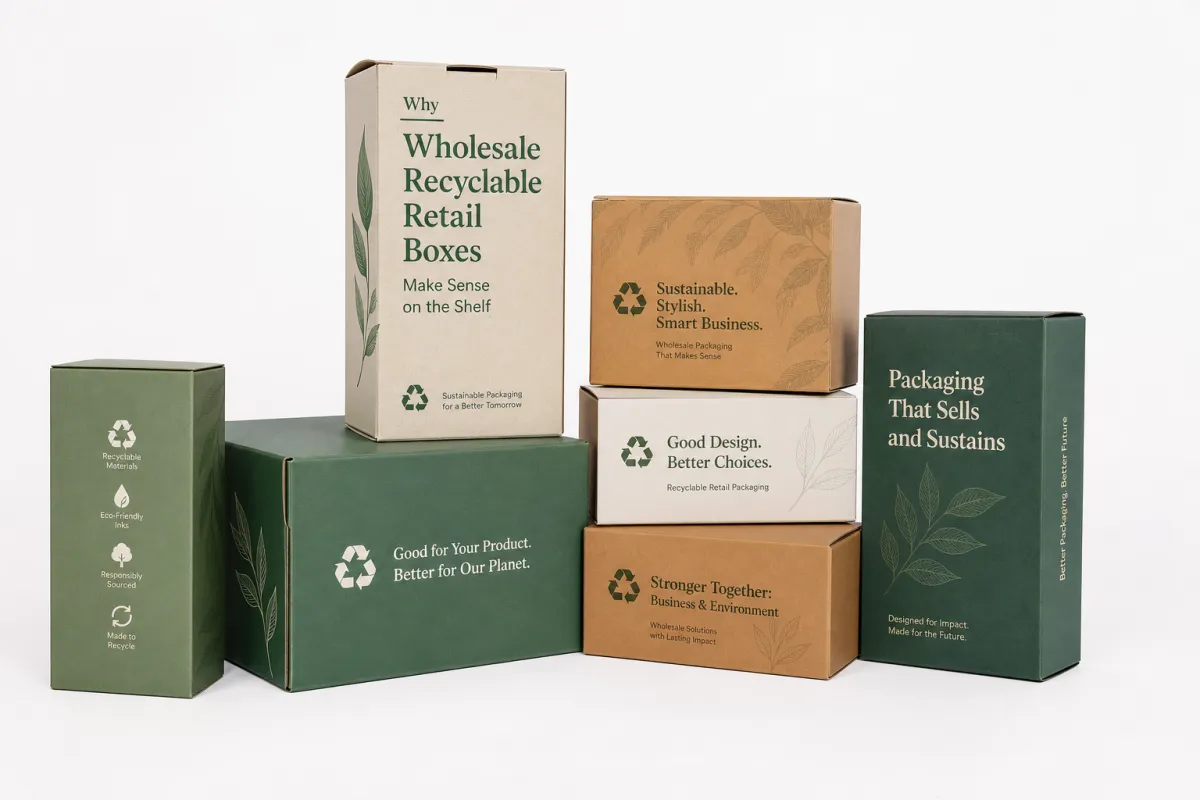
Wholesale recyclable retail boxes improve shelf performance by making the packaging work like part of the product display instead of a barrier between the product and the buyer. A clean panel structure, sharp typography, and consistent dimensions can do more than a flashy shape that confuses store staff. The box should help the sale move forward, not slow it down with awkward handling or mixed materials.
Picture five competing brands on the same shelf. The one in wholesale recyclable retail boxes does not need noise to get noticed. It needs legibility under store lighting, a clear hierarchy of information, and a panel layout that keeps the product looking deliberate. Good paperboard packaging can do that with less material than many buyers expect, which matters in categories where the item itself is small, light, or visually refined.
The business case is just as strong. Wholesale recyclable retail boxes reduce overpackaging, store efficiently in case packs, and keep replenishment predictable. A carton that tears during stocking or opens too early creates extra work for everyone handling it. A package that forces customers to separate plastic from paper before recycling adds friction at the exact moment when the brand should feel easy to trust. Paper-based construction keeps the path clearer. That said, recyclability still depends on local collection rules, so a claim should always match the actual material mix and the market where the box will be used.
Recyclable does not have to mean plain. That assumption still appears in packaging briefs. Brands sometimes think a more sustainable box must look unfinished, almost apologetic. The opposite is true. With accurate die cutting, disciplined print coverage, and a coating that does not interfere with recycling, wholesale recyclable retail boxes can feel more intentional than a pack built from several competing materials. Design for the shelf and the recovery stream at the same time, and the result is usually stronger than a one-sided approach.
"A recyclable box that stacks straight, opens cleanly, and survives retail handling is usually more useful than a flashy structure that creates problems in the warehouse."
Scaling brands feel that difference quickly. A launch run and a replenishment run should not rely on two different packaging philosophies. They need one repeatable carton that behaves the same way every time it is printed, folded, packed, shipped, and stocked. That consistency is a major advantage of wholesale recyclable retail boxes. The brand gets a stable physical format that supports operations, presentation, and customer experience without changing course every time demand shifts.
For buyers comparing structures across product types, the first question should be simple: what job does the box need to do? Some cartons need to hang on a peg. Others must sit inside a tray or protect a fragile item during distribution. A sleeve, tuck end carton, or mailer-style retail box may suit the product better than a generic folding carton. Once the job is clear, wholesale recyclable retail boxes become easier to quote, easier to build, and easier to repeat.
Wholesale Recyclable Retail Boxes: Materials and Print Options
The board choice sets the tone before a customer reads a single word. Most wholesale recyclable retail boxes use paperboard, usually SBS, kraft paperboard, or a folding carton stock chosen for a blend of print clarity and strength. SBS, short for solid bleached sulfate, gives a bright, clean surface that works well for beauty, supplements, personal care, and premium consumer goods. Kraft paperboard brings a more natural, restrained look that suits brands trying to signal honesty, warmth, or lighter material use.
For many projects, wholesale recyclable retail boxes use 14pt to 18pt board for light to medium-weight items. Heavier products may call for 18pt to 24pt stock or a structure with reinforcements. The right board depends on product weight, the stress of distribution, and the amount of handling the carton will face on the shelf. Thin board can look elegant until it buckles. Overbuilt board can protect the product while making the package feel oversized. The sweet spot changes by category, and it is usually found by testing a few real samples rather than guessing from a mockup.
Print method matters just as much. CMYK is the standard choice for full-color artwork, while PMS spot colors help a brand preserve a precise logo tone or a signature color across repeat runs. Interior printing can work well for launches, gifting, and premium unboxing, but it should serve the product story rather than act as decoration for its own sake. Strong packaging often relies on clear structure and strong typography instead of visual clutter.
Finishing choices shape how the carton feels in hand and how it performs in recycling. Wholesale recyclable retail boxes usually pair well with aqueous coating, matte coating, gloss coating, or carefully selected low-impact embellishment. Some soft-touch finishes may be acceptable depending on the coating chemistry and the local recycling route, yet plastic film lamination deserves caution because it can complicate paper recovery. A clean paper-based structure usually benefits from keeping mixed-material decoration to a minimum.
Paper-based inserts, partitions, and dividers can extend that same logic into the interior of the box. A die-cut paperboard insert often holds a bottle, jar, or accessory securely without adding a plastic tray that changes how the package is sorted later. The box and the internal support should be designed together. That is where wholesale recyclable retail boxes become stronger than a box plus a loose insert chosen at the last minute.
Design constraints are part of the job, not obstacles to the job. If a project needs windows, the earliest question should be whether a paper-based window, a cut-out, or no window at all creates the cleaner result. Mixed-material window patches, heavy foil coverage, and layered decorative add-ons can be valid choices for certain brands, but they need a clear business reason. For brands that want a simple sustainability story, wholesale recyclable retail boxes should stay as close to single-material paper construction as possible.
Material sourcing can support trust. If sustainability claims appear anywhere on the pack, the board should come with documentation that can be checked rather than guessed. Ask for chain-of-custody records and confirm whether the board aligns with FSC-certified sourcing standards at FSC. A green color palette is not proof. Paper sourcing is.
There is a second reason board selection matters: ink behavior. Natural kraft absorbs ink differently than bright SBS, so the same artwork can look darker, flatter, or more muted depending on the substrate. That is not a defect. It is a production fact. Wholesale recyclable retail boxes perform best when the artwork is designed for the actual board instead of being pushed through a generic template that ignores how paper behaves.
Specifications That Define a Reliable Retail Box
Reliable structure begins with the right style. Wholesale recyclable retail boxes commonly use tuck end cartons, reverse tuck cartons, sleeve packs, or retail mailer-style cartons depending on how the product needs to open, display, and ship. A lightweight cosmetic item may fit neatly in a tuck end structure. A giftable SKU or a subscription-style product may benefit from a sleeve or mailer format that feels more deliberate in the customer’s hand.
Dimensions should be based on the product, any insert, and the retail environment, not just the item itself. That means accounting for clearance around the product, room for barcode placement, regulatory text, and artwork safe zones. If the box must sit on a hook, face out in a display, or fit into a tray, those requirements belong in the spec before the dieline is finalized. Well-planned wholesale recyclable retail boxes save time later because the print does not have to be squeezed around a structure that was never sized correctly.
Board thickness is another detail that carries more weight than many first-time buyers expect. A carton that feels too thin can collapse under stacking pressure. A carton that is too heavy can inflate cost and make the product feel larger than it really is. For many recyclable retail cartons, a balanced caliper in the 14pt to 18pt range is enough for light retail goods, while heavier products or premium categories may need a sturdier stock. The right choice should be measured against product weight and the handling the pack will face in shipping and merchandising.
Manufacturing details matter too. Score quality affects how cleanly the box folds. Glue flap size affects bond strength. Fold direction affects whether the print lands correctly on the outer face. Window cutouts, if used, need enough border strength so the panel does not warp. Even the opening behavior matters, because retail staff need the carton to open predictably when they are stocking shelves or arranging display units. Wholesale recyclable retail boxes tend to succeed when all of those details are checked together instead of one at a time.
Artwork preparation is just as technical as the structure. Use a confirmed dieline, build in the proper bleed, and keep important text inside the safe area. A standard bleed of 0.125 in is common for folding carton work, though the exact requirement can vary by plant and structure. Barcode placement should respect quiet zones, and the artwork should be checked for orientation on every panel. If the box includes exterior and interior print, specify that early so the proof reflects the full build of the carton.
Testing deserves attention as well. For products that travel through distribution before reaching retail, compression and drop testing aligned to ISTA guidance at ISTA can reveal problems that a screen proof will never show. A box that looks strong on a monitor is not always the same as a box that survives case packing, palletizing, and repeated store handling. Wholesale recyclable retail boxes should be engineered as physical packages, not only as print surfaces.
A single spec sheet can prevent a long chain of revisions. When structure, dimensions, board, finish, and print layout are documented clearly, wholesale recyclable retail boxes become easier to quote accurately and easier to reproduce on repeat orders. That consistency matters for seasonal launches, promotional runs, and SKUs expected to scale into larger volume later.
Pricing and MOQ for Wholesale Recyclable Retail Boxes
Pricing for wholesale recyclable retail boxes depends on a small set of variables that can move the total quite a bit: box size, board type, print coverage, finish selection, insert requirements, tooling, and quantity. The farther the structure moves from a standard folding carton, the more setup and production complexity usually rise. A box can still look simple on the shelf while being more expensive to produce than it appears.
Unit cost tends to fall as quantity rises because fixed expenses are spread across more cartons. A launch order often costs more per unit than a reorder of the same pack. The carton did not change. The cost distribution did. That is why many buyers compare wholesale recyclable retail boxes in quantity bands rather than assuming a single price can fit every order size.
MOQ, or minimum order quantity, depends on the combination of structure and finishing. A basic folding carton can often start lower than a custom box with specialty dies, heavy ink coverage, or inserted components. In practical terms, many custom wholesale recyclable retail boxes begin around 1,000 to 2,500 pieces, while more efficient runs often land at 5,000 pieces or more. The exact threshold depends on the plant, the die size, and the amount of setup required.
Total landed cost tells a better story than the printed box price alone. Freight, warehousing, rework, and revision delays can lift the actual cost of a project even when the quote looks attractive on paper. Buyers who manage wholesale recyclable retail boxes well tend to look at the whole picture: material, lead time, packaging efficiency, and the cost of inventory sitting before it is used.
| Quantity band | Typical unit price | Best fit | Notes |
|---|---|---|---|
| 1,000 to 2,499 | $0.48 to $0.90 | Launches, pilots, test retail runs | Higher setup cost per unit; useful for validating artwork and structure |
| 2,500 to 4,999 | $0.28 to $0.55 | Early growth, seasonal placements | Better balance between setup efficiency and inventory risk |
| 5,000 to 10,000+ | $0.18 to $0.42 | Reorders, national rollouts, established SKUs | Best pricing efficiency; strongest case for repeating wholesale recyclable retail boxes |
Those numbers are planning ranges, not promises. They fit simple to moderately customized packs using standard paperboard, common print coverage, and ordinary finish choices. Add embossing, foil, soft-touch coating, inserts, or unusually large dimensions and wholesale recyclable retail boxes can move higher in price. A buyer who understands that spread can budget with far less guesswork before requesting a formal quote.
Print design also affects cost in ways that are easy to miss. High-coverage solids, multiple PMS colors, and inside printing can increase setup and production effort. A restrained layout can lower the cost of recyclable retail cartons without draining shelf presence. Strong typography, controlled negative space, and a clean structural silhouette often carry more visual weight than a crowded design.
Comparing two or three quote scenarios is usually the best way to find the real cost break. A natural kraft version, a bright SBS version, and a premium coated version show where the price moves and why. That makes it easier to decide whether a feature adds value or merely adds expense. The best wholesale recyclable retail boxes are not always the most decorated ones. They are the ones that justify each material and production choice.
From Quote to Delivery: Process and Timeline
The ordering process for wholesale recyclable retail boxes is usually direct, but the brief controls the speed. A strong inquiry includes product dimensions, target quantity, artwork files, preferred board, finish expectations, and the delivery destination. If the box must support shelf hanging, retail trays, or compliance text, that information belongs in the first message, not the third revision.
Specification review comes next. The structure is matched to the product and the production path is confirmed. If the artwork needs a custom dieline, that is established before proofing begins. For wholesale recyclable retail boxes, this is the stage that prevents many of the most common headaches: wrong dimensions, crowded copy, barcode placement issues, or a finish Choice That Works against the sustainability goal.
Proofing should act like a real quality gate. Digital proofs help check spelling, panel order, color breaks, and placement on the dieline. Physical samples, if needed, should be checked for fold behavior, glue performance, and print appearance under normal light. A customer who reviews the proof with care usually gets better wholesale recyclable retail boxes the first time and fewer surprises once production starts.
Timeline depends on complexity. Straightforward recyclable retail cartons often move faster than highly customized packs with special coatings, inserts, or multi-panel artwork. A common production window for a simple order is about 10 to 15 business days after proof approval. More detailed projects can take 15 to 20 business days or more depending on workload and finishing steps. Repeat runs are usually quicker because the approved structure already exists, which makes wholesale recyclable retail boxes especially useful for brands that need a steady replenishment rhythm.
Shipping and receiving should line up with the launch calendar. If a product reset is scheduled for a specific week, the packaging should not arrive after the store team has already started setting the shelf. Seasonal promotions need the same attention. Transit time, receiving time, and internal inspection time all belong in the plan before the boxes are needed on the floor. Good wholesale recyclable retail boxes help only if they show up when the product actually needs them.
Carton packing configuration matters more than most people expect. Some projects are packed flat for storage efficiency. Others are bundled in smaller counts to make warehouse handling easier. That choice changes freight, receiving speed, and how quickly a team can deploy the packaging on site. A precise brief usually produces more predictable wholesale recyclable retail boxes and fewer surprises after arrival.
Artwork preparation deserves one more check before files are sent. Confirm file format, font outline status, linked images, and color mode. Those details sound mundane, yet they save time and shorten revision loops. For wholesale recyclable retail boxes, the fastest route to production is usually a clean brief and a proof reviewed by someone who understands the pack in hand, not only the file on screen.
Why Choose Us for Wholesale Recyclable Retail Boxes
The real test is not whether a supplier can print a carton. The question is whether they can guide the project so the carton works in the field. Many buyers look for a packaging partner who understands material behavior, retail presentation, and factory-floor realities. Wholesale recyclable retail boxes need practical guidance, not just a price sheet and a promise.
A strong partner helps with board selection, structure choice, and finish decisions while keeping the brand and the budget in view. If a customer wants the strongest possible shelf presence within a paper-based structure, that can often be achieved with smart color blocking, sharp typography, and disciplined layout rather than heavy decoration. The best recyclable retail cartons usually come from clear tradeoffs, not from adding every feature available.
Quality control matters at every step. Board consistency, print registration, glue integrity, cut accuracy, and the way cartons stack after packing all affect performance. Those details sound basic because they are basic, yet they decide whether the retail box survives case packing and store handling. When wholesale recyclable retail boxes are checked properly, the customer receives a carton that looks consistent from the first unit to the last.
First-time buyers usually need translation as much as production. A product brief can describe the item well and still leave the structural needs vague. A strong packaging partner turns that brief into a manufacturable carton, flags risks early, and keeps the order moving without endless back-and-forth. That kind of help is especially valuable for wholesale recyclable retail boxes because the sustainability goal should not turn into production confusion.
Repeat consistency matters too. A brand that grows from a few thousand units to a much larger run should not need to rediscover its packaging every time it reorders. Color expectations, board feel, and folding performance should remain stable. That is one of the real advantages of wholesale recyclable retail boxes handled by a supplier who understands wholesale production rather than only one-off print jobs.
Trust comes from direct advice. If a requested finish will complicate recycling, that should be stated plainly. If a heavier board is needed to protect the product, that should be stated too. A reliable supplier does not force every project into the same formula. They help the buyer balance sustainability, shelf appeal, cost, and lead time in a way that makes sense for the actual product. That is the standard I would expect for wholesale recyclable retail boxes, and it is the standard buyers should insist on.
Next Steps for Ordering Wholesale Recyclable Retail Boxes
If you are ready to request pricing for wholesale recyclable retail boxes, start with the essentials: product dimensions, target quantity, print elements, board preference, and any retail compliance notes. If the product needs an insert, hanger, sleeve, or display requirement, include that too. A clearer brief usually means a tighter estimate and a shorter revision cycle.
Next, decide what matters most to the brand presentation. Some products belong in a natural kraft finish with restrained ink coverage. Others need a bright retail face with crisp full-color graphics. A third group needs the strongest possible shelf statement while staying inside a paper-based structure. Knowing the direction early helps narrow the right version of wholesale recyclable retail boxes before quote revisions begin.
Artwork and technical data should be ready before the quote request, especially if the box needs barcodes, legal copy, or panel-specific instructions. Missing details slow almost every order. A complete brief lets the quote reflect the real scope of wholesale recyclable retail boxes instead of a guessed version that changes later.
Compare options by more than unit price. Board type, MOQ, lead time, finish choices, and whether the proposal includes insert work or special tooling all matter. Sometimes the higher quote is the better buy because it cuts waste, avoids rework, or gives the carton a longer useful life in retail. That is especially true for wholesale recyclable retail boxes that will be reordered often.
Brands still deciding between a few structures should request two or three variants and compare them on shelf impact, cost, and handling. Once the product dimensions and artwork are locked, the best route usually becomes obvious. If the goal is a cleaner presentation, simpler recycling, and a wholesale price that scales with volume, wholesale recyclable retail boxes are often the most sensible packaging decision. Start with the specs, compare the tradeoffs carefully, and move forward with the version that gives the product the best balance of presentation, durability, and repeat-order value.
What materials are best for wholesale recyclable retail boxes?
Paperboard options like SBS, kraft paperboard, and folding carton stock are the most common recyclable choices. The best material depends on product weight, print style, and whether the brand wants a bright premium look or a more natural finish. Local recycling rules matter too, especially if coatings or special finishes are involved.
Can wholesale recyclable retail boxes still look premium on shelves?
Yes. Careful board selection, accurate print, and restrained finishing can create a polished retail presentation without mixed materials. Premium does not require heavy embellishment; strong structure and clean artwork usually matter more. A box that looks calm and intentional often reads as higher quality than one packed with effects.
What affects the price of wholesale recyclable retail boxes the most?
Quantity, board thickness, print complexity, finish selection, and any inserts or special structures are the biggest cost drivers. Higher volumes usually reduce unit cost because setup expenses are distributed across more boxes. Freight, rework, and revisions can also change the real landed cost more than buyers expect.
How long does production usually take for custom recyclable retail boxes?
Timing depends on artwork approval, structure complexity, and order size, but simple projects move faster than highly customized ones. Repeat orders are typically quicker because the approved dieline and print setup already exist. If a sample or revised proof is needed, the schedule stretches a bit.
What should I prepare before requesting a quote for wholesale recyclable retail boxes?
Have product dimensions, quantity targets, artwork files, barcode details, and any special retail requirements ready. Clear specifications help reduce revision time and lead to a more accurate price and timeline. If you already know the board feel or finish you want, include that as well.


