Buyer Fit Snapshot
| Best fit | Eco Friendly Retail Packaging Boxes projects where brand print, material claims, artwork control, MOQ, and repeat-order consistency need to be specified before quoting. |
|---|---|
| Quote inputs | Share finished size, material target, print colors, finish, packing count, annual reorder estimate, ship-to region, and any compliance wording. |
| Proofing check | Approve dieline scale, logo placement, barcode or warning zones, color tolerance, closure strength, and carton packing before bulk production. |
| Main risk | Vague material claims, crowded artwork, missing packing details, or unclear freight terms can make a low unit price expensive after revisions. |
Fast answer: Eco Friendly Retail Packaging Boxes: Board, Finish, Dieline, and Unit Cost should be specified like a repeatable production item. The safest quote records material, print method, finish, artwork proof, packing count, and reorder notes in one written spec.
Production checks before approval
Compare the actual filled-product size with the drawing, then confirm tolerance on folds, seals, hang holes, label areas, and retail display edges. Reserve space for logos, QR codes, warning copy, and material claims before decorative graphics fill the panel.
Quote comparison points
Review material grade, print process, finish, sampling route, tooling charges, carton quantity, and freight assumptions side by side. A quote is only useful when the supplier can repeat the same color, closure quality, and packing count on the next order.
If you're buying Eco Friendly Retail packaging boxes, I’ll save you the polished sales pitch: the best one is not the one that screams “sustainable” the loudest. It is the one that uses less material, protects the product, and still looks like it belongs on a shelf. eco friendly Retail Packaging Boxes only earn their keep when they cut waste without making the display look cheap or forcing the shipper to add another layer just to fix a bad design.
That sounds obvious, but packaging choices go sideways fast when buyers chase labels instead of function. A shiny box with a recycled icon is not automatically better than a well-sized kraft carton with clean printing and a tighter fit. In real production, eco friendly retail packaging boxes are a system decision: board, structure, ink, coating, inserts, freight, and end-of-life recovery all have to pull in the same direction.
I have seen brands spend money on a green-looking box, then wrap that box in extra tissue, filler, and a mailer because the fit was off. That is not sustainability. That is just a more expensive way to hide the problem.
What Are Eco Friendly Retail Packaging Boxes?
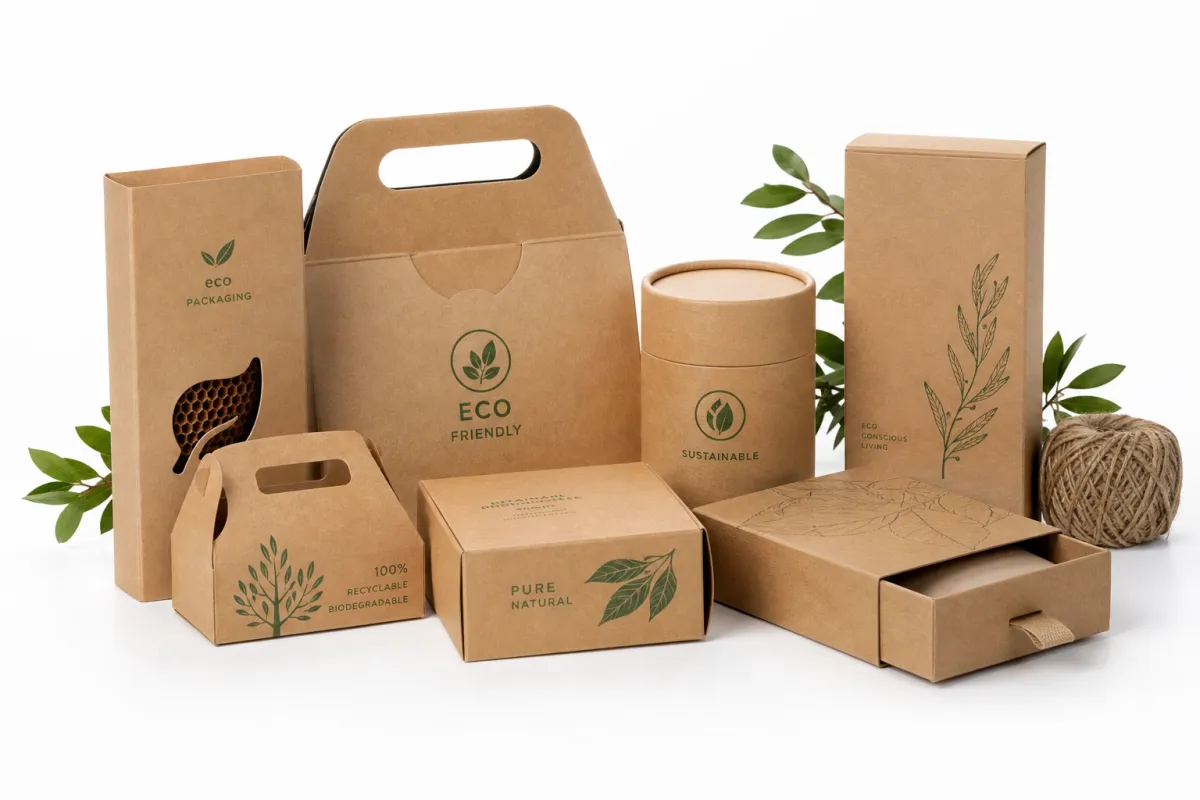
Eco friendly retail packaging boxes are paper-based retail boxes designed to reduce waste, use lower-impact materials, and still do the basic job of protecting and presenting a product. That can mean recycled board, FSC-certified paper, mono-material construction, or compostable components when the use case actually fits. The label is broad, which is why buyers need to ask better questions. A box can look responsible and still be a recovery headache.
Do not confuse eco with decorative. If a carton depends on plastic lamination, metalized film, oversized foam inserts, and a window that blocks paper recovery, the sustainability story falls apart pretty quickly. Same problem with rigid boxes used for light retail items just because they feel premium in hand. Nice feel. Heavy footprint. eco friendly retail packaging boxes should lower the total material load, not just wear a green label and hope nobody checks the details.
Real sustainability is different from greenwashing, and the difference usually shows up once someone asks plain questions. What is the board grade? Is it recyclable in common curbside paper streams? How much post-consumer recycled content is in the substrate? Are the inks and coatings compatible with recovery? If the answers come back vague, the claim is probably vague too.
Retail packaging has four jobs at once: protect the product, support the brand, survive handling, and keep packing efficient. Break any one of those, and the “eco” claim gets expensive fast. A carton that crushes in transit creates returns and replacements. A box that looks flimsy on shelf can hurt conversion. A box that needs too much filler wastes labor and space. eco friendly retail packaging boxes only make sense when all four jobs line up.
Practical rule: the least wasteful box is the one that arrives intact, fits the product, and does not need a second packaging layer to make up for bad design.
That is the part people miss. Sustainability is not a sticker. It is an outcome. And yes, eco friendly retail packaging boxes can still look premium. Clean edges, sharp print, a tight fit, and the right finish usually beat a busy package that borrowed more board than it needed.
How Eco Friendly Retail Packaging Boxes Work
The lifecycle starts long before printing. Fiber is sourced, pulped, pressed into board, converted into sheets or rolls, printed, die-cut, glued, packed, shipped, opened, used, and then recovered or tossed. Every step adds friction. eco friendly retail packaging boxes are built to reduce that friction, not hide it somewhere else.
Structure matters as much as material. A box that is 2 mm too large can force void fill. A box that is too tight can crush corners, scuff surfaces, and create returns. Caliper and board strength matter because they change how much protection you get from the same square footage of fiber. In a lot of retail programs, resizing the carton saves more material than swapping to a different paper grade. Not glamorous. Still true.
The pieces that affect recyclability are usually the ones buyers rush past:
- Inks: water-based and low-coverage print is usually easier to recover than heavy flood coats or specialty effects.
- Adhesives: paper-friendly glues are easier to manage than mixed-material constructions.
- Coatings: soft-touch and plastic film can improve feel, but they can complicate recovery.
- Windows: clear plastic windows often reduce paper-only recoverability unless the design is separated cleanly.
- Inserts: molded fiber, paperboard, and corrugated dividers usually fit the sustainability brief better than foam-heavy alternatives.
For testing and transport expectations, I like to point people toward actual standards instead of marketing language. The ISTA test series is a useful reference for distribution performance, and FSC chain-of-custody guidance at fsc.org helps buyers verify sourcing claims. That does not magically make a box sustainable. It just gives you something real to check.
eco friendly retail packaging boxes also depend on the recovery stream. A plain kraft carton may be recyclable in theory, but if the local system prefers paper separation and the carton is covered in mixed coatings, the real recovery rate drops. That is why material choice and decoration need to be one decision, not two unrelated ones.
Think of the box as part of the packaging system, not an accessory. If the box is too weak, the team adds wrap. If it is too loose, they add filler. If it is too heavy, freight costs rise. The best eco friendly retail packaging boxes reduce the need for rescue materials downstream. That is the point.
Eco Friendly Retail Packaging Boxes: Key Materials and Costs
The material discussion usually starts with recycled content, but the cost picture is messier than that. Board grade, print coverage, finishing, die complexity, insert design, order quantity, and shipping weight all move the price. eco friendly retail packaging boxes can be cheap or expensive depending on how many moving parts you add. The fiber story is only one piece of the bill.
Here is the blunt version: recycled board is often a smart choice, but a recycled box with heavy lamination, foil stamping, and a Custom Magnetic Closure is still not a budget solution. Fancy is fancy. Green does not erase fancy. In many runs, print and finish cost more than the substrate itself.
Typical packaging buyers see the biggest cost jumps in these areas:
- Full-bleed color: more ink coverage means more setup and more press attention.
- Special finishes: soft-touch, spot UV, foil, and embossing add labor and often reduce recyclability.
- Windows and inserts: extra components add assembly cost and can complicate recovery.
- Complex die lines: intricate folds, locks, and displays increase tooling and make production slower.
- Low quantities: the smaller the order, the more each setup charge hurts.
Below is a practical comparison buyers can use when deciding between common options for eco friendly retail packaging boxes.
| Option | Typical Use | Strengths | Tradeoffs | Approx. Unit Cost at 5,000 Units |
|---|---|---|---|---|
| Recycled paperboard tuck box | Light retail items, cosmetics, supplements | Clean shelf look, low material use, good print surface | Less crush resistance than heavier corrugated options | $0.18-$0.32 |
| Kraft folding carton | Natural-looking product packaging, gift items, small accessories | Simple, lower-impact appearance, easy to recycle | Print colors can look muted; premium feel depends on structure | $0.16-$0.29 |
| Corrugated retail mailer | Ship-to-consumer retail goods, subscription items, bundles | Better protection, lower damage risk, reduced need for outer packaging | Bulkier than paperboard; shelf presentation is different | $0.32-$0.68 |
| Molded fiber insert with paperboard carton | Fragile items, premium kits, bottle sets | Good cushioning, paper-based component mix, strong unboxing feel | Tooling and fit testing can add time; not always cheapest | $0.40-$0.95 |
| Rigid setup box | Luxury retail and gift presentation | High-end look, strong structure, premium hand feel | Heavier, more material, usually harder to defend as low-waste | $0.85-$2.50+ |
That last row is where buyers usually get stuck. A rigid box can be right for a high-value item, but it is not the default sustainable choice just because it feels nice. If the product does not need that level of structure, the box is doing more theater than work.
Cost per unit matters, but cost per sale matters more. A slightly stronger carton can reduce returns, damage claims, and overpacking labor. A cleaner design can lower freight weight and speed up assembly. I would rather see a buyer spend a few extra cents on a box that avoids a replacement shipment than save pennies and bleed margin later. That is usually how the math plays out once volume gets real.
For readers comparing options, our Custom Packaging Products page is a good starting point if you need custom printed boxes, a dieline adjustment, or a retail carton that balances branding with freight reality.
One more thing: minimum order quantity matters. A supplier may quote a lower per-unit price at 10,000 pieces, but if your storage space is tight or your design changes often, that savings can disappear fast. The right number is the one you can store, use, and reorder without turning the warehouse into a cardboard museum.
How to Choose the Right Eco Friendly Retail Packaging Boxes
The best selection process starts with the product, not the box. Measure the item accurately. Record width, depth, height, weight, and any fragile zones such as corners, caps, labels, or decorated surfaces. Then define the retail job: shelf display, ship-to-consumer, gift presentation, or multi-pack bundling. eco friendly retail packaging boxes work best when the structure matches the actual use case.
After that, choose the box style. A tuck-end carton is common for light retail items. A mailer works better when shipping is part of the job. A sleeve can provide strong branding without much material. A corrugated structure makes more sense when the pack has to travel farther or hold heavier items. A rigid build is best left for premium presentation when the value justifies the extra board.
Do not skip testing. I mean real testing with the actual product, not a placeholder. Put the item in the sample, shake it, drop it, stack it, and leave it in a warm room for a day if the product is sensitive to warp or adhesive movement. If the sample rattles, you are gonna hear about it later in returns. eco friendly retail packaging boxes should reduce failure points, not create them.
Ask suppliers the annoying questions. Good. They should be able to answer. What percentage of the board is recycled content? Is it FSC-certified? Does the coating change recyclability? Are inserts made from paper, molded fiber, or foam? Is the final carton accepted in a paper recovery stream or not? If the vendor answers with vague “eco” language, you are not getting a clear picture.
It also helps to define the decision rule early. Here are the four most common:
- Shelf impact: the box needs to sell at first glance.
- Lowest waste: the brief prioritizes minimal material and recovery-friendly construction.
- Lowest unit cost: the packaging must stay under a strict spend ceiling.
- Balanced performance: the design has to look good, protect the product, and stay efficient.
Most brands say they want the fourth one. Fair enough. That is usually the right answer. The problem is that “balanced” needs numbers attached to it. If the box is allowed to weigh 20% more just to add a second coating, that is not balance. That is decoration.
When package branding matters, keep the graphic strategy disciplined. Strong typography, a tight color palette, and one or two intentional finishes usually beat a crowded layout. Custom printed boxes can still feel premium without turning into a materials blooper reel. Good packaging design does not need to shout. It needs to fit.
Production Process and Timeline for Eco Friendly Retail Packaging Boxes
The production path is more predictable than people think, but only if the brief is clean. A typical order for eco friendly retail packaging boxes moves through discovery, dieline setup, artwork prep, proofing, sampling, production, finishing, packing, and freight. Skip a step or change direction halfway through, and the schedule stretches. That is not drama. That is print production.
For a simple carton with standard print, a common timeline is around 12-18 business days after proof approval. Add structural revisions, special coatings, custom inserts, or more involved color matching, and that window can move to 3-5 weeks or more depending on the order size. If the job needs multiple sample rounds, the calendar gets longer. Fast is possible. Instant is not.
The main delay points are boring, which is exactly why they keep happening:
- Artwork approvals: someone is always “just checking one more detail.”
- Structural revisions: a dieline that looked fine on screen may fail in hand.
- Color matching: brand colors and recycled stocks do not always behave the same way.
- Sample round trips: physical samples take time to make, ship, and review.
- Insert fit: molded or die-cut inserts need tighter coordination.
To keep eco friendly retail packaging boxes on schedule, buyers should send a complete brief up front. That means final product dimensions, target quantity, print-ready files if available, packaging goals, sustainability requirements, and the launch date that actually matters. A photo of the product helps more than people expect, especially if the item has irregular edges, fragile closures, or a finish that scratches easily.
Here is a simple planning sequence that keeps the project sane:
- Confirm product size, weight, and fragility.
- Choose the structure and material family.
- Approve the dieline and internal fit.
- Review proof samples for color, text, and coating behavior.
- Test the actual product in the actual box.
- Lock production and book freight with buffer time.
In retail packaging, the launch date is the boss. Not the artwork. Not the box spec. Not the spreadsheet someone made at 11 p.m. Plan backward from the shelf date or fulfillment date, then add margin for proofing and shipping. If the boxes arrive after the inventory, the whole sustainability conversation turns into a warehouse problem.
One practical note: eco friendly retail packaging boxes often use paper-based structures that behave differently under humidity than plastic-heavy options. If your product sits in a warm stockroom or a damp delivery path, ask about storage conditions. Paper is not fragile, but it is honest. It reacts to the environment. Better to know that before shipment than after a customer has to wrestle with a swollen carton.
And yes, the right vendor should be able to talk through all of this without sounding like they copied it from a recycled brochure. If they cannot explain the process, they probably cannot manage the process either.
Common Mistakes Buyers Make With Eco Friendly Retail Packaging Boxes
The biggest mistake is overdesign. Buyers add extra layers, extra print, extra inserts, and extra coatings, then call the result sustainable because the board itself contains recycled fiber. That is not a plan. That is a costume. eco friendly retail packaging boxes should reduce waste in the real world, not just in the product description.
Second mistake: choosing a box that looks good in a flat mockup and fails in transit. Mockups leave things out. They do not show compression, vibration, corner impact, or stacking pressure. A carton that looks elegant on screen can arrive scuffed, bent, or open at one end if the locking tabs are weak. Once the supply chain starts moving, physics becomes the lead designer.
Third mistake: assuming recycling rules are identical everywhere. They are not. A paperboard box with a light coating may be acceptable in one recovery stream and annoying in another. A plastic window may be tolerated by one processor and rejected by another. Buyers should ask how eco friendly retail packaging boxes behave in the likely end market, not just in a theoretical brochure claim.
Fourth mistake: ignoring fit. Loose packaging rattles. Tight packaging crushes. Either way, the item suffers. When the fit is poor, people add filler, tissue, bubble wrap, or extra wraps. So the “eco” box ends up needing more stuff to do its job. That is a bad trade.
Fifth mistake: buying on unit price alone. Low price is seductive. I get it. But if the cheapest option creates a 3% damage rate, adds 20 seconds of packing labor, or needs a reprint because the finish fails, it is not cheap. It is deferred pain.
Good packaging does not just lower material use. It lowers the number of things that can go wrong after the product leaves the plant.
There is also a branding mistake I see all the time. Brands spend all their energy on a bold logo and forget the box shape, opening experience, and structural clarity. That is backwards. Package branding lives in the whole object. The way the flap closes. The way the product sits. The way the carton opens without tearing. Those details matter more than another decorative layer nobody asked for.
If you need a sanity check, compare the original concept to the actual requirements:
- Does the box protect the item without extra wrap?
- Does it stay within the freight and storage limits?
- Can it be recovered in a paper stream where available?
- Does the retail presentation still look intentional?
- Does the cost make sense at your real order volume?
If the answer is “no” to two or more of those, the design needs work. Not excuses. Work.
Expert Tips and Next Steps for Better Orders
The fastest way to improve eco friendly retail packaging boxes is to audit the current pack honestly. Measure the waste. Count the damage rate. Note how much filler gets used. Look at the freight cube. That gives you a starting point. Without that, everyone is just arguing opinions with nicer fonts.
Once you know the baseline, ask for two sample builds if possible: one leaner version and one stronger version. Compare protection, shelf presence, assembly speed, and total landed cost. Sometimes the cheaper unit cost loses once labor and damage are included. Sometimes the simpler box wins across the board. The point is to compare reality, not assumptions.
Ask for documentation before approval. Recycled content claims should be backed by supplier information. FSC claims should be traceable. Coating and ink details should be written down. Minimum order quantity should be clear. If the box has a decorative feature that affects recyclability, You Need to Know that before committing, not after the first shipment.
For brands managing multiple SKUs, standardizing structural families can save money and reduce waste. One carton height, two insert sizes, shared print logic, fewer special dies. That kind of packaging system thinking is not glamorous, but it cuts errors and makes reorders much easier. eco friendly retail packaging boxes get better when the program is repeated, not reinvented every time.
My best advice is simple: choose the lowest-impact design that still protects the product and sells the item. Not the fanciest. Not the cheapest. The one that behaves well in the real world. If your team needs a retail-ready structure, a custom printed box, or a material recommendation, start with the product and work outward. That is how you get better product packaging without paying for unnecessary extras.
If you are planning a new run of eco friendly retail packaging boxes, line up the launch date, sample window, and production slot early. That is the difference between a clean rollout and a frantic reorder. And frankly, frantic reorders are expensive in every way that matters.
Use the box to solve the packaging problem, not decorate it. Measure the product, choose the simplest structure that protects it, verify the recovery path, and test the sample in real conditions. That is the part that Actually Moves the Needle.
Are eco friendly retail packaging boxes actually recyclable?
Usually yes, if they are made from a single paper-based material and do not rely on plastic-heavy coatings, windows, or mixed inserts. Ask the supplier what stream the box belongs in, because recyclable on paper and recyclable in your local system are not always the same thing. eco friendly retail packaging boxes only deserve the label if the recovery path is realistic.
Do eco friendly retail packaging boxes cost more than standard boxes?
Sometimes, but not always. The cost difference usually comes from structure, print coverage, finishing, and order size more than the recycled content itself. A simpler eco design can be cheaper than a flashy conventional box that uses extra layers and extra finishing. In other words, eco friendly retail packaging boxes are not automatically the expensive option.
What materials work best for eco friendly retail packaging boxes?
Recycled paperboard, kraft board, corrugated board, and molded fiber inserts are common strong options. The best choice depends on product weight, shelf appeal, shipping stress, and whether the box needs to be opened and closed repeatedly. For many retail jobs, eco friendly retail packaging boxes built from paper-based components are the cleanest balance.
How long does it take to make custom eco friendly retail packaging boxes?
Simple jobs can move quickly, but custom artwork, sample rounds, and specialty finishes add time. Build in time for proof approval, sampling, production, and freight so you are not chasing boxes at the last minute. For most buyers, eco friendly retail packaging boxes are a planning project, not a rush order.
Can eco friendly retail packaging boxes still look premium?
Absolutely. Clean structure, sharp print, smart color choices, and a good tactile finish usually beat overdesigned packaging with wasteful extras. Premium does not have to mean material-heavy; it usually means the box feels intentional and fits the product properly. The best eco friendly retail packaging boxes look calm, not busy.


