Buyer Fit Snapshot
| Best fit | Wholesale Sustainable Mailer Boxes for Startups That Scale projects where brand print, material claims, artwork control, MOQ, and repeat-order consistency need to be specified before quoting. |
|---|---|
| Quote inputs | Share finished size, material target, print colors, finish, packing count, annual reorder estimate, ship-to region, and any compliance wording. |
| Proofing check | Approve dieline scale, logo placement, barcode or warning zones, color tolerance, closure strength, and carton packing before bulk production. |
| Main risk | Vague material claims, crowded artwork, missing packing details, or unclear freight terms can make a low unit price expensive after revisions. |
Fast answer: Wholesale Sustainable Mailer Boxes for Startups That Scale should be specified like a repeatable production item. The safest quote records material, print method, finish, artwork proof, packing count, and reorder notes in one written spec.
Production checks before approval
Compare the actual filled-product size with the drawing, then confirm tolerance on folds, seals, hang holes, label areas, and retail display edges. Reserve space for logos, QR codes, warning copy, and material claims before decorative graphics fill the panel.
Quote comparison points
Review material grade, print process, finish, sampling route, tooling charges, carton quantity, and freight assumptions side by side. A quote is only useful when the supplier can repeat the same color, closure quality, and packing count on the next order.
Wholesale Sustainable Mailer Boxes for Startups That Scale Without Wasting Margin
I still remember the first time a founder slid a crushed return across a conference table and said, half embarrassed and half annoyed, "I thought the box was just the box." It was one of those moments that makes the whole room go quiet for a second. The product was solid, the branding looked polished online, and the store was pulling in orders, but the wholesale sustainable mailer boxes for startups they had chosen were too light for the parcel network, so every dented corner turned into a refund, a replacement, or a bad photo posted before the customer service team could even answer the email. The cartons had already spent four to six days moving through Chicago and Dallas hubs, and the damage was happening long before anyone had a chance to intervene.
I was gonna say packaging is only one line item, but that is too small for what it actually does. For a startup, the mailer touches freight, returns, support workload, customer perception, and the margin on the SKU itself. Ship 1,000 orders a month and let 30 arrive damaged, and the true cost is never just 30 boxes. You have return labels, staff time, replacements, review fallout, and the quiet drag on repeat purchase behavior that shows up later in a spreadsheet and feels a lot bigger than it looked in the planning meeting. I usually treat wholesale sustainable mailer boxes for startups as a supply-chain choice first and a brand choice second, because the package has to survive the route before it can tell the brand story. A beautiful failure is still a failure, and a $7.50 replacement on a $19 item can wipe out a week of sales in a hurry.
On a visit to a corrugated plant outside Shenzhen, a line operator said something I still repeat in meetings: "A box that fits right costs less than a box that fixes problems." He was talking about void fill, pallet efficiency, and breakage, but the point reaches further than that. The right wholesale sustainable mailer boxes for startups reduce waste, protect the product, and make the unboxing feel planned instead of patched together at 11 p.m. by a tired team and a stack of rushed samples. That factory was running around 18,000 mailers a shift, and a one-spec change shaved nearly 6% off scrap. That sort of improvement is not flashy, but it is very real.
Sustainability works best when it sits on top of practical decisions. Right-sized packaging uses less kraft, less filler, and fewer inches of freight space. Oversized cartons often cost more to ship than buyers realize, especially once dimensional weight pricing starts acting like the grumpy accountant in the room. I have seen a 9 x 6 x 3 mailer outperform a larger 12 x 9 x 4 carton by a meaningful margin because the smaller box stayed under a carrier threshold and stacked cleanly on a pallet. That kind of difference is not glamorous, but it is real money, especially at 5,000 units per quarter.
If you are comparing wholesale sustainable mailer boxes for startups, the real question is not whether a logo can be printed on the panel. It is whether the structure survives a parcel network, keeps the goods intact, and still respects the budget after freight and storage are counted. The sections ahead cover board grades, construction details, pricing tiers, lead times, and the questions I ask before I sign off on a run. After enough packaging conversations go sideways, you start to notice the same pattern: the devil usually lives in the dimensions, not the mockup, and a half-inch mistake can matter more than a full-color proof.
Wholesale Sustainable Mailer Boxes for Startups: The Value Proposition
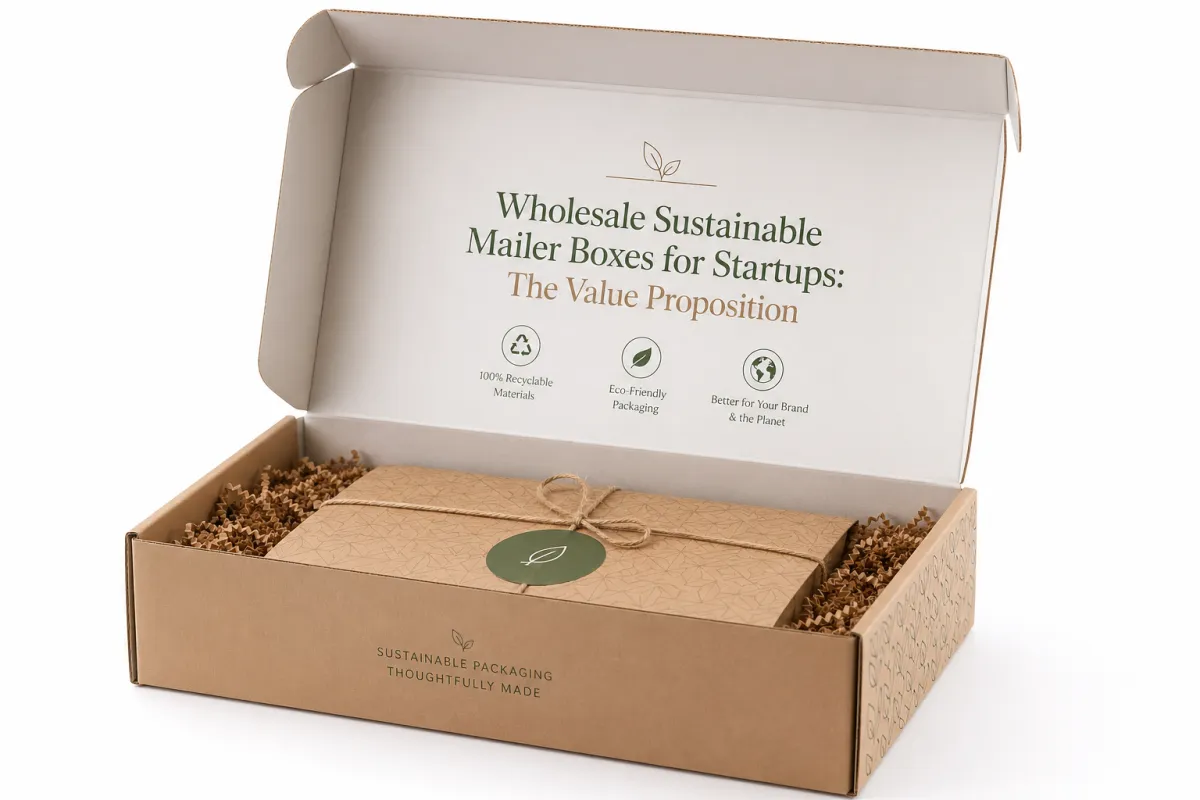
Founders usually begin with branding and then get surprised by damage claims. I worked with a skincare startup that spent $4.80 per unit on a handsome printed outer carton, only to discover the bottle was sliding around inside because the insert had been treated like an optional extra. The fix was practical: move to wholesale sustainable mailer boxes for startups with tighter dimensions, a properly cut insert, and a closure that stayed secure through handling. Complaints dropped, and the customer photos started looking deliberate instead of fragile. Honestly, that was a relief, because nobody wants their launch feed filled with broken glass and sad tissue paper from a 500-unit first run.
The math is plain. A 3% damage rate on 1,000 monthly orders means 30 replacements. If each replacement costs $7.50 in fulfillment work alone, that is $225 gone before refund fees, support labor, or lost repeat sales enter the picture. Add a few negative reviews every week and the hidden cost becomes impossible to ignore. I tell clients to think about wholesale sustainable mailer boxes for startups as insurance they can measure, touch, and ship, which is a lot better than hoping the carrier has a gentle week. One launch in Austin went from a 2.8% damage rate to 0.6% after the box spec changed, and the support inbox calmed down within 14 days.
Customer perception carries more weight than many spreadsheets admit. A parcel that arrives in a recyclable kraft mailer with crisp edges and a tight closure sends a message of control. Buyers do not separate packaging from product quality nearly as neatly as procurement teams do. In practice, wholesale sustainable mailer boxes for startups can lift the perceived value of the item inside even when the box itself costs only a few cents more than a plain shipper. I have watched buyers linger over a well-made mailer the way they do over a good jacket seam or a machined metal clasp; people notice care, even if they cannot always explain why. A 350gsm C1S artboard wrap on a corrugated base can make that first impression feel more polished without blowing up the print budget.
At a supplier meeting in Yiwu, I watched a brand owner try to save $0.06 per unit by thinning the board. The vendor explained that the lower spec would likely raise crush risk by 1.5% in transit. That is a poor trade when the product inside costs $18 and the box saves six cents. This is why wholesale sustainable mailer boxes for startups belong in the margin-protection conversation, not just the packaging budget. I have a very low tolerance for tiny savings that create giant headaches later; it is the packaging version of stepping over dollars to pick up pennies. On that run, the buyer ultimately chose a 32 ECT board, and the claim rate stayed under 1% across 4,000 parcels.
Practical sustainability also improves freight economics. A right-sized mailer reduces dunnage, lowers cube usage, and can improve pallet density. If your packing station is pushing 250 orders a day, trimming even a quarter inch from each side across the order set can mean fewer master cartons, cleaner warehouse stacking, and less dead air moving through the network. The environmental benefit is real, but the business case is even stronger: wholesale sustainable mailer boxes for startups can simplify the outbound flow from carton erection to final scan. That kind of operational calm is underrated until the warehouse team starts clapping because a carton finally folds the way it should, especially at a 7:30 a.m. shift change in Newark.
"We stopped seeing dented corners within two weeks of changing the mailer spec, and our review rate improved the same month." That was the comment from a founder I worked with after we moved them to a tighter corrugated design with recycled-content board and a closure that held under transit abuse, including the repeated side-loads that happen in regional distribution centers.
If you want to compare structural families before you buy, our Custom Packaging Products page is a useful starting point. For brands still testing channel mix, our Wholesale Programs page shows how a small launch order can grow into a larger repeat run without forcing a fresh spec every time. If your catalog also includes soft goods, our Custom Poly Mailers may fit lighter SKUs while your premium line ships in wholesale sustainable mailer boxes for startups. That split works well for apparel brands shipping a $12 tee in a lighter mailer and a $48 gift set in a stronger box.
Two standards are worth keeping in view. For shipment testing, I often reference ISTA protocols because they tell you whether a package survives real distribution hazards instead of merely looking neat in a mockup. For fiber sourcing, FSC certification gives buyers a clearer signal that the board comes from responsibly managed forests. Those details matter when a startup wants to prove it is serious about wholesale sustainable mailer boxes for startups instead of leaning on green language and hoping nobody asks follow-up questions. A buyer in Portland may not ask for the certificate on day one, but a retail chain in Berlin almost certainly will.
How Do Wholesale Sustainable Mailer Boxes for Startups Reduce Damage and Shipping Costs?
Wholesale sustainable mailer boxes for startups reduce cost in two places at once: they lower the chance of damage and they keep the package closer to the product's actual size. That means fewer refunds, less void fill, cleaner pallet density, and less exposure to dimensional weight pricing. A right-sized recyclable corrugated mailer also cuts down on tape, filler, and the labor time spent wrestling oversized cartons closed. In practice, the savings show up in fewer replacements, steadier customer reviews, and a packaging line that moves with less friction from packing station to parcel scan.
The best results usually come from matching board strength, closure style, and internal fit to the product weight and shipping lane. A tighter kraft mailer with a proper insert can protect a fragile SKU far better than a larger box with empty space inside, and that is where the real economics of wholesale sustainable mailer boxes for startups start to make sense. If the package is moving through a rough belt, a long regional sort, or a humid warehouse, that extra attention to structure is doing more for the business than a nicer hero image ever could.
Product Details: What Sustainable Mailer Boxes Actually Include
When people talk about wholesale sustainable mailer boxes for startups, they usually mean corrugated mailer boxes built for e-commerce shipping, subscription fulfillment, and direct-to-consumer orders. The phrase sounds simple, yet the structure varies a great deal. A good mailer is not a folded sheet with a logo on top; it is a designed container with a lid, locking tabs, and enough board strength to handle parcel movement from warehouse floor to doorstep. I have seen teams underestimate that last part and then act shocked when gravity did what gravity always does, even after the carton spent 12 hours in a truck line out of Los Angeles.
Common material choices include kraft corrugated, recycled-content board, and FSC-certified stock. Kraft gives that natural brown finish many buyers associate with lower ink use and a cleaner recycling story. Recycled-content board can fit brands that want to show a lower virgin-fiber footprint. FSC stock is useful when a retail buyer or regulated channel wants a verified sourcing claim. In my experience, wholesale sustainable mailer boxes for startups work best when the board choice matches the product weight, not the mood board. Mood boards are fine for inspiration; they are terrible at surviving transit, especially if the parcel has to pass through a humid warehouse in Singapore or a dry winter route in Minneapolis.
Construction details matter more than most founders expect. A tuck-top closure is easy for fulfillment teams and works well for lighter goods. A roll-end front lock adds more structure and is often my first choice for subscription sets or products that move through multiple touchpoints before delivery. Self-locking tabs save tape and speed up packing, while crush resistance becomes essential for boxes that pass through regional hubs, last-mile carriers, and the occasional rough sorting line. If your wholesale sustainable mailer boxes for startups cannot handle a drop test or a stacked pallet, the sustainability claim is carrying too much weight by itself. A 24-inch drop from each corner should not turn the box into confetti.
Print and finish choices should support recyclability. A single-color logo on natural kraft is often the cleanest route. Full-color exterior print can look excellent, but it needs better registration control and careful ink coverage so the box stays curbside recyclable. I prefer water-based inks, restrained flood coverage, and a matte look over glossy coatings that make recovery harder. That preference comes from watching too many attractive boxes lose their appeal once the finish started working against the materials. I still remember one box that looked premium until the coating scuffed in storage and turned into a shiny mess; nobody ever asked for "premium" to mean "looks tired after two days" after three weeks in a San Diego warehouse.
Optional inserts are where many startups find real value. Ship a candle, a serum trio, or a bundle with accessories, and an insert can prevent movement that no amount of outer print can solve. Dividers, partitions, and custom cutouts all have a place, especially when products are fragile or positioned as premium. I have seen wholesale sustainable mailer boxes for startups become far more effective with a simple die-cut insert that costs less than a return shipment and removes a lot of transit anxiety. That is the kind of quiet improvement that makes a packing team breathe easier, particularly when the pick line is processing 600 orders before lunch.
One factory-floor detail still sits in my notebook: a cutter operator showed me how a 1 mm change in score depth altered how a mailer folded at the closing flap. That tiny adjustment made the difference between a box that popped open in transit and one that held firm through repeated handling. If you are buying wholesale sustainable mailer boxes for startups, those small details are not small at all. They are the difference between "works fine" and "why is this thing trying to escape the parcel?" The same line in Foshan ran 70,000 pieces a day, and that one-score tweak cut flap complaints almost immediately.
Specifications That Affect Performance and Shelf Appeal
Start with the basics: dimensions, board strength, flute type, thickness, and carrier suitability. Many damage problems begin because the box size was guessed rather than measured. I ask for product length, width, height, the heaviest unit in the SKU set, and the maximum acceptable clearance before I recommend a structure for wholesale sustainable mailer boxes for startups. Loose numbers produce a loose spec, and a loose spec travels poorly. Packaging is one of those areas where "close enough" can become expensive very quickly, especially if the destination network includes secondary hubs in Atlanta or Memphis.
Fit is the first rule. I usually want a small clearance around the product, often 0.125 to 0.25 inches per side depending on the insert strategy. Too much space invites movement, and movement invites corner crush, scuffing, and product shift. Too little space makes packing miserable and slows the line. There is a narrow sweet spot, and that is where wholesale sustainable mailer boxes for startups do their best work. I have watched a team go from wrestling every box shut to packing with actual rhythm once the fit was corrected, which is the kind of operational mood change everybody appreciates. On a 2,400-unit run, that change can save a full hour of labor per shift.
For lightweight apparel or beauty items, a lighter board and an E-flute-style build may be enough if the box is well designed. For candles, supplements, or multi-item kits, I often move up to a stronger single-wall structure, a thicker flute profile, or a higher ECT rating. A 32 ECT spec can be fine for a small cosmetic box; a 44 ECT build may be more appropriate when the product is heavier or the shipping lane is rougher. The right answer depends on the parcel profile, not the catalog description. A fragile serum bottle does not care how charming the product naming is, and neither does a carrier belt in Louisville.
Branding specs should stay practical. Ask about ink limits, print registration, whether the interior needs print, and whether the exterior should stay uncoated or carry a matte varnish. A natural kraft look can hide handling marks and keep the box honest. Full-color art can work too, but only if the design respects the fold lines and the print budget. For wholesale sustainable mailer boxes for startups, I usually recommend spending on structure before spending on decoration. A box that stays intact in transit does more for the brand than an elaborate print scheme that arrives bruised and tired, especially if the freight line takes a detour through Ontario in January.
If you want a quick buying checklist, use this one:
- Product dimensions: Measure the packaged unit, not the bare product.
- Weight: Use the heaviest SKU, because the lightest one does not define the box.
- Carrier path: Confirm whether the box will ride standard parcel lanes or gentler regional routes.
- Print need: Decide whether you need one-color branding, full-wrap print, or no print at launch.
- Storage footprint: Check how many flat cartons your warehouse can hold per pallet.
For buyers who like concrete numbers, I often suggest mapping box strength to product class. A 7 oz apparel bundle does not need the same board as a 22 oz candle set. A beauty trio packed with a paper insert is different again. That is why wholesale sustainable mailer boxes for startups should be matched to the SKU, the fulfillment environment, and the damage tolerance target, not just the lowest quote on the page. A bargain that breaks is just an expensive lesson wearing a discount tag, and I have seen that lesson cost a brand more than $3,000 in one quarter.
There is a shelf appeal angle too, even for DTC. A mailer can arrive, photograph well, and still be efficient to ship. That balance is the point. Many startup teams assume "sustainable" means plain and dull, which is lazy thinking. A clean kraft panel, precise print, and good closure design can look more premium than a glossy box trying too hard. I prefer packaging that knows what it is doing; the confidence reads better than decoration ever could. A strong unboxing shot on a phone in Brooklyn or Bristol starts with a box that closes squarely on the first try.
Wholesale Sustainable Mailer Boxes for Startups: Pricing and MOQ
Pricing is where most buyers need to slow down. The quote for wholesale sustainable mailer boxes for startups depends on board grade, dimensions, print coverage, inserts, coatings, and order quantity. If a supplier gives you one number without asking for size, weight, and artwork coverage, that number is mostly a placeholder. Real quotes start with the dieline and end with freight. Everything else is theater, and I have sat through enough packaging theater to know the script by heart. A correct quote from Dongguan can look very different from one in Ho Chi Minh City once freight, setup, and board spec are actually in the open.
The pattern is consistent: as volume rises, unit price falls. That sounds obvious, yet it matters because startups often overestimate how much they need and understate the benefit of a test run. At 1,000 units, a Custom Sustainable Mailer might cost $0.95 to $1.45 each depending on print and board. At 5,000 units, that same style may drop to $0.48 to $0.92. At 10,000 units, I have seen some plain or lightly printed builds land around $0.36 to $0.70. Those are not universal prices, but they are realistic enough to use while comparing wholesale sustainable mailer boxes for startups. The trick is not to fall in love with the lowest line item before you know what it actually buys you, and a $0.15 per unit rate at 5,000 pieces is only meaningful if the board, closure, and print finish are all specified.
Setup costs need to stay separate from unit costs. Tooling, plates, and custom dielines are often one-time or infrequent expenses, while the box itself is the recurring cost. I have seen tooling run from $120 to $350, dielines from $0 to $75 depending on complexity, and sample sets from $35 to $120 if a startup wants physical approval before committing. That is how a quote for wholesale sustainable mailer boxes for startups can look inexpensive until the setup line items appear. The first quote may feel friendly; the total often has more personality. A proof set shipped from Shenzhen to Seattle can add another $28 to $60 if you want the samples in hand quickly.
Freight and storage belong in the real cost, not the footnote. A mailer shipped flat still takes pallet space, and a bulky box design can raise ocean or domestic freight charges faster than people expect. One client lowered landed cost by nearly 11% simply by tightening the box size and reducing the master carton count per pallet. Nothing about the unit print changed. The savings came from better packaging economics, which is exactly why wholesale sustainable mailer boxes for startups deserve a total landed-cost review. I would rather see a founder spend an hour on pallet math than six weeks chasing avoidable overruns. On a 20-foot container out of Ningbo, that sort of optimization can mean 80 to 120 extra units on the same freight spend.
| Option | Best For | Typical Unit Cost at 5,000 | Notes |
|---|---|---|---|
| Plain recycled kraft mailer | Launch-stage apparel or accessory orders | $0.42-$0.58 | Lowest print cost, fast to approve, strong sustainability story |
| One-color printed mailer | Beauty, wellness, subscription, and small DTC kits | $0.55-$0.82 | Good branding balance with modest setup cost |
| Full-color printed mailer with insert | Premium launches and fragile items | $0.98-$1.65 | Better shelf appeal, higher protection, more artwork control required |
| Heavier-duty mailer with custom partition | Candles, gift sets, and multi-item bundles | $1.12-$1.95 | Higher board and insert cost, but lower damage exposure |
MOQ is the other lever. A lower MOQ helps startups test demand before they commit to larger inventory. I like that flexibility, but I also tell buyers not to romanticize it. Small runs usually cost more per unit, and they can create supply gaps if sales spike faster than expected. The best move is often a pilot order of 1,000 to 2,500 units, then a second run once the sell-through curve is visible. That approach works especially well for wholesale sustainable mailer boxes for startups that are still refining packaging and product fit. I have seen founders celebrate a tiny MOQ, then panic two weeks later because the first batch sold out faster than expected. Good problem, yes, but still a problem, especially if the re-order lead time is 15 business days and the store is still trending.
In a negotiation with a packaging buyer last quarter, I pushed back on a request to hit the lowest possible price on a 2,000-unit order. The board strength in the request sat too close to the failure point for the item weight. We ended up spending $0.07 more per unit, but the return-rate estimate fell enough to justify the change. That is the kind of trade I prefer in wholesale sustainable mailer boxes for startups because the cheapest box is rarely the cheapest outcome. I would rather be mildly annoying in a meeting than mildly devastated by a wave of returns. A single avoided claim on a $24 product can pay for the stronger spec across hundreds of units.
Process and Timeline: From Quote to Delivery
The normal workflow is simple enough, but each step can stall if the brief is messy. First, request a quote with product dimensions, target quantity, print intent, and shipping destination. Next comes the dieline, the structural template the artwork must fit. Then you review a sample or proof. Production should begin only after that review is done. For wholesale sustainable mailer boxes for startups, skipping one of those steps usually creates rework later. I have seen a "quick approval" turn into a week of corrections because somebody eyeballed a measurement and called it close enough. It was not close enough, and the correction added three business days before production could start.
The biggest delays tend to come from three things: unclear measurements, late artwork changes, and slow proof approval. I have seen a startup spend four days debating whether the inside should carry a second print panel, then blame the supplier for a missed launch date. The proof had been sitting untouched for 48 hours. If the calendar is tight, wholesale sustainable mailer boxes for startups need a decision-maker, not a committee. Too many cooks do not just spoil the broth; they can also ruin a packaging schedule. A single approval email can save a week, especially when the plant in Foshan is holding a slot for your job.
Here is the timeline framework I give clients most often: 2 to 4 business days for quote and structure review, 3 to 5 business days for sample or proof approval, 12 to 15 business days from proof approval for production on a standard custom run, and 5 to 30 days for transit depending on the shipping method and origin. Air freight can move faster but costs more; ocean freight costs less but demands planning. If you are shipping inventory to a warehouse before launch, build in a cushion so the wholesale sustainable mailer boxes for startups arrive first. The box should never be the reason product sits on a pallet waiting for a home, and a two-day gap can become a two-week delay if customs or weather gets involved.
Rush orders can happen, though they are not magic. If the artwork is final, the dieline is settled, and the board is in stock, expedited production is sometimes possible Without Cutting Quality checks. If any of those pieces are missing, you are paying extra to move uncertainty faster. My advice is direct: use rush only when the business case is stronger than the cost difference. That rule has saved more than one founder from an expensive panic order of wholesale sustainable mailer boxes for startups. Panic usually wants a premium shipping quote and a miracle; packaging tends to offer neither. On a rush build out of Shenzhen, the air-freight surcharge can easily add $0.22 to $0.40 per unit before customs even enters the picture.
One client meeting still stays with me because the whiteboard ended up full of arrows, dates, and carrier codes. The founder assumed packaging could be ordered after the product landed. I pointed out that the box needed to be in the warehouse before the first inbound pallet, not after inventory was already on the floor. We reworked the calendar, pushed packaging ahead by three weeks, and the launch moved cleanly. That is how I like wholesale sustainable mailer boxes for startups to be managed: early, specific, and tied to the inventory plan. Clean planning is not flashy, but it saves everybody from improvising under pressure, which is rarely where good ideas are born. The best schedule I have seen gave the packaging vendor a 10-day buffer and the warehouse a full 5 days to stage the first shipment.
Why Choose Us for Wholesale Sustainable Mailer Boxes
At Custom Logo Things, the strongest case for wholesale sustainable mailer boxes for startups is not a slogan. It is control over material sourcing, structural guidance, and quality checks that keep the shipment working in the real world. I have learned the hard way that sustainability claims sound impressive until a corner collapses in transit. The box has to ship, stack, and open correctly, or the message falls apart. Nobody remembers a grand claim if the product arrives looking like it took a wrestling match with a conveyor belt, especially after it has gone through a 1,200-mile ground route.
Startups usually need more than a quote. They need help with sizing, artwork preparation, board selection, and the way packaging scales as sales increase. That is where a practical supplier matters. I have sat in meetings where the buyer was focused on logo placement while the structure was still under debate. My blunt view: the better partner for wholesale sustainable mailer boxes for startups is the one that asks about product weight, warehouse space, and carrier type before it talks about print finishes. If the first questions are all about shiny extras, I start worrying. A supplier that asks for the heaviest SKU, the sales forecast, and the receiving dock zip code is usually thinking like an operations team, which is exactly what you want.
Reliability matters because packaging is part of operations, not decoration. Clear communication, stable lead times, and repeatable production control save more money than a flashy mockup ever will. When a packaging line runs the same way on the second order as it did on the first, the whole supply chain gets easier. That is especially true for wholesale sustainable mailer boxes for startups, where a founder might place order number one, then order number four, then a larger repeat run once sales data is clearer. Stability is boring in the best possible way, and boring is excellent when 6,000 boxes have to arrive before a Tuesday launch.
I also like the hidden-cost argument. Better fit reduces filler. Better board reduces damage. Better print planning reduces scrap and rework. Those are not marketing wins; they are operational wins. I have seen startups cut downstream support costs by making a smarter packaging choice up front, which is why wholesale sustainable mailer boxes for startups should be judged on landed cost and customer experience together. If the box saves a dollar in the cart but costs five dollars in damage, that is not savings. That is a trap with better typography, and it usually becomes obvious by the third shipping cycle.
Proof matters too. Sample availability, transparent production steps, and repeat-order consistency all signal that a supplier can support growth. The moment a brand goes from 300 orders a month to 3,000, weak packaging systems show up quickly. If the supplier cannot keep pace, the brand pays for it twice. That is why I prefer a supplier relationship that treats wholesale sustainable mailer boxes for startups as a repeatable program rather than a one-off sale. Growing brands need a packaging partner, not a one-time vending machine. A good partner can hold the same tolerance stack on a second run in Dongguan six months later without forcing a full requalification.
"The box should fit the product, the route, and the budget in that order." I say that because I have watched too many startups reverse the order and pay for it in damage, freight, and revisions.
If you want a broader view of what we can build, the Custom Packaging Products catalog shows how mailers, cartons, and inserts can work together without turning the process into a maze. For teams buying across multiple SKUs, the Wholesale Programs page explains how recurring orders can be structured for steady supply. And if you are comparing lighter shipping options for lower-risk products, our Custom Poly Mailers can complement your wholesale sustainable mailer boxes for startups strategy instead of competing with it. That mix is often smart for subscription brands shipping both soft goods and rigid kits.
Next Steps: Build Your First Order Plan
Before you place an order for wholesale sustainable mailer boxes for startups, confirm four things: product dimensions, monthly volume, board grade, and whether print is essential at launch. If you know those details, the rest of the conversation gets easier. If you do not, the quote will be guesswork, and guesswork is expensive in packaging. I have never met a founder who enjoyed paying extra for avoidable uncertainty, especially when the difference between two quotes was only $0.11 per unit.
Then ask for three concrete items: a sample pack, a dieline, and a formal quote. Those three documents let you compare suppliers on the same basis. Without them, one vendor may appear cheaper simply because they ignored the insert or used a weaker board. I have seen that enough times to know better. With wholesale sustainable mailer boxes for startups, equal comparison is half the battle. It sounds basic because it is basic, but basic is where many expensive mistakes begin. A sample approved on Wednesday and a quote revised on Friday can expose a $400 difference on a 2,000-unit order.
Next, map the packaging timeline against inventory arrival, website launch, and fulfillment setup. Packaging should be locked before the first shipment hits the warehouse. If inventory lands on the 10th and the boxes arrive on the 18th, you are not launching; you are waiting. Build a buffer, especially if you are coordinating with overseas production or a narrow retail window. That is how wholesale sustainable mailer boxes for startups stay useful instead of becoming a bottleneck. The most elegant box in the world cannot ship product that is still sitting naked on a pallet in Louisville or Long Beach.
My order of priorities is simple: fit first, durability second, branding third. A beautiful box that fails in transit is expensive theater. A plain kraft mailer that protects the product and lowers freight is a better starting point than a glamorous structure that creates returns. Once the foundation is right, the branding can do its job. That is the logic I use whenever I spec wholesale sustainable mailer boxes for startups for a growing brand. I am not against beauty; I just prefer beauty that survives the mail stream and the receiving dock.
If you are ready to turn the packaging decision into a launch plan, start with the product dimensions, ask for the smallest sensible test run, and then scale once the sell-through data confirms the fit. Write down the heaviest packed weight, the shipping lane, and the target monthly volume, then compare suppliers using the same sample, the same dieline, and the same landed-cost math. That is the cleanest way to make wholesale sustainable mailer boxes for startups pay for themselves without guessing, and it keeps your first run honest from the start.
Frequently Asked Questions
What are wholesale sustainable mailer boxes for startups made of?
Most wholesale sustainable mailer boxes for startups are made from corrugated board with recycled content or FSC-certified kraft stock. The right option depends on product weight, shipping distance, and whether the box needs to carry print on the inside or outside. For a light apparel order, recycled kraft may be enough; for a heavier candle set, I would usually choose a stronger corrugated build. The material should earn its keep in transit, not just look good on a sample table, and a 32 ECT or 44 ECT spec can be the difference between a clean arrival and a dented corner.
What is the usual MOQ for sustainable mailer boxes for startups?
MOQ varies by supplier and structure, but smaller test runs usually cost more per unit than repeat wholesale orders. Many buyers start with 1,000 to 2,500 units so they can validate the size and print before scaling. Ask whether the supplier offers low-MOQ sampling, pilot runs, or tiered pricing as volume rises for wholesale sustainable mailer boxes for startups. I like small tests because they keep mistakes small too, which is a lovely feature in packaging, especially if the first run is going to a San Francisco launch or a Berlin pop-up.
How much do wholesale sustainable mailer boxes for startups cost?
Price depends on size, board grade, print coverage, inserts, and order quantity. A plain recycled kraft mailer might land around $0.42 to $0.58 at 5,000 units, while a full-color printed mailer with an insert can move closer to $0.98 to $1.65. The real comparison should include freight, storage, and replacement costs from damaged shipments, not just the quoted box price for wholesale sustainable mailer boxes for startups. I have yet to see a box invoice that tells the whole truth by itself, and a landed-cost sheet from Ningbo or Shenzhen usually tells a much better story.
How long does production take for custom sustainable mailer boxes?
Timelines usually include artwork approval, proof review, manufacturing, and shipping. In many cases, quote and structure review takes 2 to 4 business days, proofing takes 3 to 5 business days, production takes 12 to 15 business days from proof approval, and transit depends on the lane. Startups should build in buffer time so wholesale sustainable mailer boxes for startups arrive before inventory goes live. A calendar with no buffer is just a wish list dressed up as a schedule, and that wish list tends to cost money when a factory slot in Dongguan slips by two days.
Can sustainable mailer boxes be custom printed for a startup brand?
Yes, most can be printed inside, outside, or both, depending on the design and budget. Keep the artwork aligned with recyclable finishes and avoid overcomplicated specs that slow production or raise scrap. For the best results, make sure the print plan supports the structure rather than fighting it, especially when you are ordering wholesale sustainable mailer boxes for startups at launch volume. A good print job should feel like it belongs there, not like it was forced into a tuxedo, and one-color water-based ink on kraft often delivers that clean look with less risk.


