The Tiny Label That Makes a $12 Jam Bag Look Giftable
At a crowded farmers market, buyers make a judgment fast. A finished soap bar, jam bundle, honey jar wrap, or sewn pouch can look handmade and expensive in the best way, or it can look unfinished because the branding gave up after one damp morning. That is why woven labels unit cost for Farmers Market Sellers deserves more attention than it usually gets. A small label is not just decoration. It tells the buyer the product was designed on purpose.
Paper tags bend. Stickers peel. Cheap hang tags look tired after one humid Saturday. Woven labels hold up, especially on reusable totes, tea towels, aprons, linen pouches, knitted goods, fabric jar toppers, and gift bundles. They make a product feel complete without forcing a small seller into custom boxes, printed tissue, or a full retail packaging system.
That little bit of structure changes how people read the product. Annoying, but true.
For Farmers Market Sellers, the display table has three jobs at once. It has to sell quickly, survive handling, and still look coherent after the tenth person picks up the same item. A clean woven label helps buyers read the product as intentional instead of improvised.
The budget question still matters. If you are selling $8 soap, $12 jam, $18 tea towels, or $24 gift sets, a label that costs too much can quietly wreck margin. A label that costs a few cents more but raises perceived value can do the opposite. The trick is knowing which specs matter, which ones are cosmetic, and where minimum order quantities distort the math.
Where Woven Labels Fit on Farmers Market Products
Woven labels are strongest on products that get handled more than once. Think sewn-in labels for textile goods, fold-over labels on handmade accessories, patch-style branding on canvas bags, and loop labels on bundled products. They are useful when the buyer is likely to keep, wash, reuse, or gift the item.
That makes them a smart fit for bakery gift bags, honey jar fabric toppers, lavender sachets, handmade soap wraps, produce totes, seed packet bundles, knitwear, dog bandanas, aprons, napkins, and reusable packaging. If the item has a second life after purchase, the label keeps working after the first sale.
Printed labels and paper tags still have a place. Printed labels can carry ingredient lists, care instructions, barcodes, batch numbers, and tiny regulatory details. Paper tags are cheap, fast, and easy to change by season. Woven labels bring a different kind of value: durability, texture, and a more finished look. They cost more upfront. They also survive the kind of handling that can shred paper in a hurry.
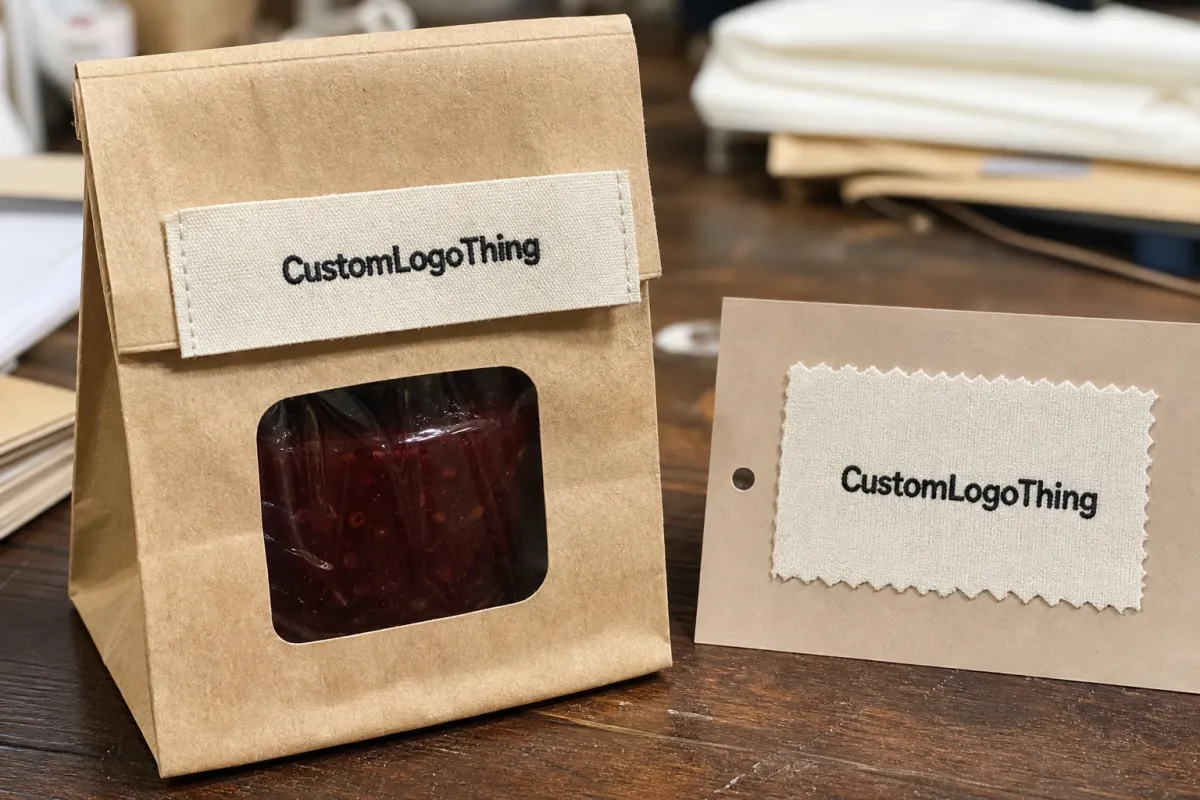
For consumables such as jam, honey, baked goods, herbal blends, or soap, woven branding usually belongs on the reusable part of the package, not the throwaway part. Put it on the bag, wrap, topper, pouch, or gift set component that stays with the buyer. That is where the branding earns its keep.
A good rule: if the item is part of a wider product line, keep the label design consistent across the line. Seasonal inventory feels more organized when the label system stays steady, even if the products change month to month.
| Option | Typical Cost Per Piece | Best For | Tradeoff |
|---|---|---|---|
| Paper hang tag | $0.03-$0.12 | Low-cost, disposable branding | Cheapest, but weakest durability |
| Printed satin label | $0.06-$0.22 | Small text, care details, softer look | Better detail, less texture |
| Woven label | $0.08-$0.90 | Reusable goods, premium finishing | Higher setup and MOQ pressure |
| Woven patch | $0.18-$1.20 | Bags, aprons, outer branding | More visible, usually higher unit cost |
Woven Labels Unit Cost for Farmers Market Sellers: Real Ranges
The honest answer is that Woven Labels Unit Cost for Farmers Market Sellers depends on size, fold type, thread colors, quantity, finish, attachment method, and whether the artwork is ready for production. Buyers like simple numbers. Suppliers price from variables. That tension is not glamorous, but it is real.
For larger quantities, simple woven labels often land around $0.08-$0.25 each. Smaller trial runs can sit closer to $0.35-$0.90 each, especially once tooling fees, setup charges, sampling, and minimum order rules enter the calculation. Custom patches, metallic thread, dense weaving, heat-seal backing, merrowed borders, and oversized shapes can push the cost higher.
MOQ matters. Many custom woven label orders start around 100-500 pieces, but stronger bulk pricing usually appears at 500, 1,000, or 2,500 pieces. Ordering 50 labels sounds harmless until the setup cost eats half the order. That is how tiny budgets turn expensive fast.
The real buying question is not only the unit cost. It is whether the label improves perceived value enough to justify the spend. If a $0.20 label helps a $14 item feel like a $17 item, the math is not subtle. Even if only part of that perceived value turns into higher pricing or faster sell-through, the label may be doing useful work.
Ask for quotes at multiple quantities. A 300-piece order may protect cash flow. A 1,000-piece order may drop the cost per piece enough to make more sense over a full season. Both can be right. The answer depends on how fast you sell, how many products can use the same label, and whether the design will still feel current six months from now.
“A label is expensive only when it is doing nothing for the product. On a reusable item, a decent woven label can pay for itself faster than most sellers expect.”
Here is a practical way to think about it. If you sell 40 reusable produce bags every weekend for a 20-week season, you need 800 labels before counting damaged items, samples, wholesale orders, or holiday bundles. In that case, a 1,000-piece order may be sensible. If you sell a limited run of 75 lavender sachet sets for one event, a smaller order or a printed label may be the cleaner choice.
Do not compare only the cheapest quoted unit price. Compare total landed cost: setup, sampling, shipping, taxes or duties if applicable, and any charge for backing, folding, cutting, or packaging. A $0.14 label can become less attractive if the order carries high fixed fees and long freight timing. A $0.22 label from a simpler production path may be the better buy for a seller who needs the goods before market season starts.
When you request pricing, send the size, quantity, fold style, number of thread colors, attachment method, artwork file, and deadline. If any of that is vague, the quote will be vague too. No mystery there.
Specs That Change Price, Feel, and Durability
Size changes price, and it changes legibility. A tiny label is cheaper, but if the logo turns into a smudge of thread, you did not save money. You bought unreadable branding. Common practical sizes include 0.5 x 1.5 inches for side seams, 1 x 2 inches for fold-over branding, and larger patch sizes for bags, aprons, and outer-facing applications.
Fold type affects both labor and appearance. A straight cut label works for flat application. An end fold is useful when the label is sewn down at both ends. A center fold works for hems and edges. A Manhattan fold gives a more apparel-style finish. A loop fold suits hanging applications. The best option depends on how the product is built, not on whatever looked expensive in a sample book.
Density matters too. Higher woven density captures more detail and smoother curves, but it increases cost. For many farmers market brands, standard density is enough if the logo is bold and the text is short. If your design depends on thin script or tiny flourishes, the price starts rising while readability drops. That is a bad trade unless the look is central to the brand.
Thread colors are another lever. Fewer colors usually mean lower cost and cleaner production. Most small sellers do well with 1-3 colors. A watercolor logo or tiny gradient is not a woven label problem. It is an artwork problem. Shocking, I know.
Material choice changes the hand feel. Damask is soft, detailed, and common for higher-quality woven labels. Taffeta is more budget-friendly, with a slightly crisper and less refined feel. Satin can look smooth and polished, though it may not suit rustic, farm, cottage, or botanical brands as well as a matte woven finish. If the product is washed, handled, or reused often, ask about wash resistance, edge fray, thread stability, and the best attachment method.
Backings deserve a separate look. Sew-on labels are the default for textiles and usually the most durable. Heat-seal backing can help with patches or certain fabric applications, but it depends on the base material, press settings, adhesive quality, and wash expectations. Peel-and-stick backing is convenient for short-term use, displays, or non-washable packaging, but it is not a substitute for sewing on items that will be laundered.
Edges matter more than people expect. Hot-cut edges can feel slightly firm. Ultrasonic cutting can reduce fraying on synthetic materials. Merrowed borders add a patch-like edge and more visual weight, but they also add cost and bulk. For a folded seam label, that bulk may be irritating. For a canvas tote patch, it may be exactly the point.
For brands that care about certified materials and shipping performance, ask whether the supplier can support FSC-related paper inserts or packaging components through a partner program, and review shipping or durability expectations using references such as ISTA or broader packaging education from the Packaging School / packaging.org. Those resources will not choose the label for you. They do help keep the conversation tied to performance rather than wishful thinking.
Artwork Prep: Keep the Logo Simple or Pay for the Mess
Woven labels do not print artwork. They translate it into thread. Fine lines, shadows, gradients, tiny text, distressed effects, and overly detailed illustrations can vanish or turn muddy. A logo that looks sharp on a website header can become a fuzzy disappointment on a 1-inch label.
The best files are vector formats such as AI, EPS, or a clean production-ready PDF. A high-resolution PNG can work for quoting, but production usually wants vector art. The cleaner the file, the fewer revisions you need. Yes, that saves time.
Use bold text. Avoid lettering below roughly 5-6 points, depending on label size and weave density. Simplify icons. Keep contrast high. If the logo cannot survive being reduced to thread, it is too fussy for the application.
Farmers market brands often look better with restrained color use and clear typography than with decorative chaos. Rustic, organic, handmade, herbal, bakery, and cottage-style brands usually win on clarity. The product already has charm. The label does not need to audition for a painting show.
A digital proof checks layout, size, fold, color placement, and sewing allowance. It is not the same as seeing thread in your hand. A physical sample is worth asking for if exact texture, color, or legibility matters. That is especially true for tiny text, multi-color logos, patch-style construction, or labels that will be used on wholesale products.
If the order is for a small market launch, a proof alone may be enough. If the order supports retail shelves, premium gifting, or a line that will be reordered for years, sample first. The sample cost is usually easier to absorb than discovering too late that the cream thread disappears against a natural linen pouch.
Common mistakes are painfully predictable: using the same logo file from a website header, cramming an address and slogan onto a tiny tag, choosing beige thread on cream fabric, or approving a proof without checking the fold allowance. Buyers are not solving a puzzle at your table. Neither is the person sewing 500 labels the night before a market.
Production Process and Timeline from Quote to Delivery
The buying process is straightforward when the information is clean. Send specs and artwork, receive a quote, approve pricing, review the digital proof, approve a sample if needed, begin weaving, then cut, fold, finish, inspect, pack, and ship. That is the normal path. The delays usually come from missing details, not from the loom suddenly becoming philosophical.
For planning, quoting can take 1-2 business days if the specs are complete. Proofing usually takes 1-3 business days. Standard production often runs about 10-18 business days after proof approval, then shipping time gets added. Rush service may be available, but it costs more and depends on capacity.
There are a handful of things that slow orders down: missing size details, unclear fold type, low-resolution artwork, late proof approval, thread color changes after pricing, quantity changes after the quote is sent, and uncertainty about attachment method. Any one of those can extend the timeline and change the cost.
Seasonal planning matters. Spring market openings, holiday gift season, harvest events, and craft fairs all push production schedules harder than people expect. If you need labels for a launch, order at least 3-4 weeks ahead whenever possible. If the design needs sampling, build in more room.
Also leave time for application. A finished label sitting in a box is not yet on a product. Sewing labels into 300 pouches, heat applying patches to 150 bags, or tying loop labels onto gift bundles takes labor. That labor may be yours, a contractor’s, or someone on your team. It still belongs in the plan.
For sellers who care about packaging sustainability, check whether the supplier offers recyclable inserts, FSC-related paper components, or reduced-waste packing for the label shipment itself. Even when the woven label is the main feature, the shipment should not arrive wrapped like a birthday prank.
Quality-Control Checks Before You Attach 500 Labels
Do not open the box and immediately start sewing. Check the labels first. A few minutes at this stage can save hours of repair work and a surprising amount of irritation.
Start with the basics: count, size, fold, color, and spelling. Compare the finished label against the approved proof. Thread colors may not match a screen perfectly, but they should make sense against the approved direction. If the logo name is wrong, the fold is reversed, or the sewing allowance is too narrow, stop before application.
Check legibility from a realistic viewing distance. A label may look acceptable under bright desk light and still fail on a shaded market table. Look at it on the actual product fabric, jar wrap, pouch, or bag. Contrast behaves differently on linen, kraft paper, canvas, muslin, and patterned fabric.
Inspect the edges. Look for fraying, hard corners, inconsistent cuts, loose threads, uneven folds, or adhesive backing that lifts before use. A few loose fibers can be trimmed. A batch-wide construction problem should be documented before the labels are applied.
If the item will be washed, test one label on the actual material before committing the full batch. For sewn labels, check whether the corners curl or irritate the product finish. For heat-seal patches, test press temperature, pressure, dwell time, and cooling. Adhesives can fail for boring reasons: fabric finish, waxy coatings, moisture, and insufficient pressure are regular offenders.
Keep a small number of labels aside from each order. They are useful for reorders, product photography, wholesale samples, and troubleshooting if a future batch looks different. Boring operational habit. Very useful.
How Custom Logo Things Helps Small Sellers Buy the Right Quantity
Custom Logo Things helps sellers make a practical choice, not a dramatic one. The point is to match label construction and quantity to how the product is used, handled, priced, and sold. If your item is washed often or moved through gift packaging, the label choice should reflect that. If it is a short-run seasonal item, the order should reflect that too.
That starts with comparing label types, fold options, sizes, backing choices, and quantities before anyone commits to a drawer full of tags. The review should look at the actual use case, not just the logo file. A side-seam label for a tea towel, a patch for a canvas tote, and a loop label for a honey gift bundle are not the same purchase.
Quantity breaks matter here. Seeing the difference between 300, 500, 1,000, and 2,500 pieces can clarify whether bulk pricing is worth the cash outlay. Sometimes the 1,000-piece price is obviously better. Sometimes a smaller order protects you from stale branding, seasonal changes, or a product line that has not proven itself yet.
Good quoting is not magic. It is spec review, artwork feedback, proofing, and a straight look at cost per piece. Sellers should be able to see what is driving the price: size, weave density, folds, thread colors, backing, edge finish, sampling, or freight.
Quality checks matter, too. Legibility, color contrast, edge finish, fold accuracy, backing performance, and packaging for easy counting all affect the seller’s experience. A label can be visually attractive and still be annoying to apply if the fold is inconsistent or the stack arrives mixed.
For farmers market sellers, cottage food brands, handmade textile makers, apothecary brands, and small retail shops, the goal is a polished finish without overbuilding the packaging system. If the woven label, hang tag, and outer package need to work together, connect the decision with Custom Labels & Tags so the parts do not fight each other. A clean system beats random pieces. Every time.
Next Steps: Get a Quote Without the Back-and-Forth Circus
If you want a fast and accurate quote, send the basics up front: desired label size, estimated quantity, product use, fold type if known, number of colors, logo file, deadline, shipping location, and whether the labels will be sewn, heat applied, stuck on, or used as patches. That is the shortest path from question to price.
If you sell more than one product line, start with one versatile design that can move across the range. A neutral woven label can work on pouches, bags, wraps, aprons, napkins, and gift bundles. That is usually smarter than ordering a separate label for every SKU and then wondering why the supply drawer looks like a museum of abandoned ideas.
Ask for two or three quantity breaks. It gives you a real view of unit cost, setup charges, and the difference between tight inventory control and paying more than necessary per piece. Sometimes the smallest order is the right order. Sometimes the better number is slightly higher than your first instinct.
Put your market dates, launch deadlines, wholesale meetings, and holiday events in the first message. Production planning works better when nobody is pretending custom woven labels appear out of thin air.
For an accurate Woven Labels Unit Cost for farmers market sellers, send your specs, artwork, quantity target, and timeline. Clean inputs produce clean pricing. Everything else is guesswork with a nicer font.
FAQ
What is a typical woven label unit cost for farmers market products?
Many custom woven labels fall around $0.08-$0.25 each at larger quantities, while smaller runs can be closer to $0.35-$0.90 each. Size, fold, colors, backing, setup, sampling, and shipping all affect the final number. Request pricing at several quantities, such as 300, 500, 1,000, and 2,500 pieces.
What MOQ should farmers market sellers expect for woven labels?
Common MOQs often start around 100-500 pieces, but the best unit cost usually begins at 500 pieces and improves at 1,000 pieces or more. If cash flow is tight, use one versatile design across several products instead of ordering separate labels for every SKU.
Are woven labels better than printed labels for handmade market goods?
Woven labels are better for durability, texture, and premium presentation, especially on reusable bags, textiles, pouches, wraps, and giftable items. Printed labels are better for tiny details, ingredient lists, barcodes, regulatory copy, or very low-cost disposable packaging.
How long does custom woven label production take?
A typical order may take about 10-18 business days after proof approval, plus shipping time. Proofing, artwork changes, sampling, rush needs, and seasonal volume can affect the final schedule. If labels must be attached before a market or wholesale delivery, include that application time in your planning.
What artwork works best for affordable woven labels?
Simple vector artwork with bold text, clean lines, strong contrast, and 1-3 thread colors usually gives the best balance of legibility and cost. Avoid gradients, tiny lettering, thin script fonts, distressed effects, and detailed illustrations unless you are willing to simplify the design or increase the label size.
Should I choose sew-on, heat-seal, or adhesive woven labels?
Sew-on labels are usually best for textiles and washable goods. Heat-seal backing can work for patches and some fabric products if tested with the correct temperature, pressure, and dwell time. Adhesive backing is convenient for short-term packaging or display use, but it is not the right choice for items that will be washed or heavily handled.