A necklace box can look polished on the shelf, but a loose, fuzzy, or unreadable label quietly pulls down the perceived value. That is why buyers keep searching for Woven Labels Unit Cost for jewelry: the label is small, yet it shapes the way customers judge a $30 gift item, an $80 everyday piece, or a $300 premium line. For brands with tight margins, every packaging add-on has to earn its place.
The right label does three jobs at once. It identifies the brand, supports SKU control, and gives the unboxing experience a cleaner finish. The cheapest quote is not always the smartest buy. A better lens is straightforward: presentation, durability, and unit economics need to line up.
Why jewelry brands buy woven labels before the package arrives
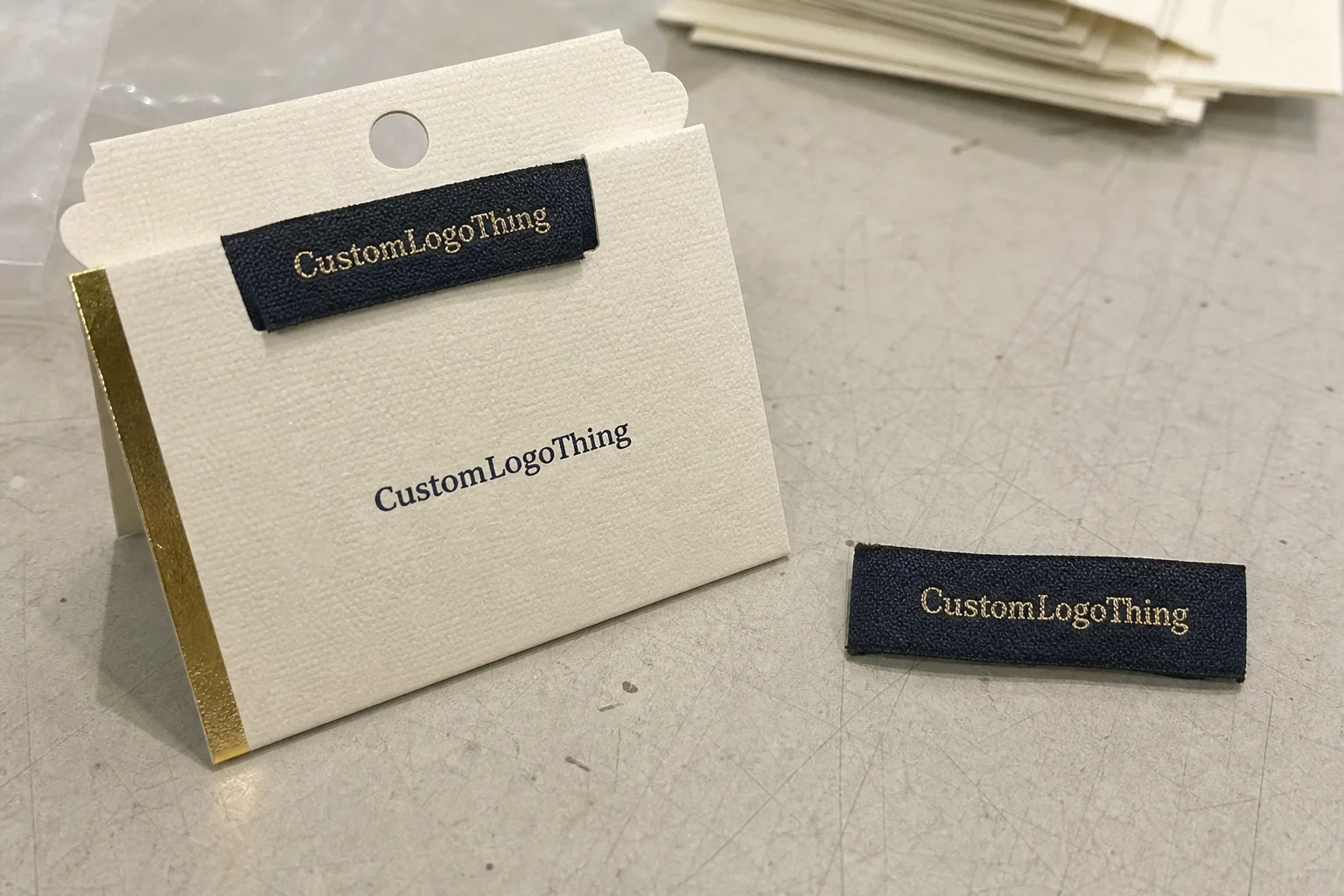
Jewelry packaging lives close to the customer’s first impression. A rigid box, velvet pouch, or paper insert can feel premium, but if the label looks generic or hard to read, the presentation loses authority. That matters more than many buyers expect. People often remember the smallest details because the product itself is small.
Woven labels help jewelry makers, gift-box suppliers, and direct-to-consumer brands create a consistent look across collections. They also help organize variants. One label can separate sterling silver from plated metal, bridal from fashion, or core collection from seasonal release. From a packaging buyer’s point of view, that is not decoration. It is operational clarity.
The reason the Woven Labels Unit Cost for jewelry gets so much attention is simple: these brands often order in smaller runs. A capsule launch may need only a few hundred pieces. A single low-MOQ run can protect cash flow, but it also means the cost per piece has to make sense against product margin. A label that costs pennies may still influence how a customer evaluates a jewelry item priced at ten times that amount.
Practical rule: if the label improves perceived value, supports reorders, and survives handling, it is doing real work. If it only looks cheap on paper, the savings are questionable.
Some buyers focus only on the opening quote. Better buyers compare what the quote includes, how the label will appear in photographs, and whether it still looks right after shipping, shelf handling, and customer unboxing. That broader view usually reveals where the real value sits.
Woven label styles, sizes, and finishing details for jewelry
Jewelry labels are usually smaller and more presentation-driven than apparel labels. The same woven structure can be used, but the purpose shifts. Instead of sizing or garment care only, the label may reinforce brand identity, material verification, or a premium gift feel.
Common constructions include damask, satin, and taffeta. Damask gives the best detail resolution, so it is often the first choice when a logo has fine lettering or thin strokes. Satin feels smoother and can look more elegant in small applications. Taffeta is usually the more economical option, but it is less refined visually. If the design is tiny, weave detail matters more than the word “custom” on the quote sheet.
Finishing options matter too. Edge-fold, center-fold, end-fold, and cut-and-seal each change how the label attaches and how it sits against the package. For jewelry boxes and pouches, the fold type often matters as much as the artwork. A flat cut-and-seal label can work on a rigid box insert, while an edge-fold label may be better for a pouch seam or hanging loop.
Size is where many designs get compromised. A jewelry label may need to fit a 20 mm by 30 mm space, or even smaller if it is attached to a card or pouch. That size constraint forces cleaner artwork. Fine patterns, gradients, and small legal text can disappear in production if the weave count is too low. If the logo cannot be read at arm’s length, it is probably too busy for the format.
- For necklace cards: keep text short and logo-first.
- For bracelet inserts: prioritize legibility and a balanced layout.
- For pouches: choose a softer finish that feels appropriate to the product.
- For gift boxes: use the label to reinforce the brand mark, not crowd it.
In practice, the best woven labels for jewelry are often the simplest ones. High-contrast colors, clean edges, and a single focal point usually outperform dense artwork that looks impressive on screen but loses clarity in production.
Specifications that change the final label quote
The final quote depends on a handful of variables, and buyers can usually control most of them. The biggest drivers are label width and height, number of colors, weave density, fold style, and quantity. Change one of those and the unit cost can shift noticeably.
Artwork complexity is another major factor. Tiny type, thin lines, and layered symbols can increase production difficulty. Sometimes the issue is not that the design is impossible. It is that the design is too small for the weave structure to reproduce cleanly. A good supplier will tell you when a logo needs simplification before the order is placed.
Material and durability choices also influence price. Jewelry packaging labels often do not need the same abrasion resistance as garment labels, but they may still need to survive repeated handling, storage, and shipping. If the label is used on textile pouches, a softer satin weave can feel more appropriate. If it will be touched often or packed tightly with inserts, durability becomes more important than a glossy look.
For buyers comparing quote quality, ask exactly what is included. Some suppliers build setup charges into the piece price. Others list them separately. In a quote review, that difference matters. The lowest line item can hide the highest total if tooling fees, proofing, and packing are added later.
| Specification | Typical impact on quote | Buyer takeaway |
|---|---|---|
| Smaller label size | Can raise cost if detail must be preserved | Simplify artwork early |
| More weave colors | Usually increases production complexity | Limit colors where possible |
| Damask construction | Higher than basic taffeta | Use when logo clarity matters |
| Special fold or cut | May add setup or finishing cost | Choose only if needed for application |
| Lower MOQ | Raises cost per piece | Useful for testing a new collection |
Artwork files also affect lead time. Clean vector files, clear dimensions, and a note on intended use reduce back-and-forth. A quote for Woven Labels Unit Cost for jewelry is only as accurate as the inputs you send. If the supplier has to guess size or fold style, the quote becomes less useful.
For brands that want consistency across printed packaging and textile details, it can help to review Custom Labels & Tags alongside the woven format. The point is not to buy more. It is to match the label structure to the package surface, the brand tone, and the order volume.
When quality control matters, standards thinking helps. Packaging buyers often look at shipping durability for external packs, then adapt that same discipline to labels and inserts. Resources from ISTA are useful for understanding how packaged goods are handled in transit, while FSC matters when printed inserts or board components are part of the package system. Different parts of the pack fail in different ways.
Woven labels unit cost for jewelry: pricing, MOQ, and savings
Here is the core pricing logic: as quantity rises, the setup burden gets spread over more labels. That is why bulk pricing usually lowers the cost per piece. The relationship is not perfectly linear, but it is predictable enough to plan around.
For small jewelry brands, MOQ is a balancing act. A low MOQ reduces inventory risk. That matters when the design may change after one season, or when a new collection is still being tested. The tradeoff is that smaller runs usually carry a higher unit price. A bigger order can improve the unit cost, but it can also leave a buyer with more labels than needed if the product line pivots.
Below is a practical way to think about pricing scenarios. These are general ranges, not promises, because exact numbers depend on artwork, size, fold style, and shipping method.
| Order scenario | Typical MOQ | Typical unit cost range | Best fit |
|---|---|---|---|
| Test run for a new collection | 100-500 pieces | $0.18-$0.42 each | Capsule drops and market tests |
| Standard brand order | 1,000-3,000 pieces | $0.08-$0.20 each | Steady sellers and repeat SKUs |
| Bulk program | 5,000+ pieces | $0.04-$0.12 each | Core lines and wholesale programs |
What should be included in a real quote? At minimum: design review, weaving, finishing, packing, and shipping. Some vendors include sampling in the first order. Others add it as a separate line. If a quote looks unusually low, check for hidden setup charges and ask whether the sample is credited later. That is how buyers avoid false comparisons.
For a jewelry brand, the best quantity is not always the biggest one. It is the one that protects margin and supports the reorder cycle. If a line sells slowly, a lower MOQ may be the smarter choice even with a higher unit cost. If a best-seller moves steadily, bulk pricing can make sense because the labels will be used quickly and consistently.
One useful rule of thumb: if the woven label is a permanent brand element, not a seasonal detail, it deserves a stronger economics review. The first quote should not only answer “what does it cost?” It should also answer “what does this do to my packaging budget per unit?” That question is the real test behind woven labels unit cost for jewelry.
And yes, suppliers differ. Some specialize in lower MOQs. Others are more competitive on larger runs. Ask for two scenarios: a test quantity and a bulk pricing quote. The comparison often reveals the true savings threshold faster than a single quote ever will.
Production steps, timeline, and approval checkpoints
The production workflow is usually more predictable than the pricing. It starts with artwork review, then moves to a digital proof, then sampling or strike-off if needed, then production, finishing, and final inspection. The exact order may vary, but those checkpoints are common.
Delays usually happen in the same places. The logo needs cleanup. The color reference is unclear. The fold style is not specified. Or the buyer is waiting on internal approval while the order sits idle. None of that is unusual. It usually means the project did not have enough front-end detail.
For timing, separate the stages. A proof may be turned around quickly. Mass production often takes longer. Shipping is its own variable. A realistic plan is better than a vague promise. For many woven label orders, buyers should expect several business days for proofing and roughly one to two weeks for production after approval, but that depends on order size and current workload. Rush orders can shorten the schedule, though not always without a price increase.
Rush requests also affect feasibility. If the label needs special colors or a nonstandard fold, the supplier may not be able to compress the timeline safely. That is especially true when the buyer wants a compact label for a delicate jewelry presentation and the artwork still needs adjustments.
To keep the order moving, prepare these items before you ask for a quote:
- Logo file in vector format if available.
- Exact size or the packaging surface it must fit.
- Fold style or attachment method.
- Quantity for both test and repeat use.
- Intended application: box, pouch, insert, or hang tag.
That information reduces revisions and makes the quote more dependable. It also cuts the odds of a label arriving that looks fine on screen but too crowded in real life. For jewelry, scale is everything.
Packaging professionals often borrow a standards mindset from transit and materials testing. If the package will be handled in storage or shipping, the label should hold up to friction and folding. That is one reason to think beyond price and ask about finish quality, trim consistency, and repeatability.
How we support jewelry packaging buyers with consistent output
Consistency is where a supplier proves value. The first run can look great. The second run is the real test. If a reorder drifts in color, size, or edge finish, the packaging system starts to look fragmented. That is especially visible on small items like jewelry labels, where even a minor mismatch stands out on a box or pouch.
Quality control should be practical, not theatrical. Check logo alignment, weave clarity, fold accuracy, and trim consistency. On compact labels, a tiny defect is not tiny. It is visible. That is why dependable output often matters more than chasing the absolute lowest opening price.
Buyers also need responsive quote support. A good team should help compare constructions, explain what changes the woven labels unit cost for jewelry, and recommend the format that works for the packaging surface. If a design is too detailed, it should be simplified before production, not after a failed run.
Service matters in another way too: artwork optimization. Many jewelry brands are using labels inside very small packaging systems, so the design has to fit the product, the card, the pouch, and the photo. A supplier who understands that can help avoid expensive misalignment later.
As a buyer, you want three things from the relationship: consistent reorders, practical proofing, and honest advice on MOQ. If a supplier says a design will not reproduce cleanly, that is a useful answer. It saves time and protects the brand.
Next steps to get the right label quote today
Before requesting a quote, gather five items: logo file, label size, fold style, quantity, and intended use. That alone will make the response more accurate. If you can also send packaging photos or a mockup, even better. The label should be sized to the actual presentation, not an abstract template.
Ask for two pricing scenarios. One should reflect a lower MOQ test run. The other should show bulk pricing for a larger order. That comparison exposes the real savings threshold and helps you decide whether to prioritize cash flow or lower unit cost. For many brands, the right answer is somewhere in the middle.
Before approving production, request a proof and confirm the timing. If the supplier cannot explain setup charges or tooling fees clearly, ask again. Clear quotes are easier to compare, and they reduce internal debate later. That is especially useful if you are managing several packaging components at once.
Most importantly, review the woven labels unit cost for jewelry against margin targets, reorder plans, and presentation goals. A label is small, but it is not minor. In the right format, it supports brand value and keeps packaging consistent across every box, pouch, and insert.
If you are ready to quote, start with the details that matter and keep the specification tight. The smartest purchase is rarely the flashiest one. It is the one that fits the product, the budget, and the next reorder.
FAQs
What affects woven label unit cost for jewelry the most?
Order quantity, label size, weave detail, number of colors, and fold type are the biggest cost drivers. Complex artwork and low-volume runs usually raise the per-piece price.
What is a typical MOQ for custom woven jewelry labels?
MOQ varies by supplier and label construction, but smaller runs are often available at a higher unit cost. Ask for both MOQ pricing and a larger-volume quote to compare true savings.
Can woven labels be made small enough for jewelry boxes and pouches?
Yes, but the logo and text must stay legible at a smaller size. Simpler artwork and higher-contrast colors usually work best on compact labels.
How long does production usually take after artwork approval?
Timing depends on sampling, production load, and shipping method. A proof approval step usually comes before full production begins, so fast responses help reduce total turnaround.
What should I send to get an accurate quote for woven labels for jewelry?
Send your logo file, preferred size, quantity, fold style, color count, and how the label will be used. Including photos of the packaging or jewelry presentation helps refine the quote.


