For apparel buyers, the Woven Labels Unit Cost for apparel is only useful when it is viewed alongside durability, appearance, and the realities of production. A label can be priced a few cents higher and still be the better buy if it holds detail more clearly, feels better against the skin, or reduces rework on the sewing floor. A label that looks cheap but frays, fades, or reads poorly can quietly cost more than a stronger construction ever would.
The better question is not simply, “What is the unit price?” It is, “What does each finished label really cost once setup, finishing, shipping, and defect risk are included?” That broader view matters especially for brands that repeat styles across seasons, because even small differences in trim quality can ripple through garment consistency, packing efficiency, and final presentation at retail.
Woven labels are small components, but they carry a large share of the garment’s first impression. A clean neck label, a sharp side seam tag, or a well-finished brand tab can make a basic product look considered and deliberate. Buyers who know what drives the quote can choose a label that fits the garment rather than forcing the garment to adapt to an underspecified trim order.
Why the lowest label price is not always the lowest cost
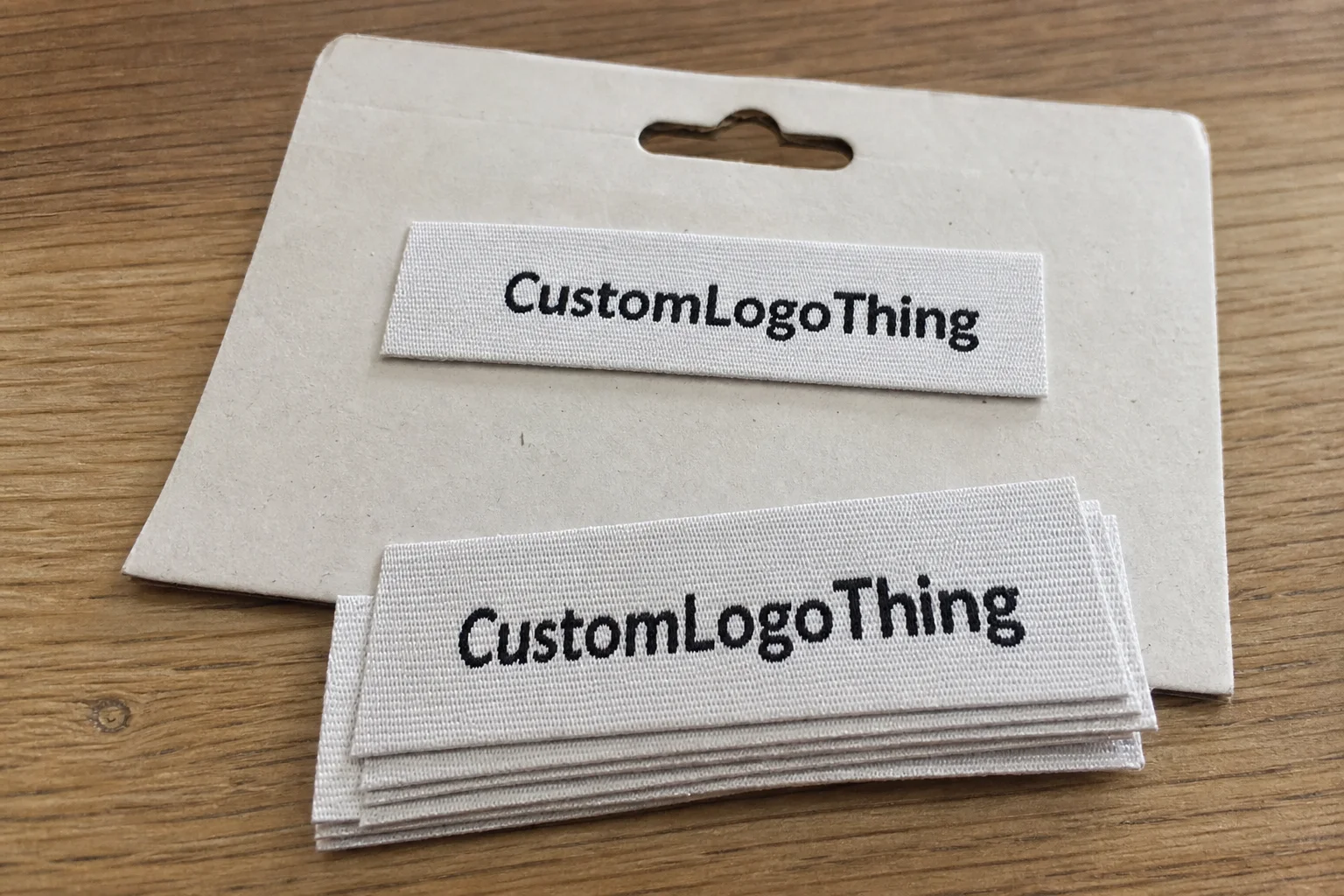
The cheapest line item on a quote is not always the most economical option once production begins. That is especially true with woven labels, where the visible quality of the weave, fold, and edge finish can affect both garment presentation and manufacturing speed. A label that is difficult to sew, hard to read, or inconsistent from one batch to the next can create more expense than a slightly higher-priced label that arrives ready to use.
Buyers often focus on the unit number because it is easy to compare. The problem is that two quotes with the same headline price can behave very differently in practice. One may include a standard fold and clear proofing, while another may charge separately for packing, revisions, or a minimum run that only becomes visible later. The real spend is the sum of the label, the setup, the handling, the freight, and the time lost if the trim does not meet the garment spec.
There is also the matter of garment value. A premium hoodie, outerwear piece, or specialty activewear item can usually justify a more refined woven label because the trim supports the product’s price point. A lower-cost basic tee may not need the same level of detail, but it still needs a label that survives wear and washing without becoming a weak point in the build.
“A low label quote can be expensive if it causes unreadable text, extra sewing time, or rework after inspection. The better number is the one that holds up through production and wear.”
That is why experienced buyers compare more than unit price. They look at proof quality, finishing consistency, sampling behavior, and the way the label will function on the garment line. A trim that saves ten minutes across a large order is worth more than a low initial quote that creates friction every time it reaches a sewing station.
Woven label options that shift the quote
Construction has a direct effect on pricing, and small changes in specification can move the final quote more than many buyers expect. Damask labels are common in apparel because they support fine detail and crisp lettering, especially when the artwork includes small type or tight line work. Satin woven labels offer a smoother face and softer hand, which makes them appealing for garments that touch skin more often. Taffeta is usually the more economical choice and can work well for straightforward branding where the artwork does not require extra definition.
Fold style is another practical cost driver. Straight cut labels are typically simpler to produce, but they may require more careful sewing or edge handling during garment assembly. End fold and center fold styles add finishing steps, which can raise the unit number while improving appearance and making application cleaner. Book folds are useful for neck labels because they conceal raw edges and create a neat presentation, though they are not the best choice for every placement.
Thread density matters as much as weave type. A dense weave can preserve small letters, narrow borders, and subtle shapes, but it also takes more time and precision to produce. If the art is simple, the label can often be woven with fewer variables and at a lower cost. If the logo includes tiny text, multiple lines, or narrow spacing, the supplier may need to increase the weave count to keep the artwork legible once it is reduced to finished size.
Placement changes the economics as well. Neck labels, side seam labels, hem labels, and external brand tabs each have different requirements for size, fold, and sewing method. A label may look inexpensive in isolation, but if the artwork is too detailed for the intended size, the supplier may need to enlarge it, simplify it, or shift to a different weave structure. That can change both the quote and the approval timeline.
| Label Type | Typical Use | Cost Impact | Buyer Note |
|---|---|---|---|
| Damask | Detailed branding, finer text, premium apparel | Moderate to higher | Usually the best choice for sharp detail |
| Satin | Soft-touch garments, fashion basics, skin-contact pieces | Moderate | Comfortable hand feel, softer visual finish |
| Taffeta | Cost-sensitive runs, simple logos, basic trims | Lower | Good when the artwork is uncomplicated |
| Folded label | Neck labels, seam labels, presentation-focused branding | Higher than straight cut | Finishing adds labor and cleaner appearance |
| Straight cut | Flat applications, exterior branding, simple attachment | Lower | May need more careful sewing or edge treatment |
Garment category should guide the choice, not just the budget. Activewear and workwear usually need higher durability and clearer readability than fashion pieces that are worn less aggressively. For premium or highly branded lines, the label is not a minor afterthought; it is part of the product’s finish, and buyers often recover the added cost through better presentation and fewer problems during production.
Specs to confirm before requesting pricing
Accurate pricing depends on complete information. The clearest quotes come from buyers who provide finished size, fold type, weave style, thread colors, background color, and any edge or backing requirements. If one of those details is missing, the supplier has to make an assumption, and assumptions usually lead to revisions or unexpected add-ons later.
Artwork quality matters just as much as the written spec. Vector files are easier to evaluate because they show line weight, spacing, and shape clearly. Raster files can work as reference material, but they often need rebuilding before weaving. That is where many delays begin: small text that looked fine in a presentation file turns into unreadable detail once the label is reduced to its actual size.
Compliance details should be shared early. If the label will carry fiber content, care symbols, or country-of-origin information, the supplier needs that upfront so the layout can be checked before production. Buyers should also indicate whether the label sits directly against skin, since comfort can affect the material choice and finish. A neck label that feels harsh on a screen mockup may be a real problem once it is sewn into a garment.
The most useful pre-quote information is the kind that removes guesswork. A buyer does not need to over-explain the program, but the quote should be based on a complete set of production facts, not a rough sketch. That is how teams avoid price drift later.
- Finished size in millimeters or inches
- Fold type or straight cut requirement
- Artwork file, preferably vector
- Number of thread colors
- Application method such as sew-in or adhesive backing
- Label placement on the garment
- Wash durability expectations
The cleaner the spec package, the closer the quote will be to the final spend. It also makes it easier to compare suppliers on an equal basis, which is essential if the goal is to understand the real woven Labels Unit Cost for apparel rather than a misleading headline number. When trim programs include several SKUs, even small inconsistencies can make comparisons meaningless.
Woven labels unit cost for apparel: what drives pricing, MOQ, and landed cost
Quantity remains one of the strongest pricing levers. As order size rises, setup charges and loom preparation are spread across more pieces, which lowers the per-label figure. A 1,000-piece order will almost always carry a higher unit cost than a 10,000-piece order with the same artwork, because the fixed work at the front of the job is being absorbed by far fewer units.
MOQ exists because woven labels require preparation before the first finished piece can be produced. The supplier has to review artwork, confirm colors, create the weave plan, set up production, and then finish the labels in the requested fold or cut. Smaller orders can still be worthwhile, but they usually carry a more expensive unit cost because those fixed tasks are divided across a limited quantity.
Several variables tend to move the quote in predictable ways: size, weave density, color count, fold style, backing, and packing preferences. A one-color straight-cut label is generally cheaper than a multi-color folded label with a soft finish, special backing, and individually packed units. Each added requirement creates more handling, more inspection, or more production time.
For buyers who need a practical benchmark, the market often behaves like this, though supplier structure and region can shift the numbers:
| Order Size | Simple Design | Detailed Design | Buyer Observation |
|---|---|---|---|
| 500-1,000 pcs | Higher unit cost | Highest unit cost | Setup charges weigh heavily |
| 2,000-5,000 pcs | Moderate unit cost | Moderate to higher | Often the most workable range for growing brands |
| 10,000+ pcs | Lower unit cost | Lower than smaller runs | Best for repeat programs and core styles |
Unit price alone is not enough. A buying decision should be based on landed cost, which includes freight, packing, any sample charges, and the effect of order timing. The label price can look attractive until shipping is added. That is especially true for smaller orders, where freight can take up a larger share of the final total than the trim itself.
Rush production can raise the Woven Labels Unit Cost for apparel even when the artwork is simple. Split deliveries can do the same, because one order divided into multiple shipping dates or destinations creates more handling and more risk. If the labels are tied to a launch or replenishment cycle, build in enough time to avoid expedited freight unless the timeline is truly fixed.
Production steps and lead time
Most woven label orders follow a familiar sequence: inquiry, spec review, artwork check, proof, approval, weaving, cutting or folding, inspection, and packing. Each step is straightforward on paper, but timing depends on how complete the buyer’s information is and how quickly approvals move. A clean file and a complete spec sheet can save days; a vague brief can add them back immediately.
Lead time is influenced by design complexity as much as by quantity. Simple labels generally move faster than labels with multiple colors, specialty folds, or fine text that needs extra review. If the supplier has to reconstruct artwork or clarify tiny details, the schedule usually stretches. That is why final copy should be settled before proof approval, not after the order is already in motion.
Shipping time matters too. A label order is often small compared with the garment shipment, but it still has to arrive in time for production. Domestic and overseas transit follow different timelines, and the right option depends on urgency, order size, and margin. For a replenishment program, a short delay can matter just as much as a production delay if the labels are needed for cutting or sewing on schedule.
Quality control should not stop at the proof. Buyers who care about consistency usually check finished sample photos or request a physical sample when color accuracy, hand feel, or small type is important. If the artwork includes delicate text, the sample stage is where the buyer can catch a problem before a full run is committed.
One practical discipline helps more than most people expect: consolidate all changes before approval. Every revision can add time, recheck effort, or partial reset of the workflow. Once the proof is approved, the order should move forward with as few changes as possible. That protects both schedule and the final Woven Labels Unit Cost for apparel, since time overruns often turn into cost overruns.
Transit quality also deserves attention. Labels are small, but they still need packing that prevents deformation, contamination, or moisture issues during shipment. Packaging standards from organizations such as the International Safe Transit Association and the ASTM framework can be useful references for buyers thinking about material performance and shipping durability. A tiny component can still be damaged if it is packed carelessly.
How to evaluate a supplier for consistency and margin control
A low quote is only valuable if the supplier can reproduce the result across the full order and, ideally, across future runs. Consistency is the part of the job that protects margin over time. If the label varies in width, shade, fold accuracy, or text clarity from batch to batch, the trim program becomes harder to manage and the garment line loses predictability.
Good suppliers tend to be specific. They call out size limits for small text, warn when a design will lose detail at the finished dimension, and explain how a fold or backing choice will change the price. That kind of precision is often more useful than broad promises. It shows that the supplier understands the limits of woven construction and is willing to flag a problem before it reaches production.
Samples are worth considering whenever color fidelity or hand feel matters. A screen can hide subtle differences in weave density and brightness, and a PDF can make a label seem more refined than it will appear in the hand. If the product is going to sit close to skin or carry a premium brand position, a sample can prevent an expensive mistake.
Communication around packing, corrections, and shipping should be direct. If a supplier is vague about setup charges, proof timing, or carton counts, that is a sign the final invoice may not be as clean as it first appears. On the other hand, a supplier that explains revisions clearly and keeps the production steps visible is usually easier to work with on repeat orders.
If sustainability requirements are part of the program, buyers may also need to ask about packaging materials and any paper-based components around the trim order. Certification paths such as FSC can matter when cartons, inserts, or outer packaging are part of the procurement scope. The woven label itself is textile-based, but the supporting materials still affect the purchase decision.
In practical terms, the best supplier is the one that reduces uncertainty. That means a cleaner proof, a clearer lead time, and a quote that reflects the real work required to deliver a label that fits the garment.
Ordering without overpaying
Before requesting pricing, gather the information that actually changes the job: size, fold, artwork, quantity, and application method. With those five pieces in place, a supplier can produce a quote that is comparable to other offers and useful for buying decisions. Without them, the number is only a placeholder.
Ask for both unit price and landed price. The unit price tells you what the label costs in isolation, but the landed price shows what it will cost to receive and use it. Freight, packing, sample charges, and any special handling can alter the outcome enough that the cheapest quote on paper is not the cheapest order in practice.
Check legibility at actual size before approving. This is where many woven label projects go wrong. Small lettering, care details, and tight borders can lose clarity once they are translated into thread. If the artwork is difficult to read at the intended size on screen, it will be harder to reproduce in the weave. Simplifying the design can improve both visual clarity and the final woven labels unit cost for apparel.
Leave a small buffer if the label supports an ongoing production run or a replacement need. A modest overage is often cheaper than a rush reorder, and emergency freight can erase any savings from ordering too tightly. For programs with multiple sizes or colorways, a little extra quantity is usually the safer choice.
Standardizing the order path across trims also helps. It makes approvals easier, keeps pricing comparisons cleaner, and reduces the chance of last-minute changes. For teams that manage several SKUs at once, that operational clarity can matter as much as the quote itself.
Buying woven labels well is usually a matter of asking the right questions early and comparing the full cost, not the headline number alone. If the specs are clear, the proof is accurate, and the timeline is realistic, the label becomes a controlled part of the garment cost rather than a source of surprise.
What affects woven labels unit cost for apparel the most?
The biggest drivers are quantity, size, weave complexity, number of colors, fold style, and any special backing or packing requirement. Smaller orders usually have a higher unit cost because setup is spread over fewer pieces.
What is a typical MOQ for custom woven apparel labels?
MOQ varies by supplier and construction, but it is usually set to cover loom setup, proofing, and efficient production. Lower quantities are possible, though they often come with a higher per-piece price and fewer finishing options.
How long does it take to produce custom woven labels?
Lead time depends on proof approval, quantity, and finishing requirements. Simple labels are faster to produce, while detailed artwork, specialty folds, and rush requests can extend the schedule.
Do woven label samples usually cost extra before production?
Some suppliers charge for samples, while others apply that cost toward the final order. Sampling is especially useful when color matching, hand feel, or small text clarity matters.
How do I get an accurate quote for woven labels for apparel?
Provide finished size, artwork file, fold type, quantity, and the intended placement on the garment. Ask for a full cost breakdown so you can compare unit price, setup, shipping, and any handling charges before approving the order.


