An acrylic winter hats wholesale supplier for trade show buyers has one job: deliver hats that are warm enough to wear, simple enough to brand, and affordable enough to hand out without regret. That sounds basic because it is. Trade show merchandise rarely succeeds by being clever. It succeeds when the item gets used the same day, survives the trip home, and still looks decent after a week of wear.
The best giveaway is the one that leaves the hall on someone’s head, not the one that looks good in a mockup.
Acrylic stays in the mix because it handles volume well. It knits predictably, holds embroidery cleanly, and costs less than most premium winter fibers. For event teams working with deadlines and freight limits, that combination matters more than romance about materials.
If the goal is to support staff, warm up booth traffic, or give attendees something they will keep, the brief should start with utility. Decoration comes second. Color comes third. That order saves money and usually produces a better hat.
Acrylic winter hats wholesale supplier for trade show buyers: what actually works
The right beanie for a trade show has to do several things at once. It needs enough warmth to feel useful, enough structure to show a logo clearly, and enough durability to survive a packed tote bag, a taxi ride, or a compressed carton at the receiving dock. Acrylic does that well enough for most event programs, which is why it keeps showing up in wholesale orders.
From a buyer’s perspective, the appeal is not mystery. Acrylic is available in many yarn weights, it accepts decoration methods that make sense at scale, and it is easy to price against cotton, wool, or blends that raise the bill quickly. For a large booth team, a winter roadshow, or a seasonal giveaway, those differences are not minor.
There is also a practical visibility issue. People wear what feels comfortable and uncomplicated. A clean cuffed acrylic beanie with a decent logo is far more likely to get worn than a novelty item that tries too hard. That wear time is where the value sits. One wearer at the show can become ten impressions on the commute, in a hotel lobby, or at the airport gate.
Event buyers usually care about three things: freight weight, branding area, and repeatability. Acrylic scores reasonably well in all three. It is light, it gives you a stable surface for embroidery or a patch, and it can be reordered without starting from scratch if the supplier keeps the original spec on file.
Useful beats flashy, especially on the show floor. A hat that fits, keeps shape, and displays the logo clearly will do more for a program than a fashionable style that looks great in a presentation and awkward on actual heads.
Product details that make a trade show beanie worth handing out
Most bad orders start with a vague request. “We need a beanie” leaves too much open. Style, gauge, cuff height, hand feel, and decoration method all affect how the final piece performs. For trade show buying, that detail matters because the audience is broad and the use case is rough.
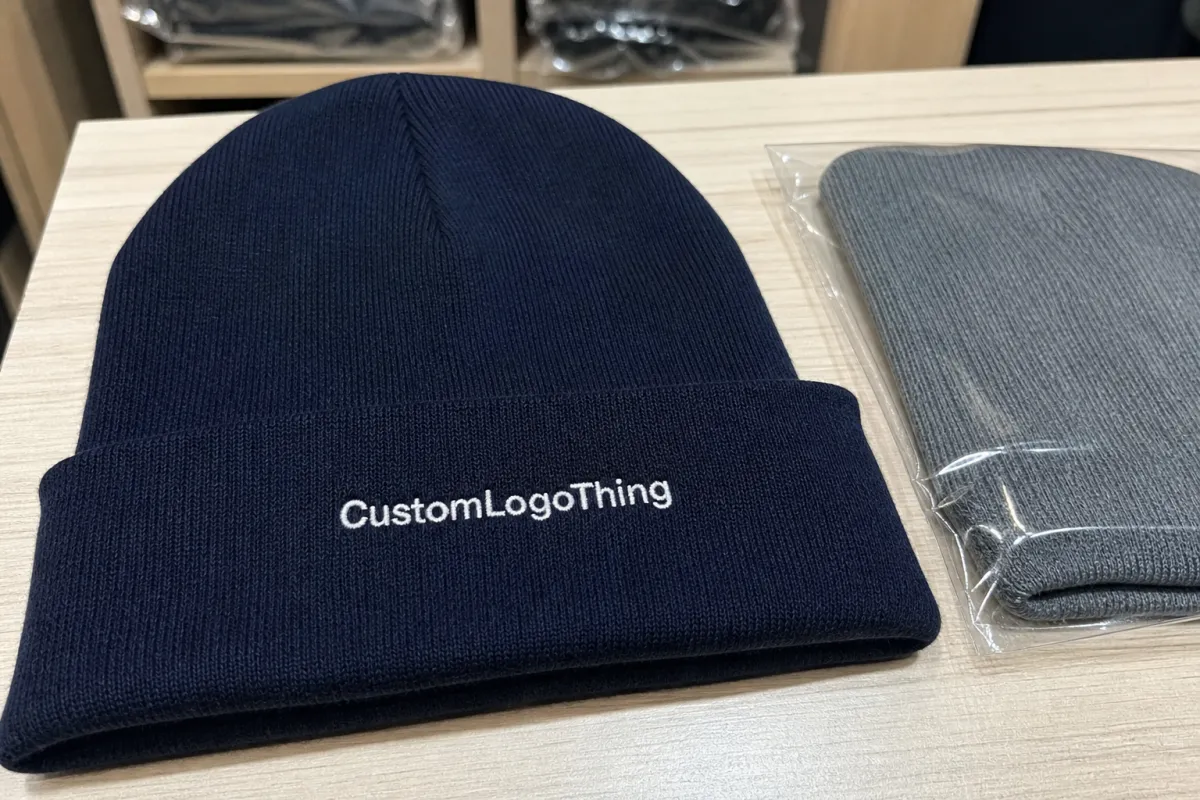
Cuffed Knit Beanies are the safest default. They give you a flat front panel for embroidery, they fit most adults, and they read clearly from a few feet away. Ribbed acrylic caps work well for staff uniforms because they sit closer to the head and feel a little more structured. Slouch beanies carry a more casual tone, which can work for lifestyle brands, but they are less predictable for booth teams. Double-layer winter hats add warmth and body, making them useful for outdoor events or colder markets.
The material spec should be more than “acrylic.” A solid order will usually define the yarn blend, knit gauge, and stretch profile. Common wholesale options include 100% acrylic or an acrylic-poly blend. The hand feel changes with yarn thickness and stitch density. A denser knit tends to look cleaner and holds embroidery better, while a looser knit can feel softer but may not support fine detail as well.
Decoration choice changes the look as much as the style does. Front-cuff embroidery is still the cleanest finish for a simple logo. Woven labels work well if you want a retail-style feel. Patches add weight and make a smaller mark feel more intentional. Inside labels matter when the hat is supposed to feel closer to a store product than a giveaway.
Color discipline matters more than buyers expect. One or two brand colors usually outperforms a crowded mix. Acrylic dye lots can shift slightly between batches, so fewer colorways tend to produce a more consistent order. If the event spans several locations, consistency is worth more than novelty.
| Style | Best use | Decoration | Typical MOQ | Approx. unit cost at 300 pcs |
|---|---|---|---|---|
| Cuffed knit beanie | General giveaway, booth staff | Embroidery, woven label | 100-200 | $2.10-$3.40 |
| Slouch beanie | Lifestyle campaigns, premium handouts | Patch, woven label | 150-300 | $2.40-$3.90 |
| Ribbed acrylic cap | Staff uniform, outdoor teams | Embroidery | 100-200 | $2.20-$3.60 |
| Double-layer winter hat | Cold-weather events, VIP gifts | Embroidery, patch | 200-300 | $2.80-$4.40 |
The numbers above are directional, not fixed. Stitch count, yarn weight, patch size, and packaging can move the final cost up or down. A buyer who understands that early can budget more accurately and avoid the frustrating surprise of discovering the “cheap” hat became expensive after decoration and freight were added.
Specifications to confirm before you request a quote
A clean quote starts with clear spec language. Suppliers can move fast when the brief is specific. They slow down when they have to interpret “something warm and branded” across three email threads and a half-finished mood board.
Start with yarn blend and knit construction. If the order is for a winter trade show with a broad audience, 100% acrylic is usually the simplest option. If the hand feel needs to be a little softer or the price target is narrow, an acrylic-poly blend may work better. Then confirm the knit gauge, cuff height, body length, and stretch recovery. Those four details determine how the hat fits the head and how the logo sits on the front panel.
Fit should never be treated as an afterthought. A beanie that sits too shallow looks cheap. One that stretches too far can lose shape after a few wears. For staff orders, ask for a sample fit against the actual people working the booth. For giveaways, assume a mixed crowd, thicker hair, and winter layers under the hat. The best test is not how the hat looks flat on a table. It is how it sits on a moving person.
Decoration limits need to be explicit. Knit fabric has boundaries. Very fine text, tiny symbols, and thin lines often need to be simplified before embroidery or patch production. That is not a flaw in the supplier; it is the material being honest. If your logo has a delicate script or a narrow icon, ask for a digitized proof early so the issue is caught before production begins.
Packaging should be specified with the same care as the hat. Confirm whether each piece ships polybagged, tagged, labeled by size, or packed loose for faster distribution. If the order is going to a booth or a warehouse, carton labeling and count clarity matter more than people think. For printed inserts or hang tags, FSC-certified paper stock is a sensible option. If the order is heading into a more formal packaging workflow, ask for carton protection standards so the goods arrive clean instead of compressed and wrinkled.
If the event includes regulated markets or youth audiences, ask for compliance details before production starts. Some programs need material declarations, and some need documentation around labeling or fiber content. It is easier to request that once than to hunt for it after the order is already moving.
Pricing, MOQ, and unit cost for wholesale trade show orders
Price is a stack, not a number. Blank product, decoration, setup, packaging, freight, and rush handling each add their own layer. A buyer who asks for one all-in price without separating those pieces usually gets a quote that is hard to compare and even harder to defend internally.
For acrylic beanies, unit cost tends to improve quickly as quantity rises. A 100-piece order often looks expensive because setup costs are spread across fewer units. At 300 pieces, the same style usually becomes much easier to justify. By 500 pieces, value tends to improve again, especially if the event calendar includes multiple stops or if the hats can be reused across more than one show.
For a simple acrylic beanie with one-color embroidery, the range below is realistic enough to use as a planning tool:
| Order size | Typical unit range | Common notes |
|---|---|---|
| 100 pcs | $3.40-$5.20 | Setup fee has a larger effect |
| 300 pcs | $2.10-$3.90 | Usually the most practical trade show range |
| 500 pcs | $1.85-$3.30 | Stronger value if the design stays simple |
MOQ depends on the style and decoration method. Stock blanks can start lower, but custom embroidery, woven labels, or special packaging can push the minimum higher. That is normal. There is setup work behind the scenes, and setup work has a cost whether the order is fifty units or five hundred.
Good quotes separate the variables. Product cost, decoration setup, sample fee, freight, and rush charges should be listed line by line. If all those items are bundled into one number, the buyer cannot tell where the real savings are. It becomes difficult to compare one supplier against another, and harder still to explain the choice to procurement or marketing.
A practical quote from an acrylic winter hats wholesale supplier for trade show buyers should tell you how the cost changes at 100, 300, and 500 pieces. That spread is often more useful than the headline number.
Production steps, lead time, and turnaround from proof to delivery
The production flow is straightforward. The problems usually start when the timeline is treated casually. A good order moves from inquiry to quote, from quote to proof, from proof to approval, and then into production, quality control, and shipment. Each step can happen quickly if the buyer answers clearly. Each step can stall if the artwork is incomplete or the event schedule has already started to drift.
For custom acrylic hats, a realistic lead time is often 10 to 20 business days after proof approval, plus shipping. New knit patterns, special packaging, multi-location delivery, or a rush freight request can extend that window. Blank stock with minimal decoration may move faster, but a trade show order usually involves some level of branding, which means time is needed for setup and inspection.
Slowdowns usually come from the same three places: late artwork, vague color references, and quantity changes after production planning has started. If the logo file is low resolution, the proof takes longer. If Pantone references are missing, color matching becomes guesswork. If the order count changes after the factory has bought yarn or reserved machines, the schedule and price both get messier.
Quality control matters as much as timing. A finished shipment should be checked for stitch consistency, logo placement, loose threads, color match, and size spread. On knit goods, a small defect can repeat across many units if it is not caught early. That is why a sample or pre-production proof is worth the extra step. It catches the issue before it becomes a carton full of the same problem.
Packaging and routing should be discussed early, especially if the shipment is going to a booth, a staging warehouse, or a show service provider. Carton count, gross weight, and label format are not glamorous details, but they are the details that keep receiving smooth. Trade shows run on narrow windows. A shipment that arrives with unclear labeling or the wrong receiving address can turn a simple order into an expensive delay.
For event buyers, the safest approach is to schedule the hats earlier than the booth build, not alongside it. That extra margin is not waste. It is how you avoid paying to fix a calendar problem.
Why a direct wholesale supplier beats random stock for event buyers
Direct sourcing gives a buyer control over the parts that matter most: color consistency, decoration quality, packaging, and repeat orders. That control sounds abstract until the cartons arrive and the event team starts sorting through inventory. At that point, small differences become very visible.
Marketplace stock can work for one-off purchases, but it creates risk for event programs that need consistency. The logo might shift slightly in placement. The color may not match the last run. The sizing may feel different from piece to piece. Those issues are easy to dismiss online and hard to ignore in a booth.
For trade show buyers, a direct acrylic winter hats wholesale supplier is more useful when the order needs to be repeated. Keep the yarn reference, decoration file, packaging spec, and carton labeling instructions together. The next order becomes easier to place and easier to match. That matters if the same event appears in different cities or if the winter program stretches across multiple months.
Direct sourcing also improves communication. A supplier that handles the production chain will usually tell you sooner if your artwork needs simplification or if the chosen decoration method will not read well on knit fabric. That honesty saves time and avoids the false comfort of a product that looked fine in a digital proof but failed once knitted.
There is a practical trust advantage too. When a repeatable order is on the line, the buyer wants a supplier that can explain how the yarn, stitch count, and decoration method will affect the final piece. Random stock sellers usually cannot give that level of detail because they are not controlling the process.
Common mistakes trade show buyers should avoid before ordering
The first mistake is overcomplicating the logo. Knit surfaces are not flat paper. Fine serif type, thin lines, and tiny symbols can disappear or blur once they are translated into embroidery or a patch. A simplified production version usually reads better and looks more expensive than a crowded original.
The second mistake is under-ordering. Booth traffic is hard to predict, and the item people want is rarely the item you expected to move fastest. Once attendees realize the hat is genuinely useful, inventory can disappear quickly. A replenishment order after the event starts is usually more expensive and almost always more stressful.
The third mistake is approving the proof too quickly. Lighting changes how a logo looks. Expo halls have glare, shadows, screens, and overhead fixtures that make weak contrast more obvious. A proof that seems fine on a laptop can look muddy under booth lighting. If the logo is hard to read in the proof, it will not improve in the hall.
The fourth mistake is ignoring receiving details. Ship-to address, dock rules, and delivery hours should be confirmed before production begins. If the order is headed to a booth service contractor, a warehouse, or a regional event team, note it clearly. One wrong label can create more damage than a decoration error.
The fifth mistake is forgetting how the product will be packed and handled after arrival. If the hats are meant to sit at a registration desk, they need to arrive clean and easy to count. If they are intended for staged distribution, carton labels should reflect that. If the order includes inserts or hang tags, those pieces need to be approved early enough to fit the print schedule.
Small issues are rarely small once the freight leaves.
Next steps to lock your trade show beanie order
Start with a complete brief: logo files, color targets, quantity range, event date, and destination address. That basic set of information does more for the order than a long email full of adjectives. Suppliers can price more accurately and proof faster when they know what the job actually needs to do.
Choose the decoration method before you get lost in extras. Embroidery is still the strongest default for most Trade Show Giveaways because it is durable and reads well from a distance. Woven labels and patches make sense when the goal is a more retail-oriented finish, but they work best after the main spec is already settled.
A sample or digital mockup should be part of the process on any first run. A mockup shows proportion and placement. A physical sample shows texture, stretch, and color. If the order is large or the event is high stakes, both are worth the time.
For internal comparison, use the same checklist across vendors: material, decoration method, MOQ, unit cost at multiple quantities, packaging, and delivery timeline. That keeps the comparison grounded in facts rather than sales language. If you need a reference point for available options, the Wholesale Programs page can be used as a starting spec sheet.
Once the proof is approved, lock the timeline and keep the order details together for reorders. A good event program gets easier when the supplier already has the original spec, and the next run does not have to be rebuilt from zero.
What MOQ should I expect for acrylic winter hats wholesale orders for trade show buyers?
Custom decorated orders often start in the low hundreds. Stock blanks can sometimes go lower, but once embroidery, woven labels, or special packaging are added, the minimum usually rises. Ask for pricing at 100, 300, and 500 units so you can see where the best value sits.
How long does acrylic winter hat wholesale production usually take?
After proof approval, standard production commonly runs 10 to 20 business days, plus shipping. Simple stock styles may move faster, while custom knit patterns, special labels, or rush freight can add time. The proof stage is often the slowest part if the logo file is incomplete.
Can trade show buyers add a logo, woven label, or patch to acrylic beanies?
Yes. Embroidery is usually the cleanest choice for simple logos, while woven labels and patches are better for a more retail-style finish. The right option depends on the logo detail, the look you want, and how much decoration the knit fabric can support without losing clarity.
What is the best decoration for a giveaway beanie at a trade show?
Front-cuff embroidery is the safest default because it is durable and easy to read. If the goal is a more elevated presentation, a woven label or patch can work well. Thin lettering and tiny icons often need simplification regardless of the decoration method.
How do I reorder acrylic winter hats wholesale for a second event?
Keep the original artwork, yarn reference, decoration file, and packaging spec together. That makes the second run faster and easier to match. If the same hat needs to ship to a new city or a different receiving dock, confirm the destination details early so the repeat order does not stall.
An acrylic winter hats wholesale supplier for trade show buyers should offer clear specs, honest timing, and a product people will actually wear. The strongest orders are usually the simplest ones: good fit, readable branding, sensible color choices, and enough lead time to avoid rushing the last step. That combination is not dramatic, but it works.