Buyer interest in apparel Beanies with Leather Patch MOQ usually starts with the same tension: the item needs to look premium, but the order should stay small enough to control risk. That tension shows up everywhere, from holiday merch to employee uniforms to retail test runs. A leather patch solves part of the problem because it gives a knit beanie a cleaner visual anchor than embroidery alone. The logo reads faster, the surface looks more deliberate, and the style often feels worth more than the blank itself.
There is a practical reason procurement teams keep coming back to this format. A beanie is already a seasonal purchase, which means demand can be lumpy and hard to forecast. A patch adds brand value without forcing the buyer into expensive knit customization. That matters when a 100-piece order needs to stay flexible and margin-sensitive. A difference of even $0.50 per unit is only $50 on 100 pieces, but the same change becomes much more visible when the run scales up.
For buyers, the real question is rarely whether the item looks good on a mockup. It is whether the patch material, attachment method, yarn, and carton plan still hold up once the order moves into production. That is the difference between a polished accessory and a messy purchase order.
Why Leather Patch Beanies Win Attention at Shelf and On Staff
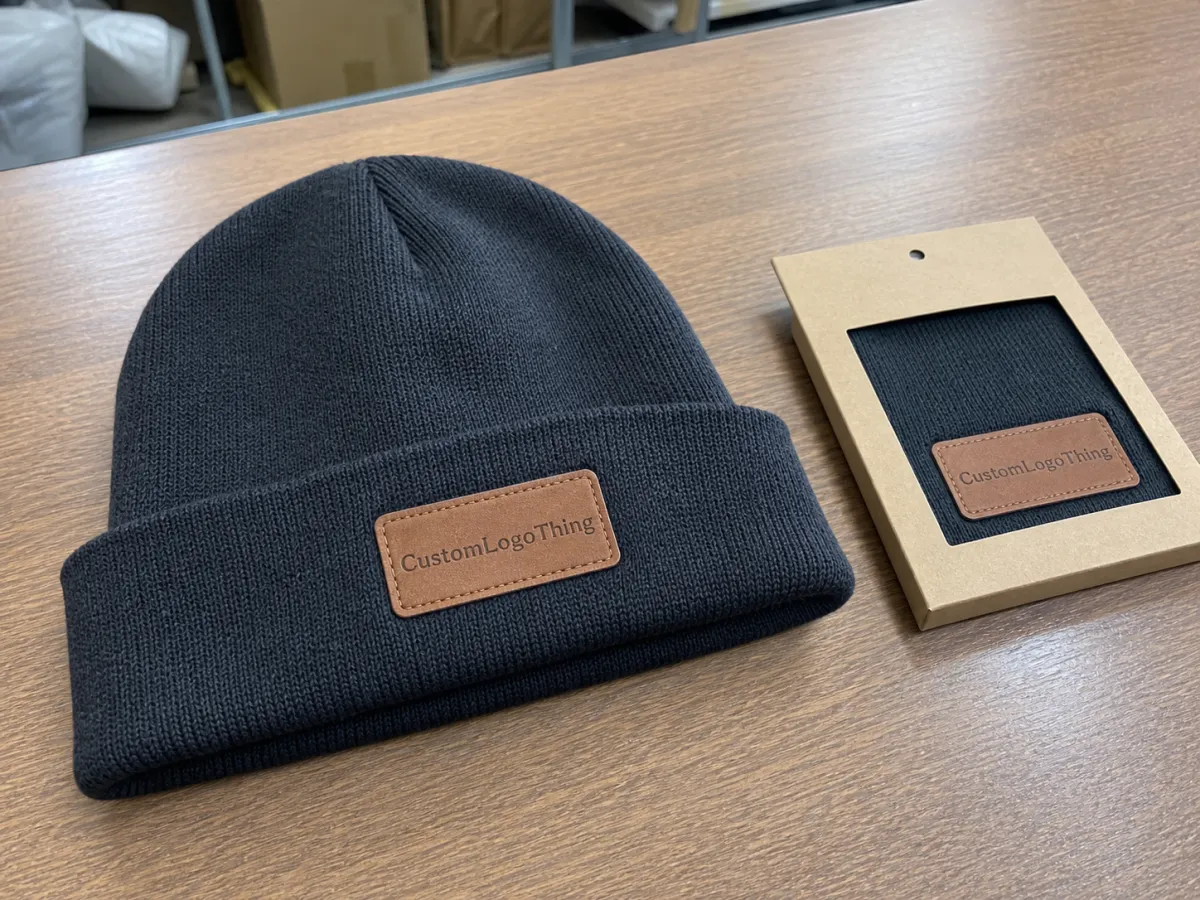
A leather patch changes how a beanie reads. Knit surfaces are visually busy; they break up edges and soften logos. Leather does the opposite. It creates a defined block of contrast that helps the brand mark stand out even when the hat is folded, pegged, or worn loosely. The effect is small in size and large in consequence. A two-inch patch can do more for shelf presence than a much larger knit pattern because the eye finds structure before it notices decoration.
That structure matters in several settings. Retail teams want something that looks intentional from a distance. Uniform buyers want a logo that feels professional rather than promotional. Event teams want a piece that people will actually keep on their heads after the giveaway table closes. The same beanie can serve all three, but the buying logic changes with each use case.
- Retail merch: cleaner shelf presence and a better shot at a higher price point.
- Staff wear: enough branding to feel organized, not so much that it looks like a billboard.
- Promotions: more likely to be worn again if the patch feels understated.
- Resale: a patch often supports a stronger margin than a plain knit cap.
There is also a production advantage that buyers sometimes overlook. Patch decoration is easier to specify than a fully knitted logo because the artwork lives on a separate component. That means fewer arguments about stitch density, yarn color shifts, or whether a tiny emblem will survive on a ribbed surface. A patch spec can usually be described in a handful of variables: size, shape, material, finish, placement, and attachment method. The shorter the spec sheet, the fewer opportunities for confusion.
Another reason the format sells well is that it feels closer to a product label than a logo treatment. That may sound minor, but it changes the psychology of the item. A patch signals that the beanie was designed, not just branded. Buyers tend to notice that difference immediately, especially in categories where the product can easily look generic.
Leather Patch Construction, Placement, and Branding Options
Patch construction shapes the finished look more than most first-time buyers expect. Genuine leather has natural grain variation, a warmer feel, and a more traditional look. Faux leather is usually more consistent in color and surface texture, which helps when a brand needs the same result across multiple runs. Neither choice is automatically better. The right option depends on budget, compliance expectations, and how much variation the buyer can tolerate from piece to piece.
Finishing method matters too. Debossed and laser-etched graphics keep the design clean and readable, which is why they show up so often on winter merch. Embossed patches add depth and can feel more premium, though the raised detail can be less forgiving on small logos. Printed or color-filled patch styles are useful when the brand needs more than one tone, but they work best when the artwork is simple and the colors are not trying to carry too much detail.
Attachment method deserves the same level of scrutiny. A patch can be sewn on, heat-applied, or attached with a hybrid method. Sewing is usually more reliable for knit goods because the patch stays put under folding and wear. Heat application can reduce labor time, but not every knit surface responds well to it, and some buyers prefer the extra security of stitching around the edge. If the beanie will be washed often or used in rougher conditions, sewn attachment is usually the safer route.
Placement changes the tone of the product. The most common positions are the center cuff, side cuff, front panel, and fold-over rib. Center cuff placement gives the highest visibility. Side placement feels quieter and can look more refined. Front-panel placement works on certain slouch styles, but the logo often needs to stay smaller so it does not fight the knit texture. The wrong placement can make even a good patch look awkward. A patch that sits too high on the cuff or too low on the rib can pull the eye in the wrong direction.
Shape is another cost lever. Round, rectangle, and shield shapes are the easiest to produce and price. Custom die-cut shapes can be striking, but they introduce tooling fees, longer setup, and more room for edge distortion. Tiny corners, hairline text, and complex outlines often disappear once the patch is cut and attached. Buyers should not assume a complicated logo will survive the conversion from flat artwork to stitched product. Simple geometry often produces the better result.
As a rule, the simplest patch that still feels branded usually wins. A smaller patch with clean contrast tends to outperform a large patch full of detail that the knit surface cannot support. That is especially true on darker beanies, where the eye already has enough texture to process.
Branding tradeoffs that affect cost
Each extra color, edge treatment, or line of tiny text adds work. That work shows up in setup time and per-piece pricing. If a logo includes six colors but only two are visible at arm’s length, simplify the artwork before production starts. The factory stage is a bad place to discover that the badge needs to be redesigned. A clean spec avoids reproofs, and reproofs are one of the quietest ways a small order can drift out of budget.
Patch size deserves its own check. On a cuffed beanie, a patch that looks balanced at 2.25 inches may feel oversized at 1.5 inches and clumsy at 3 inches. Most buyers do better when they ask for a physical measurement, not just a visual mockup. Proportion is a manufacturing issue, not an abstract design one.
Beanie Specs That Affect Fit, Feel, and Durability
The beanie body controls comfort and durability. Buyers usually compare cuffed beanies, slouch styles, rib knit, and waffle knit. Cuffed and rib knit styles are the easiest to brand cleanly because the decoration sits on a flatter, more predictable surface. Slouch styles can look good, but the patch often lands on a softer zone, which can make the logo feel less disciplined. That is not a flaw in the style; it is just a production reality.
Fiber content matters just as much as shape. 100% acrylic is common because it is cost-effective, repeatable, and easy to source at scale. Acrylic-wool blends usually feel warmer and more substantial, though they may require more careful care instructions. Recycled yarns can support sustainability goals, but they should be checked for color consistency, hand feel, and lead time before the order is approved. Some recycled yarns look excellent in samples and less consistent in bulk, especially when dye lots shift.
A few spec details can tell you a lot about the finished piece:
- Gauge: finer gauges usually create a cleaner face, while looser gauges look more casual.
- Weight: heavier knits typically feel warmer and hold shape better.
- Stitch density: tighter density helps the patch sit flatter.
- Cuff depth: deeper cuffs leave more room for branding and help with visual balance.
There are small details buyers often skip and later regret. Seam strength matters. Pilling resistance matters. Colorfastness matters. If the yarn sheds or the cuff rolls too easily, the patch can still look fine on day one and awkward a few wears later. A beanie is a low-complexity item, which makes it tempting to treat as low-risk. It is not low-risk if the knit weight is too light, the cuff is too shallow, or the patch attachment is loose.
For winter programs, thickness can also affect perceived value. A heavier beanie does not just feel warmer; it reads as more substantial in the hand. That psychological cue can support retail pricing, especially when the patch is understated and the fabric does the rest of the work.
For buyers who need sustainability language, packaging and labeling should be checked alongside the yarn. FSC-certified paper hangtags or carton labels can support the story without overpromising on the product itself. The FSC chain-of-custody standards are useful when the packaging is part of the message.
Pricing, MOQ, and Unit Cost Benchmarks
Pricing is rarely just the beanie. It is the blank, the patch material, the decoration method, the artwork prep, the packaging, and the freight. Two quotes can look similar at first glance and still produce very different landed costs. Buyers who focus only on the lowest headline price often miss the setup charges that show up later or the freight terms that shift the total more than expected.
MOQ usually changes with decoration complexity. Stock beanies with standard patch styles often start lower, sometimes around 50 to 100 pieces depending on color availability and inventory. Custom yarn colors, special knit structures, and custom-shaped patches usually push the minimum higher, often into the 100 to 300 range. If a supplier is willing to go below that, the unit cost usually rises enough to offset the lower count. There is no magic exception; small runs simply carry more labor per piece.
| Option | Typical MOQ | Common Cost Per Piece | Best Fit | Main Tradeoff |
|---|---|---|---|---|
| Stock cuffed beanie + simple faux leather patch | 50-100 pcs | $2.40-$4.50 | Promos, small retail tests, staff wear | Limited yarn color choices |
| Stock beanie + debossed or laser-etched genuine leather patch | 100-200 pcs | $3.25-$5.90 | Premium merch and resale | Higher material and setup charges |
| Custom color beanie + custom-shaped patch | 150-300 pcs | $4.75-$7.80 | Brand programs, retail launches | Tooling fees and longer approval cycles |
| Retail-ready packout with hangtag and barcode | 100-500 pcs | +$0.25-$0.95 added | E-commerce, boutiques, distribution | More labor and packing detail |
Those ranges are directional, not universal. A simple patch with a one-color logo can land much lower than a fully custom treatment, especially if the supplier already has the blank in stock. The opposite is also true. Add retail folding, barcode labels, multiple colorways, or a special edge finish, and the quote moves quickly. That is why people asking for apparel Beanies with Leather Patch MOQ should request tiered pricing, not a single number.
There is one calculation buyers should make before they approve the run. Multiply the quantity by the unit price, then add the setup charges, packaging, and freight. A $0.65 increase on a 100-piece order is only $65, but a $0.65 increase on 1,000 pieces is $650. That gap explains why some suppliers sound cheap early and expensive late. The quote is only useful if it shows the whole picture.
Give the supplier complete information from the start: quantity, beanie color, patch size, patch material, logo file type, delivery zip code, and whether the order needs polybags or retail-ready folding. Incomplete specs usually create a second round of pricing, and every second round invites delays.
Production Steps, Lead Times, and Approval Milestones
A clean workflow saves more time than a rushed email thread. The usual path is quote, artwork review, digital proof, sample or pre-production approval, production, quality check, and packout. The sequence sounds simple, but the quality of each handoff determines how much time the order actually takes. A beanie order with a clear patch spec can move quickly. A beanie order with fuzzy art, unclear placement, and shifting packaging instructions can stall for days without a single dramatic failure.
Typical lead time for stock blanks with standard patches is often 10-15 business days after proof approval. For custom patch shapes or larger orders, 15-25 business days is more realistic. Freight is separate and can add several days depending on destination and service level. If the order needs a physical sample, plan for an extra week or so, plus sample charges that may or may not be credited back on the bulk order. That difference matters. A digital proof shows layout. A sample shows scale, texture, and attachment quality.
Delay points are usually predictable. Missing vector art slows patch preparation. Late feedback on the proof pushes the schedule. Color matching debates create another revision cycle. Last-minute changes to patch size, placement, or packaging can trigger rework or new setup charges. It is common for buyers to think they are changing a minor detail and later find that the “minor” detail touched tooling, labor, or carton configuration.
If the proof is unclear, the order becomes a guessing game. The safest way to keep timing under control is to approve the artwork once, then stop changing the spec unless there is a real production reason.
Good approval discipline is usually more valuable than chasing the absolute lowest price. A supplier that responds quickly, asks specific questions, and flags weak artwork early is often easier to work with than one that promises everything and explains nothing.
For shipping cartons and distribution handling, it helps to ask whether the supplier has an internal test plan aligned with ISTA packaging testing standards. That is not a guarantee of perfection, but it does reduce the chance of crushed cartons, bent hangtags, or badly packed retail units during transit. It matters most when the order is being split across multiple locations.
Quality Checks, Packaging Options, and Supplier Fit
A reliable supplier should be able to explain four things without hesitation: patch alignment, stitch consistency, color variance, and attachment strength. If the patch sits crooked on the cuff, the beanie reads cheap no matter how good the yarn is. If the stitch line is loose, the patch can shift after wear. If the base color drifts from the proof, the whole order starts to look less controlled. On a knit product, small imperfections are rarely small. They show up immediately because the fabric itself is already textured.
There are a few quality checks worth asking for before bulk shipment. Confirm the patch is centered within a tolerable margin, especially on cuffed styles where a few millimeters can change the visual balance. Check edge finish for fraying or lifted corners. Compare the approved artwork to the production run under neutral light, not just warehouse lighting. And verify that the patch attachment survives handling, folding, and carton compression. Those checks are unglamorous, but they prevent the kind of mistakes that show up after the order is already distributed.
Packaging options affect both cost and downstream handling. Some buyers only need bulk cartons. Others need individual polybags, size stickers, barcode labels, hangtags, or retail-ready folding. If the order is going to a distribution center, carton dimensions and pack counts should be confirmed early. If the beanies are going straight to stores, retail presentation becomes a bigger part of the quote. A carton that fits the units poorly can create more damage than a slightly higher freight rate would have cost.
Suppliers also differ in how transparent they are. The best ones show MOQ, lead time, setup charges, and proofing steps in plain language. That transparency is not an extra. It is the minimum standard for a purchase that needs to stay on budget and on schedule.
If two quotes are close, choose the supplier that gives clearer sample expectations and faster production communication. That usually lowers ordering risk more than squeezing a few cents out of the unit price. For buyers comparing vendor options, the real filter is not just who is cheapest. It is who can deliver the right beanie, with the right patch, in the right carton, without repeated follow-up.
For broader packaging guidance, the Institute of Packaging Professionals is a useful reference point. It will not replace a supplier quote, but it can help buyers ask better questions before the purchase order is sent.
What a strong supplier fit looks like
A good fit usually feels uneventful in the best way. The proof matches the conversation, the sample reflects the spec, and the carton count lines up with the packing list. There is no drama because the order was defined carefully from the start. That kind of consistency matters more than sales language, especially for apparel beanies with leather patch MOQ where a small error can ripple across the entire run.
One more practical point: ask how the supplier handles dye lots and patch lot variation. Even when the product is “standard,” stock can shift enough to affect color or hand feel. A supplier who mentions that before you ask is usually one who has dealt with actual production, not just quoting.
FAQ
What is the usual MOQ for apparel beanies with leather patch?
MOQ is usually lower for stock beanies with standard patch styles and higher for custom yarn colors, custom shapes, or special finishes. A smaller run is easiest when the blank beanie is already stocked, the patch is simple, and the logo does not need extra tooling. Once the order starts asking for custom materials or unusual placement, the minimum often moves up.
How does leather patch pricing change by quantity and patch style?
Unit cost drops as quantity increases, but the biggest pricing shifts usually come from patch complexity, attachment method, and artwork setup. A simple debossed or laser-etched patch is often cheaper than a multi-step full-color patch. A 100-piece order and a 500-piece order can look similar in structure and still price very differently because setup costs are spread across more units.
Can I mix beanie colors within one leather patch MOQ?
Often yes, but the answer depends on whether the supplier is using stock blanks or custom production. Mixed colors are usually easier when the patch and decoration stay identical across every unit. Confirm whether each color counts as a separate SKU, because that can affect pricing, lead time, and the minimum for each colorway.
What files do you need for a quote on leather patch beanies?
A vector logo file is best, usually AI, EPS, or PDF, because it preserves clean edges for engraving or embossing. Include quantity, beanie color, patch size target, and delivery location so the quote reflects the real order. If your brand uses PMS colors, include them. That step reduces proofing delays and helps avoid avoidable color disputes later.
How long does production take after artwork approval?
Lead time depends on stock availability, patch method, and order size. Standard stock orders often ship faster than custom builds, especially if the proof is approved quickly and the art is production-ready. Physical samples add time, as do custom shapes, special packaging, and last-minute changes. Rush timing is possible, but only when the spec is already tight.
Is faux leather or genuine leather better for beanie patches?
Faux leather usually gives more color consistency and easier replication across runs. Genuine leather can feel more natural and may suit premium programs, but it can vary slightly from piece to piece because it is a natural material. Buyers who need a very controlled look often prefer faux leather; buyers who want a more traditional tactile finish often choose genuine leather.
If a purchase needs to stay manageable, the simplest path is still the most reliable: define the quantity, patch spec, packaging level, and timeline together before the quote is finalized. That is how apparel beanies with leather patch MOQ stay under control instead of turning into a chain of revisions.


