Event Merch Beanies with Leather Patch Bulk Order Quote
If you are planning an event merch Beanies With Leather Patch bulk order, the item works for a simple reason: people keep wearing it. A beanie does not vanish after the event floor empties. It shows up on school runs, at job sites, on cold platforms, and in weekend photos, which gives the logo a longer useful life than a short-run handout or a novelty item.
The leather patch changes the equation. It gives knit headwear a more permanent, retail-leaning finish, and it usually improves logo readability on fabric that would otherwise swallow fine detail. The result feels less like giveaway stock and more like something planned.
From a buyer's angle, the cleanest orders are the ones with a narrow brief. Pick the beanie body, settle the patch style, confirm quantity, and set the delivery date before the quote turns into a moving target. That sequence reduces revisions and makes price comparisons useful instead of noisy.
A beanie is one of the few event items people may wear all season, which is why the knit, patch finish, and ship date matter more than splashy claims.
Why Event Merch Beanies with Leather Patch Bulk Orders Work
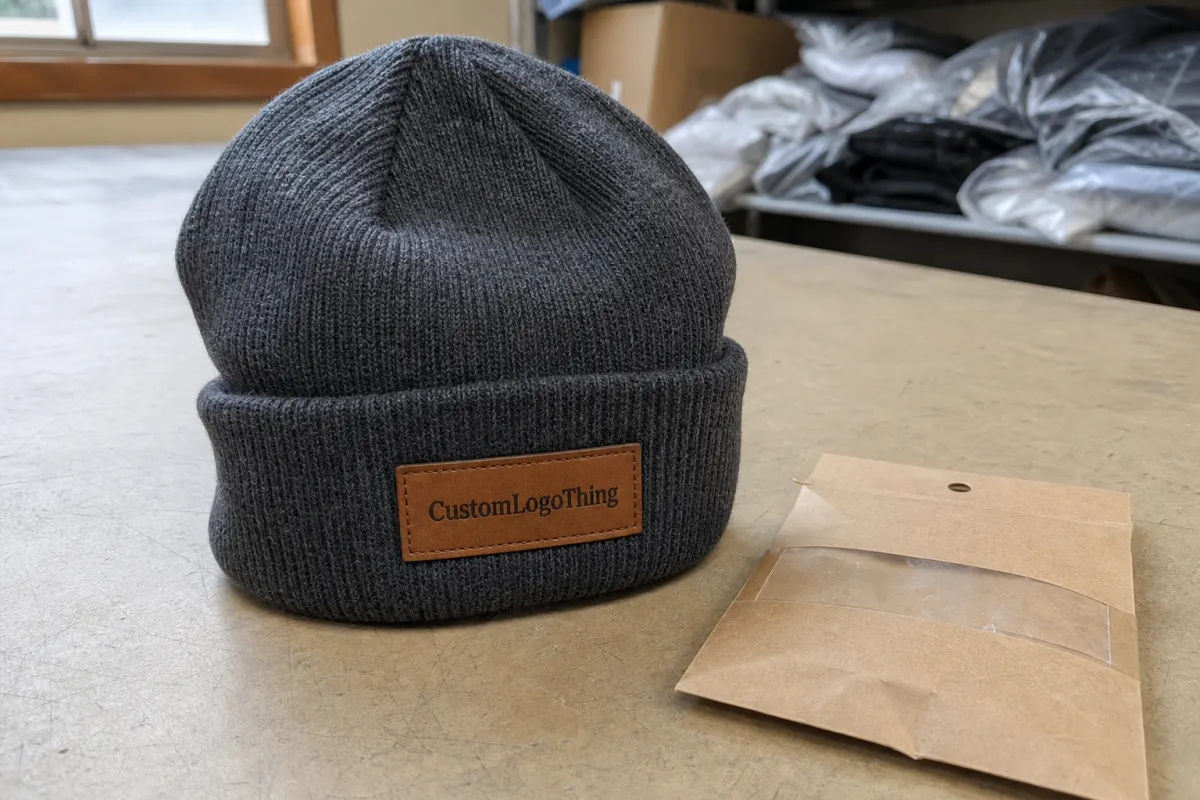
There is a practical reason winter programs keep returning to beanies. They solve a real need, and that alone makes them easier to justify than many promo items. A cold-weather cap is functional before it is promotional, and useful products earn repeat wear. That repeat wear is what extends the value of the logo after the booth closes.
The patch adds perceived value without forcing the decoration to do too much. Flat printing can disappear into ribbed knit, especially on darker yarns or coarse textures. A leather patch creates contrast and structure. It gives the eye a place to land and makes the branding feel finished, even when the rest of the design stays minimal.
This combination also holds up well across different use cases. For a staff kit, the beanie can feel practical and uniform. For a sponsor gift, it looks more deliberate than a standard promo cap. For retail or seasonal merch, the same format can feel premium enough to sit near outerwear and accessories rather than in a giveaway bin.
It is also forgiving on budget. A brand can keep the body simple and let the patch carry the identity. That matters when the run is large and every small spec choice affects the total. One extra dollar per unit can be trivial on a 250-piece order and material on a 2,500-piece rollout.
The sequence below keeps the process focused:
- Choose the beanie body that suits the weather and audience.
- Select a patch style that matches the artwork.
- Confirm quantity tiers before requesting final pricing.
- Share the delivery address and hard deadline early.
Once those details are set, the quote is much closer to the real job.
Leather Patch Styles That Fit Your Logo and Audience
Patch choice affects more than style. It changes how much detail survives production, how the logo reads at a distance, and how premium the beanie feels in hand. The most common options are debossed, embossed, laser-engraved, and printed leather-style patches. Each one handles art differently, so the logo file should drive the decision instead of the other way around.
Debossed patches press the artwork into the material. They are subtle, tactile, and often a good fit for brands that want a restrained look. Embossed patches raise the mark above the surface, which gives more dimension and a bolder read. On Cuffed Knit Beanies, both options can look sharp because the cuff provides a stable visual field.
Laser-engraved patches are useful when the logo needs crisp edges and contrast without a lot of color. They tend to feel cleaner and more understated. Printed patches open the door to more color and gradient detail, though even then the strongest results usually come from simplified artwork. Tiny type and thin lines can become muddy once they are scaled down to patch size.
Shape matters as much as finish. Rectangles remain the standard because they sit neatly on the cuff and leave room around the mark. Shields, circles, and rounded shapes can work well for outdoor brands, event teams, and heritage-inspired concepts. Custom die-cuts can add character, but they should be used with discipline. If the outline becomes too busy, the patch starts to read as decorative clutter instead of a clear brand element.
The logo itself should be checked with production in mind. Artwork that relies on hairline strokes, tight spacing, or small copy often needs to be simplified. Leather patch decoration rewards bold outlines, open counters, and strong contrast. A cleaner mark almost always survives the transition better than a crowded file full of detail that only makes sense at full screen size.
Color tone also shifts the mood. Dark brown, black, and charcoal patches feel rugged and practical. Tan, chestnut, and lighter brown shades feel warmer and a little more retail-oriented. Neither is universally better. A construction crew, a winter sports event, and a boutique retail line can all call for a different finish.
If the audience is broad, the safest path is usually a straightforward patch with limited detail. If the goal is a premium feel, the patch can carry more of the visual identity, but only if the art supports it.
Beanie Specs That Affect Fit, Warmth, and Decoration
The body style is where a lot of buyers either save themselves trouble or create it. Cuffed Knit Beanies remain the most dependable choice for bulk orders because they give the patch a flat, visible location. The cuff also helps standardize placement across a large run. That consistency matters more than people think when the order lands in cartons and gets unpacked by more than one person.
Watch cap styles are close relatives, though the cuff height and crown shape can shift the fit slightly. Slouch beanies feel more relaxed and can work well for retail or lifestyle programs, but they need tighter art direction. A patch placed too low can disappear into folds once the cap is worn. A patch that is too large can fight the drape of the crown.
Material makes a real difference in both comfort and cost. Acrylic is still the workhorse for most event merchandise because it is predictable, warm enough for common winter use, and relatively easy to source in volume. Acrylic blends can improve stretch recovery and hand feel. Wool blends bring more natural texture and better warmth retention, but they also introduce care considerations and can push the program into a higher price bracket.
There are a few specs buyers should ask for before approving anything:
Knit gauge affects how dense the fabric feels and how clean the cuff holds its shape. A tighter knit often reads more polished, while a looser knit can feel softer but less structured. Cuff height determines how much room exists for patch placement and how well the decoration stays visible once worn. Seam construction affects comfort as much as appearance, since a cleaner seam usually means a more consistent fit.
Climate should guide the choice as well. Heavy knits make sense for outdoor winter events, holiday campaigns, and cold-weather staff uniforms. Lighter acrylic beanies are often better for campus activations, general giveaways, or programs that need inventory to work across several months. The warmest option is not always the smartest option. If the audience will not wear it, the spec is wrong no matter how nice it looks on paper.
For comparison shopping, ask for body weight, available stock colors, cuff size, and whether the style is knit for decoration or for broader retail use. Those details tell you more than a generic product image ever will.
Pricing, MOQ, and Unit Cost Drivers for Event Merch Beanies with Leather Patch Bulk Order
For an event merch beanies with leather patch bulk order, the price is shaped by four main variables: quantity, beanie body, patch method, and any customization beyond the standard build. Once those pieces are clear, the quote usually makes sense. Without them, the estimate is just a rough placeholder.
Quantity has the biggest impact because setup costs get spread across more units. A 250-piece run carries more overhead per item than a 2,500-piece run. But higher quantity does not always mean higher value if the order includes special packaging, rush production, split shipments, or artwork that needs extra prep.
MOQ is tied to production method and how standard the base product is. Stock beanies with standard patch sizes usually have a lower minimum than custom-knit colors or unusual patch shapes. That is why it helps to ask for pricing at multiple tiers rather than one number. The gap between 250, 500, 1,000, and 2,500 units often reveals where the best unit cost sits.
These are useful planning ranges for budgeting, not fixed pricing:
| Quantity | Typical Unit Range | Best Fit | What Changes Most |
|---|---|---|---|
| 250-499 | $4.75-$7.25 | Local events, staff kits, smaller activations | Setup costs are spread over fewer pieces |
| 500-999 | $3.25-$5.25 | Conferences, sponsor gifts, regional programs | Better price tier on body and patch production |
| 1,000-2,499 | $2.65-$4.10 | Retail capsules, multi-site event rollouts | More efficient production and freight planning |
| 2,500+ | $2.10-$3.50 | Seasonal inventory, national campaigns | Strongest unit savings, with more attention needed on storage and shipping |
Those ranges can move quickly if you add complex art, custom packaging, extra labeling, or a deadline that compresses production. Sample fees are usually modest, often in the $25-$75 range depending on the decoration method. Rush charges can add 10%-20% if the schedule is tight. Freight is its own variable and should never be treated as an afterthought. A quote that looks lower on the product line can lose that advantage if the cartons need to move across the country on a short window.
For that reason, the smarter way to review pricing is landed cost, not unit cost alone. A slightly more expensive beanie may still be the better buy if it reduces rework, avoids a missed event date, or arrives in a more reliable packing format. Buyers who manage seasonal inventory tend to care about that more than headline price.
Programs that include paper tags, cartons, or inserts can also benefit from paying attention to recognized transit and packaging standards such as ISTA and sourcing frameworks such as FSC. Those references do not change knit pricing, but they matter when the order is expected to move through a distribution chain rather than straight to a single address.
Production Steps and Timeline from Art to Delivery
The production path is simple on paper and less simple in real life if the brief arrives incomplete. The standard sequence is quote, art review, mockup approval, production, then delivery. Every handoff in that chain depends on the information the buyer supplies at the start.
Proofing deserves more attention than it usually gets. This is the point where patch size, placement, logo detail, beanie color, and any packaging notes are locked in. Small mistakes on a mockup can repeat across the full order. If the patch sits even slightly too high or too far off-center, the whole run will reflect it.
Lead times vary by body availability, patch method, and total quantity. A simple stock-body order with a standard patch may complete production in roughly 12-18 business days after approval. Larger or more customized runs often take 18-25 business days or longer. Shipping adds more time, and the event date should always include a cushion. If the schedule is treated as exact rather than approximate, there is little room for transit delays or carton exceptions.
The fastest phase is usually approval. The longest phase is production. Freight can be smooth or unpredictable depending on lane and season. That is why it helps to share the hard deadline up front instead of after the proof is already in motion. If the beanies have to be in hand for a conference, a retail release, or a game-day activation, the timeline should be built backward from that date.
Split delivery adds another layer. Shipments to stores, event sites, warehouses, or fulfillment partners need carton counts and labels that are spelled out before production begins. Otherwise, the project gets slower for everyone involved. Clear routing instructions save more time than most buyers expect.
One useful habit: keep the same body spec, patch art, and placement notes on file if the order may repeat. Reorders move faster when the base details are already documented. That kind of consistency is not flashy, but it is one of the easiest ways to reduce errors in seasonal programs.
Quality Checks That Protect Bulk Orders at Scale
Bulk orders rise or fall on consistency. A good patch design can still look wrong if the beanie body varies too much from piece to piece or the patch shifts across cartons. That is why quality control has to happen at the sample stage and again during production.
The basic checks are straightforward: knit consistency, patch adhesion, seam integrity, color matching, and count accuracy. Knit consistency keeps the batch from feeling uneven. Adhesion matters because loose edges or weak bonding show up fast once the hat is worn. Seam integrity affects comfort and the way the cap sits on the head. Count accuracy matters more than people think when an order is split across multiple destinations.
Packaging deserves its own review. Bulk-packed beanies should arrive clean, compressed safely, and counted accurately. Cartons need clear labels if they are going to more than one address. If the inventory will be released in waves, the packing method should support that. Small decisions here determine whether receiving takes minutes or half a day.
It also helps to inspect the approved sample as if it were the whole order. Buyers often focus on the logo and forget the surrounding details: cuff symmetry, patch edge quality, how the knit holds after stretching, and whether the color reads the same under indoor light and warehouse light. Those differences are not theoretical. They show up in the first minute the carton is opened.
For repeat programs, a documented sample is worth keeping. It gives the next order a reference point for placement, materials, and finish. That protects consistency when a different team member places the reorder or when the program comes back months later.
If the shipment will pass through a distribution center, it is sensible to think about the outer carton the way packaging teams do: realistic handling, clear counts, and enough compression resistance for the journey. Soft goods are more forgiving than rigid products, but they still benefit from disciplined packing.
How We Support Teams, Events, and Retail Programs
For a buyer managing event merchandise, the challenge is rarely the beanie itself. The challenge is coordinating marketing, operations, finance, and sometimes a retail partner or sponsor at the same time. Pricing has to be readable. Proofs have to be clear. Deadlines have to be visible. If any one of those drifts, the whole order gets harder to manage.
A useful supplier response should narrow choices, not multiply them. If the buyer is unsure which body style fits the program, the best answer is a practical recommendation based on how the product will be used. A staff gift usually needs a softer hand and a restrained patch. A retail capsule may call for a sharper finish. A sports or outdoor event can often handle darker tones that hide wear better during the season.
Recurring programs benefit from process memory. Repeat orders often need the same patch art, the same placement notes, and the same ship-to structure. When those details are documented, reorders get easier to quote and less prone to avoidable delays. That is one reason larger buying teams often prefer a dedicated Wholesale Programs path for ongoing seasonal inventory.
Clear answers matter too. If the team needs to check proofing rules, order changes, or reorder conditions, a well-structured reference like the FAQ cuts back-and-forth and keeps the project moving. That is not a dramatic feature. It is a practical one, and practical tends to matter most when the deadline is real.
For brands buying this kind of item more than once, the goal should be predictable quality, honest timing, and a clean handoff from quote to delivery. A good winter merch program is built on specifics, not slogans.
What to Send for a Fast Quote and Next Steps
To get a fast, accurate quote, send the quantity, target delivery date, ship-to ZIP code, beanie color preference, and patch style. Those five details do most of the work. Without them, the price is only a placeholder, which makes budgeting and approval slower than it needs to be.
A vector logo file is best. If that is not available, send the cleanest artwork you have. Good art speeds up proofing and reduces the chance of revisions later. If the logo is unusually detailed, say so early. The patch method may need to change so the mark stays readable once it is scaled down.
It also helps to decide on one primary beanie style and one patch direction before requesting pricing. Too many open variables make the quote harder to compare and usually do not improve the outcome. Buyers who move efficiently tend to ask for pricing at a few quantity tiers rather than requesting a broad menu of almost identical options.
From there, the order follows the normal path: review the mockup, confirm the schedule, and approve the run once the details match the event plan. For teams planning an event merch beanies with leather patch bulk order, the strongest results usually come from clear art, realistic timing, and a body spec that fits the audience instead of the catalog description. That is how a simple winter accessory becomes dependable branded inventory.
Frequently Asked Questions
What is the usual MOQ for event merch beanies with leather patch bulk order runs?
MOQ depends on the beanie body and whether the patch is stock or custom. Many standard programs can begin around 100-250 pieces, while custom patch shapes, special yarn colors, or unusual packaging may require a higher minimum. The best way to compare options is to ask for price breaks at several tiers so you can match quantity to event volume.
Which beanie styles work best for leather patch branding in bulk?
Cuffed Knit Beanies are usually the most reliable choice because they create a flat, visible area for the patch. Slouch styles can work if the brand wants a looser look, but the decoration has to be positioned carefully. The right choice depends on warmth, audience, and how visible the logo needs to be once worn.
How long does a bulk order usually take after proof approval?
Lead time depends on the patch method, stock availability, and order size. Proofing is often the quickest step, while production takes the most time. A stock-body run may finish in about 12-18 business days after approval, while larger or more customized orders can take 18-25 business days or longer. Build shipping time into the schedule with a buffer around the event date.
Can I use detailed artwork on leather patch beanies?
Simple logos and bold marks usually reproduce best. Fine lines, tiny text, and heavy gradients can lose clarity on a leather patch, especially once the art is reduced to fit the cuff. If the artwork is complex, ask whether a different patch method would preserve more of the detail without hurting legibility.
What should I send to get an accurate quote fast?
Send quantity, beanie color, patch style, target deadline, and ship-to ZIP code. A vector file helps the proofing process move faster and reduces the chance of revisions. If you are comparing budget levels, ask for pricing at several quantities so you can choose the best tier for the program.


