For a front desk team, a winter welcome kit, or a small retail display near checkout, hotel Beanies with Leather Patch moq sits at the intersection of brand image and production reality. The appeal is not complicated. A knit beanie is practical, a leather patch gives it a cleaner finish, and the item still feels approachable enough for staff issue, guest gifting, or retail resale. That combination matters because hospitality buyers rarely get paid for novelty. They get judged on consistency.
A good beanie program has to do several jobs at once. It needs to look polished, stay within budget, and hold up through handling, folding, shipping, and seasonal wear. It also has to be repeatable. If the first run looks sharp but the second run drifts in color, patch placement, or fit, the item stops being a program and becomes a problem.
Leather-patch beanies are useful because they compress a lot of branding into a small footprint. The patch can carry a logo clearly without asking the knit fabric to do more than it should. That matters on a soft, stretchy item where print quality and stitch detail can become uneven fast.
Why leather-patch beanies work so well at the front desk
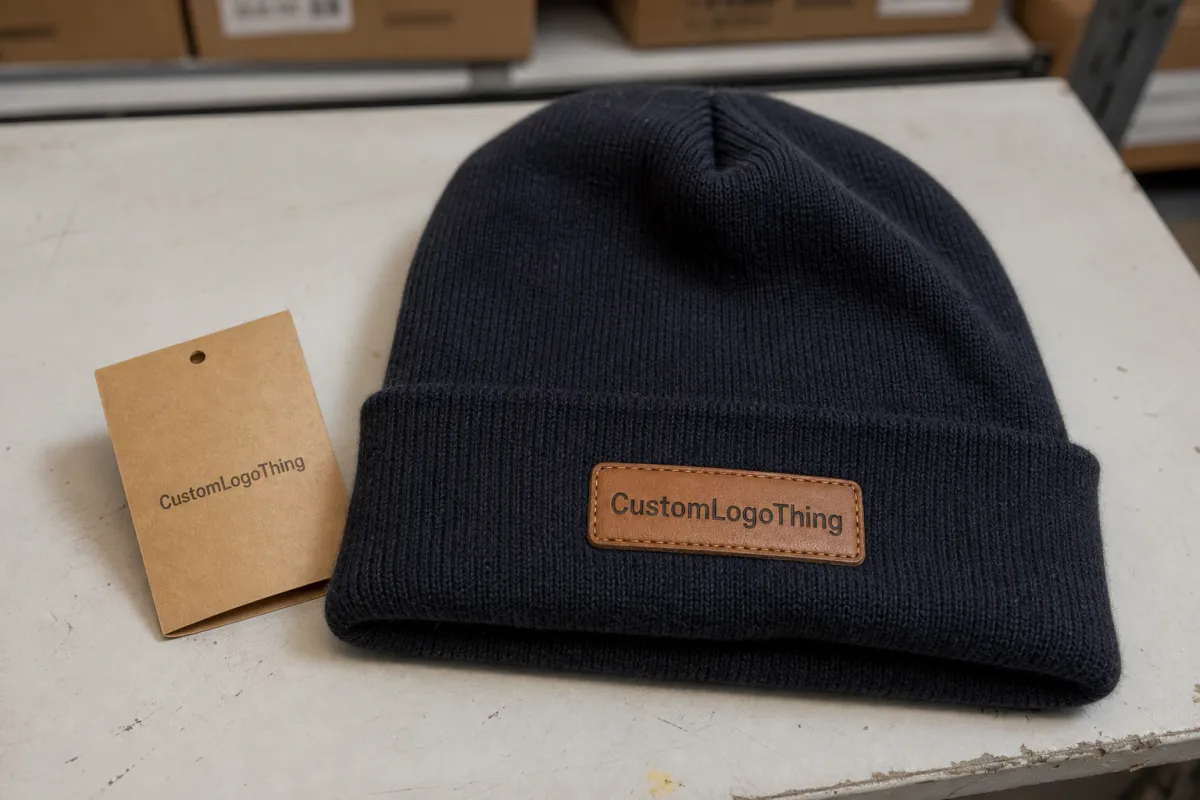
Guests notice small details in a lobby faster than most buyers expect. A folded beanie with a centered patch reads as deliberate, while a plain blank hat can feel like stock inventory that never made it through the branding process. The difference is subtle, but subtle is often enough in hospitality. A neat patch gives the impression that the property paid attention to the whole experience, not just the room key and the signage.
That is one reason this category is used across so many programs: welcome bags, employee issue, resort retail, winter promotions, loyalty gifts, and event merchandise. Each use case has a different budget, but the basic requirement stays the same. The item needs to feel finished and be easy to reorder. A leather patch helps because it keeps the logo visible without adding much production complexity.
The other reason buyers like this style is durability of appearance. Knit surfaces stretch and relax as the hat is handled. A patch creates a stable branding zone that keeps its shape better than fine print on a soft surface. Embossed or debossed artwork tends to age better than tiny printed details, especially when the logo is small.
There is also a practical presentation advantage. A beanie can sit in a display basket, ship in a bulk carton, or be packed into an amenity bag without changing its identity. That flexibility is useful in hospitality, where one product often needs to serve both guest-facing and back-of-house purposes.
Patch construction and beanie styles that hold up in use
The beanie style matters more than many first-time buyers think. A cuffed rib-knit beanie is usually the safest choice for hospitality because the cuff creates a stable decoration zone and a familiar silhouette. It also gives the patch a flatter area to sit on, which reduces the odds of crooked placement. Slouch styles can work for boutique resorts or fashion-led retail programs, but they demand tighter control over patch position because the front panel shifts more as the hat is worn or folded.
Knit weight affects performance too. A heavier gauge winter beanie generally keeps its shape better after repeated wear, while a lighter knit can feel softer but may show more variation from piece to piece. That is not a defect; it is a material tradeoff. Buyers choosing staff issue often prioritize consistency and warmth. Buyers choosing guest gifts may care more about hand feel and presentation.
Patch material changes the tone of the item in a noticeable way. Genuine leather has a richer feel and usually develops more character over time, but it can vary more in tone and grain. Faux leather tends to be more uniform and easier to match across a larger order, which is one reason it shows up often in bulk hospitality programs. If the brand wants a cleaner, more controlled look, faux leather is usually the safer starting point.
Logo style matters just as much as the patch substrate. Simple marks, short wordmarks, and badge-style logos reproduce more reliably than artwork packed with thin strokes or tiny text. Once the patch gets small, detail starts to disappear. A strong shape with clear edges almost always outperforms a busy design. If the logo includes fine lines, ask what the minimum readable size is before the patch is approved.
Placement is another place where small decisions have outsized impact. Center-front cuff placement is the most common because it looks balanced in photos, on shelves, and in use. Side placement can look more fashion-forward, but it also introduces more variation if the beanie is folded differently from carton to carton. For property programs, consistency usually wins.
Specification details buyers should lock in before quoting
The fastest route to a usable quote is a complete spec sheet. Guessing at the details usually leads to back-and-forth, and back-and-forth is how timelines slip. At minimum, a buyer should confirm yarn type, knit gauge, cuff height, crown depth, patch size, patch shape, and decoration method. Those details affect the final look, but they also affect labor, tooling, and packing.
Audience should shape the spec. Staff uniforms need fit stability and a style people will actually wear for a full shift. Guest gifts can lean softer and more presentation-friendly. Retail programs often need a stronger visual read from a short distance, which may justify a slightly larger patch or a more defined logo edge. The same product family can serve all three, but the spec should not be identical for each use.
Artwork readiness matters more than many buyers expect. Vector files are the baseline because they scale cleanly and let the patch maker work from real line weights instead of guesswork. If the art is small, line thickness becomes critical. A design that looks crisp on a screen can become muddy once it is compressed into a patch. Badge-style logos usually handle this better than wordmarks with long names or narrow letters.
Color is another point where screen assumptions fall apart. Knit yarn, patch material, and thread or embossing do not behave the same way, so a digital proof should not be treated as the final appearance. If the beanies need to match existing uniforms, interiors, or brand colors, ask for the closest available match and confirm whether a physical sample is possible. It is better to find a mismatch before production starts than after cartons are packed.
Packaging should be part of the spec, not an afterthought. Individual polybags, bulk packing, size stickers, hangtags, and carton labeling all change the quote. They also affect how efficiently the order can be distributed once it arrives. A staff issue program may need different packing than a retail order. A property rollout may need carton labels sorted by destination. Those details sound mundane, but they are usually where logistics either stay simple or become expensive.
Hotel beanies with leather patch MOQ and cost drivers
Hotel Beanies With Leather Patch MOQ is rarely a single number that applies everywhere. The minimum order depends on how standard the beanie body is, whether the patch is stock or custom, and how much setup work the decoration requires. A stock cuffed beanie with a standard patch generally allows a lower entry point than a fully custom knit program with a unique patch shape. Once custom dies, special yarn colors, or unusual trimming enter the picture, the minimum often rises because the setup cost has to be spread over fewer units.
For many hospitality buyers, realistic MOQ ranges start around 100 to 300 pieces for simple stock programs, then move higher as customization increases. A more specific run with custom patch tooling, multiple colors, or special packaging may land closer to 500 pieces or more. The exact number depends on the supplier's production model, but the underlying pattern is consistent: the more the order deviates from stock, the more volume is needed to keep it economical.
Price also shifts quickly with the same variables. The biggest drivers are patch material, tooling, decoration method, knit quality, and packaging. Genuine leather usually costs more than faux leather. Embossing or debossing often adds setup or tooling charges. Individual polybags, barcode stickers, and carton sorting can push labor costs up even when the hat itself is simple. Freight is another variable that buyers should isolate early, because production cost and landed cost can tell very different stories.
As a directional guide, a standard hospitality order might look like this:
| Quantity tier | Typical unit cost range | What usually changes | Best fit |
|---|---|---|---|
| 100-300 pcs | $2.80-$4.60 | Higher setup burden per unit, less room for tooling absorption | Pilot programs, small events, limited staff issue |
| 500-1,500 pcs | $1.85-$3.10 | Better spread of setup and more stable pricing | Seasonal hospitality orders, regional promotions |
| 2,500+ pcs | $1.35-$2.35 | Bulk efficiency, lower per-unit decoration cost | Multi-property rollouts, retail replenishment |
Those figures are directional, not universal. A small debossed mark on faux leather will price differently from a raised logo on genuine leather, and a premium knit body will move the range upward even if the patch stays simple. Buyers sometimes underprice the packaging and freight side of the order, then wonder why the landed total came in higher than expected. The unit price matters, but the full delivered cost matters more.
The most useful quote request includes multiple quantity breaks. That shows where the price starts to flatten and where the real savings begin. It also helps avoid the common mistake of ordering too few units just to stay near a lower MOQ, then paying more later for a rushed replenishment.
Production steps and timeline from approval to shipment
The production flow is usually straightforward: inquiry, artwork review, proofing, sample or virtual approval, knit production, patch application, finishing, inspection, and packing. Straightforward does not mean identical from order to order. A clean spec can keep the process moving, while unclear art or late changes can add days or even weeks.
For a stock beanie with a standard patch, lead time often lands in the 12 to 15 business day range after proof approval if materials are available and the factory queue is manageable. Custom knit programs need more time, and physical sampling adds more time again. Holiday demand and winter seasonality can stretch all of it. A project scheduled in October does not behave like one scheduled in February.
It helps to separate production time from transit time. Those are not the same thing, even when quoting language makes them sound similar. Ocean freight, air freight, and domestic shipping each produce a different landed schedule. A buyer planning for an opening date or a guest gifting window should treat transit as a separate decision, not a detail buried in the tail end of the order.
Approval speed matters more than many teams expect. If the proof is delayed for a week because the logo needs cleanup or the patch shape still has open questions, the calendar moves immediately. Clean vector art, final color direction, confirmed patch size, and a fixed ship-to destination all reduce that risk. A small pause in approvals can create a large pause in production.
A small patch change can affect die lines, stitching, and the final approval cycle. On repeat hospitality orders, it is usually safer to lock the spec early and avoid cosmetic revisions unless there is a real production reason.
Packing should match the route and the end use. Bulk cartons work well for back-of-house storage and multi-property distribution. Individual polybags make sense for guest amenity kits or retail resale. If the shipment is fragile, long-haul, or moving through multiple handling points, ask how the cartons are built and whether the pack-out plan protects the hats from crushing. That sounds basic, but hat shape loss is one of the easiest ways for a good product to arrive looking tired.
Quality control checks that prevent expensive rework
Good QC on a beanie order is not about perfection theater. It is about catching the small problems that become expensive once multiplied across hundreds or thousands of units. The first check should be placement. The patch needs to sit consistently on the cuff or front panel, with enough spacing to look intentional and enough stitching to hold through handling. If the patch drifts even slightly from unit to unit, the order starts looking uneven on a shelf.
Next comes color consistency. Knit lots can vary, and patch batches can vary too. That is especially true when the order combines a darker beanie body with a warm-toned faux leather patch. Buyers should ask whether the supplier checks against an approved sample or approved digital standard during production, not just at the end. Waiting until final packing to discover a color issue usually leaves no room to fix it.
Logo legibility is another easy failure point. On small patches, thin lines can blur and tiny text can disappear. The QC question is simple: can the mark still be read at a normal viewing distance? If not, the art probably needs to be simplified before the next run. The strongest hospitality pieces usually rely on shape and contrast, not on cramming every brand detail into a one-inch patch.
Finally, inspect packing accuracy. Carton counts, labels, and destination splits need to match the order record. That may sound administrative, but a good-looking product is not much help if half of it lands at the wrong property or arrives without the right label. Buyers who reorder regularly tend to care about this as much as the hat itself, because the second shipment is only useful if the first one established a reliable system.
What to expect from a supplier for repeat hospitality orders
Repeat orders are where supplier discipline shows up. A good sample is easy to make once. Matching that sample six months later is the harder test. Buyers should expect the supplier to keep a record of the approved spec, artwork version, patch type, and packing method. If those details are not stored cleanly, the next order can drift in ways that are hard to see until the cartons are opened.
Communication should be practical, not decorative. If a supplier says a lower price is possible, they should be able to explain what changed: patch size, packaging, decoration method, yarn weight, or quantity. Vague claims are not useful. Clear tradeoffs are. A buyer needs to know whether the savings came from a simpler spec or from a compromise that will show up later in quality or durability.
Packaging support matters here too. Hospitality programs often need bulk counts, carton labeling, or individual bagging. A supplier that can handle those details without constant correction saves time and reduces fulfillment mistakes. For a property rollout, that can matter as much as the hat itself.
The best repeat-order setup is boring in the right way. The spec is stored, the sample is referenced, the carton logic is known, and the production line is not guessing. That kind of process does not generate flashy language, but it does keep seasonal replenishment from turning into a scramble.
Next steps for requesting a quote and placing the order
A useful quote request gives the supplier enough information to price the order honestly. Send the target quantity, preferred beanie style, patch material, logo artwork, color target, packaging requirement, ship-to destination, and deadline. If the order matters for a launch, an opening, or a winter promotion, say so. Timing affects material planning and production priority, and it should be visible from the start.
Ask for pricing at two or three quantity levels. That makes the real MOQ easier to see and shows where the price break starts improving. It also helps a buyer compare total spend against actual need instead of choosing a quantity only because it looks cheaper on paper. The lowest unit price is not always the best decision if half the inventory will sit in storage.
It also helps to describe how the beanies will be used. A guest gift, staff issue program, and retail item should not be priced as if they are identical. Staff distribution may justify simpler packaging and a stronger durability focus. Retail may justify a more polished patch face or cleaner fold presentation. Guest gifts often sit somewhere in the middle, where the item has to look premium without becoming delicate.
Before approving, confirm the proofing method, sample availability, and production start date. Those three checkpoints determine whether the order can move with confidence or whether it will drift while people wait on revisions. For buyers searching hotel Beanies With Leather Patch MOQ, the most efficient path is simple: finalize the spec, request tiered pricing, and approve against a proof that matches the real patch size and logo shape.
What is the usual MOQ for hotel beanies with leather patches?
MOQ depends on whether the beanie is stock or custom, whether the patch is standard or tooled, and how much decoration work is involved. Simple stock programs often start lower, while custom knit or custom patch projects need more volume to make setup costs workable. Asking for tiered pricing usually gives the clearest picture.
Can I mix beanie colors and still meet a leather patch MOQ?
Sometimes yes, but color mixing can affect cost and inventory control. If each color needs separate setup, separate materials, or separate packing, the MOQ may need to be split by color. The cleanest approach is usually one approved patch design across a limited set of pre-approved base colors.
Which leather patch option works best for hospitality branding?
Faux leather often works well for hospitality because it is consistent, clean-looking, and easier to match across larger runs. Genuine leather can feel more premium, but it may vary more in tone and grain. For small logos, embossed or debossed artwork usually stays readable better than fine printed detail.
How long does production usually take after approval?
Simple stock programs can move quickly once artwork is approved and materials are ready. More complex projects, sample requests, or seasonal congestion add time. Shipping time should be handled separately from production time, since transit can change the real delivery date even when production stays on schedule.
What do I need to send for an accurate quote?
Send quantity, target deadline, hat style, patch material, logo file, packing requirement, and ship-to location. If the budget matters, share it early so the spec can be aligned to the right cost level. The more complete the brief, the cleaner the quote.

