Apparel embroidered Beanies Bulk Order Planning works best when the order is treated like production, not a casual merch buy. Knit headwear is less forgiving than flat apparel: a logo can look sharp on a mockup and still lose clarity once it is stitched into a stretchy cuff, folded for packing, and handled through fulfillment.
Embroidery usually gives buyers the best balance of durability and presentation. The thread is anchored into the knit, so the decoration holds up better than many print methods and reads more finished for retail, employee kits, school programs, and winter promotions. The tradeoff is that the artwork has to be simplified enough to survive the fabric.
That is why the early choices matter so much. Once the style, placement, decoration size, and quantity mix are set, the rest of the order is easier to price, proof, and deliver on time.
Why embroidered beanies outperform printed winter merch
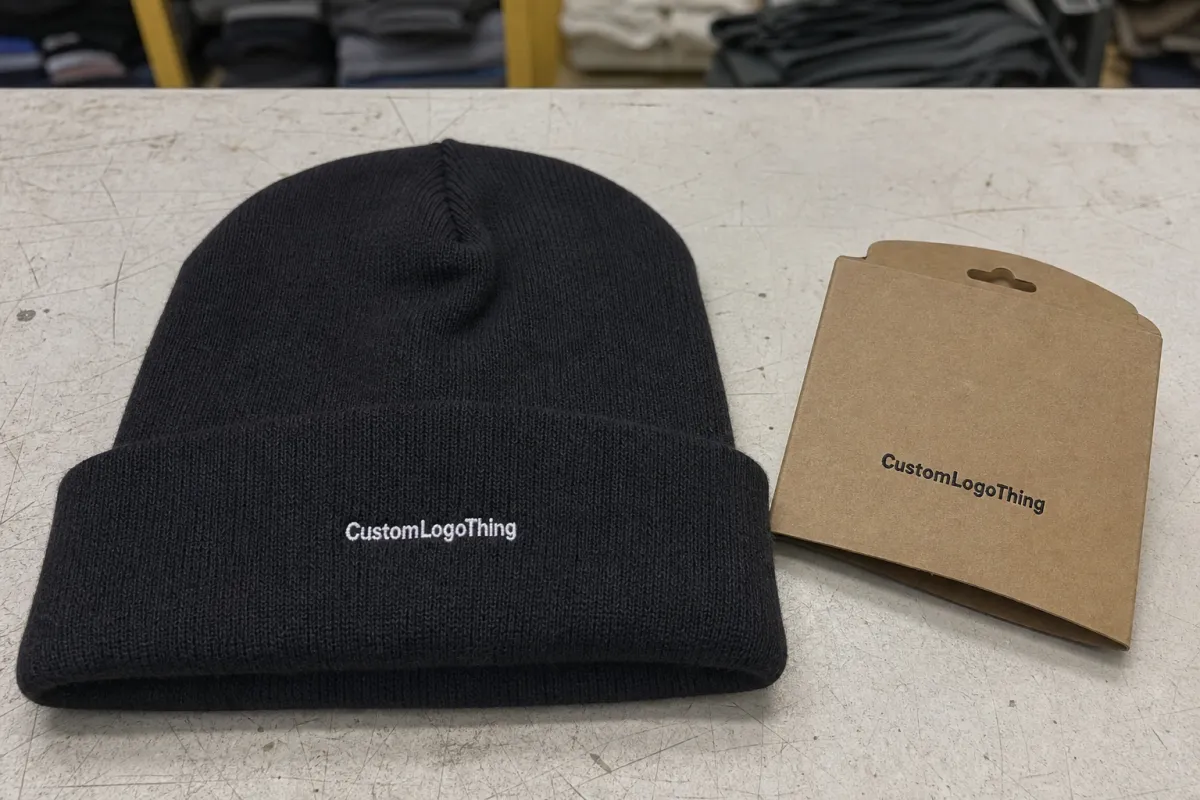
Beanies get stretched, packed, worn, and washed more aggressively than many other accessories. Print can work on some headwear, but it is more likely to crack, peel, or blur when the surface moves. Embroidery holds up better because it becomes part of the fabric structure rather than sitting on top of it.
That durability does not mean every design translates well. Tiny text, fine gradients, and highly detailed art can turn muddy once thread covers the surface. Clean logos with solid spacing usually perform better than complicated marks that only look good in a close-up render.
There is also a buyer-perception effect. A cuffed beanie with one well-placed embroidered logo often feels closer to retail merchandise than giveaway swag. That matters because people wear and keep items that look deliberate.
The safest beanie order usually wins before stitching starts: clear art, stable placement, and fewer decisions that can drift late in the process.
Embroidery also tends to age more naturally than print. If a printed layer starts to fail, the item looks old fast. Thread can fuzz over time, but it does not usually fail in the same obvious way. For logos, monograms, varsity marks, and simple icons, embroidery is one of the most reliable ways to make winter headwear look finished without driving the unit cost too high.
Beanie styles, yarns, and logo placements that change the result
Not every blank behaves the same under a needle. A cuffed acrylic beanie usually gives the most reliable decoration zone because the fold creates a firmer surface for the logo. Uncuffed styles can work too, but they require tighter control over stretch, placement, and logo height.
Material choice matters more than many buyers expect. Acrylic is common because it is warm, cost-effective, and easy to source in volume. Polyester blends can feel smoother, and recycled yarns may fit sustainability goals, but both can change how thread sits on the surface. Tighter knits generally produce cleaner edges than loose knits.
Placement drives both the look and the consistency of the run. Center-front cuff embroidery is still the most dependable option because it is easy to read and easy to repeat. Side placements can look more modern, and back hits can work for secondary branding, but both need more care. If the fold varies from piece to piece, the logo can land in a place that feels wrong even when the stitch file is correct.
- Cuffed beanies offer the most stable embroidery zone and the easiest proof approval.
- Uncuffed beanies need tighter logo sizing and more care around stretch.
- Pom beanies limit the usable field near the crown and can push the design lower than expected.
- Slouch beanies often work best with smaller marks that follow the drape instead of fighting it.
Cuff height deserves a real check before approval. A design that fits a tall fold may feel squeezed on a shorter one. Seam placement matters too, especially when the blank pattern puts the center line in an awkward spot. If a logo crosses a seam or rides too close to the edge of the fold, the finished piece can look slightly off even when the mockup looked fine.
Thread color is another small decision that can change the result. High contrast usually performs best on knit headwear. A white logo on navy or black reads quickly. Tone-on-tone stitching can work, but only when the buyer knows the mark will still be visible in winter light.
Apparel embroidered beanies bulk order planning: specs to lock before proofs
The fastest way to delay a beanie order is to leave the specifications fuzzy. Before proofing starts, lock the final logo size, exact placement, thread color count, beanie color, and any secondary decoration such as a woven label, back hit, or hangtag. Every unresolved item can create another revision cycle.
Vector artwork should be the default starting point. AI, EPS, and clean PDF files make digitizing easier because the designer can preserve lines and spacing accurately. A screenshot or compressed image file may still be usable, but it often creates cleanup work. Thin strokes, tiny letters, and intricate outlines are the first things to suffer when art is not clean.
Stitch count is worth watching because it reflects complexity. A simple wordmark may embroider efficiently and hold its shape well, while a badge with small type can force tighter spacing and denser thread movement. In bulk headwear, simpler artwork often looks better because it reads clearly from a normal viewing distance.
Color expectations should stay realistic. If a buyer needs a PMS reference, it should be provided early, but the final look will still depend on thread sheen, knit texture, and the color of the blank. Proof review should focus on contrast, legibility, and balance, not just digital color accuracy.
- Final logo size in inches or millimeters
- Exact placement on cuff, front body, side, or back
- Thread color count and PMS references if needed
- Beanie color split by quantity
- Secondary packaging such as labels, tags, or polybags
During proof review, check spacing between letters, edge clarity, how the logo sits against the cuff, and whether the design still reads from normal distance. If the artwork only looks good zoomed in, it is probably too detailed for knit headwear. A smaller, cleaner version usually survives production better.
Confirm what is included in the proof itself. Some proofs show the blank only, while others include the decoration and packaging notes. If the quote includes a specific fold style, a retail hangtag, or a polybag count, those details should appear in the proof so there is no guesswork later.
Pricing, MOQ, and unit cost drivers for bulk runs
Pricing becomes easier to compare once it is broken into parts. For embroidered beanies, ask for the blank cost, digitizing, embroidery setup, thread changes, sample requests, individual bagging, labeling, and freight. A single lump-sum quote can hide where the real cost sits.
MOQ is usually tied to setup efficiency and blank availability. A standard cuffed acrylic beanie can often be produced at lower minimums than a pom style, a specialty yarn, or a multi-location decoration job. The more the order departs from a standard blank-and-logo setup, the more likely the minimum will rise.
For buyers forecasting cost, the useful question is not only "What is the unit price?" It is "How quickly does the unit price improve as quantity rises?" Digitizing and setup are fixed costs, so the per-item price drops as volume increases.
| Configuration | Typical cost drivers | Approx. unit range at bulk quantities | Best fit |
|---|---|---|---|
| Standard cuffed acrylic beanie, one embroidery location | Low setup, simple digitizing, one thread color change | $3.50-$5.75 | Employee kits, giveaways, school programs |
| Cuffed beanie with 2-color logo | Moderate digitizing, additional thread handling | $4.25-$6.75 | Retail resale, brand merchandise, club orders |
| Pom beanie with front embroidery | More complex placement and knit structure | $5.25-$8.25 | Lifestyle programs, seasonal retail |
| Beanie plus woven label, hangtag, or individual bagging | Added finishing and pack-out steps | $5.75-$9.00 | Retail shelves, premium promos, e-commerce |
Those ranges move with quantity. A 250-piece order usually carries more setup per unit than a 5,000-piece run, even if the decoration is identical. If the order is seasonal, ask for pricing at two or three volume breaks so it is easier to judge whether one larger run or several smaller colorways make more sense.
Extra finishing can add cost faster than buyers expect. A sewn-in label, custom hangtag, or individual bagging may sound minor, but each one adds labor and pack-out time. That is not a reason to avoid finishing; it is a reason to ask for it early, before the quote has to be revised and the schedule reworked.
If the order is part of a wider apparel program, internal links such as Wholesale Programs can help with repeat buys or bundled merchandise. The main value is consistency: the same blank, same stitch file, and same pack-out should be repeatable later without rebuilding the job.
Production steps, turnaround, and lead time from proof to delivery
Most beanie orders follow the same basic path: quote, art review, digitizing, proof approval, sample confirmation if needed, bulk embroidery, quality control, and final shipping. The order moves best when each stage is finished cleanly before the next begins.
For standard embroidered beanies, turnaround often lands around 12 to 15 business days after proof approval when blanks are in stock and the art is straightforward. More complex logos, specialty yarns, or custom pack-out can stretch the schedule to 15 to 20 business days or longer. Rush service can shorten the calendar, but it usually reduces flexibility around revisions and finishing options.
Seasonality has a bigger effect than many buyers budget for. Late fall fills quickly. A quote that feels comfortable in August can become tight by October if the order needs multiple proof rounds or a special color search. For launches, fundraisers, and retail resets, it is safer to build buffer into the in-hands date.
Three things tend to speed the process up more than anything else: clean artwork, a confirmed quantity split by color, and one person with approval authority. The biggest delays usually come from late logo changes, vague placement notes, or a request for delivery before the spec sheet is settled.
Sample requests can also affect timing. A pre-production sample helps when the logo is unusual, the placement is unusual, or the buyer wants to test hand feel before the bulk run. For simpler programs, a digital proof may be enough. The right answer depends on risk, not habit.
How to compare suppliers on consistency, QC, and pack-out
A good sample is only part of a good bulk order. What matters next is whether the supplier can repeat that result across the full run. Consistency is the real test: the logo should sit in the same place, the stitch density should stay even, and the thread should look balanced from one piece to the next.
Ask how the shop checks for loose threads, skipped stitches, off-center placements, and color drift. A solid vendor should answer in plain language. If the response is vague, the process is probably vague too. Suppliers that document thread references, stitch files, and prior approvals usually handle reorders better because they are not starting from memory.
Pack-out deserves more attention than it gets. Confirm whether beanies will be folded a certain way, whether colors or sizes will be separated, whether labels need to face a specific direction, and how carton counts will be marked. For retail, distribution, or kit assembly, those details can save labor on the receiving end.
The supplier who can explain quality control without jargon usually understands it well enough to repeat it, and repeatability is what bulk headwear depends on.
Shipping and packaging standards can also reveal how disciplined the vendor is. Some programs benefit from asking whether carton handling follows ISTA drop and vibration expectations, especially if the route is long or the cartons will be handled more than once. If the order includes paper inserts or hangtags, FSC certification can be a useful benchmark for paper-based materials.
Responsiveness matters as much as decoration skill. A supplier who returns clear answers on placement, proofing, and pack-out is usually easier to work with on repeat orders than one who only sends a price and leaves the rest open-ended. Bulk headwear has enough moving parts already.
Next steps to launch a clean bulk order without delays
The cleanest quote request includes everything needed to price the order accurately on the first pass. Send the vector logo, beanie style, quantity by color, decoration placement, thread color count, and needed-in-hands date together. If the order has multiple colorways or packaging requirements, break those out clearly.
Decide early whether the beanies need folded cuff branding, a retail-ready presentation, or plain carton packing. These choices change labor and can affect the blank selection. They also shape how the order is received by the end user. A shelf-ready program needs a different pack-out mindset than an event table or onboarding kit.
Before approval, review the digital mockup carefully. Check the logo scale, placement, thread colors, and how the decoration sits against the beanie shape. Then confirm the final price, quantities, and timeline in writing so there is one approved version of the order.
For teams still gathering details, the most useful move is to organize the art file, quantity split, and delivery window before asking for a quote. That makes apparel embroidered beanies Bulk Order Planning more efficient and usually produces a better result. The stitch file is cleaner, the proof cycle is shorter, and the finished beanies are more likely to look deliberate from the first carton to the last.
FAQ
How early should I start apparel embroidered beanies bulk order planning?
Start as soon as the logo, quantity, and delivery window are known. Embroidery orders need time for digitizing, proofing, production, and shipping, and seasonal demand can tighten the calendar quickly. Add more buffer if the beanies are tied to a launch, fundraiser, or event with a hard in-hands date.
What details do I need for an accurate embroidered beanie quote?
Send the beanie style, quantity by color, logo file, decoration placement, thread color count, and whether you need custom packaging or labels. Exact specs help the quote match the final order instead of turning into a rough estimate that has to be corrected later.
What is a typical MOQ for bulk embroidered beanies?
MOQ depends on the supplier, decoration complexity, and beanie style. Standard cuffed beanies often support lower minimums than specialty knits, pom styles, or multi-location embroidery. Ask whether multiple colors can be combined under one minimum or whether each colorway needs its own threshold.
Can I mix beanie colors in one embroidered order?
Yes, many orders can mix colors, but the final structure depends on stock availability, setup efficiency, and whether the order still meets the supplier's minimums. Color mixes are easiest when the logo, placement, and beanie style stay consistent across the whole program.
What affects turnaround time on apparel embroidered beanies bulk order planning?
Turnaround is driven by artwork readiness, approval speed, stock availability, stitch complexity, quantity, and any custom finishing or packing steps. Clean art, one placement, and a fast approval cycle are the biggest factors that keep the order on schedule.

