A beauty Pom Pom Beanies unit cost review usually uncovers more than a hat price. It shows whether a winter merch program has been costed as a complete product, with yarn, decoration, packaging, freight, labeling, and campaign timing all treated as connected decisions.
That distinction matters for beauty buyers. A beanie may be softer, lighter, and less fragile than a boxed serum or glass jar, but it is also more visible after the first unboxing moment. If the fit is comfortable and the branding feels considered, the same hat may appear on winter commutes, salon visits, gym lockers, school runs, social posts, and staff event photos for months. If it feels scratchy or looks like generic clearance merchandise, the brand pays for impressions it never really earns.
The Margin Story Behind a Winter Beauty Giveaway
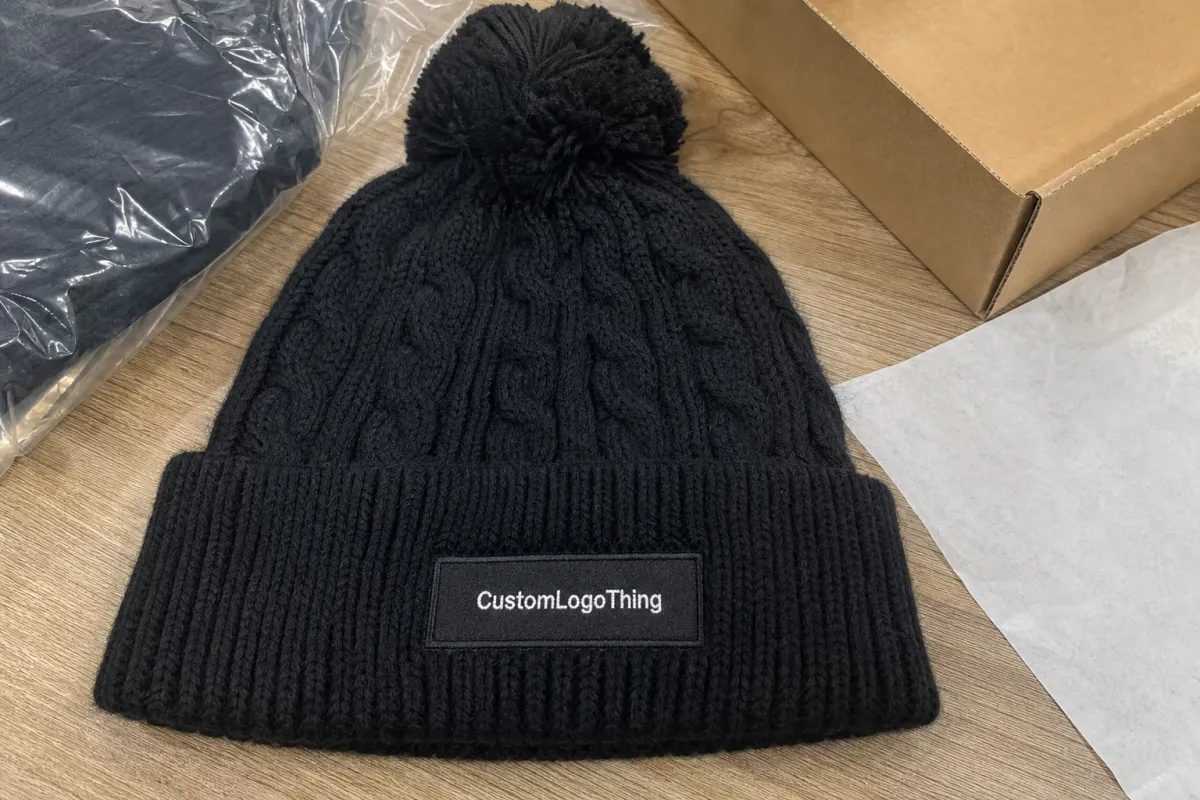
Beauty brands, spas, lash studios, skincare subscription boxes, cosmetic retailers, and salon chains often choose Pom Pom Beanies for holiday gifts, VIP perks, launch merch, staff apparel, and gift-with-purchase programs. On paper, the item looks simple: knit cap, cuff, pom, logo, package, ship. In production, each of those choices carries a cost and a quality risk.
A low-cost insert can disappear into a drawer minutes after a parcel is opened. A well-made branded beanie can be worn 30, 50, or 80 times during cold months if the hand feel, color, logo scale, and pom quality match the audience. That changes the cost-per-use argument, but it also raises the standard. A premium skincare or cosmetics brand cannot afford a beanie that sheds, pills early, smells strongly of dye, or feels rough against the forehead.
Before any supplier can quote responsibly, six inputs need to be defined: yarn, knit construction, decoration method, pom material, packaging format, and freight route. Add retail labels, barcode stickers, suffocation warnings, insert cards, or individual gift boxes, and the unit cost can move quickly. The first quoted number is rarely the final landed cost.
Buyer reality: a beanie that looks cheap on the quote sheet may become expensive after sample fees, setup charges, packaging labor, carton volume, duties, and expedited freight are added. Landed cost is the number that should guide the decision.
A useful review separates fixed costs from design choices. It shows which details protect the brand experience, which upgrades are mostly cosmetic, and which specifications will strain the calendar. That clarity reduces quote revisions and helps buyers avoid the common pattern of approving an attractive mockup, then discovering too late that the packaging cube or color requirement breaks the budget.
Why Pom Pom Beanies Fit Beauty Merch
Beauty Pom Pom Beanies are usually cuffed knit hats with faux fur, yarn, or tonal poms, customized for personal-care and beauty campaigns. The best versions do not feel like blank promotional stock with a logo added afterward. They feel soft, warm, giftable, and aligned with the sensory language beauty brands already use: texture, comfort, color, ritual, and presentation.
Soft-touch textiles sit naturally beside winter skincare, lip care, haircare, fragrance, and spa gifting. A stainless tumbler may be useful, but a knit beanie has a closer relationship with self-care, cold-weather routines, and wearable comfort. Neutral shades such as oatmeal, charcoal, ivory, mushroom, and taupe often feel more elevated than bright stock colors. Pastels can support skincare, wellness, or clean beauty positioning. High-contrast cuffs and bolder poms suit color cosmetics, youth-focused drops, or streetwear-inspired launches.
The buying reason is rarely warmth alone. Most beauty programs need perceived gift value. The beanie must photograph well, hold the chosen color, fit into the mailing or retail kit, and avoid looking like a leftover giveaway. That is why a slightly better knit weight, a cleaner patch, or a more careful packaging format can be worth more than another small discount on the base cap.
- Holiday sets: beanie packed with lip balm, hand cream, mask sachets, fragrance samples, or travel sizes.
- Influencer mailers: cuff logo visible in unboxing photos, usually paired with tissue, a card, and color-coordinated packaging.
- Staff apparel: consistent winter uniform item for salons, counters, spas, pop-ups, and outdoor promotional teams.
- VIP rewards: higher perceived value than a paper coupon, sample sleeve, or single-use insert.
Beanies also have practical advantages. They are compact compared with many apparel items, not fragile like glass packaging, and easy to kit with belly bands, hang tags, printed insert cards, tissue, kraft boxes, or mailers. Faux fur poms still need attention because they increase carton volume and can be compressed if packed poorly, but breakage risk is low compared with bottled beauty products.
Specifications to Lock Before Quoting
The fastest way to receive a vague quote is to send a vague brief. “Cute branded beanie with pom” leaves too much open: yarn, gauge, cuff height, pom type, logo method, color tolerance, packaging, labeling, and delivery destination. A clear specification does not need to be complicated, but it must give the supplier enough information to price the actual product rather than a rough idea.
Acrylic remains the common budget-friendly yarn because it offers broad stock color availability, reliable shape retention, and lower cost. Recycled polyester can support sustainability messaging, although buyers should ask what documentation is available before making recycled-content claims. Cotton blends may improve softness but can stretch and recover differently from acrylic. Wool blends provide a more premium hand feel, yet they raise cost and can create itch concerns, care-label requirements, or audience sensitivity issues.
Knit construction changes the look and the material consumption. Rib knit is classic, stretchy, and efficient. Cable knit looks more giftable but usually uses more yarn and may feel bulkier in a kit. Double-layer construction improves warmth and structure, while slouch profiles require extra length. Cuff height should be specified in centimeters or inches because a 7 cm cuff and a 10 cm cuff create different logo areas, different proportions, and sometimes different material costs.
Logo Choices That Change the Cost Profile
Decoration should match the brand mark, not simply the lowest setup charge. Embroidery can work well for simple icons, initials, and short wordmarks, especially when the stitch count is controlled. Woven patches preserve fine detail better and often suit thin serif logos, ingredient-style typography, or clean skincare marks. Leatherette patches can create a boutique wellness look, though buyers should confirm color options, wash behavior, and whether the material suits the brand’s ethics. Jacquard knit-in logos integrate the branding into the beanie itself, but they usually require higher minimums, more sampling discipline, and careful review of distortion on stretch.
The pom is not a minor trim. Faux fur poms often raise perceived value for beauty gifting, but they add volume, can increase freight cost, and need careful packing to avoid flattening. Yarn poms are more casual and economical. Tonal poms feel quieter and more premium in neutral palettes. Contrast poms create stronger shelf impact, but they require tighter color control so the hat does not look mismatched under retail lighting or in photography.
Color deserves discipline. PMS references are useful, but yarn is not ink on coated paper. Dye lots vary, and a digital mockup cannot prove whether blush, sage, cream, or cool gray will read correctly in real knit texture. If brand color is critical, approve a physical sample. If a custom dye is required, confirm minimums, sampling time, dye-lot tolerance, and whether the same yarn will be used in bulk production.
Packaging is part of the specification, not an afterthought. Options include individual polybags, recycled kraft belly bands, printed insert cards, hang tags, barcode stickers, retail labels, suffocation warnings, tissue wrap, rigid gift boxes, and master carton marks. FSC-certified paperboard can support responsible sourcing claims; buyers can review certification basics through the Forest Stewardship Council. For retail, subscription, or fulfillment programs, label placement and case pack counts should be confirmed before artwork is released.
| Specification Choice | Typical Cost Effect | Best Fit for Beauty Buyers |
|---|---|---|
| Acrylic rib knit with yarn pom | Lower unit cost; broad stock color options | Large giveaways, staff apparel, simple seasonal promos |
| Double-layer knit with faux fur pom | Higher material cost and larger carton volume | VIP gifts, retail bundles, influencer mailers |
| Woven patch logo | Moderate setup charge; strong detail control | Fine logos, boutique skincare, clean typography |
| Rigid box with insert card | Higher packaging cost, labor, and freight cube | Premium gift sets, subscription upgrades, press kits |
Beauty Pom Pom Beanies Unit Cost Review: What Buyers Really Pay
A credible beauty pom pom Beanies Unit Cost Review does not treat every hat as the same commodity. The final price is built from the base beanie, pom style, logo method, packaging, sampling, duties, and freight. Sometimes the cheapest base cap becomes the more expensive landed option because the pom increases carton size or a gift box doubles the packing volume.
Order quantity drives much of the math. Higher volumes spread setup charges, embroidery digitizing, patch tooling, custom dyeing, packaging setup, and freight across more units. A 250-piece pilot can look expensive per piece, while a 2,500-piece campaign order may become much more efficient. Still, volume does not erase every premium. A custom-dyed double-layer beanie with a large jacquard logo, faux fur pom, and rigid box will remain a more expensive product than a stock rib knit with a simple patch.
Planning ranges vary by sourcing route, specification, and shipping method, but buyers often see stock-color decorated beanies in the lower single digits for larger bulk programs. Premium knits with faux fur poms, woven patches, retail labels, and gift packaging can climb materially from there. Packaging alone may add roughly $0.18 to $0.75 per unit for belly bands, insert cards, basic labels, or simple boxes, while rigid presentation packaging can exceed that range. Freight may shift the landed cost again, especially when air shipment is needed to protect a launch date.
The most useful way to review cost is to separate the levers rather than argue over one blended number.
- Yarn type: acrylic, recycled polyester, cotton blend, and wool blend each affect cost, feel, care labels, and claim support.
- Beanie weight: heavier double-layer, cable, or slouch styles consume more material than light rib knits.
- Color program: stock shades reduce risk; custom-dyed yarn can add minimums, lead time, and sample rounds.
- Logo method: embroidery, woven patch, leatherette patch, jacquard, hang tag, or belly band each prices differently.
- Pom material: faux fur may improve gift value but increases packing volume and can affect freight.
- Packaging: polybag, kraft band, insert card, retail label, tissue, or box changes labor, carton size, and fulfillment cost.
Quote traps are common. Freight may be excluded. Sample fees may appear after mockup approval. PMS matching may be treated as automatic when it is not. Packaging volume may be ignored until the logistics team calculates carton cube. Rush production may be requested after a buyer approves a complex specification that never had room in the calendar. On tight campaigns, these issues can move the landed budget by 10% to 30%.
Ask for good-better-best pricing with enough detail to compare real choices. A strong quote should show MOQ breaks, sample costs, setup charges, carton dimensions, estimated gross weight, packaging assumptions, freight terms, and the difference between stock and custom colorways. The point is not to make the beanie cheap at any cost; it is to understand where the money goes and which decisions give the brand the best return.
Process and Timeline from Sample Approval to Delivery
The process is manageable when the brief is complete. It normally starts with intake: quantity, campaign purpose, delivery location, target landed budget, artwork, brand colors, packaging needs, and required in-hands date. From there, the order moves through artwork review, material selection, quote, digital mockup, physical sample if required, written approval, bulk knitting, decoration, inspection, packing, and shipping.
The sample stage deserves time. A digital mockup can confirm logo placement and general proportion, but it cannot prove stretch recovery, hand feel, pom fullness, cuff pressure, thread contrast, or whether a pale logo disappears into a cream knit. Physical samples are especially useful for beauty programs where the beanie needs to feel giftable rather than merely functional.
Several issues slow timelines: custom-dyed yarn, revised artwork, patch material changes, pom substitutions, packaging redesigns, late barcode files, missing ship-to details, and too many stakeholders reviewing small visual changes. One undecided approval can consume more calendar time than the decoration step itself.
Buyers should appoint one decision-maker and approve specifications in writing. Confirm adult sizing, cuff height, logo placement, pom type, packaging components, retail labels, carton marks, and delivery address before bulk work begins. If the beanies are part of a subscription kit, also confirm case pack counts, inner pack requirements, and fulfillment instructions.
Freight timing can change the entire cost profile. Air freight may protect a product launch, influencer mailer, retail floor set, or employee gifting event, but it increases landed unit cost. Ocean or consolidated freight can reduce cost when the calendar allows. For packaged programs, distribution testing principles from organizations such as the International Safe Transit Association can be useful, even though the beanie itself is not fragile.
Planning rule: build the calendar backward from the campaign drop date, not forward from the quote date. Seasonal merch fails fastest when purchasing begins after the deadline is already compressed.
Quality Checks That Prevent Winter Merch Mistakes
Beanie inspection sounds simple until cartons arrive with crooked patches, loose poms, inconsistent cuff heights, mixed dye lots, or scratchy inner seams. A beauty customer may forgive a delayed free gift more easily than a cheap-feeling one, especially if the brand has trained them to expect softness, care, and visual refinement.
Inspection should cover knit density, stretch recovery, cuff symmetry, logo placement, patch stitching, pom attachment strength, color consistency, loose threads, label accuracy, packaging count, and carton markings. Pull lightly on pom attachments. Stretch the cuff and check whether it recovers. Compare production color against the approved sample under neutral lighting, not only under warm office bulbs. Photograph carton labels before dispatch so receiving teams can identify issues quickly.
Fit is a brand issue. Adult sizing should suit the intended audience, not simply the supplier’s default block. Cuff pressure, seam feel, inner label irritation, and pom weight can decide whether recipients keep wearing the hat. A large faux fur pom may look premium in a flat-lay photo but feel unbalanced if the beanie body is too light or shallow.
Artwork control needs extra attention on knit surfaces. Thin serif logos, small ingredient-style text, hairline icons, and low-contrast embroidery can fail on ribbed material. Woven patches or labels often preserve detail better. If embroidery is required, simplify the stitch path, avoid overly small lettering, and test thread contrast against the actual knit color before approving bulk production.
Compliance and retail readiness should be confirmed early. Care labels, fiber content, country of origin, carton marks, barcode labels, and polybag suffocation warnings may be required depending on sales channel and destination. If paper packaging is used, confirm recycled-content claims, certification language, print specs, and label placement before final artwork is released.
For hard campaign dates, request pre-shipment photos, a production sample, or inspection reporting before final balance and dispatch. Catching a crooked patch or wrong belly band before cartons leave is far cheaper than finding the error after 1,000 influencer kits have been packed.
Quote-Ready Details for a Cleaner Bulk Order
A smart quote request starts with decisions, not adjectives. Confirm quantity, target landed budget, preferred yarn, beanie color, pom style, logo method, packaging format, delivery date, and shipping destination. If the campaign has a fixed retail floor set, mailer drop, event date, or subscription packing window, state that immediately.
Send vector artwork, PMS references, brand guidelines, packaging inspiration, barcode files if available, and retail labeling requirements. Clear inputs reduce revisions and make the cost review more useful. They also help separate design preference from actual budget pressure.
Ask for three quote tiers:
- Standard option: stock-color beanie, simple embroidery or patch, individual polybag.
- Upgraded option: better knit weight, faux fur pom, woven patch, branded belly band.
- Premium gift option: refined colorway, retail-ready label, insert card, tissue wrap, or gift box.
MOQ breaks are useful at practical quantities such as pilot, campaign, and reorder volumes. A quote at 300, 1,000, and 3,000 pieces can reveal where the unit cost changes enough to affect strategy. Some teams may choose a smaller test despite the higher unit cost; others may move into a larger seasonal buy once the setup and freight are spread across more units.
Custom Logo Things can help coordinate branded presentation details alongside the beanie order, including insert cards, belly bands, labels, gift boxes, and carton requirements. That coordination matters because packaging is not decoration added after the fact. It affects unit cost, freight, lead time, fulfillment accuracy, and the way the gift is perceived when the package is opened.
Use a beauty pom pom Beanies Unit Cost Review as a working checklist before approving samples, budgets, and production timelines. The strongest buy is not the lowest advertised number. It is the beanie that matches the brand, lands on time, fits the campaign budget, and still feels worth wearing after the first photo is taken.
FAQ
What affects beauty pom pom beanies unit cost the most?
The largest drivers are order quantity, yarn type, knit weight, pom material, logo method, packaging complexity, and freight method. Custom-dyed yarn, faux fur poms, woven patches, and gift-ready packaging can raise unit cost, but they may also improve perceived value for beauty promotions.
What MOQ should beauty brands expect for custom pom pom beanies?
MOQ depends on whether the buyer selects stock colors, custom yarn colors, standard decoration, or fully custom packaging. Stock-color beanies with a patch or embroidery usually allow lower minimums than custom-knit, jacquard, or custom-dyed programs.
Can pom pom beanies be packaged for beauty gift sets?
Yes. They can be packed in individual polybags, belly bands, tissue wrap, kraft boxes, rigid gift boxes, or kits with insert cards and product samples. Packaging should be quoted early because boxes, inserts, labels, and tissue affect unit cost, carton size, freight, and fulfillment labor.
Which logo method is best for beauty pom pom beanies?
Woven patches work well for detailed logos, embroidery suits simpler marks, leatherette patches create a boutique look, and jacquard logos integrate the branding into the knit. The best choice depends on logo complexity, brand tone, budget, and whether the beanie needs to feel promotional or retail-grade.
How long does a custom beauty beanie order usually take?
Timing depends on sample approval speed, material availability, decoration method, packaging requirements, and freight choice. Buyers should plan backward from the campaign date and approve artwork, colors, packaging, labeling, and delivery details before bulk production begins.


