Restaurant Logo Patch Beanies Bulk Order Planning That Prevents Waste
Restaurants sometimes buy cold-weather uniform pieces the way they buy office supplies: count the heads on staff, add a few extras, approve the cheapest line item, and hope the box arrives before the first cold weekend. That approach breaks down quickly with decorated headwear. Restaurant Logo Patch Beanies bulk order planning sits closer to inventory control than novelty merch buying because the product has to survive weather, grease, repeated handling, staff turnover, back-room storage, and guests looking directly at the logo during service.
A rushed 50-piece order can feel safe because the first invoice is smaller. Then the patio team expands, a delivery schedule changes, two new hires need uniforms, and the second order arrives with a slightly different yarn shade or patch border. A planned 250-piece order may lower the unit cost, keep logo production consistent, and give the supplier enough time to avoid rush freight or forced substitutions.
Beanies make sense for many restaurant programs because the use cases are practical. Patio servers need warmth. Food truck teams need to be recognizable from the sidewalk. Breweries and cafes often want staff gear that also looks good on a retail shelf. Delivery crews need a visible brand mark in cold weather. Cold-storage or market teams may need a knit layer that performs better than a cap.
The patch changes the impression. A printed cap can read as promotional, while a structured logo patch on a knit beanie often feels more durable and intentional. That matters for staff morale, retail value, and brand consistency. It also changes the buying question from “How cheap can we get these?” to “Which beanie, which patch, which quantity, which packing method, and which timeline protect the budget without weakening the brand?”
Operational rule: treat staff beanies like controlled uniform inventory, not leftover giveaway stock. Start with use case, quantity tiers, artwork risk, packaging, and delivery date before choosing the decoration that looks best in a mockup.
Match the Beanie Style to Staff Use, Guest Visibility, and Seasonality
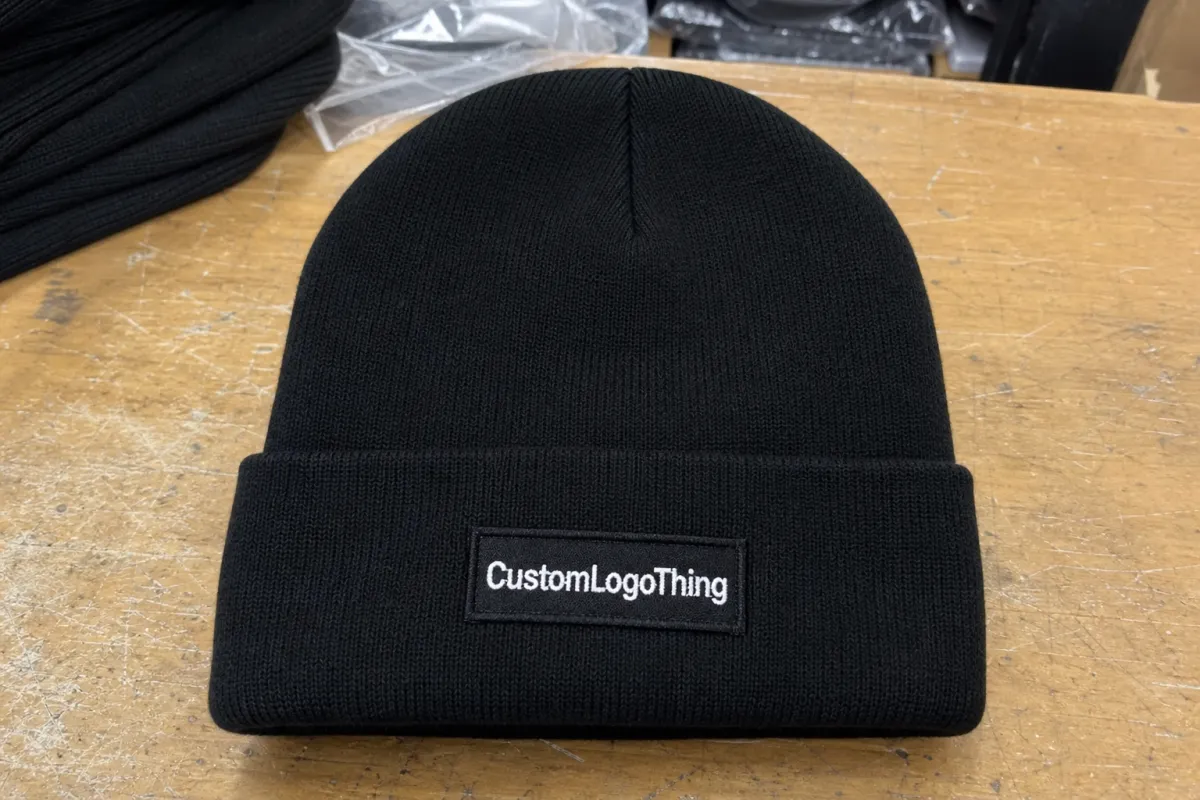
Not every knit hat belongs on a restaurant floor. Cuffed Knit Beanies are the safest starting point for most teams because the folded cuff creates a stable surface for the patch and keeps the logo visible while staff bend, carry trays, run curbside orders, or lean through a pickup window. Short fisherman beanies suit modern casual concepts, coffee bars, and chef-driven brands that want a sharper profile. Pom beanies are stronger for holiday campaigns, brewery merch tables, and staff gifts. Fleece-lined beanies belong in outdoor queues, winter markets, cold docks, and delivery programs where warmth matters more than a slim silhouette.
Color deserves more attention than it usually gets. Black, charcoal, navy, forest, and dark brown hide stains better than cream or pale gray. Heather yarns can soften a bright mark without burying it. High-contrast patches help in dim dining rooms, beneath patio heaters, and at night pickup windows. A restaurant may use a black-on-black logo system on menus and signage, but headwear often needs a tan leatherette patch, a cream woven border, or a lighter thread color so the mark can be read in motion.
Different restaurant concepts should not all buy the same hat. Quick-service groups need repeatable color and decoration across locations. A chef-led dining room may need a quieter look, such as a charcoal cuffed beanie with a small woven patch. Breweries can lean into a retail finish with leatherette or embroidered badges. Food trucks need warmth, contrast, and recognition from a distance. A single style can work across a program, but only if the actual work conditions line up.
Separate uniform units from retail or giveaway units before the quote is built. Staff inventory may need one color, bundled by location in cartons of 25. Retail units may need hang tags, individual bags, mixed colors, or case labels that match a store count. If those categories are blended too late, packing becomes harder, carton labels become less useful, and managers end up sorting product on the floor when they should be prepping for service.
For a first run, one controlled core style is usually smarter than four silhouettes. Add variation only when the program has a clear reason: manager beanies in one color, patio staff in fleece-lined knits, kitchen runners in a darker shade, and retail merch in a premium finish. That keeps the buying process disciplined rather than decorative.
Patch Options, Logo Detail, and What Holds Up in Restaurant Work
A restaurant logo that looks excellent on a menu header can fail at two inches wide on a beanie cuff. Tiny type, thin script, intricate mascot faces, distressed textures, and multi-color gradients all need review before patch production. The issue is not taste; it is the limit of thread width, stitch density, border shape, heat, pressure, and decoration on a flexible knit surface.
| Patch type | Best fit | Strengths | Watch-outs |
|---|---|---|---|
| Woven patch | Detailed restaurant logos and small lettering | Clean detail, flat surface, strong readability | Less raised texture than embroidery |
| Embroidered patch | Bold heritage marks, taverns, diners, breweries | Textured, classic, durable appearance | Fine type may fill in at small sizes |
| Leatherette patch | Barbecue, cafes, breweries, chef-driven concepts | Premium casual look, strong contrast, retail feel | Limited color behavior compared with woven art |
| PVC patch | Outdoor teams, food trucks, weather-exposed programs | Moisture resistance, bold molded look | Can feel heavier and less traditional on soft knits |
| Sublimated patch | Artwork with gradients or full-color graphics | Handles color transitions and image detail | May look more promotional than uniform-grade |
Woven patches are often the best choice for detailed restaurant marks because they keep small shapes cleaner than embroidery at compact sizes. Embroidered patches work well when the logo is bold: block letters, simple icons, crests, and heritage-style marks. Leatherette patches suit brands that want warmth and texture without turning the beanie into a loud advertisement. PVC can be useful for moisture exposure and frequent handling, although not every restaurant identity suits a molded patch.
Restaurant conditions are not gentle. Steam, cooking oil, outdoor moisture, gloved hands, apron pockets, and repeated storage all test the attachment method. The patch border should sew cleanly. The yarn should recover after stretch. The cuff should hold its fold instead of collapsing around the patch after a few wears. ASTM textile test methods and packaging distribution standards from groups such as ASTM International and ISTA are useful reminders that durability can be reviewed as performance, not merely as a visual preference.
Patch shape also affects production. Rectangles feel uniform-ready and usually provide the most efficient logo space. Circles read like badges. Ovals soften a hospitality mark. Custom shapes add personality, but they can increase setup complexity and make border sewing less forgiving on a ribbed cuff. A good artwork review should flag unreadable lettering, weak contrast, gradients that will not translate, and borders that may not sit cleanly on the selected beanie.
Specifications to Lock Before You Request a Quote
Incomplete specs create misleading quotes. A leatherette patch, woven patch, and embroidered patch can sit on the same blank beanie, but they do not carry the same setup requirements, production steps, or unit economics. If the quote request says only “black beanie with logo,” the buyer is not getting a true comparison. They are getting a placeholder that will change once the real decisions are made.
Lock the practical details before procurement approval: beanie style, knit weight, yarn color, patch type, patch size, patch placement, quantity, packaging, and target delivery date. A typical cuff patch may land around 2 to 2.5 inches wide, depending on the logo shape and cuff depth. A tall badge on a short fisherman beanie can look crowded. A wide rectangle on a ribbed knit may distort if the cuff is too narrow or the patch is too stiff for the surface.
Logo files matter more than many buyers expect. Vector artwork is preferred because it preserves clean lines and scalable shapes. If vector files are not available, send the highest-resolution file available for review. A small web logo pulled from a site header rarely has enough information for clean patch production, especially if the mark includes thin type or detailed illustration. Better files shorten the proofing cycle and reduce the chance of awkward compromises.
Build tolerance into the conversation. Beanies stretch. Cuffs fold. Patches sit on a flexible textile surface, not a rigid carton panel. Professional consistency is the goal, but plastic-like precision is not realistic on knitwear. If the brand has strict placement standards or a visual merchandising guide, share that early and request a pre-production review when the order size or visibility justifies it.
Multi-location restaurants need a packaging decision before quoting. One master shipment to headquarters is different from 12 split shipments. Labeled cartons differ from individual bags. Bundles of 25 for managers differ from retail-ready single units. Paper labels, hang tags, or cartons may also matter for brands tracking sourcing claims; the Forest Stewardship Council is a useful reference for buyers evaluating paper-based packaging components.
- Quantity by use case: staff uniforms, new hires, managers, outdoor teams, retail, giveaways, and backup stock.
- Logo version: full-color, one-color, simplified icon, or location-specific mark.
- Patch direction: woven, embroidered, leatherette, PVC, or sublimated.
- Color requirements: yarn color, patch background, border color, and contrast target.
- Delivery plan: in-hand date, ship-to locations, carton labels, and reorder expectations.
That checklist turns restaurant Logo Patch Beanies bulk order planning into a quote-ready brief instead of a guessing exercise.
Cost, Pricing, MOQ, and the Numbers Behind Bulk Beanie Orders
Pricing is driven by several variables at once: blank beanie cost, patch type, patch size, decoration setup, stitch or attachment complexity, quantity, packaging, and shipping destination. A cheaper blank with a complex patch may cost more than a better blank with a simpler woven label. Freight can shift the math again, especially for split shipments or urgent delivery.
MOQ depends on the style and decoration method. Lower quantities can work for a single restaurant, a pilot run, or a limited staff gift. Multi-location groups usually get better unit economics by consolidating orders because setup costs spread across more units. Artwork conversion, proofing, patch setup, and machine preparation do not shrink just because the order is small.
The cost logic is straightforward. If a setup charge is spread across 50 units, each beanie carries a heavier share. Spread the same setup across 250 or 500 units, and the unit impact drops. Not always dramatically, and not in every configuration, but often enough that buyers should ask for tiered pricing before approving a small first run.
| Order size | Typical buying scenario | Procurement risk | Planning note |
|---|---|---|---|
| 50 units | Single location, pilot, staff gift | Higher setup impact per unit | Good for testing, weaker for seasonal demand |
| 100 units | Busy restaurant or small group | May still run short after turnover | Add backup stock for new hires |
| 250 units | Multi-location uniform order | Requires tighter inventory planning | Often a practical balance of cost and control |
| 500+ units | Restaurant group, retail merch, promotion | Storage and distribution need structure | Ask about carton labels and split delivery |
The hidden cost is under-ordering. A restaurant that buys too few before cold weather or a holiday promotion may end up paying for a rush reorder, expedited freight, or mismatched inventory. A small initial order can look tidy on a purchase order, then become more expensive once the second batch is forced through under pressure.
Ask for tiered quoting at 100, 250, 500, and 1,000 units if the program might grow. Also ask what freight and packaging assumptions are included. Are cartons split by location? Are units individually bagged? Are retail pieces packed separately from staff inventory? The Wholesale Programs page is a practical starting point if the order will be recurring, multi-location, or tied to seasonal campaigns.
Production Steps, Timeline, and Lead Time from Artwork to Delivery
The cleanest orders follow a predictable path: request review, artwork check, quote, digital proof, sample or pre-production approval when needed, patch production, beanie decoration, quality control, packing, and shipment. Each step is simple on paper. Delays usually happen at the handoff points, especially during proof approval, artwork revision, and packing instruction changes.
Lead time depends on artwork readiness, patch complexity, order quantity, approval speed, production capacity, and shipping method. A simple reordered woven patch program can move faster than a first-time leatherette patch with revised artwork and split cartons. Buyers often focus on production time, but response time is part of the schedule too. If a proof sits in an inbox for four business days, the ship date can move even when production capacity is available.
Plan backward from the true in-hand date, not the public event date. If beanies are needed for a patio launch on a Friday, staff may need them the previous week for sorting, manager distribution, onboarding photos, and replacement of damaged pieces. If a holiday merch drop goes live on a Monday, retail units may need to arrive earlier for tagging, shelf setup, photography, and POS entry.
A sample is worth considering for first-time bulk orders, high-visibility restaurant groups, retail merchandise, unusual colors, or logos with small text. Sampling adds time and sometimes cost, but it can prevent a 500-unit mistake. For repeat programs with approved patch art and the same blank, a digital proof may be enough. The right choice depends on risk tolerance, order value, and deadline pressure.
Quality control should cover more than a quick logo glance. Check patch placement, stitch security, cuff fold, color consistency, packing count, carton labels, and visible defects. For packaging and shipment planning, ISTA-style thinking is useful because transit is a performance test. Cartons get stacked, dropped, crushed, rerouted, and opened by busy managers who may not read a packing slip twice.
Avoid making first-time decoration, color, and packaging decisions at the last minute, especially before colder months, large openings, outdoor events, or holiday promotions. Reorders can move faster once the specs are proven. First runs need room for artwork questions and material review.
Actionable Next Steps for a Cleaner Bulk Order Decision
Start with the count. Separate staff needs from promotional needs before choosing colors or patch finishes. A practical model includes current staff, expected new hires, two to five percent backup stock for loss or damage, managers, outdoor teams, giveaway units, retail inventory, and later locations. If turnover is high, build that into the quantity instead of assuming one hat per current employee will cover the season.
Then choose one primary beanie style. Shortlist two patch types, not five. Confirm the best logo file. Set the real in-hand date. Request tiered pricing. That sequence keeps the order moving because each decision narrows the next one, and it helps Custom Logo Things quote around actual production variables rather than vague assumptions.
Send operational details with the artwork. Is the restaurant a quick-service group, brewery, food truck, hotel restaurant, cafe, or chef-led concept? Are the beanies staff uniforms, retail items, or giveaways? Will shipments go to one headquarters address or multiple locations? Do managers need labeled bundles? Does the brand prefer paper labels or individual bags? These details affect cost, packing labor, and delivery performance.
Custom Logo Things can help compare patch options, review artwork limitations, guide bulk quantities, support packaging decisions, and quote based on real production inputs. If procurement questions remain, the FAQ covers file prep, order flow, and common production questions.
- Count uniform, retail, giveaway, and backup quantities separately.
- Choose a cuffed, fisherman, pom, or fleece-lined beanie based on actual use.
- Shortlist woven, embroidered, leatherette, PVC, or sublimated patch options.
- Send vector artwork or the highest-resolution logo file available.
- Ask for tiered pricing and state the required in-hand date.
Restaurant Logo Patch Beanies bulk order planning works best when specs, quantity tiers, artwork, packaging, and delivery dates are settled before production starts. Send the logo, target quantity, preferred beanie style, patch direction, packing requirements, and deadline to Custom Logo Things so the quote reflects how the order will actually be made and delivered.
FAQ
What is the best patch type for restaurant logo beanies in bulk?
Woven patches are usually best for detailed restaurant logos because they hold small lettering and compact shapes well. Embroidered patches suit bold marks, leatherette patches create a premium casual look, and PVC works well for weather-resistant branding. The right choice depends on logo detail, budget, desired texture, and whether the beanies are for staff uniforms, retail merch, or promotional giveaways.
How early should I start restaurant beanie bulk order planning?
Start as soon as the in-hand date is known, then work backward for artwork review, proof approval, patch production, decoration, quality control, packing, and shipping. First-time orders, complex patches, split shipments, and seasonal demand need more buffer than simple reorders with approved artwork.
What MOQ should I expect for custom logo patch beanies?
MOQ depends on the beanie style, patch type, and production setup. Bulk orders usually become more efficient as quantity increases because setup costs spread across more units. Ask for tiered pricing at several quantities so you can compare the true unit cost before choosing the order size.
Can I order restaurant logo patch beanies for multiple locations?
Yes. Provide quantity by location, ship-to addresses, packaging preferences, and whether each location needs labeled cartons or individual bundles. Multi-location planning can reduce unit cost if orders are consolidated before production instead of placed as separate urgent runs.
What artwork files are needed for logo patch beanie production?
Vector artwork is preferred because it helps preserve clean lines, accurate shapes, and scalable logo detail. If vector files are not available, send the highest-resolution logo file possible and request an artwork review before approving the patch proof.


