A beanie can photograph well and still fail in hand. That gap is exactly why a beer Ribbed Winter Beanies Material Sample guide matters before a purchase order is signed. A swatch shows yarn feel and color tone, but a finished sample reveals the real questions: does the rib rebound after stretch, does the cuff hold its shape, and does the knit still look premium after a few minutes of wear?
That matters more for beer-branded winter beanies than people sometimes expect. Brewery merch, taproom giveaways, retail bundles, and staff uniforms all ask for the same thing in different ways: a cap that feels warm, looks intentional, and survives repeated use. Rib knits can be flattering or sloppy depending on yarn choice, gauge, and finishing. A screen image rarely exposes the difference.
For buyers, the sample phase is not a formality. It is the cheapest place to catch a mistake that would be expensive to fix later. A loose rib, a scratchy blend, a patch that pulls the knit out of line, or packaging that arrives crushed can all sink an otherwise solid order. The sample tells you what production is likely to repeat.
Beer ribbed winter beanies material sample guide: what a swatch really tells you
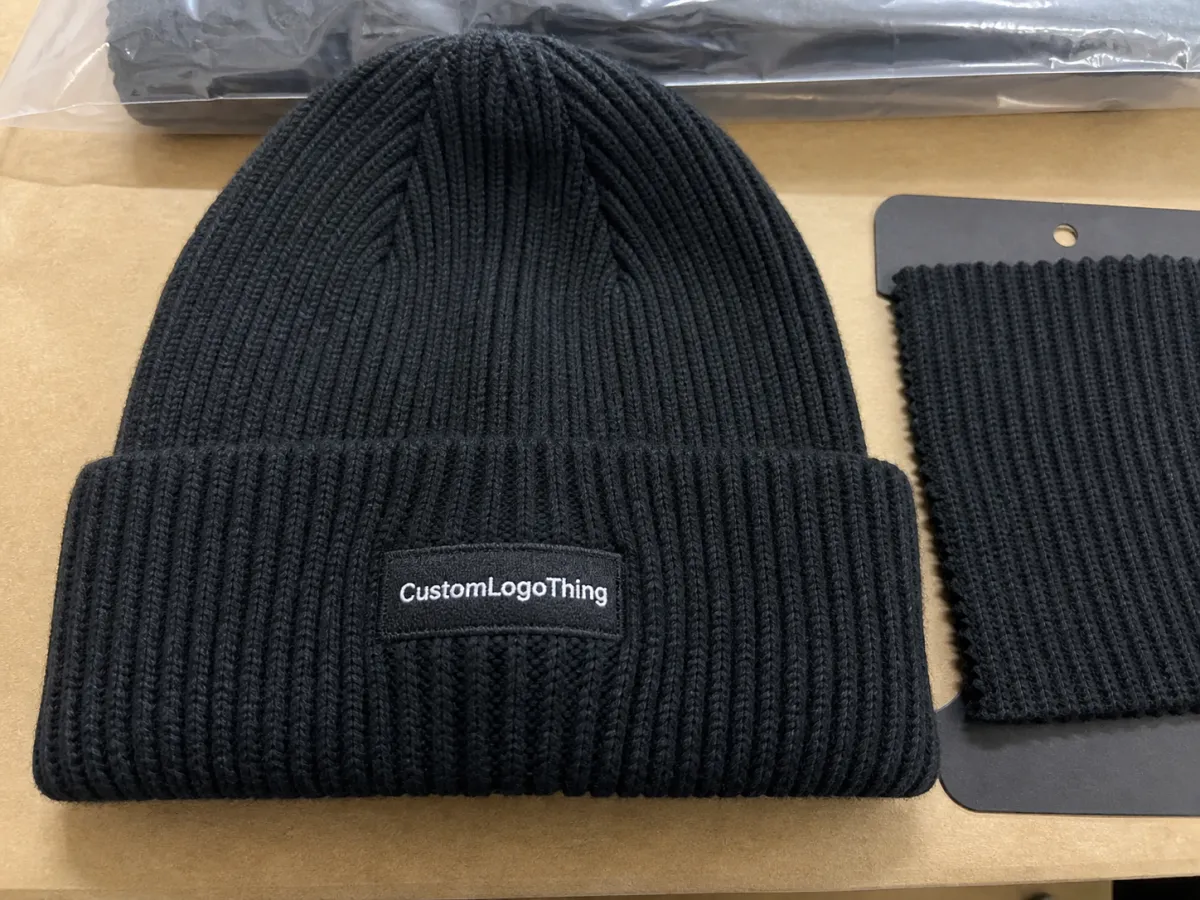
A swatch is useful, but only up to a point. It answers the first layer of questions: how the yarn feels against the skin, how dense the rib appears, whether the color reads warm or flat, and whether the knit has enough structure to sit cleanly under a cuff. It does not show how the beanie behaves once it is pulled over the head, folded, worn, and taken off again.
A full cap sample adds the parts that matter most. The crown shape becomes visible. The seam either disappears or announces itself. The cuff may stand neatly, or it may collapse the moment the hat is handled. On a ribbed beanie, that distinction is not cosmetic. It changes the product’s entire market position, because a cap that feels too soft or too loose reads as budget even when the yarn itself is decent.
Sample sets are most useful when they include a progression rather than a single object. The strongest set usually includes a knit swatch, a full cap sample, a trim or label mockup, and a decoration test. If the product will ship with a woven label, embroidery, or a patch, the decoration sample should be treated as a separate approval item, not a detail at the end of the process.
Rib structure is easy to underestimate. A 1x1 rib, a 2x2 rib, and a wider mock-rib pattern may all look similar in a product photo, but they behave differently under stretch. Tighter ribs tend to recover better and hold the outline of the beanie. Looser ribs can give a softer drape, though they may lose shape faster. Neither is automatically better. The right choice depends on whether the buyer wants a fitted winter cap, a relaxed slouch style, or something in between.
A swatch tells you what the yarn is. A full cap tells you what the finished product will do.
Packaging can reveal something too. When the sample arrives in corrugated cardboard with kraft paper or a simple protective insert, it usually signals that the supplier understands transit damage and handling. That does not make the knit better, but it often predicts fewer surprises later. If the brand cares about recycled materials, FSC certified paper, or biodegradable packaging, the sample stage is the time to confirm those details rather than treating them as a last-minute note.
For larger buying teams, the sample phase also exposes consistency. Are the ribs even all the way around? Does one side of the beanie twist slightly? Is the seam centered? Does the fold return to the same position after it has been stretched? Those are small faults on one unit and serious problems across a production run.
How material samples are used to compare fit, warmth, and finish
Reviewing a sample works best when the process is slightly boring. That is a compliment. Touch the knit. Stretch the cuff. Hold it under daylight and then under indoor lighting. Put it on different head sizes. Let it sit for a while. A beanie that passes only the first glance is not ready for approval.
Fit starts with measurements, not impressions. Most buyers want at least the finished width, body height, cuff depth, and seam style confirmed in writing. A sample should also show how much it grows under tension and how much of that growth it keeps. If the beanie expands too easily and never fully rebounds, the fit will drift after a few wears. A simple hand test catches this faster than a long discussion.
Warmth is more complicated than thickness. A dense acrylic rib can trap heat well even when it does not feel especially heavy. A wool blend may feel softer and more natural but shed warmth differently depending on the knit density and lining. Add a brushed acrylic lining or a fleece band and the thermal profile changes again. The outer shell, inner texture, and cuff height all matter. So does wind resistance, which is rarely obvious in a studio photo.
Finish should be judged with the same discipline. Look for pilling after a few rubs with the palm. Check whether the yarn twist opens when stretched. Notice whether the surface looks even from a distance and also close up. Ribbed knits hide minor inconsistencies better than flat knits, but they also magnify shadow lines, so a small issue can become visible once the hat is worn.
Decoration tests deserve special attention. Embroidery can pucker rib fabric if the backing is too stiff or the stitch count is too heavy. Woven patches sit cleanly on many caps, but they can feel bulky if the beanie is already thick. A heat-applied badge may look neat on day one and then fail when the knit flexes. If the logo is central to the order, the exact branding method should be present on the sample, not imagined from a mockup.
- Fit notes for small, average, and larger head sizes
- Recovery notes after repeated stretch and wear
- Warmth notes based on indoor and outdoor use
- Finish notes for pilling, surface evenness, and rib clarity
- Branding notes for logo placement, tension, and flatness
The review should be documented while the sample is still in hand. Photos matter, but only if they are useful. Flat-lay images rarely show how a beanie sits on the head. Front, side, seam, cuff, and close-up shots tell a clearer story. If feedback is going back to a supplier, mark the image rather than sending a vague sentence. “Too loose at the crown” is better than “needs work.”
Key factors that decide whether a knit sample is worth approving
Fiber content is the first filter. Acrylic is still common because it gives predictable color, reasonable cost, and straightforward care. Wool or wool-blend caps usually feel more natural and can hold warmth well, but they raise the price and may require more care guidance. Recycled yarns are increasingly used in promotional and retail beanies, especially when a brand wants a material story that can be backed up by specification rather than vague claims. Cotton blends are softer in some constructions, but they are not always the best choice for deep winter insulation.
Construction matters just as much as fiber. Gauge, stitch density, and yarn thickness shape the final look more than many buyers expect. A heavier yarn does not automatically create a warmer beanie. If the knit is too open, warm air escapes. If it is too dense, the cap may feel stiff or overbuilt. The right sample balances structure with comfort, and that balance is usually visible before it is measurable.
Seam quality deserves inspection. Flat seams are generally cleaner against the forehead and less likely to print through the fabric. Overlocked seams can be acceptable, especially in price-sensitive programs, but they should still sit evenly and not create a ridge that distorts the crown. A sample that looks tidy from the outside but feels lumpy inside is a warning, not a minor flaw.
Color is another place where buyers get surprised. Ribbing changes how light lands on the fabric. It deepens shadows and can make the same yarn look darker than it did in the yarn card or on a smooth knit. Pantone references help, but they do not remove the effect of texture. A buyer should compare the sample in multiple lighting conditions and, if the order matters for a campaign, also under camera light. What looks rich in daylight can look nearly flat on a phone screen.
Care requirements are worth checking before approval. If the cap will pill easily, shed lint, or lose shape after a wet test, that matters more than whether the knit initially feels soft. A sample should be rubbed, stretched, and left sitting in a bag or box for a period of time to see if the surface changes. A material that looks polished on the day it arrives can still disappoint once it has been handled several times.
Packaging should be reviewed with the same seriousness as the beanie itself. If the program calls for a retail insert, care card, hangtag, or presentation box, inspect those components while the sample is being evaluated. Corrugated cardboard protects better than thin paperboard in transit, but the visual finish may need a cleaner outer shell if the product is headed for retail display. The choice is not just about appearance. It affects damage rates, unpacking experience, and the buyer’s confidence in the supplier’s process.
Cost, pricing, and MOQ for sample-driven beanie orders
Sample pricing often looks simple on the quote and becomes more complicated in practice. There may be a charge for the sample itself, another for shipping, and a separate fee if the first version needs revision. Some suppliers credit the sample fee back against the final order; others do not. That detail should be confirmed early, because a low sample quote can turn into a higher real cost once freight and adjustments are included.
MOQ changes the economics in a straightforward way. A lower minimum order quantity reduces inventory risk, which is useful for seasonal programs or limited brewery drops, but the unit price usually rises. A larger run spreads setup cost over more pieces and usually brings the per-item price down. The useful question is not “What is the sample price?” It is “What will the approved product cost once sampling, freight, revisions, and production are all included?”
| Sample option | What it shows | Typical cost range | Best use |
|---|---|---|---|
| Knit swatch | Yarn feel, rib density, color tone | $10-$30 | Early material screening |
| Full cap sample | Fit, shape, seam behavior, warmth | $25-$80 | Final product approval |
| Decoration test | Logo placement, stitch pull, patch balance | $15-$60 | Brand-heavy orders |
| Packaging mockup | Insert fit, label, retail presentation | $10-$35 | Retail or gift sets |
Those numbers are broad on purpose. A wool blend with embroidery and a sewn label will cost more than a plain acrylic cap. A recycled yarn sample may need extra lead time if the exact color or fiber blend is not stocked. Overseas shipping can also outweigh the sample itself, especially when a buyer requests only one or two pieces. That is why landed cost is a better measure than the line item alone.
There is also a hidden cost in revisions. A second round can be worth it if it fixes a genuine problem, but every change adds time, freight, and coordination. That is one reason disciplined spec sheets matter. A clear brief keeps the first sample closer to production reality and reduces the chance of paying twice for the same decision.
Packaging can affect cost in a subtle way. Kraft paper, recycled inserts, and corrugated mailers may add a small amount to the sample expense, but they can save money by reducing damage and replacement shipments. For brands tracking recycled materials or FSC certified board usage, that tradeoff is often reasonable. The important part is to approve the package with the product, not after it.
Process and timeline: from swatch request to production approval
The process starts with a brief that is tighter than most first requests. Include yarn type or preferred fiber blend, rib structure, approximate finished size, logo method, packaging needs, and the intended use case. A supplier that has to infer those details will often build a sample that looks fine but misses the buying intent. Brewery merch, retail stock, and event giveaways do not need the same cap.
A workable timeline often begins with a swatch, then moves to a full cap sample, then a decoration test if branding is part of the order. Simple swatches may take 3-5 business days. Full samples usually need 7-12 business days, depending on knitting capacity and finishing work. If revisions are required, another 3-6 business days is common. Production typically begins only after final approval and then runs for 15-25 business days, with longer lead times for larger quantities or more complex decoration.
Delays are usually ordinary. Missing artwork files. Unclear sizing. No Pantone reference. Feedback that arrives after half the review team has left for the week. None of those problems is dramatic, and all of them push the schedule. A buyer can save days by deciding in advance who signs off on fit, who signs off on branding, and who signs off on packaging.
Two external standards can help keep the process grounded. For paper sourcing and packaging claims, the FSC system is a useful reference: fsc.org. For package performance and transit testing, ISTA provides practical guidance: ista.org. Neither one tells a supplier how to knit a beanie, but both help buyers distinguish between a nice presentation and a package that can actually survive shipment.
- Day 1-3: request brief, confirm yarn and decoration direction
- Day 4-10: review the first sample and check fit on multiple heads
- Day 11-14: approve, revise, or hold for a second round
- Day 15+: release to production after written sign-off
The schedule is only useful if the review window is real. A sample sitting unopened for a week does not protect the launch calendar. Tight approval windows are not glamorous, but they are how seasonal products stay on track.
Common mistakes buyers make when reviewing sample beanies
The first mistake is to judge by color alone. Light changes everything. A ribbed knit can look darker in a warehouse, brighter under office lighting, and flatter on camera. If the beanie is meant for ecommerce or an event, that variation matters. A sample should be seen in more than one environment before anyone says yes.
The second mistake is skipping stretch recovery. A beanie that expands easily but does not return to form will look tired after a short display period. It can also fit differently by the end of a workday or after repeated use. Buyers notice this late more often than they should because the hat still feels fine on the first try.
The third mistake is treating decoration as secondary. It is not. Embroidery tension can pull rib fabric off-center. Patches can feel too rigid. Woven labels can look polished but still shift if the seam allowance is poor. The logo is often the reason the order exists in the first place. If the branding fails, the product misses its purpose even when the knit quality is acceptable.
The fourth mistake is comparing sample prices without tracking the full approval path. A cheaper sample may mean slower communication, more freight cost, or repeated revisions. Rework is not free. Neither is a delayed launch. If one supplier appears cheaper but needs three rounds to get the fit right, the real cost may be higher than the supplier who got close on the first try.
There is also a quieter mistake that shows up in packaging-led programs. Buyers approve the beanie and forget the box, insert card, or hangtag. Then the insert is too large, the box tears in transit, or the paper stock looks thin beside the cap. If the sample includes packaging, review packaging. That sounds obvious. In practice, it is where many programs unravel.
A sample that misses fit or branding is not a bargain. It is an early warning.
Expert tips and next steps after the sample arrives
Use the same scorecard for every sample. Rate feel, fit, warmth, decoration, packaging, and cost impact on the same scale. That keeps the conversation from drifting into preference theater, where the loudest opinion wins instead of the strongest sample. A standardized review also makes it easier to compare suppliers without pretending every cap is identical.
If two samples are close, change one variable at a time. Tighten the rib. Shift the logo 5 mm. Raise the cuff slightly. Ask for a second version only after the first set of notes is clear. Broad redesigns usually create new questions before they solve the old ones. Small revisions tell you more.
Before production, lock the spec sheet in writing. Confirm fiber content, rib width, cuff depth, finished dimensions, seam style, label placement, decoration method, and packaging format. If recycled materials are part of the claim, define exactly how that will be described. If the pack uses FSC certified board or biodegradable packaging, write that down now. Ambiguity is expensive once production has started.
It also helps to keep a record of what the sample proved and what it did not. A sample is evidence, not a guarantee. It can show that the knit is strong, but not how it performs after months of retail handling. It can show that the patch sits well, but not how the adhesive behaves in summer storage. Honest caveats make better decisions than polished assumptions.
For teams handling multiple beer-branded winter beanie programs, the final step is usually simple: compare the sample against the original brief, the cost target, and the launch date. Approve only the version that clears all three. If the fit is right but the logo is weak, revise. If the material feels good but the price climbs too far, re-spec. A disciplined sample review does not eliminate compromise, but it makes the compromise visible.
That is the real value of a beer Ribbed Winter Beanies Material Sample guide. It turns a product that could be guessed at into one that can be measured, checked, and approved with far less noise.
What should a beer ribbed winter beanies material sample include?
A useful sample should show the rib knit, the cuff behavior, the final color, and the exact branding method planned for production. If fit matters, request a full cap sample rather than relying on a small swatch. If the order includes packaging, ask for that mockup at the same time so the cap and the presentation are judged together.
How many samples should I request before approving an order?
For custom beer-branded winter beanies, one swatch and one finished sample are usually the minimum starting point. Add a second version only if the first sample misses on stretch, color, or logo placement. If the line will ship in multiple colorways, compare the primary color and at least one alternate before signing off.
What affects the price of ribbed winter beanie samples the most?
Fiber choice, decoration method, and whether the sample is stock or fully custom are the biggest drivers. Shipping and revision fees can matter just as much, especially on small orders. A low sample fee does not mean a low total cost if every adjustment adds freight and time.
How long does the sample and production timeline usually take?
Simple swatches can be ready in a few business days, while full beanie samples usually take longer because knitting, finishing, and decoration all add steps. Production often starts 15-25 business days after approval, depending on order size and complexity. Faster timelines are possible, but only if feedback is clear and the brief is complete from the start.
What is the biggest mistake when reviewing ribbed winter beanie samples?
Approving by look alone is the most common error. Fit, rebound, seam behavior, and decoration quality all affect whether the product feels finished. Skipping real-world lighting tests can also hide color issues that only show up after the order is already moving.
Handled well, the sample stage does more than confirm a knit. It tests the supplier’s judgment, the buyer’s brief, and the product’s ability to survive real use. That is a stronger filter than any catalog image, and it is usually the difference between a beanie that merely ships and one that actually holds up.


