The sample that looks polished on a desk can still fail the moment it is pulled over a forehead, packed into a gift box, or worn under a coat collar for a full afternoon. That is why the cosmetics Ribbed Winter Beanies Material Sample guide matters. Two beanies can share the same knit weight and still behave very differently once stretch, recovery, and decoration start working against each other.
For cosmetics brands, the beanie is not only a cold-weather accessory. It has to frame the face cleanly, sit well beside skincare or fragrance packaging, and read as premium in a retail display, influencer kit, or seasonal bundle. A strong sample tells you whether the cuff stays put, whether the seam disappears under wear, and whether the logo still looks centered after the knit has been handled a few times.
That is the real purpose of sampling. It cuts down on guesswork before bulk production freezes the fiber, stitch structure, decoration method, and packaging format.
What the cosmetics ribbed winter beanies material sample guide reveals first
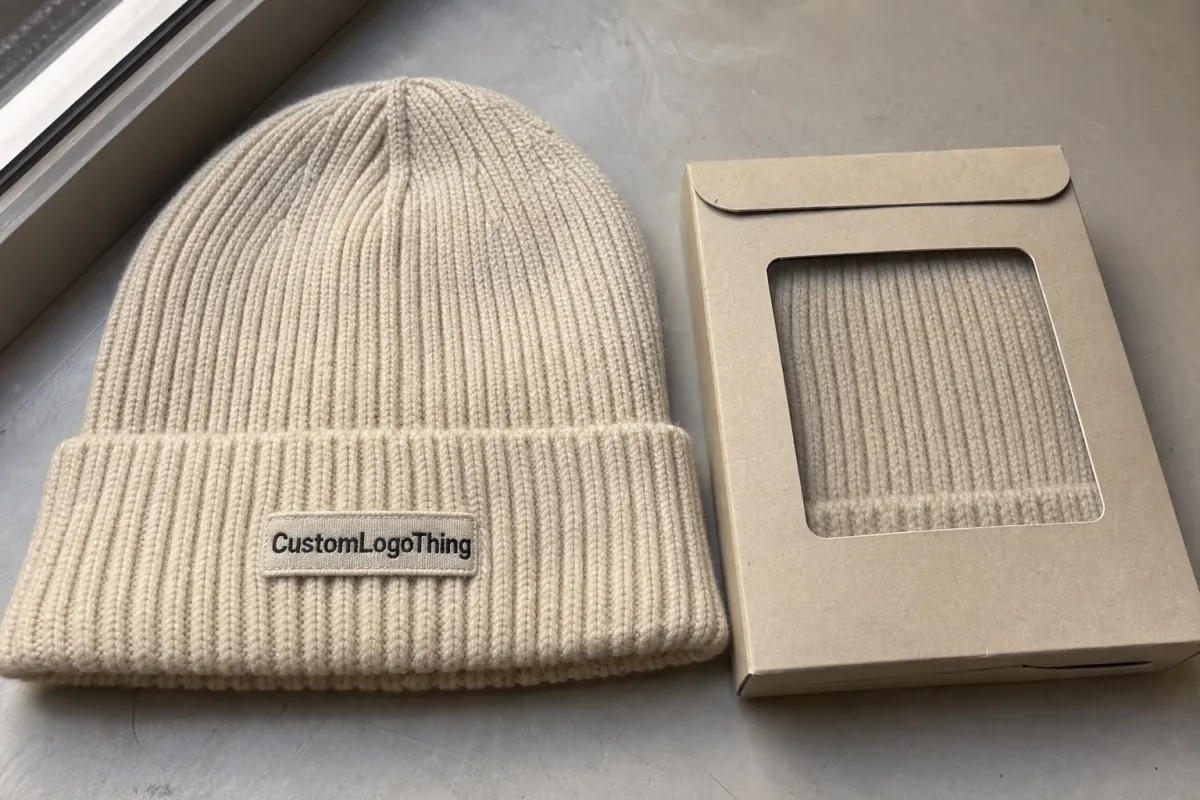
The first test is not color. It is recovery. Ribbed knits can look nearly identical in photos, yet one will spring back neatly while another stays loose around the cuff or distorts at the crown after a short wear test. That difference shows up fast once someone stretches the beanie over hair, tugs it lower on the forehead, or folds it flat for packing.
Buyers often start with softness because it is immediate and easy to judge. That is understandable, but it is not enough. A better sample review checks stretch range, rebound time, seam comfort, cuff stability, and whether the knit twists after a few minutes on different head shapes. If the silhouette shifts before the day is over, the bulk order will not hold a premium look for long.
Cosmetics programs are unusually sensitive to presentation. These beanies often sit next to gift sets, travel kits, and promotional products, so the shape has to stay controlled. The logo should be legible from a few feet away, not just in a close-up product photo. A flat swatch gives a hint; the actual sample shows whether the beanie survives packing, handling, and wear without losing its line.
The sample also shows whether the factory understood the brief. If the cuff height is off, if the face opening feels too shallow, or if the knit drifts from the approved shape, the problem may be pattern drafting rather than yarn selection. That distinction matters. A well-made sample is a decision tool, not a souvenir.
For packaging buyers, the logic is familiar. Transit packaging tests, wrap approval, and insert sizing all follow the same principle: performance matters as much as appearance. That becomes even more relevant when the beanie ships in recycled mailers, FSC-certified cartons, or layered gift packaging that has to survive store handling before the first customer ever sees it.
How ribbed construction changes fit, drape, and decoration
Ribbing is what gives the beanie its identity. A 1x1 rib alternates one knit stitch and one purl stitch, which usually creates a tighter, more balanced surface. A 2x2 rib appears broader and a little softer, with more visible texture. Neither is automatically better. The right choice depends on the silhouette you want, the head-size range you need to cover, and how much structure the decoration requires.
Gauge and yarn thickness shift the outcome again. A dense rib usually holds its outline better, which helps when the beanie carries embroidery or a woven label. A looser knit feels more relaxed and fashion-led, but it can lose shape more quickly. In practice, the most expensive mistake is assuming all ribbed beanies stretch the same way. They do not. Even small differences in stitch tension can change how the cuff sits after packing.
Decoration adds another layer of risk. Embroidery can pucker if the knit is too elastic. Woven patches tend to sit cleaner on the cuff, especially when the rib does not distort the edges. Heat transfers can look sharp on day one and then crack or lift if the surface moves too much. A sample should always be reviewed on-head. Flat review alone hides the problem.
Use this comparison as a working reference during sample review:
| Construction | Visual feel | Fit behavior | Decoration risk |
|---|---|---|---|
| 1x1 rib | Tighter, cleaner, more technical | Snug recovery, less slouch | Lower puckering if gauge is stable |
| 2x2 rib | Chunkier, softer, more relaxed | More give, slightly less structure | Logo distortion can appear faster |
| Folded cuff rib | Premium, retail-friendly | Better face framing, more warmth | Best for patches and woven labels |
That table only helps if the sample is tested the way it will actually be sold. Side seams, crown shaping, and cuff height all influence how the beanie reads in a campaign image. A few millimeters can be enough to make a logo feel too high, too narrow, or slightly off center. That is not a cosmetic issue; it is a production one.
There is also a practical comfort angle. Ribbing that feels elegant on a hanger can become aggressive on the skin if the tension is too tight. Buyers sometimes miss that because they are focused on the visual profile. One short wear test usually exposes the truth.
Fiber, finish, and hand-feel factors that decide quality
The best sample is not always the softest one on first touch. Buyers usually see four main fiber families: acrylic for cost control, wool blends for warmth and a more natural hand, recycled polyester for durability, and cotton blends for a softer, less clingy feel. Each behaves differently once the beanie is stretched, worn, folded, and washed.
Finish matters just as much as fiber. Anti-pilling treatment helps the surface stay cleaner after repeated wear. Brushing adds loft, but it can also make the beanie feel warmer and more casual. Pre-washing reduces shrinkage surprises. Thermal lining changes the comfort profile entirely, especially for outdoor promotions or colder climates. The sample should make those trade-offs visible before the order gets large.
Color and sheen are part of hand-feel in practice, even though they are visual signals. Matte yarns usually look more refined for beauty branding. High-gloss yarns can drift toward sporty or streetwear territory unless the design is clearly meant to do that. If a beanie is going into a cosmetics kit, the fabric should feel premium without looking delicate or overworked.
Two physical checks matter more than most line sheets admit. First, inspect for lint transfer against dark clothing and inside the box. Second, rub the fabric lightly along the forehead line to judge scratchiness. If the sample feels rough after thirty seconds, it will not feel kinder after an hour. A simple colorfastness check is also worth requesting, especially if the beanie may sit near makeup bags, fragrance bottles, or damp packaging.
Construction details can reveal quality faster than the product description. Ask for the yarn count, stitch density, cuff depth, seam type, and any added elastane or recycled content. If a supplier cannot identify those details clearly, the sample may still be usable, but the production risk rises. Clarity in the sample stage usually predicts clarity in bulk.
Sampling is also a packaging story. A beanie shipped in a folded kraft paper sleeve inside a corrugated cardboard mailer can arrive with fewer false impressions than one tossed loosely into a polybag. If the program uses recycled materials, post-consumer waste content, or FSC-certified cartons, the presentation should support the brand rather than distract from it. For transport standards, many teams use ISTA methods as a baseline reference because they reflect real handling conditions. See ISTA for testing context, and FSC for chain-of-custody guidance.
| Fiber option | Typical sample price effect | Hand-feel | Best fit for |
|---|---|---|---|
| Acrylic | Usually lowest prototype cost, often $18-$35 per sample run | Light, warm, slightly synthetic | Value-driven promotions and broad color matching |
| Wool blend | Often $24-$45 per sample run | Warmer, more natural, premium | Higher-end cosmetics gifting and colder-weather sets |
| Recycled polyester | Commonly $22-$42 per sample run | Smooth, durable, consistent | Brand sustainability messaging and repeat wear |
| Cotton blend | Often $20-$38 per sample run | Softer, more breathable | Indoor events and mild-weather promotions |
Price should not be the only filter. A lower-cost acrylic sample may be perfectly suitable if the brand wants broad color options and a clean retail margin. A wool blend may be worth the extra cost if the product has to feel warmer and more substantial in hand. The right answer depends on where the beanie sits in the full assortment, not on the fabric label alone.
Cost, pricing, and MOQ for sample beanies
Sample pricing is usually shaped by five items: development fee, yarn sourcing, decoration setup, freight, and revisions. If a quote looks unusually low, ask what is missing. Sometimes the inexpensive sample excludes logo setup or uses substitute yarn. That can be useful for early shape testing, but it is not a dependable approval sample.
A better sample program often costs more at the beginning and saves money later. The prototype should mirror the bulk build as closely as possible, especially for rib structure and decoration size. When the sample is simplified too much, the first production run becomes a second round of paid problem-solving. That is a poor trade for any buyer trying to protect margin.
MOQ changes the economics too. A supplier may quote one fee for a single prototype and a different unit cost once the order reaches the minimum run. For a 5,000-piece order, the difference between a $0.18 and $0.28 bulk unit adds up quickly, especially if the beanie is part of a scarf set or a seasonally packed cosmetics bundle. That is why itemized quotes matter. They show where the money is going before the order is locked.
Ask for a breakdown in this order:
- Sample development fee
- Yarn and trim cost
- Decoration setup
- Revision or resample charge
- Shipping and duties if applicable
If the supplier agrees to credit the sample fee against the bulk order, that helps, but only if the final spec matches the sample closely. Watch for rush charges as well. A short approval window can put pressure on both sides, and that often shows up in logo placement, shade matching, or cuff consistency. The cosmetics Ribbed Winter Beanies Material Sample guide should help you compare total cost, not just the prototype line on the quote.
Lead time deserves its own line item in the decision. A domestic sample may be ready in a few business days if yarn and decoration are already on hand. Offshore samples often take longer because sourcing, knitting, finishing, and freight all stack together. Special dye lots extend the schedule again. None of that is unusual, but it should be visible before the review calendar gets tight.
Production steps and turnaround from request to approval
A clean sampling cycle usually follows six steps. First, the buyer sends a spec brief. Second, the supplier confirms material availability. Third, the prototype is knitted. Fourth, decoration is applied. Fifth, the buyer reviews photos or the physical sample. Sixth, revisions are approved or the design moves toward production. The process sounds simple. The delays usually happen in the gaps.
The fastest approvals come from a complete brief. Include size targets, color references, logo placement, packaging needs, and any skin-contact or allergy restrictions. If the beanie will be packed with other beauty items, say so early. A supplier can then test the full presentation in a corrugated shipper instead of assuming a loose bag is enough. That detail saves time later.
Revisions are not failure. A second round is common when fit or color needs tightening. The key is to consolidate comments before sending them back. Ten scattered messages reset the timeline more effectively than one clear change request. That is why production teams often track sample status with a simple approval log, even for small seasonal programs.
For buyers who want a clean handoff, the approval should include one physical sample kept as the master reference, one photo record, and one line sheet listing the final color, stitch count, cuff height, logo dimensions, and acceptable tolerance range. That documentation is what keeps the next order from drifting. Without it, teams start arguing over memory instead of measurements.
A practical approval file also notes acceptable shrinkage, stitch variance, and packaging orientation. Those are not glamorous details, but they are the ones that protect a repeat order from avoidable drift. In knitwear, a small change in tension or finishing can make the whole line look different.
Common mistakes that distort sample evaluation
The first mistake is judging the beanie under only one light source. Store lighting, daylight, and phone flash can make the same sample look like three different products. A gray tone may read cool under daylight and slightly green under warm indoor bulbs. If the color matters, check it in both settings. Better yet, compare it beside the actual packaging and adjacent cosmetics items.
The second mistake is testing only one head size. Ribbed beanies need to fit a range. A sample that feels perfect on one person may ride too high, sit too tight, or collapse too loosely on another. Buyer teams usually solve this by testing on at least three wearers with different hair volume and head shape. That sounds basic, but it catches problems quickly.
The third mistake is skipping wash and wear testing. A sample can look fine on day one and still pill, shrink, or lose recovery after a few uses. Even a simple home-style test helps: wear it for an afternoon, fold it into a bag, then check whether the cuff springs back. That tells you more than a flat photo ever will.
Decoration-only approval is another trap. A logo can look crisp on a flat image and still warp once the knit stretches over the forehead. Embroidery density, patch backing, and label size all matter more on ribbing than they do on smooth fleece or woven caps. If the logo is the main branding surface, approve it on-head.
If the sample only looks good flat, it is not done yet. The real approval happens after the fabric moves, stretches, and comes back to shape.
Finally, do not assume the sample equals final production without a locked spec sheet. Dye lots can shift. Stitch tension can drift. Finishing can change hand-feel. The best protection is a written approval that records the final version in enough detail to recreate it later, without depending on memory or a photo on a phone.
Expert next steps after the sample passes
Once the sample works, turn it into a one-page spec sheet. Include fiber content, stitch count, rib type, cuff height, logo placement, artwork dimensions, acceptable tolerance ranges, and packaging instructions. That document matters because it turns a good sample into a repeatable production reference.
Before bulk knitting starts, request a pre-production check that matches the approved sample as closely as possible. If the final packaging is part of the brand story, confirm the carton style, tissue, and outer wrap now. A clean presentation in FSC-certified corrugated cardboard with kraft paper or biodegradable packaging can make the kit feel deliberate instead of improvised.
Do one last wear test if the order is going to retail, gifting, or event use. Confirm stretch recovery, comfort against the skin, and color stability after a simple wash. If the beanie will be sold as part of a cosmetics seasonal bundle, this is the moment to verify that the hat supports the whole set visually instead of competing with it.
Set reorder rules before the first order closes. Name the approval contact, lock the lead time, and define how much revision is allowed before the process resets. That sounds administrative, but it saves time on the second and third order, where the margin often gets decided.
The cosmetics Ribbed Winter Beanies Material Sample guide is really about discipline: compare the right things, document the right things, and approve only what you can reproduce. That is how a small sample turns into a bulk order that feels consistent, looks premium, and fits the brand the first time.
What should I check first in a ribbed winter beanie material sample?
Start with stretch and recovery, because ribbed knits can feel similar in hand but behave very differently when worn. Then check seam comfort, cuff shape, and logo distortion on an actual head, not just on a table. Finish with color and lint under both daylight and indoor lighting.
How many sample rounds are normal before approval?
One round is enough when the spec is simple and the materials are already available. Two rounds are common when color, decoration placement, or fit needs refinement. More than two usually means the brief needs tighter tolerances or better reference photos.
What drives the price of sample beanies most?
Fiber choice and yarn sourcing are usually the biggest drivers. Decoration setup, revision requests, and freight can add more than the knit itself. MOQ affects the later bulk quote, so the sample price should always be reviewed alongside the expected unit cost.
How long does the sampling process usually take?
Domestic samples can move in a few business days if the yarn and decoration method are already available. Offshore sampling often takes longer because sourcing, production, and shipping all add time. Any change to color or logo placement can extend the turnaround quickly.
How do I compare two cosmetics ribbed winter beanies samples fairly?
Put both samples under the same lighting and test them on the same range of head sizes. Compare stretch recovery, warmth, color accuracy, and decoration quality using one checklist. Record measurements and notes immediately so the stronger sample is chosen on evidence, not memory.


