Tea Ribbed Winter Beanies Material Sample guide for buyers starts with a simple observation: two ribbed beanies can look nearly identical on screen and still wear very differently in hand. Stitch density, yarn twist, cuff recovery, and seam bulk all change the experience. A buyer who only approves from a photo is usually trusting the least revealing part of the product.
This tea Ribbed Winter Beanies Material Sample guide is meant to reduce that risk. The sample is not just a color check. It is the only early proof that the knit feels right, the fit holds, and the decoration can sit on the fabric without making it stiff or lopsided. In a category where a one-millimeter seam ridge can feel larger than a whole Pantone shift, those details matter.
For custom-logo headwear programs, the sample should answer three questions fast: does it feel premium, does it recover after stretch, and does it still look clean after handling? If the answer to any of those is weak, bulk production will not magically fix it.
Tea ribbed winter beanies material sample guide: what to inspect first
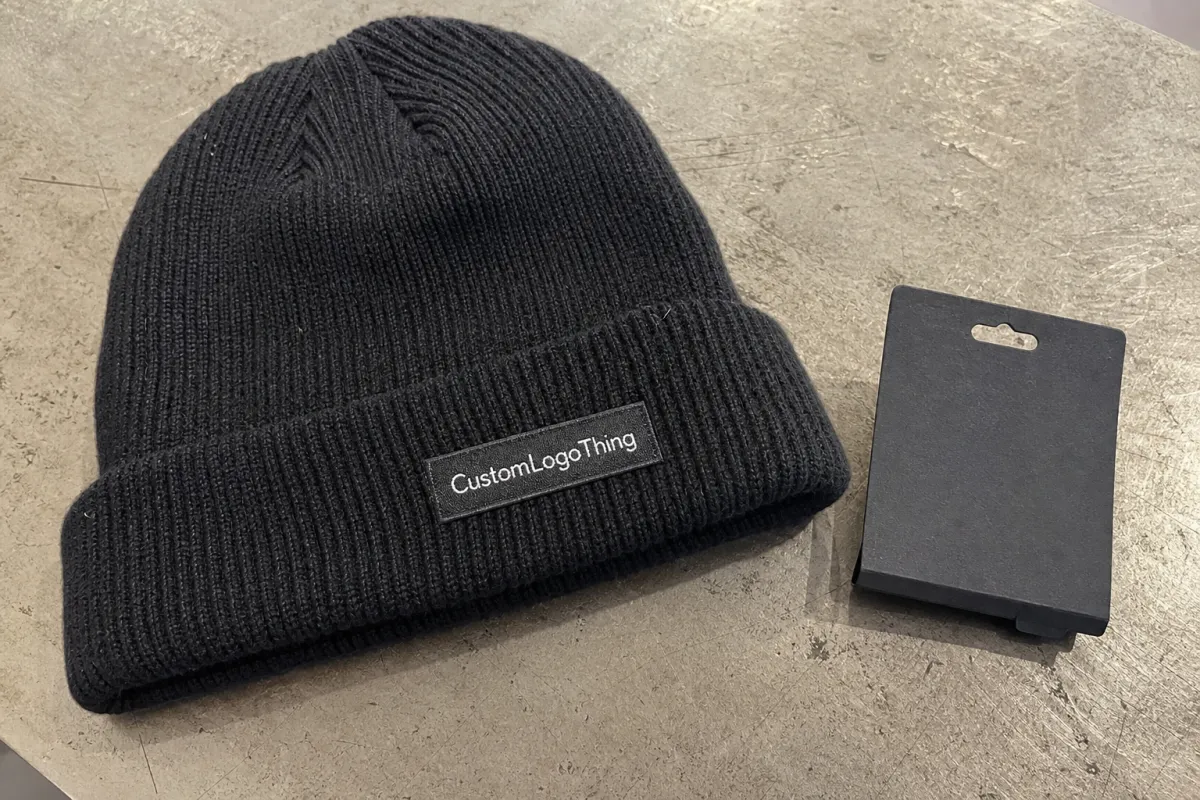
The first review should focus on the actual sample, not the render or the line sheet. A ribbed winter beanie can pass a flat-lay test and still fail in real wear if the knit is loose, the cuff collapses, or the seam creates a bump at the crown. Retail buyers notice that quickly; event buyers notice it once staff start wearing the pieces; uniform programs notice it when one size fits a narrow range better than expected.
Start with hand feel. Rub the surface lightly, then stretch the cuff several times and release it. A cleaner sample feels even across the knit, without scratchy yarn ends, hard seam ridges, or an edge that pulls more on one side than the other. A slow spring-back is a warning sign. It often means the beanie will relax out of shape before the wearer has finished a commute.
Three checks tell you a lot in under a minute:
- Stitch density: tighter knit usually reads cleaner, blocks wind a little better, and photographs more sharply; looser knit may feel softer but can show surface movement.
- Cuff rebound: the cuff should stretch without bagging out, then return to a stable shape after a short hold.
- Surface quality: the yarn should stay smooth under light abrasion, with no early fuzzing, pilling, or broken fibers at stress points.
There is also a fit clue hidden in the crown. If the crown gathers too abruptly, the top can look pointy on smaller heads and cramped on larger ones. If it spreads too flat, the beanie can lose its winter profile. Neither problem shows up well in a product photo, which is why the sample stage exists in the first place.
“If the cuff springs back slowly, I already know the bulk run will be hard to trust.”
That is the real value of the tea Ribbed Winter Beanies Material Sample guide. It is a risk filter. It catches the problems that later become refunds, rework, or a stack of almost-right inventory no one wants to reorder.
How rib depth, yarn blend, and lining change warmth and drape
Rib depth changes the personality of the beanie more than many buyers expect. Deep ribs are more forgiving because the knit opens and closes with the head shape. Tighter ribs create a cleaner line and a more controlled look. If the brief leans retail and fashion-forward, tighter ribs usually feel more polished. If the goal is broad comfort across a mixed audience, a slightly deeper rib often wears easier.
Yarn blend matters just as much. Standard acrylic remains the budget benchmark because it is consistent, color-stable, and easier to repeat from one run to the next. Wool blends add warmth and a more natural hand, but the cost goes up and care instructions usually become stricter. Recycled yarns can support sustainability claims, although the final hand feel depends on the fiber mix, the spinner, and whether the yarn has been softened or left more textured.
Lining changes the equation again. Fleece or thermal linings improve warmth and wind resistance, but they also add weight and alter drape. They can make the cuff sit thicker on the forehead, and embroidery may need adjustment so dense thread does not distort the knit underneath. If you are comparing samples, place lined and unlined versions side by side. The difference in bulk is often more obvious than the difference in warmth, at least at first touch.
A useful way to think about it is this: the yarn decides the base hand, the rib decides the shape, and the lining decides how much of the beanie’s original flexibility survives. If one of those three fights the others, the sample usually feels slightly off even when every spec sheet says it should be fine.
Here is the short version:
- Acrylic: best for controlled pricing, repeatability, and simple bulk programs.
- Wool blend: warmer hand, more premium feel, higher material cost.
- Recycled blend: useful for eco-led programs, depending on the actual fiber quality.
- Fleece-lined: strongest cold-weather option, but thicker fit and higher shipping weight.
Packaging should be checked at the same time, not after approval. A sample shipped in a plain but tidy corrugated cardboard mailer with kraft paper or FSC-certified inserts usually tells you more about production habits than a glossy presentation box. If the project claims recycled materials or biodegradable packaging, sample packaging is the easiest place to confirm whether the claim is already operational or still just language on a proposal. For transit standards and handling logic, guidance from ISTA is useful because even a well-made beanie can arrive misshapen if the pack-out is careless.
Cost, pricing, and MOQ: what moves the quote up or down
The quote usually moves for very specific reasons. Yarn grade is the biggest one, followed by stitch complexity, lining, decoration method, labeling, and packaging. Custom color matching can raise the number too if a special dye lot is required or the yarn is not already stocked. Buyers sometimes blame “market conditions” for a higher price, but the real answer is usually visible in the spec if you know where to look.
MOQ reflects manufacturing efficiency. A factory can spread knitting setup, trim prep, and finishing labor across a larger order, so a 3,000-piece run often lands at a lower unit price than a 500-piece test order. That does not make the small run wrong; it just means the per-unit number has less room to absorb one-off labor. Sample charges work the same way. A development sample may include design time, revision work, and shipping, while bulk pricing assumes the spec has already been locked and can be repeated with less handling.
The cleanest comparison comes from asking for line items. If two suppliers quote nearly the same headline number, the real difference may sit in the details: yarn type, label construction, polybag versus kraft wrap, embroidery density, or whether revision labor was included. A buyer who only looks at the final total can miss a meaningful gap hidden inside the finish.
| Option | Typical sample charge | Approx. bulk price at 5,000 pcs | Warmth / feel | Best fit |
|---|---|---|---|---|
| Basic acrylic rib knit | $35-$60 | $1.80-$2.40 | Medium warmth, soft and predictable | Promotional programs, retail basics |
| Wool blend rib knit | $45-$85 | $2.60-$3.80 | Warmer hand, more premium feel | Cold-weather retail, gift sets |
| Recycled yarn blend | $50-$90 | $2.40-$3.60 | Depends on fiber mix and finish | Sustainability-led programs |
| Fleece-lined custom knit | $60-$120 | $3.10-$4.80 | Highest warmth, thicker fit | Cold climates, winter campaigns |
Those ranges are not universal. Order size, destination, and decoration complexity move them up or down. Still, they give buyers a practical frame of reference. If a quote sits far outside those bands, ask what changed. The answer is usually one of three things: a better yarn, a slower production method, or a packaging spec that quietly adds cost.
One more note: a low sample charge does not always mean a cheaper project. If revision time is billed later, the sample can look inexpensive while the approval cycle becomes costly. That is especially true for custom knitting, where every correction can trigger new machine time.
Sample process, turnaround, and production steps from request to approval
Sample process matters because it reveals how the bulk run will behave. A useful brief starts with intended use, target audience, fit preference, decoration method, and whether the beanie should feel casual, premium, or utility-focused. From there, the supplier confirms yarn options, rib structure, and color references before the first sample is knit.
For a simple repeat style, the first sample often takes about 7-12 business days after details are approved. If the order needs custom yarn dyeing, a lined construction, or a more complex knit pattern, 12-18 business days is more realistic, and 15-25 days is common when multiple departments have to coordinate. Shipping adds its own delay, especially if the sample crosses borders or travels by economy courier.
The checkpoints worth tracking are usually practical rather than glamorous:
- Material sourcing: does the exact yarn already exist, or does it need a special run?
- Knitting slot availability: is machine time actually open, or queued behind other orders?
- Decoration setup: does the logo need embroidery, woven labels, patch work, or something flatter?
- Packaging and transit: will the sample arrive protected, labeled, and easy to inspect?
If the supplier sends multiple revisions, ask what changed between versions. A color shift is one issue. A change in gauge, crown depth, or cuff height is another. The first affects appearance. The second can change fit, production speed, and unit cost. Buyers often treat those as interchangeable. They are not.
Requesting the sample packed the same way bulk goods will ship is a small but useful test. A neat carton, corrugated cardboard inserts where needed, and simple kraft paper wrapping tell you how the supplier handles goods before they leave the facility. If the brief includes FSC-certified paper or recycled materials, keep proof with the sample file instead of burying it in email. That habit saves time when compliance questions show up later. For packaging verification and shipment integrity, FSC and ISTA references are more useful than vague sustainability claims.
How to compare color accuracy, stretch recovery, and decoration methods
Color on a knit is never just color. Ribbed surfaces catch light differently, so a yarn that looks muted near one window can look brighter under a warehouse lamp. Compare the sample under daylight and indoor light before you approve a bulk run. If you are using Pantone references or another color system, judge the yarn itself, not only the printed swatch card.
Stretch recovery is where the beanie proves itself. Pull the cuff to a comfortable wearing width, hold it for a few seconds, then release it. A solid sample returns cleanly without a wavy opening or a stretched-out edge. You do not need lab equipment to catch the problem. Your hands, plus a real head form, will tell you more than a static measurement ever will.
Decoration changes both feel and perceived value. Woven labels usually keep the knit flexible and create a tidy retail finish. Embroidery gives strong brand visibility, but dense stitching can stiffen thin rib structures or pull the fabric slightly off line if the backing is too heavy. Patches can feel bold and modern, though they add bulk where the cuff folds. If the beanie is meant for retail, the decoration should look like part of the garment, not a late addition.
Compare samples with a scorecard so the conversation stays grounded:
- Comfort: soft enough for repeated wear, or slightly rough at the edge?
- Branding visibility: readable without overwhelming the knit?
- Warmth: matches the climate and use case?
- Retail presentation: photographs well and looks clean on display?
- Recovery: cuff returns after stretching?
If two samples are close, the one that performs better in wear testing usually deserves the order. A beanie that only photographs well can disappoint once it is actually worn. That difference is small in the sample room and large on the shelf.
There is also a practical point many teams skip: decoration should be tested after stretching, not only on a flat sample. A logo that looks perfect at rest can distort when the cuff is opened, which matters more on ribbed knits than on smooth jersey fabric.
Common sample mistakes that lead to weak bulk beanies
The most expensive mistake is approving a sample because the color is right while the fit is wrong. A beanie can match the brand palette exactly and still fail if it stretches out, pinches the forehead, or sits too shallow on the head. By the time that becomes obvious in customer feedback, the bulk order has already moved too far to correct cheaply.
Another common miss is seam placement. If the seam lands too high, feels too thick, or twists when worn, the piece reads less polished even when the yarn quality is fine. Cuff stability matters too. A wobbly cuff can make the beanie look relaxed in the sample room and sloppy on a retail peg. Edge finishing deserves the same attention, because loose ends and uneven trimming are usually the first signs that production control needs another pass.
Vague revision notes create repeat problems. “Make it better” is not actionable. Say exactly what failed: shorter crown, tighter cuff, softer yarn, lighter embroidery, less seam bulk, or a flatter fold. Specific feedback shortens the correction cycle and keeps the next sample from drifting in the same direction.
Do not skip wear and wash checks if the style will see regular use. A quick hand wash or a short wear test can expose pilling, shrinkage, or distortion that looked invisible at first glance. If time allows, a basic abrasion check and a stretch-retention review are worth doing before sign-off. Even a small failure rate matters here; in a 5,000-piece order, one weak detail repeated across the run becomes a serious quality issue.
One more trap: approving a sample under ideal conditions. A beanie that looks excellent when steamed and laid flat may behave differently after being folded, packed, shipped, and worn. Samples should be judged in the same state the buyer will actually receive and sell them.
Action steps after sample approval: lock spec, timing, and reorder plan
Once the approved sample is in hand, the tea Ribbed Winter Beanies Material Sample guide turns into a working specification. Put the winning version into writing with yarn type, gauge, rib depth, color code, label placement, trim details, packaging notes, and acceptable variation limits. That file becomes the reference everyone can use later, which matters more than it sounds when multiple people approve the same style from different angles.
Then confirm the production path in plain terms. Ask for the final bulk quantity, the current schedule, the expected completion window, and the shipping method. If the supplier still needs to source a color-matched yarn or reserve machine time, get those checkpoints on record so nobody assumes the run will move faster than it can. A clear timeline keeps the project honest.
It is also smart to plan the reorder before the first bulk order ships. Mark which details are critical and must never drift, and which details can tolerate a small range if the style needs to be restocked later. For example, logo placement may need exact positioning, while a hang-tag string length might allow a little flexibility. That kind of note saves time on the next order and reduces back-and-forth.
If the program uses retail-ready packaging, store the approved sample with the label spec, carton count, and any note about corrugated cardboard, kraft paper wrap, or biodegradable packaging. If the brief includes FSC-certified paper or recycled materials, keep that proof with the sample file. Clean archives are boring until a claim needs to be verified six months later.
The best final check is simple: compare the approved sample against the original brief and see whether the beanie still matches the business need, not just the design idea. A style can be technically accurate and commercially wrong. The sample folder should protect you from that gap, not hide it.
What should I check first in a tea ribbed beanie sample?
Check cuff recovery, stitch density, and seam bulk before focusing on branding. Then compare hand feel against the real use case, whether that is retail, events, or workwear. A sample should also match the target fit on a real head, not only in flat-lay photos.
How do I compare ribbed winter beanie samples for warmth?
Look at yarn blend, rib depth, and whether the style is lined or unlined. Test how much air passes through the knit, because a looser rib may feel lighter but insulate less. If possible, wear the sample outdoors or in a cold room for a short period and judge comfort in actual conditions.
Why does pricing change between custom beanie samples and bulk orders?
Samples often include development labor, setup, and shipping, while bulk pricing spreads those costs across a larger run. The unit price usually improves when the factory can use the same yarn, gauge, and decoration method at scale. MOQ, color matching, and special finishes can all raise the number too.
How long does the sample process for ribbed winter beanies usually take?
Simple repeats usually move faster than fully custom knit structures or lined versions. Lead time depends on yarn sourcing, machine availability, revision count, and shipping distance. A step-by-step schedule helps you see where delays are likely to happen.
What should I do after I approve the final beanie sample?
Turn the sample into a written spec sheet and share it with every decision-maker. Confirm quantities, timing, packaging, and the approved reference before bulk production starts. Keep the approved sample and notes together so you have a clean benchmark for reorder checks.
Keep the tea Ribbed Winter Beanies Material Sample guide notes with the approved sample, because that small archive becomes the fastest way to repeat the right fit, the right hand feel, and the right finish on the next run.