Buyer Fit Snapshot
| Best fit | custom sleeve packaging for launches buyer review for packaging buyers comparing material specs, print proof, MOQ, unit cost, freight, and repeat-order risk where brand print, material, artwork control, and repeat-order consistency matter. |
|---|---|
| Quote inputs | Share finished size, material target, print colors, finish, packing count, annual reorder estimate, and delivery region. |
| Proofing check | Approve dieline scale, logo placement, barcode or warning zones, color tolerance, and any recyclable or compostable wording before bulk production. |
| Main risk | Vague material claims, crowded artwork, or missing packing details can create delays even when the unit price looks attractive. |
Fast answer: Custom Sleeve Packaging for Launches Buyer Review: Dieline, Finish, Proof, and Buyer Review should be specified like a repeatable production item. The safest quote includes material, print method, finish, artwork proof, carton packing, and reorder notes in one written spec.
What to confirm before approving the packaging proof
Check the product dimensions against the actual filled item, not only the sales mockup. Ask for tolerance on folds, seals, hang holes, label areas, and retail display edges. If the package carries a logo, QR code, warning copy, or legal claim, reserve that space before decorative graphics fill the panel.
How to compare quotes without losing quality
Compare board or film grade, print process, finish, sampling route, tooling charges, carton quantity, and freight assumptions side by side. A lower quote is only useful if the supplier can repeat the same color, closure quality, and packing count on the next order.
Best Custom Sleeve Packaging for Launches: Top Picks
A sleeve can rescue a launch faster than a full packaging redesign, and that is not marketing fluff. The best custom sleeve packaging for launches adds shelf impact in the first two seconds, which is often the only window a buyer gives you before moving on. People notice contrast, texture, fit, and confidence before they process a single line of copy, so the sleeve has to earn its keep right away.
Too many teams still treat sleeves like decoration. The best custom sleeve packaging for launches does more than dress up a carton or tray; it supports perceived value, carries the brand story, and keeps production moving when the schedule is tight. A modest sleeve that lands cleanly can outperform a more expensive structure that arrives late or feels overworked in hand. I have seen that happen more than once, and it is usually the simpler solution that ends up carrying the launch better.
This review focuses on launch conditions rather than polished mockups. I am looking at print quality, fit, finish, speed, cost, and how each option behaves in the real world: retail debut, influencer seeding, DTC unboxing, and limited-edition drops. Those launch types reward different sleeve constructions, and the best custom sleeve packaging for launches depends on which one you are actually running.
Quick Answer: The Best Custom Sleeve Packaging for Launches
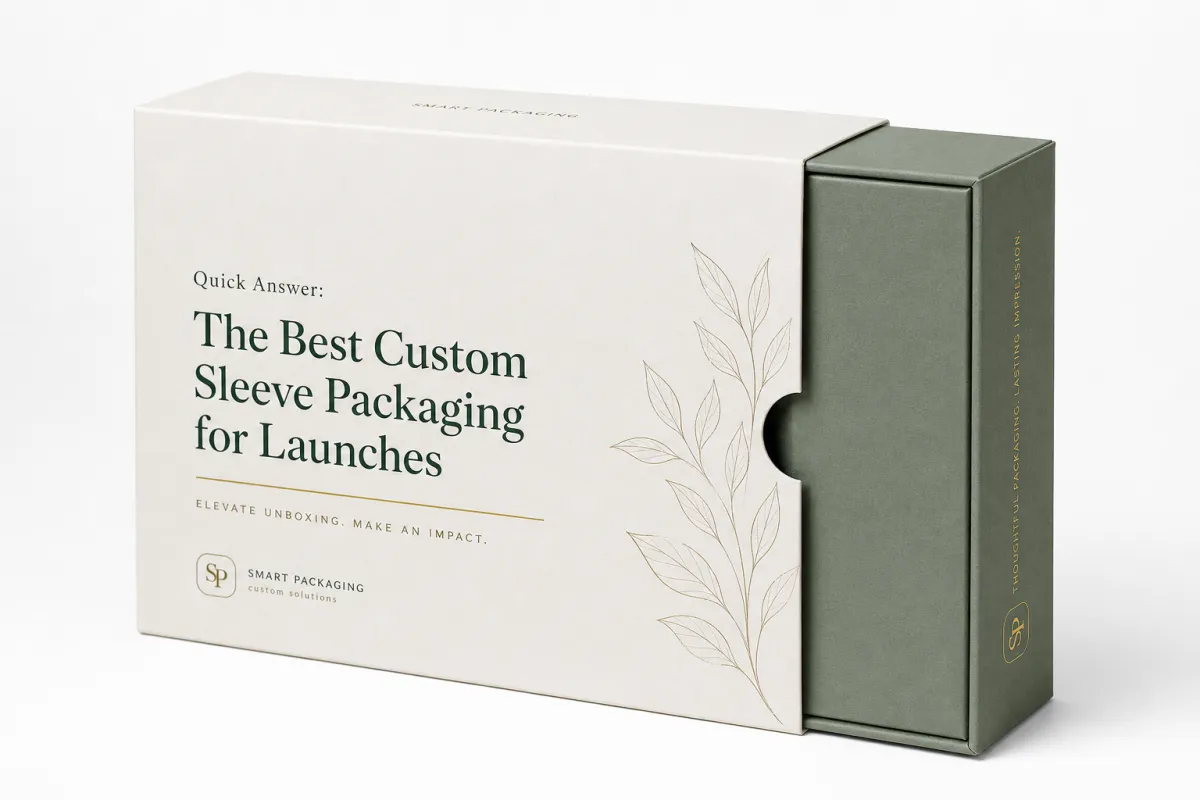
If you need the short answer, the best custom sleeve packaging for launches is usually a well-fitted paperboard sleeve with a finish that matches the product price point and the channel. It gives you a fast visual lift without forcing a full custom box rebuild, which matters when the launch brief shifts halfway through prepress. For many teams, that is the difference between shipping on time and missing the window by two weeks, and I am not exaggerating there.
The part that surprises people is how much a sleeve can move perceived value. A $0.25 to $0.45 sleeve with sharp registration, a tight dieline, and one thoughtful finish often changes how a product reads on shelf more than a heavier structure that costs twice as much but arrives with flat artwork or sloppy fit. That is especially true in retail packaging, where the first glance does most of the selling.
Here is the lens I would use:
- Print quality: Does the sleeve hold fine type, clean solids, and brand color accurately?
- Fit: Does it stay snug on the primary pack without scuffing or tearing at the corners?
- Finish: Are you using coating, foil, embossing, or spot UV to support the price point instead of just adding shine?
- Speed: Can the supplier sample quickly and hold a realistic production slot?
- Cost: Does the sleeve improve launch performance enough to justify the spend?
The best custom sleeve packaging for launches also depends on channel. A retail debut wants stackability and barcode visibility. Influencer seeding wants an unboxing moment that reads well on camera. A DTC launch usually wants lightweight shipping economics and quick assembly. A limited-edition drop can tolerate higher unit cost if the sleeve feels collectible. Same category, different job.
"A sleeve should do three jobs at once: frame the product, survive the shipment, and make the buyer feel the launch was planned."
Launch packaging is rarely judged in isolation. It sits beside custom printed boxes, inserts, tissue, labels, and shipping cartons. The sleeve has to support the whole package branding system, not fight it. That is why the best custom sleeve packaging for launches is not always the most ornate one; it is the one that stays coherent across the full product packaging stack.
Top Options Compared for the Best Custom Sleeve Packaging for Launches
The best custom sleeve packaging for launches is rarely a single format for every product. Different sleeve styles solve different launch problems. A paperboard sleeve is the workhorse. A rigid sleeve signals prestige. Kraft keeps the sustainability message honest. High-gloss presentation sleeves can sell hard in beauty, candy, or gift set packaging where visual punch matters more than restraint.
From a packaging design standpoint, the choice should start with the product and the channel, not the finish catalog. Cosmetics want clean typography and controlled color. Food products need legibility and compliance-friendly layouts. Electronics often need a sleeve that protects the front face while leaving room for technical details. Wellness brands usually benefit from softer tactile coatings and a calmer visual field. Gift sets can carry more decoration, but only if the structure still closes well and stacks correctly.
| Sleeve style | Best for | Typical stock / build | Typical unit cost at 5,000 | Pros | Tradeoffs |
|---|---|---|---|---|---|
| Paperboard sleeve | Most retail launches, beauty, wellness, food | 300-400gsm SBS or C1S board | $0.18-$0.42 | Good print fidelity, efficient, flexible | Less premium feel unless finishes are used well |
| Rigid sleeve | Luxury gift sets, premium launches, collector drops | Rigid chipboard wrapped with printed paper | $0.55-$1.40 | Strong perceived value, good structure | Higher cost, longer setup, more shipping weight |
| Kraft sleeve | Sustainable positioning, natural brands, artisanal launches | Kraft board with minimal coating | $0.16-$0.34 | Natural look, lower material impact, easy brand story | Color range is narrower; dark solids can look muted |
| High-gloss presentation sleeve | Beauty, confectionery, seasonal drops | Coated board with gloss AQ or UV | $0.22-$0.48 | Shelf pop, strong contrast, camera-friendly | Shows scuffs more easily; can feel overdone if crowded |
If the goal is speed and control, paperboard usually wins. If the goal is premium perception, rigid sleeves push the product higher on the value ladder, but the budget has to support that jump. Kraft is the clearest sustainability signal when you want the packaging itself to support a lower-impact story, especially if you pair it with FSC-certified paper options from FSC. High-gloss styles are the most aggressive on shelf, and that can be useful if the launch is fighting for attention in a dense category.
The best custom sleeve packaging for launches also has to survive production realities. Thin sleeves can warp if the grain direction is wrong. Rigid sleeves can chip on corners during assembly. Gloss coatings can pick up fingerprints and scuff marks under retail lighting. Kraft can make premium white space look unfinished if the design is not disciplined. These are not abstract issues; they show up in mockups, then show up louder in the first production run.
For brands comparing branded packaging options, the real question is not "Which sleeve looks nicest?" It is "Which sleeve can be produced consistently, shipped safely, and still support the launch story after a 12-hour day on a retail shelf?" That is the practical test behind the best custom sleeve packaging for launches.
There is also a channel issue that gets missed. Influencer seeding often rewards a sleeve with a reveal moment: a pull tab, a die-cut window, or a layered open. DTC unboxing rewards tidy construction and low shipping weight. Retail packaging rewards flat, bold, legible front panels. The best custom sleeve packaging for launches respects that difference instead of trying to do everything badly.
Detailed Reviews: What Each Sleeve Style Gets Right
A paperboard sleeve is the safest starting point for the best custom sleeve packaging for launches because it handles a wide range of print methods and costs. On a 350gsm C1S board with matte AQ coating, it usually gives you enough stiffness for shelf presentation without creating assembly headaches. It is a strong fit for cosmetics cartons, supplement packs, and small electronics where the outer structure is doing most of the branding work.
What it gets right is balance. You can add foil, embossing, or spot UV without pushing the budget too far. A die-cut window can expose a product color or shape, which is often enough to stop a shopper. For launch programs, that matters because the sleeve becomes a short-form sales tool. It should answer three questions fast: what is it, why does it matter, and why should I trust this brand?
A rigid sleeve is a different animal. It is best for the best custom sleeve packaging for launches when the product needs to feel like a gift, a collector item, or a high-ticket purchase. A wrapped rigid structure with a clean pull-open mechanism has more presence in hand. It also photographs well, which helps DTC campaigns and press kits. The downside is tolerance. If the build is even slightly off, corners compress, edges show, and assembly time rises.
Kraft sleeves usually get chosen for one reason: the brand wants to look grounded, natural, or lower impact. The strongest versions are simple and disciplined. A 24pt to 32pt kraft board with black or single-color ink can look excellent, especially for wellness, food, and artisanal launches. The failure mode is just as clear. Too much ink on kraft, and the design feels muddy. Too many special finishes, and the sustainability story starts to look staged. The best custom sleeve packaging for launches in this segment is often the least forced one.
High-gloss presentation sleeves are useful when the launch needs instant visual lift. They create contrast under store lighting and can be effective for limited editions or seasonal sets. They also work well when the product itself is modest but the brand needs the package to feel more valuable than the base structure suggests. I would still be careful. Gloss can be persuasive, but it can also exaggerate fingerprints, corner wear, and print imperfections. If the sleeve will be handled a lot before purchase, the defects will show.
Here is where finish choices shift perceived price point:
- Soft-touch lamination: lowers glare and makes premium beauty or wellness products feel more controlled.
- Foil stamping: works when used sparingly, especially on logos or launch marks.
- Embossing/debossing: adds tactility without adding much visual noise.
- Spot UV: useful for contrast, but it needs a strong base design or it looks busy.
- Die-cut windows: effective when the product color, texture, or shape is part of the sale.
Testing also matters. For transit performance, many teams reference ISTA test methods when they want to understand compression, drop, and vibration risks. That matters because the best custom sleeve packaging for launches is not just the sleeve that looks good in a proof; it is the sleeve that stays aligned after shipping, storage, and repeated handling.
If I had to rank sleeve styles by launch utility, I would put them this way: paperboard for most launches, rigid for high-value gifts or press kits, kraft for sustainability-led brands, and high-gloss for shelf pop where visual urgency matters more than tactile restraint. That ranking changes by category, but the logic stays the same. The best custom sleeve packaging for launches is the one that gives the team the clearest return on design effort.
Cost, Pricing, MOQ, and Unit Cost Breakdown
Cost is where launch packaging gets real. The best custom sleeve packaging for launches may look expensive in a proof and still be a better business choice than the cheaper option if it improves sell-through or reduces launch risk. The reverse happens too. Teams sometimes overspend on finish complexity that shoppers barely register, and that kind of waste shows up fast once the first invoice lands.
The main cost drivers are predictable. Material grade matters. Print method matters. Finish complexity matters. Tooling matters. Order volume matters the most. A simple four-color paperboard sleeve can be economical at volume, but setup charges make low-MOQ runs look expensive fast. A short run of a premium sleeve may land at $0.65 to $1.80 per unit depending on structure and finish, while a larger run can drop sharply once plates, die-lines, and make-ready are spread across the quantity.
For reference, these are the cost patterns I usually see in launch work:
- Simple paperboard sleeve: around $0.18-$0.42 per unit at 5,000 pieces.
- Premium rigid sleeve: around $0.55-$1.40 per unit, sometimes more with wrapped boards and special inserts.
- Kraft sleeve: around $0.16-$0.34 per unit when print coverage stays light.
- High-finish sleeve: around $0.22-$0.48 per unit before you add uncommon specialty work.
MOQ depends on the supplier and the build, but many launch programs can start with smaller quantities if the structure is straightforward. The catch is that low MOQ usually means a higher per-unit price and fewer finishing choices. That is not a bad trade if the launch is uncertain or the market test is limited. It is a bad trade only if you pretend the short run will price like a full-scale retail order.
The cheapest quote is not always the lowest-risk quote. A sleeve with a weak dieline, inconsistent registration, or poor finish adhesion can cost more in rework than a slightly more expensive quote would have cost upfront. That is why I always advise comparing like with like: same board, same print coverage, same finish, same quantity, same shipping assumption. The best custom sleeve packaging for launches is the one that survives a fair comparison, not the one that simply comes in lowest on the first line.
Ask suppliers to break pricing into these buckets:
- Material: board type, thickness, and any recycled content.
- Printing: color count, coating, and whether the artwork needs special matching.
- Finishing: foil, embossing, spot UV, soft-touch, lamination.
- Tooling: dies, plates, and setup charges.
- Fulfillment: packed flat, glued, kitted, or assembled.
That breakdown makes it easier to spot where a quote has hidden cost. A sleeve may look inexpensive until the supplier adds charges for a custom die, a complex fold, and an extra packing step. Once that happens, the launch team is no longer comparing sleeves; it is comparing total landed cost. That is the only number that really matters.
If sustainability is part of the brief, ask whether the board is FSC-certified and whether the coating choices still support recycling pathways in your target market. Sustainable claims should be accurate, not decorative. A sleeve can be paper-based and still be difficult to recycle if the finish stack is too aggressive. That is another place where the best custom sleeve packaging for launches avoids flashy overreach.
Process, Timeline, and Lead Time for Launch Orders
The fastest way to miss a launch is to treat packaging like the last task instead of a project stream. The best custom sleeve packaging for launches starts with dimensions, print intent, and the launch date, then works backward. If those three items are not locked early, even a simple sleeve can drift.
The standard flow is straightforward. Brief the supplier. Confirm the primary pack dimensions. Build or approve the dieline. Review artwork on the layout. Request a sample or digital proof. Approve the finish. Run production. Ship and receive. Each step can move quickly, but any revision loop can slow the whole schedule. Artwork corrections and finish approvals are the two most common delay points, especially when multiple stakeholders are involved.
Typical lead times for the best custom sleeve packaging for launches often look like this:
- Dieline and proofing: 2-5 business days if dimensions are ready.
- Sampling: 5-10 business days for most straightforward sleeves.
- Production: 12-20 business days after final approval for standard runs.
- Complex finishes: add 3-7 business days, sometimes more if the schedule is crowded.
- Freight: depends on destination and shipping mode, so do not ignore it in the launch plan.
Rush work is where the compromises show up. A compressed schedule may reduce finish options, limit sampling, or require the team to sign off on a proof without a physical sample. That can work for a low-risk refresh. It is less comfortable for a first-time launch, where the sleeve is carrying a lot of brand weight. The best custom sleeve packaging for launches is rarely the one forced through the fastest path; it is the one given enough time to be checked properly.
There is also a testing angle. If the sleeve is part of a product that ships through retail distribution or e-commerce, test the assembly and package behavior before approval. Ask whether the sleeve will hold up under compression, whether the print scuffs during carton packing, and whether the barcode remains readable. Those small checks save large headaches later. For many teams, packaging compliance and transit integrity are not abstract requirements; they are the difference between a clean launch and a complaint cycle.
Launch planning checklist:
- Confirm product dimensions and allowed tolerance.
- Decide whether the sleeve must fit over a carton, tray, or bottle.
- Choose the finish level before artwork is finalized.
- Approve one physical sample whenever possible.
- Build buffer time for revisions, shipping, and reprints.
That checklist sounds basic, but it prevents expensive guessing. The best custom sleeve packaging for launches is often the one that was planned backward from the campaign date, not forward from the supplier's first available slot.
How to Choose the Best Custom Sleeve Packaging for Launches
Choosing the best custom sleeve packaging for launches comes down to priorities. Is the product premium, natural, technical, or giftable? Is the main goal shelf visibility, DTC excitement, or speed-to-market? Is sustainability a core promise, or just a preference if costs allow? The answers should steer the sleeve selection before any artwork is polished.
For premium positioning, I would start with a strong paperboard or rigid sleeve and one controlled tactile finish. Soft-touch lamination, foil on the logo, or embossing around a mark can elevate perceived value without drowning the panel in decoration. For retail visibility, a bolder contrast ratio and a clean front face usually work better than clever design tricks. For sustainability-led launches, kraft or uncoated board with restrained ink coverage tends to read as more credible. For speed, the simplest structure wins, kind of by definition.
The best evaluation process is hands-on. Request samples in the actual board grade. Check the fit on the real product, not a placeholder. Pack and unpack the sleeve several times. Look at it under warm light, cool light, and direct glare. Photograph it on a phone. If the package looks dull on camera, that matters more than a glossy mockup would suggest. The best custom sleeve packaging for launches should survive both the retail shelf and the social feed.
Use this decision framework:
- Premium feel: rigid sleeve or paperboard with soft-touch and foil accents.
- Budget control: simple paperboard sleeve with limited print coverage.
- Fast production: standard paperboard or kraft with minimal finishing steps.
- Sustainable positioning: kraft or FSC-certified paperboard with clean, recyclable construction.
- High shelf impact: glossy or high-contrast design with careful scuff planning.
Fit tolerance matters more than many teams expect. A sleeve that is too loose can slide during transit and make the product look underbuilt. A sleeve that is too tight can scuff corners, buckle edges, or slow assembly. If the package includes an insert, confirm how the sleeve interacts with it before printing. A millimeter in packaging is not a tiny thing; it is the difference between a clean reveal and a frustrated line operator.
That is why the best custom sleeve packaging for launches is not simply the prettiest option. It is the one that keeps the story intact across samples, cartons, shipping, shelf display, and customer photos. A sleeve that wins on one metric but fails on the others usually costs more in the end.
If you need to coordinate multiple packaging components, it helps to keep everything under one language system. The sleeve, the insert, the shipper, and the label should feel like one branded packaging family rather than separate purchases. For teams that want to streamline the source list, Custom Packaging Products can be a useful starting point for comparing formats before the final order is locked.
Our Recommendation and Next Steps for a Launch-Ready Order
My recommendation is simple. For most retail and DTC launches, the best custom sleeve packaging for launches is a well-executed paperboard sleeve with a finish chosen for the actual channel, not the mood board. It gives the most reliable mix of price control, shelf impact, and production speed. If the launch is premium or highly giftable, move up to a rigid sleeve. If sustainability is central, use kraft or FSC-certified board and keep the design disciplined. If the campaign depends on instant visual punch, choose a high-gloss presentation sleeve and protect it from scuff risk.
For launch teams, the next steps should be concrete:
- Gather exact product dimensions, including any closure, insert, or label thickness.
- Shortlist two material options so you can compare cost and finish honestly.
- Ask for pricing at at least two quantities to see how unit cost changes with volume.
- Request a physical sample or prototype before final print sign-off.
- Confirm production lead time, freight timing, and a backup plan if revisions are needed.
When you talk to suppliers, ask the questions that reveal whether the quote is solid or just attractive on paper. What is the board grade? What is the real MOQ? How is the sleeve packed for transit? Are revisions included? Is the finish compatible with the intended use? Those questions sound basic, but they expose where the risk sits. The best custom sleeve packaging for launches is usually the one that answers those questions clearly and without defensive language.
If you are deciding under pressure, keep the objective narrow. Choose the sleeve that balances story, Cost, and Production reliability. Not one. All three. That is the tension in launch packaging, and it is why elegant-looking sample boards can mislead teams. The final order has to work in cartons, on shelves, and in customer hands. Anything less is just packaging theater.
For a brand moving now, I would lock the structure first, then the finish, then the print details. Reserve production time as soon as the dimensions are confirmed. The calendar gets tighter fast. If your team is serious about the best custom sleeve packaging for launches, make the decision early enough that the packaging supports the campaign instead of chasing it.
The clearest takeaway is this: start with a sleeve that fits the pack perfectly, choose one finish that reinforces the price point, and test the physical sample before you approve the run. That one sequence avoids most launch-day surprises and gives the packaging a real job instead of a decorative one.
What makes the best custom sleeve packaging for launches different from standard sleeves?
Launch sleeves usually prioritize shelf impact, unboxing, and speed-to-market more aggressively than everyday packaging. They often use tighter print standards, more deliberate sizing, and finishes that support a campaign or debut. The best custom sleeve packaging for launches still has to balance visual lift with production reliability so the order does not slip.
How much does custom sleeve packaging for a product launch usually cost?
Cost depends on material, print method, finish complexity, and order volume. Small runs usually carry a higher unit cost because setup and tooling are spread across fewer pieces. A practical way to compare quotes is to request pricing at two or three quantities so you can see how the unit cost changes as volume rises. That is often the clearest way to judge the best custom sleeve packaging for launches.
What is the typical MOQ for launch sleeve packaging?
MOQ varies by supplier and construction, but launch projects often start lower than full retail programs. Simple paperboard sleeves can usually run at lower quantities than heavily finished or specialty formats. If your launch is uncertain, ask for a prototype or short run option before committing to a larger order so you can test the best custom sleeve packaging for launches with less risk.
How long is the lead time for custom sleeve packaging?
Lead time usually includes artwork review, sampling, approval, printing, finishing, and shipping. Complex finishes or multiple revision rounds can extend the timeline quickly. The safest move is to build extra time into the schedule so the packaging is approved before the campaign window opens. That gives the best custom sleeve packaging for launches room to be checked properly.
How do I choose the right sleeve for a high-end launch?
Start with the product's positioning: luxury, natural, technical, or giftable. Match that position to finishes, stock, and structure that reinforce the price point without looking overstated. Always test the sleeve on the actual pack, because a beautiful render can still fail in hand or under retail lighting. That is usually the most reliable way to identify the best custom sleeve packaging for launches.

