Buyer Fit Snapshot
| Best fit | Custom Sleeve Packaging Boxes Price projects where brand print, material claims, artwork control, MOQ, and repeat-order consistency need to be specified before quoting. |
|---|---|
| Quote inputs | Share finished size, material target, print colors, finish, packing count, annual reorder estimate, ship-to region, and any compliance wording. |
| Proofing check | Approve dieline scale, logo placement, barcode or warning zones, color tolerance, closure strength, and carton packing before bulk production. |
| Main risk | Vague material claims, crowded artwork, missing packing details, or unclear freight terms can make a low unit price expensive after revisions. |
Fast answer: Custom Sleeve Packaging Boxes Price: Board, Finish, Dieline, and Unit Cost should be specified like a repeatable production item. The safest quote records material, print method, finish, artwork proof, packing count, and reorder notes in one written spec.
Production checks before approval
Compare the actual filled-product size with the drawing, then confirm tolerance on folds, seals, hang holes, label areas, and retail display edges. Reserve space for logos, QR codes, warning copy, and material claims before decorative graphics fill the panel.
Quote comparison points
Review material grade, print process, finish, sampling route, tooling charges, carton quantity, and freight assumptions side by side. A quote is only useful when the supplier can repeat the same color, closure quality, and packing count on the next order.
If you are trying to pin down Custom Sleeve Packaging boxes price, the honest answer is that a sleeve often costs less than a fully Custom Rigid Box, but the final number still moves around once you change dimensions, board thickness, print coverage, or order volume. A printed sleeve wrapped around a standard carton can give you a polished, retail-ready look without forcing you into a heavy structural build, which is why so many brands reach for it when they need branding to work harder than the budget would normally allow.
The part that trips people up is that quotes can look clean while hiding a few important variables. A sleeve price that seems friendly on the first line can jump once tooling, coatings, sampling, or freight enter the picture. The best way to read custom sleeve packaging boxes price is to break it into the pieces that actually change the number, then compare vendors using identical specs so you are not comparing apples to oranges.
Custom Sleeve Packaging Boxes Price: What Drives the First Quote
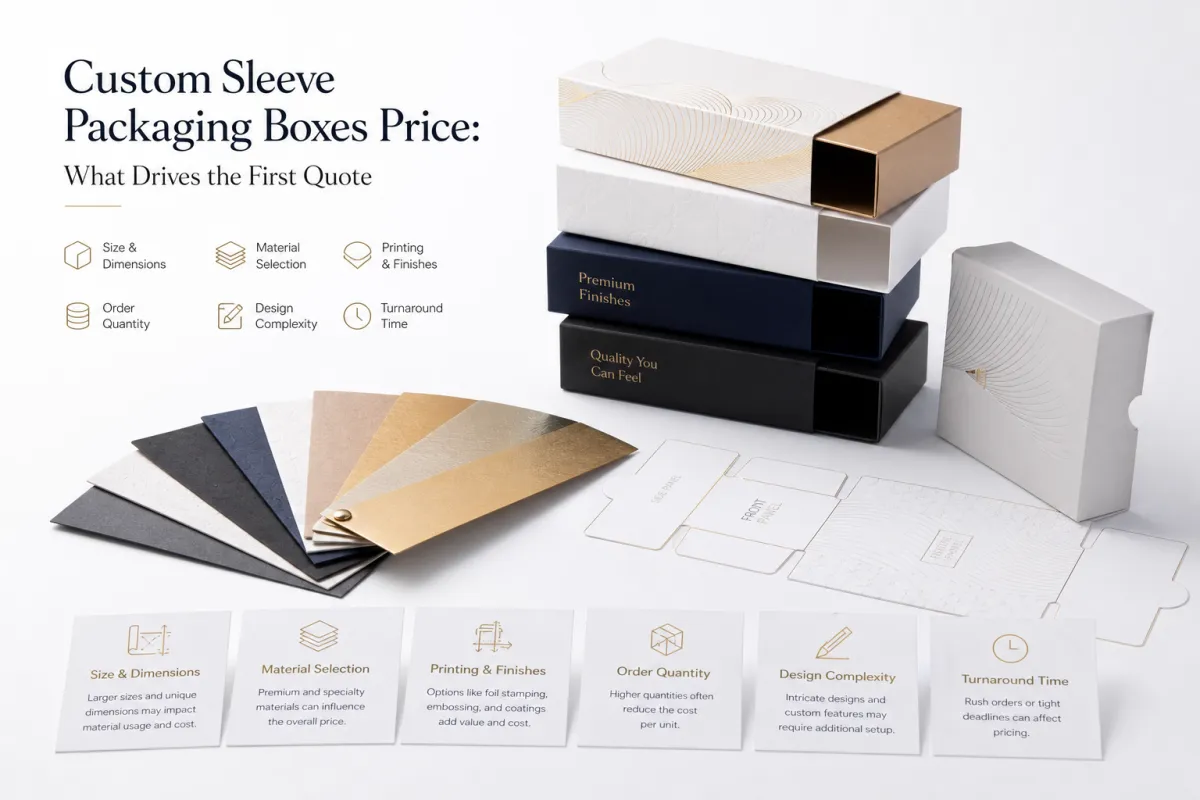
The sleeve itself is usually simpler than the box underneath it, but custom sleeve packaging boxes price still depends on the carton, the print method, and the quantity you order. A sleeve is a printed wrap, not a full redesign of the package structure. That means you can give a standard folding carton, tray, or tuck-end box a more finished presentation without paying for a rigid structure with wrapped board, foam inserts, magnetic closures, and all the other extras that sound nice but often do not match the actual job.
In day-to-day packaging work, a good sleeve can turn a plain mailer or retail carton into something that feels ready for the shelf. I’ve seen that with candles, skincare sets, apparel boxes, and gift packs more times than I can count. The brand wants stronger shelf presence, but it does not want a luxury box budget. A well-made sleeve handles that middle ground nicely, and it gives you a flexible surface for seasonal art, launch copy, or SKU-level changes without rebuilding the whole pack every time the graphics shift.
Four variables usually decide the first quote for custom sleeve packaging boxes price:
- Size: larger sleeves use more board and create more sheet waste.
- Material: coated paperboard, kraft, and premium stocks each carry different costs.
- Print coverage: a one-color logo is cheaper than full-bleed CMYK artwork.
- Quantity: setup costs spread out faster once the run gets past low MOQ territory.
That is the pricing logic, plain and direct. If a supplier cannot explain those four parts clearly, the quote is not ready yet. You do not need a polished sales pitch. You need a number that matches the actual build.
For buyers comparing custom sleeve packaging boxes price across vendors, the safest move is to request a quote with the same dimensions, the same board, the same print coverage, and the same finish. Otherwise, you are comparing different products and pretending the unit rate means something it does not. A low number on a different spec is not savings. It is a different package.
If you want to see how sleeves fit into a broader packaging lineup, take a look at Custom Packaging Products. That gives you a cleaner way to compare sleeve packaging against other custom printed boxes before you settle on a final structure.
Sleeves also do more than decorate. They can hold barcodes, ingredient panels, compliance text, QR codes, and seasonal messaging. That is one reason custom sleeve packaging boxes price is tied to both visual branding and production utility. Good packaging design should carry its own weight, not just look tidy in a mockup.
What Sleeve Packaging Boxes Are and What You Actually Get
Sleeve packaging boxes are straightforward once you strip away the jargon. They are an outer printed wrap that slides over a carton, tray, folded box, or rigid base. The sleeve adds graphics, a sense of structure, and a more complete brand story without forcing you to re-engineer the entire package. That is why custom sleeve packaging boxes price is usually lower than a fully custom carton with printed interiors and specialty closures.
What you are actually paying for is a defined set of components. The sleeve stock. The die-cut shape. The printed coverage. The finish. In some jobs, a window. In others, a locking tab or glue line. Each one can nudge custom sleeve packaging boxes price up or down, and none of them are random if the vendor understands the production side.
The common use cases are easy to recognize:
- Cosmetics: a sleeve adds shelf appeal without changing the primary jar or bottle insert.
- Candles: sleeves protect branding and make a plain vessel look retail-ready.
- Apparel: sleeves help differentiate sets, gift packs, or folded garments.
- Food: sleeves work well for gift tins, bakery boxes, and limited-run seasonal packaging.
- Subscription packaging: sleeves give recurring shipments a fresh branded face.
Compared with a full custom box, the savings usually come from less material, simpler finishing, and lower labor. You are not paying for as much board, as much assembly, or as much structural complexity. That is why custom sleeve packaging boxes price often looks attractive when the inner carton is already doing the heavy lifting.
Sleeves still have limits. Oversized coverage, heavy ink, full-wrap printing, a custom window, or specialty board can push the quote up quickly. Some buyers assume a sleeve automatically means cheap. It does not. It means efficient, which is not the same thing.
From a packaging buyer’s point of view, sleeves make sense when the inside pack is functional and the outer layer is doing the selling. That is a strong fit for retail packaging where shelf presence matters. It also works well when you need flexible package branding across several SKUs and do not want to rebuild the base box every time the artwork changes.
For sourcing teams that care about documentation and responsible materials, board options can also be selected to support FSC chain-of-custody requirements. If that matters to your brand, ask about certified stock and supplier paperwork. The FSC site is a clear place to understand the baseline.
Materials, Print, and Finishes That Change the Price
Material choice has a real impact on custom sleeve packaging boxes price. A sleeve made from thinner SBS or coated paperboard will usually cost less than one made from thicker, more crush-resistant board. That lighter stock can work well for low-weight items or short-run campaigns. Once the box is handled often, shipped in bulk, or stacked in retail, the cheaper board may scuff, bend, or look worn before it reaches the customer. I have seen plenty of low-cost sleeves lose the fight with corrugated freight and store handling, which is why the cheapest stock is not always the cheapest outcome.
The tradeoff is pretty easy to see. Thicker board gives better rigidity and a better print feel, but it raises material cost and can increase die-cut waste. A mid-weight paperboard often ends up as the sweet spot for many sleeves. It gives enough body for product packaging without pushing the budget into a premium lane that does not match the product.
Print complexity changes custom sleeve packaging boxes price faster than most first-time buyers expect. A one-color logo on kraft is efficient. Full-color CMYK with gradients, deep blacks, and edge-to-edge coverage requires more prep and tighter ink control. Add spot color matching and the price climbs again, especially if your brand needs strict color consistency across multiple SKUs.
Finishes matter too. The usual suspects are:
- Matte lamination: clean, modern, and good for reducing glare.
- Gloss lamination: brighter and more reflective, useful for color-heavy art.
- Soft-touch coating: premium feel, though it adds cost and can show handling marks in some settings.
- Foil stamping: sharp brand accents, especially for logos and limited editions.
- Embossing or debossing: tactile detail that lifts the design, but it requires extra tooling.
- Spot UV or varnish: useful for contrast on logos or product names.
Every one of those choices can improve the pack. Every one of them can also push custom sleeve packaging boxes price higher than planned. The smarter route is usually one or two premium details, not five. Pick the finish that supports the brand story, then stop there.
There are hidden cost drivers that do not announce themselves in the first line of a quote. Windows need cutting. Special shapes need tooling. Interior printing adds setup. Compatibility with inserts or a specific carton size can tighten tolerances and increase waste. If your sleeve has to wrap around an awkward structure, the dieline may need extra adjustments. That work has a cost.
| Spec Level | Typical Price Impact | Best Use | Notes |
|---|---|---|---|
| Basic board + 1-color print | Lowest | Simple branded packaging | Good for tight budgets and clean layouts |
| Full-color CMYK + matte finish | Moderate | Retail packaging and general product packaging | Best balance of look and cost for most programs |
| Full-color + soft-touch + foil | Higher | Premium launches and gift sets | Looks strong, but custom sleeve packaging boxes price rises fast |
| Heavy board + special die-cut + window | Highest | Display-driven custom printed boxes | Use only when the shelf value justifies it |
Buyers often ask how to keep the look strong without paying for every upgrade. My answer stays the same: choose one statement feature. A foil logo. A strong matte finish. A precise die-cut window. Stacking every finishing option because the sample sheet looks tempting usually creates a bloated spec with no real payoff. A disciplined build gives the best custom sleeve packaging boxes price without making the package feel stripped down.
For brands that care about material transparency and lifecycle choices, it helps to understand how packaging materials are evaluated more broadly. The EPA has useful guidance on materials, waste, and recovery that can help frame packaging decisions, especially if your team tracks sustainability claims.
Print coverage also changes price more than many buyers realize. A small logo on one panel is not the same thing as a full-wrap sleeve with bleed. If you want the cleaner number, simplify the artwork placement first. That does more for custom sleeve packaging boxes price than trying to shave a few cents off the finish.
Custom Sleeve Packaging Boxes Price by Quantity and MOQ
Quantity is the biggest reason custom sleeve packaging boxes price changes so much from one order to the next. Setup, cutting, press preparation, and proofing do not scale neatly. They cost roughly the same whether you order 100 sleeves or 5,000 sleeves. The unit price drops as volume rises because those fixed costs get spread across more pieces.
For simple printed sleeves on standard paperboard, these are realistic ballpark ranges I would expect to see in the market, assuming normal artwork and no exotic finishes. These are not promises, and they are definitely not a substitute for a supplier quote, but they are useful for sanity-checking a proposal that feels too high or suspiciously low.
| Order Size | Typical Unit Range | Cost Pressure | Best Fit |
|---|---|---|---|
| 100-250 pcs | $1.20-$2.80 each | Very high | Prototype runs, market tests, small launches |
| 500 pcs | $0.70-$1.60 each | High | Small retail programs, seasonal SKUs |
| 1,000 pcs | $0.38-$0.95 each | Moderate | Growing brands that want a better unit cost |
| 5,000 pcs | $0.18-$0.42 each | Low | Established product lines and repeat orders |
| 10,000+ pcs | $0.12-$0.28 each | Lowest | Stable SKUs with predictable demand |
Those ranges are not magic numbers. They move based on size, artwork, board thickness, finish, and shipping terms. They do show the pattern clearly: low MOQ orders carry a much higher custom sleeve packaging boxes price per unit because the setup cost has fewer pieces to absorb it.
MOQ expectations matter as well. Some suppliers will quote low quantities for standard specs, then raise the MOQ for specialty boards, foil, embossing, or complex die-cuts. That is normal. A factory does not want to run a complicated job for a tiny order unless the margin makes sense. The same logic applies on your side. No one wants to lose money on a small run dressed up as premium.
Watch for setup charges too. Plate fees, cutting dies, sample charges, and artwork prep can all sit outside the unit price. That is where buyers get annoyed, because the first number sounds fine and the landed cost is not fine at all. A clear custom sleeve packaging boxes price quote should tell you whether tooling, proofing, and samples are included.
"If the quote is cheap but the freight and setup are vague, the price is not cheap. It is unfinished."
Freight can quietly wreck a deal that looked good on paper. Packaging is light, but volume takes space. A flat carton shipment, a mixed pallet, or an export carton arrangement can shift the final landed cost far more than people expect. Packaging method matters too. Sleeves that ship nested, flat-packed, or cartonized in different ways can change the logistics bill. That is why custom sleeve packaging boxes price should be judged on landed cost, not just box cost.
For brands comparing suppliers, ask for two versions of the same quote: one at your target quantity, and one at a higher quantity such as 1,000 or 5,000. That comparison makes the breakpoints visible. You will see quickly where custom sleeve packaging boxes price becomes sensible, and where you are still paying the low-MOQ penalty.
If the sleeve must protect a carton during transit, it is worth thinking beyond graphics. Transit testing standards such as ISTA matter when packaging has to survive shipping abuse, not just sit neatly on a shelf. The ISTA site is a useful reference if your program has distribution risk, retail resupply, or e-commerce handling in the mix.
How the Quote, Proof, and Production Timeline Works
A clean quoting process saves money and shortens the time it takes to reach the final custom sleeve packaging boxes price. The fastest way to slow everything down is to send half the spec and hope the supplier fills in the missing pieces. They will, but the number will be less accurate and the back-and-forth will stretch out longer than anyone wants.
Here is the quoting sequence that usually works best:
- Send exact dimensions of the sleeve and the object it wraps.
- State the construction type: carton sleeve, tray sleeve, or wrap-around band.
- Confirm material preference, print colors, and finish.
- State quantity and target budget.
- Give the shipping destination so freight can be estimated early.
Once the quote is approved, production usually moves through dieline setup, artwork check, proofing, and scheduling. If the job is simple, the timeline is manageable. If the sleeve includes special finishes or a custom sample, the schedule expands. That is not a failure. It is just the pace of packaging production.
For a straightforward order, a typical timeline might look like this:
- Dieline and artwork check: 1-2 business days
- Digital proof approval: 1-3 business days depending on revision count
- Sampling or pre-production sample: 3-7 business days if requested
- Production: often 12-15 business days after approval for standard sleeve jobs
More complex jobs can take longer, especially if the art is not final, the color target is strict, or the finish needs extra curing time. That is one reason custom sleeve packaging boxes price and lead time often move together. More complexity usually means more steps, not just more cost.
The delays I see most often are predictable rather than mysterious. Missing artwork. Unclear dimensions. Color corrections after proofing. Late approval on a sample. If your team wants a cleaner custom sleeve packaging boxes price and faster delivery, send a complete spec sheet the first time. No guesswork. No drama.
There is also a subtle quality issue worth keeping in view. A sleeve that fits tightly enough to look premium but not so tightly that it scuffs the carton is a balancing act. If your dimensions are off by even a few millimeters, the result can feel sloppy or be awkward to assemble. Precise measurements matter more than pretty mockups. Good packaging design is technical before it is visual.
Why Choose Us for Sleeve Packaging Without Paying Extra Noise
People do not want mystery pricing. They want a real custom sleeve packaging boxes price and a supplier who can explain what sits inside it. That is where direct manufacturing matters. When a quote passes through too many layers, costs get padded, assumptions get buried, and nobody is quite sure who added the extra margin. Useful system? Not really.
Our approach is direct: clear specs, clean production, and honest feedback on where money is going. If a design is overbuilt for the target market, I would rather say that plainly than hide behind vague praise. If the sleeve can be simplified without hurting the brand, that should be part of the conversation too. Good custom printed boxes are not about stuffing every option into the spec sheet. They are about Choosing the Right ones.
Consistency matters most in sleeve work. Buyers need stable color, crisp die-cuts, and sleeves that fit correctly batch after batch. That consistency protects package branding and keeps the product line from drifting between runs. It also keeps returns and rework from eating the savings you thought you gained from a lower unit rate.
From a practical buyer perspective, the best supplier support looks like this:
- Spec checking before the quote goes out
- Dieline help when the carton size changes
- Advice on which finish improves the look without blowing up cost
- Clear explanation of setup, sampling, and freight
That is how you get a sensible custom sleeve packaging boxes price instead of a cheap-looking quote that turns expensive later. It is also how you avoid hidden rework on packaging that was never going to fit well in the first place.
If you need to compare different product packaging options, the easiest route is to review the available structures first, then choose the sleeve spec that matches your budget and handling needs. The Custom Packaging Products page is a good starting point for that kind of comparison.
I also care about the details buyers only notice after something goes wrong. Clean gluing. Accurate fold lines. Proper board selection. Those are not glamorous, but they are what separate an acceptable sleeve from one that feels cheap in hand. A smarter custom sleeve packaging boxes price is the one that buys reliability, not just a lower invoice total.
What to Send for an Accurate Quote and Your Next Step
If you want a fast and accurate custom sleeve packaging boxes price, send the quote request like you mean it. The more complete the brief, the fewer correction rounds you will need. That saves time, and time is money whether the supplier says it out loud or not.
Use this checklist:
- Dimensions: sleeve width, height, and depth, plus the object it wraps
- Material: board type or preferred thickness
- Print: one-color, CMYK, spot color, or full coverage
- Finish: matte, gloss, soft-touch, foil, embossing, UV, or none
- Quantity: target order size and any future repeat volume
- Delivery location: so freight is priced into the landed total
If you already have a reference sample, send it. If you have artwork, send that too. If the sleeve has to fit a carton, tray, or rigid base with a precise tolerance, say so right away. That one detail can change custom sleeve packaging boxes price more than a buyer expects.
When comparing quotes, do not get distracted by the lowest unit number alone. Ask whether setup is included. Ask whether sample costs are included. Ask whether freight is included. Ask whether the finish you want is actually part of the quoted spec. That is how you separate a real offer from a teaser price designed to win the first email.
If your goal is to balance unit cost and presentation, ask for two options: one with the minimum viable premium finish, and one with the premium look you wish you could justify. Seeing them side by side makes the tradeoffs obvious. In many cases, the better custom sleeve packaging boxes price is the one that removes one unnecessary embellishment and keeps the sleeve visually strong.
Here is the blunt version. The right sleeve should improve shelf appeal, support product packaging, and hold its shape without burning budget on features nobody notices. That is how you get value. That is how you avoid overpaying. And that is why custom sleeve packaging boxes price should always be judged against the actual job the box has to do.
Bottom line: gather your dimensions, quantity, material preference, and finish choices, then request a quote with landed shipping included. If you do that, the custom sleeve packaging boxes price conversation gets a lot cleaner, a lot faster, and a lot less annoying.
What affects custom sleeve packaging boxes price the most?
Size, material thickness, print coverage, and order quantity are usually the biggest drivers of custom sleeve packaging boxes price. Special finishes such as foil, embossing, or soft-touch can raise the cost quickly, and the shipping destination also changes the landed total.
How much do custom sleeve packaging boxes cost at low MOQ?
Low MOQ orders usually carry a higher per-unit price because setup costs are spread across fewer pieces. Simple sleeves cost less than sleeves with special finishes or heavy board stock, so ask for pricing at two quantities to see where custom sleeve packaging boxes price drops.
Can I lower custom sleeve packaging boxes price without weakening the design?
Yes. Keep the structure simple, use one premium finish instead of several, and avoid oversized sleeves that waste board. Standard material choices and efficient print coverage usually save more than trimming the visual impact, which keeps custom sleeve packaging boxes price under control.
How long does it take to produce custom sleeve packaging boxes?
Simple orders move faster than jobs that need samples, special coatings, or complex die-cuts. Most delays come from artwork changes or late proof approval, so a clean spec sheet speeds up quoting and production planning for custom sleeve packaging boxes price and lead time alike.
What information do I need for an accurate custom sleeve packaging boxes price quote?
Send dimensions, quantity, material preference, print colors, finish, and shipping destination. Include whether the sleeve wraps a carton, tray, or rigid box so sizing is correct, and attach artwork or a reference sample if you have one. That makes the custom sleeve packaging boxes price quote far more reliable.

