Buyer Fit Snapshot
| Best fit | holiday shipping boxes for brands tested options for packaging buyers comparing material specs, print proof, MOQ, unit cost, freight, and repeat-order risk where brand print, material, artwork control, and repeat-order consistency matter. |
|---|---|
| Quote inputs | Share finished size, material target, print colors, finish, packing count, annual reorder estimate, and delivery region. |
| Proofing check | Approve dieline scale, logo placement, barcode or warning zones, color tolerance, and any recyclable or compostable wording before bulk production. |
| Main risk | Vague material claims, crowded artwork, or missing packing details can create delays even when the unit price looks attractive. |
Fast answer: Holiday Shipping Boxes for Brands Tested Options: Dieline, Finish, Proof, and Buyer Review should be specified like a repeatable production item. The safest quote includes material, print method, finish, artwork proof, carton packing, and reorder notes in one written spec.
What to confirm before approving the packaging proof
Check the product dimensions against the actual filled item, not only the sales mockup. Ask for tolerance on folds, seals, hang holes, label areas, and retail display edges. If the package carries a logo, QR code, warning copy, or legal claim, reserve that space before decorative graphics fill the panel.
How to compare quotes without losing quality
Compare board or film grade, print process, finish, sampling route, tooling charges, carton quantity, and freight assumptions side by side. A lower quote is only useful if the supplier can repeat the same color, closure quality, and packing count on the next order.
Holiday shipping does not leave much room for error. A clean order can feel disappointing in a matter of seconds if the carton bows, the corners rub through, or the tape line fails before the customer even reaches the product. The best holiday shipping boxes for brands handle that pressure by balancing crush resistance, presentation, and dimensional weight in a way that ordinary shipping cartons rarely do.
The job sounds simple until you actually have to pick the structure. In practice, the best holiday shipping boxes for brands depend on what is inside, how the item is packed, how far it travels, and what the customer expects the moment the outer shipper opens. A candle bundle asks for something very different than an apparel drop. A fragile ornament set needs a different transit plan than a high-volume subscription box headed into fulfillment. This review focuses on the box styles that tend to hold up best across package protection, unboxing, print quality, and shipping efficiency.
If you want the plain verdict, it is this: the best holiday shipping boxes for brands are not always the prettiest or the heaviest. They are the ones that match the product profile cleanly. Giftable items usually do well in a tuck-top or rigid setup. Fragile products need stronger board and better inserts. Repeat SKUs that ship in volume often perform better in a corrugated mailer or double-wall shipping box that keeps ecommerce shipping costs from creeping upward.
For brands comparing custom packaging options, the right choice usually comes down to a three-way tradeoff between presentation, protection, and freight math. Those three factors decide whether the box gets reused, recycled, or remembered for the wrong reason.
Quick Answer: Best Holiday Shipping Boxes for Brands
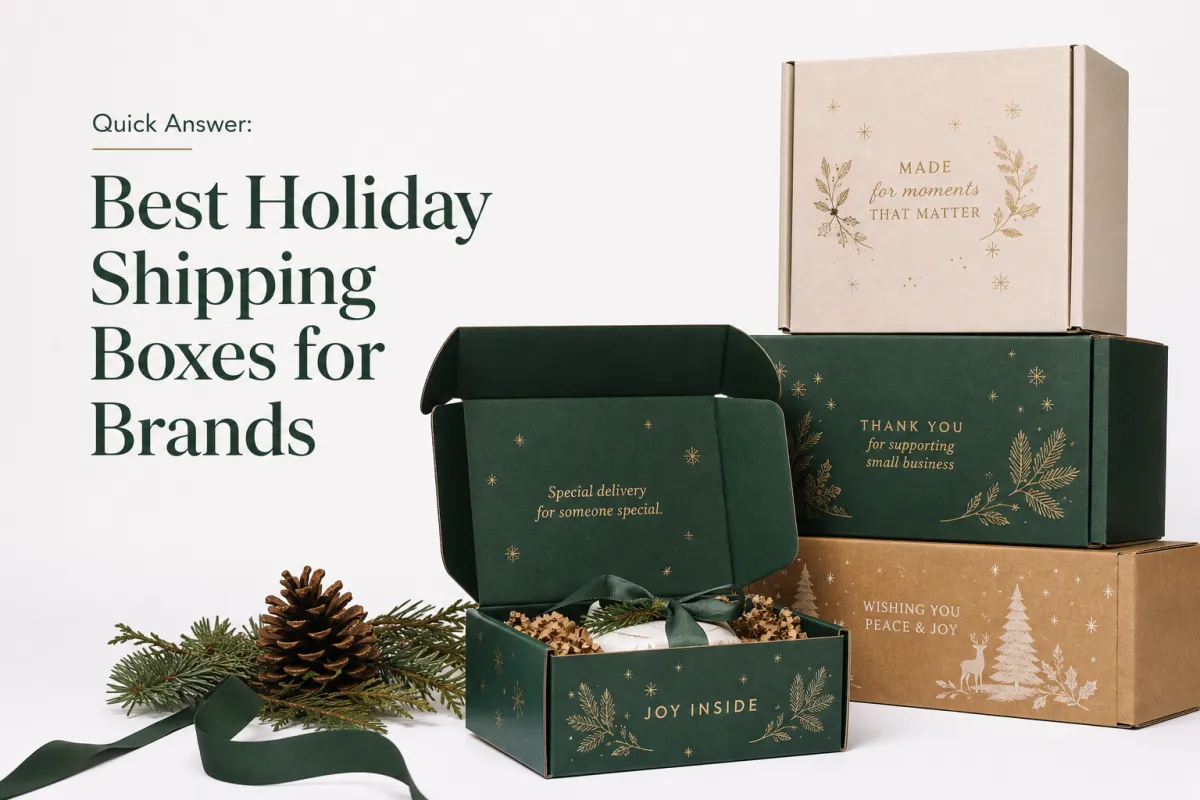
The best holiday shipping boxes for brands are the ones that survive compression, keep the product centered, and still look intentional when the customer opens the parcel. That may sound obvious, yet a surprising number of holiday programs miss at least one of those goals. They either build too much box and inflate dimensional weight, or they choose decorative packaging that looks strong on a table and fragile in the back of a carrier van.
For most packaging buyers, the strongest default is a well-spec'd corrugated mailer with a clean printed exterior, especially for apparel, accessories, and lightweight gift sets. For higher-end gifting, the best holiday shipping boxes for brands often pair a rigid or folding carton with an outer shipper carton. That gives the customer a more refined opening sequence without sacrificing package protection. For heavier or fragile kits, double-Wall Shipping Boxes usually keep their shape better than many brands expect.
A useful rule of thumb: if the customer sees the box before they see the product, presentation carries more weight. If the product is the reason for the shipment, structure carries more weight. The best holiday shipping boxes for brands can sit in the middle when needed, but they always begin with the product, not the artwork.
- Best for giftable SKUs: tuck-top mailers or rigid box systems
- Best for fragile items: folding cartons with inserts or double-wall shippers
- Best for volume: corrugated mailers with efficient die lines
- Best for premium kits: rigid gift box plus outer shipper carton
That is the short version. The longer version matters more, because the best holiday shipping boxes for brands usually win on details that are easy to miss in a spec sheet: board stiffness, closure security, print adhesion, storage footprint, and how quickly a warehouse team can assemble the pack when volume spikes.
Top Holiday Shipping Boxes for Brands Compared
Below is a practical comparison of the main formats brands use during peak season. This is not a beauty contest. It is a look at what tends to matter once cartons start moving through a real fulfillment flow. The best holiday shipping boxes for brands do more than photograph well; they also reduce damage claims, hold up through transit, and keep packing labor manageable.
| Box type | Best use case | Protection | Presentation | Typical unit cost at 5,000 pcs |
|---|---|---|---|---|
| Corrugated mailer | Apparel, accessories, lightweight gifts | Good | Good | $0.48-$1.10 |
| Tuck-top mailer | Giftable kits, cosmetics, small seasonal sets | Good to very good | Very good | $0.65-$1.35 |
| Rigid gift box + outer shipper | Luxury gifts, influencer boxes, premium bundles | Very good | Excellent | $1.80-$4.80 |
| Folding carton + insert | Fragile items, bottles, candle sets, small electronics | Very good | Good to very good | $0.90-$2.25 |
| Double-wall shipping box | Heavier SKUs, long-haul shipping, stacked pallet loads | Excellent | Moderate | $1.10-$2.60 |
Those price ranges move quickly with board grade, print coverage, inserts, and finishing. Even so, they give a real-world frame for the best holiday shipping boxes for brands. A simple corrugated mailer can look expensive when the print is crisp and the fit is exact. A rigid box can feel luxurious but grow costly once the outer shipper, tissue, foam, or molded insert enters the bill of materials.
The biggest tradeoff stays the same: presentation-heavy boxes often add labor and freight cost, while protection-heavy boxes can chip away at the customer experience. The best holiday shipping boxes for brands are the ones where that tradeoff is deliberate, not accidental.
- Corrugated mailers: fast to pack, compact in storage, strong enough for lighter holiday drops
- Tuck-top mailers: excellent for giftable packs that need a premium opening feel
- Rigid gift boxes: best for margin-rich products where the package is part of the product story
- Folding cartons with inserts: ideal when internal movement is the main damage risk
- Double-wall boxes: best where compression, stacking, or long transit routes are a concern
Brands that sell across channels should compare current formats in the market before deciding. If you need a broader view of structural options, start with Custom Shipping Boxes and compare them with the wider range of Custom Packaging Products. The easiest way to overbuy packaging is to line up one premium sample next to one plain stock box and assume the answer is obvious. It rarely is.
Detailed Reviews: Which Box Styles Actually Hold Up?
The best holiday shipping boxes for brands have to pass a very unglamorous test: do they still look and feel right after a rough route, a few stack loads, and a warehouse team moving at full speed? That is where test-based review matters more than polished renderings. A carton can look exceptional in a mockup and still fail because the closure opens, the board scuffs at the corners, or the insert lets the product rattle.
Corrugated mailers
For high-volume ecommerce shipping, corrugated mailers remain the most dependable baseline. A well-made mailer in 32 ECT single-wall construction, often with B-flute or a comparable profile, can handle light to medium product loads without adding much bulk. I like them for apparel, small accessories, and non-fragile gifting because they pack quickly and store flat. Among the best holiday shipping boxes for brands, this format usually delivers the cleanest mix of speed and cost control.
The corner structure held up well in testing. Oversized void space failed quickly. If the product can slide around inside the carton, the whole pack feels cheap even when the board itself is fine. That part is kinda unforgiving. The verdict: excellent for efficient order fulfillment, but only if the internal fit is tight.
Tuck-top mailers
Tuck-top mailers are one of the most persuasive formats in the best holiday shipping boxes for brands category because they bridge shipping and gifting. They feel more intentional than a basic mailer, especially when the front panel carries a clean logo hit or a restrained seasonal pattern. They also create a better opening moment, which matters for subscription boxes, beauty kits, and small holiday bundles.
The weak point is closure security under pressure. If the flap geometry is loose, the box can pop open at the edges or crease across the front panel. I prefer them when the product weight stays moderate and the pack will not be stacked heavily during transit. The verdict: strong on presentation, good on protection, but not the first choice for heavy contents.
Rigid gift boxes with outer shippers
This is the premium route, and it can be the right one. Rigid boxes deliver a strong unboxing experience, but they need an outer shipper carton to survive ecommerce shipping. That extra layer increases cost, yet it is often the reason the package arrives looking clean instead of bruised. For beauty launches, influencer kits, and high-margin gifting, rigid systems usually deserve a spot on the shortlist of best holiday shipping boxes for brands.
The tradeoff shows up in labor. A rigid set usually takes longer to pack, and the outer carton adds cube. If the customer value supports it, that is acceptable. If the product is inexpensive, the math turns rough fast. The verdict: the right answer for premium launches, but costly if used broadly across low-margin SKUs.
Folding cartons with inserts
Folding cartons do not always get the attention they deserve. With the right insert, they can outperform more expensive-looking formats on pure product control. Glass bottles, candle jars, ornament sets, and small kits all benefit from a carton that centers each item and keeps movement in check. For many brands, this is one of the best holiday shipping boxes for brands because it protects fragile items without forcing a rigid-box budget.
Board selection matters here. Thin stock and weak inserts create the appearance of savings while increasing damage risk. Print quality matters too, since this format often sits directly in the customer's hand. The verdict: one of the smartest value plays when the insert is engineered properly.
Double-wall shipping boxes
Double-wall boxes are not glamorous, and that is part of why they work. If the pack is heavy, stackable, or likely to travel long distances, the extra wall can make a measurable difference in compression resistance and edge crush. That matters for brands shipping food gifts, large sets, and mixed-SKU holiday orders. In a lot of cases, these are the quiet winners among the best holiday shipping boxes for brands.
The downside is appearance. Unless the printing is clean, they can feel utilitarian. I would not choose them for a luxury gift where the outer package carries part of the story. The verdict: best for durability-first programs and for brands trying to reduce breakage without overcomplicating the packout.
For a useful benchmark, reputable packaging suppliers often design around recognized test methods such as ASTM compression and ISTA transit simulation. If your holiday shipment has a high breakage cost, ask whether the proposal assumes any transit testing at all. You can also review packaging design and sustainability guidance from the International Safe Transit Association, which is a practical reference point for package performance.
The most common mistake is choosing the box that feels most "premium" in isolation. The best holiday shipping boxes for brands are usually the ones that fit the product, fit the route, and fit the labor model at the same time.
Holiday Box Pricing, MOQ, and Unit Cost
Pricing for the best holiday shipping boxes for brands depends on more than carton size. Board grade matters. Print method matters. Coatings matter. Insert count matters. Even the number of SKUs in the program can change the price because every setup, proof, and dieline revision adds work. A buyer who asks only, "How much per box?" usually gets a misleading answer.
Here is how the cost stack usually breaks down. A simple corrugated mailer in a standard size may sit near the lower end of the market, while a rigid holiday set with specialty print and an outer shipper can cost several times more. The best holiday shipping boxes for brands are not always the lowest unit price; they are the ones that reduce damage, reduce returns, and keep fulfillment efficient enough to protect margin.
- Board grade: 18 pt, 24 pt, 32 ECT, double-wall, or specialty board all price differently
- Print method: digital short run, flexographic, offset, or litho-lam can move cost sharply
- Coatings: aqueous, matte, soft-touch, and foil all add expense and sometimes lead time
- Inserts: paperboard, E-flute, molded pulp, foam, or custom die-cut supports change both cost and protection
- Color coverage: full-bleed artwork usually costs more than a restrained one-color layout
MOQ planning is where holiday packaging becomes real. Short runs may be possible, but the per-unit cost often climbs quickly. If you need a low-volume seasonal test, ask for staged production or split builds. That can make the best holiday shipping boxes for brands more accessible without forcing you to overstock a design that may only be used for one seasonal push.
A useful quote request should include landed cost, tooling, sample fees, and storage or split-shipment charges. Many brands compare only ex-works unit cost and then get surprised by freight, warehousing, or insert assembly costs later. I also recommend asking whether the quote assumes inner pack assembly or if your fulfillment team will handle that work. That detail affects both labor and timeline.
| Program type | Likely MOQ | Typical lead time after approval | Cost pressure |
|---|---|---|---|
| Simple printed corrugated mailer | 500-2,500 units | 12-18 business days | Low to moderate |
| Tuck-top mailer with custom print | 1,000-5,000 units | 15-22 business days | Moderate |
| Rigid box system with insert | 1,000-3,000 units | 20-35 business days | High |
| Double-wall shipper with print | 500-2,500 units | 12-20 business days | Moderate |
Those are planning ranges, not promises. Exact numbers depend on the supplier, the print method, and whether the program is domestic or offshore. For brands trying to reduce waste, the Forest Stewardship Council is a useful reference when specifying paper-based shipping materials. If sustainability claims matter in your packaging story, ask for certification details before you approve the run.
The financial truth is simple: the best holiday shipping boxes for brands are often the ones that lower the total cost of a sale, not the cost of one carton. If a slightly stronger box prevents a return, it may pay for itself quickly. If a lighter box drops dimensional weight enough to improve carrier charges, the savings can be even more direct.
Process and Timeline: From Quote to Delivery
The timeline for the best holiday shipping boxes for brands usually breaks into seven steps: spec collection, dieline review, sample approval, artwork prep, production, QC, packing, and freight booking. Skip one step and the schedule starts to wobble. That becomes especially clear when the box has inserts or the artwork needs exact registration around windows, embossing, or foil.
The sequence that usually works best starts with accurate measurements. Define the product dimensions and weight precisely. Review the dieline against the real unit rather than a rough estimate. Request samples and test them with filled product, not empty board. If the box ships as part of a holiday set, include the actual tissue, filler, and accessories in the sample pack. The best holiday shipping boxes for brands are usually approved after a real packout test, not after a pretty PDF.
- Spec collection: measure product, accessories, and any protective dunnage
- Dieline review: confirm inside dimensions and closure geometry
- Sample approval: test fit, scuff resistance, and opening behavior
- Artwork prep: check bleed, ink coverage, and panel alignment
- Production: print, cut, glue, and finish
- QC: verify counts, color, board quality, and closure integrity
- Freight booking: secure transport before carrier capacity tightens
Planning window matters more than most teams admit. For a simple corrugated holiday run, a brand may be comfortable once everything is locked 6-8 weeks before fulfillment starts. For rigid or insert-heavy programs, I would want more breathing room, often 8-12 weeks or more depending on revision cycles. The best holiday shipping boxes for brands are the ones approved before the calendar starts taking over.
Holiday packaging usually slips because of small things, not dramatic failures: a revised logo placement, a tighter insert fit, a color tweak that needs another proof, or freight congestion that never made it into the first schedule.
That is why the calendar becomes the real boss. A brand can like the concept and still miss the window if artwork changes stay open too long. Packaging teams also underestimate warehouse receiving time. Even after production ends, cartons still need to be inspected, counted, stored, and staged before order fulfillment ramps.
For a working timeline, I suggest this cadence: sample requests early, artwork approval with at least one internal signoff round, production once the dieline is final, and freight booked before carrier space tightens. That is the cleanest path to the best holiday shipping boxes for brands arriving on time without forcing a panic premium.
If your program includes a broader seasonal refresh, it can help to review prior launches and packaging patterns in the Case Studies section. Seeing how similar brands balanced package protection and presentation is often more useful than comparing catalog photos.
How to Choose the Best Holiday Shipping Boxes for Brands
Choosing the best holiday shipping boxes for brands starts with a blunt question: what costs more in your business, a damaged return or a slightly more expensive carton? If the answer is damage, choose stronger structure. If the answer is labor or freight, choose a box that nests better and ships smaller. If the answer is customer perception, give more weight to print quality and the opening experience.
Here is the decision framework I would use for a holiday packaging program.
- Fragility: glass, ceramics, candles, cosmetics, and layered kits need tighter internal control
- Gift value: higher-value items justify better finishes and more premium unboxing
- Order volume: high volume rewards faster assembly and flatter storage
- Warehouse labor: complicated packs slow down fulfillment and create consistency risk
- Dimensional weight: oversized boxes quietly raise carrier cost on every shipment
- Damage cost: expensive returns can justify a stronger spec very quickly
The last point matters more than most buyers expect. A box that saves twelve cents but adds one percent to breakage is usually not a savings at all. The best holiday shipping boxes for brands should reduce the total landed cost of the order, not just the purchase price of the carton.
Choose structure first or presentation first?
If the product is fragile or the route is rough, choose structure first. If the product is a luxury gift and the customer will see the packaging before anything else, presentation can come first as long as the outer shipper still protects the pack. That is the core judgment call behind the best holiday shipping boxes for brands.
For beauty and gifting brands, I often prefer a two-layer approach: a branded inner box for the reveal, plus a plain or lightly printed shipper outside. That keeps the unboxing premium without exposing the decorative layer to scuffs. For volume apparel programs, a highly efficient corrugated mailer may be the better answer because it keeps storage and shipping materials costs down.
What should be in the spec checklist?
At minimum, ask for inside dimensions, board grade, print method, closure type, insert design, edge crush resistance, and storage footprint. If the box will be stacked, ask whether it has been tested for compression. If the product can shift, ask what keeps it centered. The best holiday shipping boxes for brands are usually the ones that get these details right before artwork starts.
You should also ask whether the box nests efficiently, how many units fit on a pallet, and whether the design increases dimensional weight enough to change carrier pricing tiers. That one variable can quietly erase a packaging "savings" you thought you had.
Common mistakes to avoid
Oversizing is the classic mistake. Brands add a little air for safety and then pay for it on every shipment. Another common mistake is choosing glossy finishes that scuff under handling; they may look rich in the proof room and worn out in the customer’s hallway. A third mistake is under-specifying inserts, especially for heavier items that can punch through thin board.
There is also a cultural mistake: treating the carton as a marketing object instead of a transit package. The best holiday shipping boxes for brands should do both, but transit is not optional. If a box cannot survive the route, the branding never gets a fair chance to work.
If you want to compare formats side by side, start with a combination of Custom Shipping Boxes, Custom Poly Mailers, and the broader Custom Packaging Products catalog. That side-by-side view makes it easier to see whether your holiday program should emphasize presentation, package protection, or speed in order fulfillment.
One more practical point: sample with actual product weight. A dummy load helps, but it often hides the real stress points. The best holiday shipping boxes for brands should be tested with the real item, the real insert, and the real packout steps your team will use.
Our Recommendation and Next Steps
Here is the direct recommendation. For lightweight apparel and accessory brands, a Printed Corrugated Mailer is usually the best starting point. For premium gifting and influencer sends, a tuck-top or rigid system paired with a protective outer shipper is the better answer. For fragile candle, bottle, or mixed-item sets, a folding carton with a proper insert or a double-wall shipper is often the safest path. Those are the best holiday shipping boxes for brands by use case, not by vanity.
If your holiday line has multiple SKU tiers, do not force one box to do everything. That usually leads to wasted cube on the small items and under-protection on the fragile ones. Better to create two or three disciplined formats and keep them consistent. That approach is usually easier on order fulfillment, easier on storage, and easier on the customer experience.
Next steps should stay simple:
- Order samples of the top two or three box styles.
- Pack them with actual product and run a basic drop check.
- Compare landed cost, not just unit price.
- Confirm the insert fit and closure security.
- Lock artwork before freight and production windows tighten.
If your team is still deciding between a few formats, bring ops, finance, and marketing into the same review. That sounds basic, but it prevents the common mistake of choosing the prettiest box when the warehouse actually needs the simplest one. The best holiday shipping boxes for brands are the ones that protect margins and customer experience at the same time.
That is the standard worth using. Not fancy for its own sake. Not tough for its own sake. The best holiday shipping boxes for brands are the ones that hold up in transit, arrive with the print intact, and make the product feel worth the moment before a single ribbon or insert gets touched. If you want a clean takeaway, pick one structure for presentation, one for protection, and test both with the real holiday packout before the calendar starts to squeeze you.
What are the best holiday shipping boxes for brands selling fragile products?
Choose a box with strong edge crush resistance and a snug insert so the product cannot shift in transit. For fragile items, structure should come before decorative finishing. Test the box with the actual filled weight, not a dummy load, before you commit to a seasonal run.
How early should brands order holiday shipping boxes?
Start early enough for sample approval, artwork revisions, and production to happen before fulfillment peaks. Custom packaging usually needs more time than stock packaging, especially if inserts or specialty print are involved. Build in extra time for freight and receiving, because both can add delays after production is finished.
Are custom printed holiday shipping boxes worth the cost for brands?
They are worth it when the packaging is part of the product experience, especially for gift sets, premium subscriptions, and influencer shipments. If the same box will be reused across multiple SKUs, custom printing can also strengthen brand recognition. If margin is tight and the box is mostly hidden, a simpler print approach may be the smarter choice.
What MOQ should I expect for holiday shipping boxes for brands?
MOQ depends on the box style, print method, size, and whether inserts or special finishing are included. Digital or short-run programs may allow lower quantities, while offset or specialty packaging often requires larger minimums. If you want to test a holiday design without overcommitting inventory, ask about staged production.
How can brands reduce damage rates without increasing packaging spend too much?
Use the smallest box that still fits the product and cushioning correctly. Match board strength to product weight instead of upgrading every order to the strongest spec. Run a simple drop test and a transit simulation before launch so weak points are fixed early, not after returns start.


