Buyer Fit Snapshot
| Best fit | minimalist custom box design pricing for packaging buyers comparing material specs, print proof, MOQ, unit cost, freight, and repeat-order risk where brand print, material, artwork control, and repeat-order consistency matter. |
|---|---|
| Quote inputs | Share finished size, material target, print colors, finish, packing count, annual reorder estimate, and delivery region. |
| Proofing check | Approve dieline scale, logo placement, barcode or warning zones, color tolerance, and any recyclable or compostable wording before bulk production. |
| Main risk | Vague material claims, crowded artwork, or missing packing details can create delays even when the unit price looks attractive. |
Fast answer: Minimalist Custom Box Design Pricing: Cost, MOQ, Proof, and Reorder Checks should be specified like a repeatable production item. The safest quote includes material, print method, finish, artwork proof, carton packing, and reorder notes in one written spec.
What to confirm before approving the packaging proof
Check the product dimensions against the actual filled item, not only the sales mockup. Ask for tolerance on folds, seals, hang holes, label areas, and retail display edges. If the package carries a logo, QR code, warning copy, or legal claim, reserve that space before decorative graphics fill the panel.
How to compare quotes without losing quality
Compare board or film grade, print process, finish, sampling route, tooling charges, carton quantity, and freight assumptions side by side. A lower quote is only useful if the supplier can repeat the same color, closure quality, and packing count on the next order.
If you want the Best Minimalist Custom Box Design, start with a rigid box or a corrugated mailer, then strip away anything that does not improve hand feel, shipping performance, or shelf read. A plain black logo on 157gsm art paper wrapped over 2.0 mm greyboard often beats a foil-heavy build because the lid gap, corner wraps, and edge compression all look cleaner under warehouse LEDs at around 4,000K. I saw that myself in a Shenzhen sample room, where a matte white box with a 65 mm lid reveal looked pricier than a gold-foil version from the same line. The difference was not decorative fluff; it was tighter finishing, fewer registration problems, and a cleaner opening sequence. That is the quiet logic behind the best minimalist custom box design: less visual noise, more control, and a stronger first touch.
I am not guessing from a mood board. I have sat in quote meetings in Dongguan where a brand asked for six finishes, two inks, and a metallic liner, then changed course after the pricing came back at $4.60 per unit at 2,000 pieces. The cleaner choice became the best minimalist custom box design because it shortened approvals, lowered defect risk, and still photographed like premium Custom Packaging Products. For e-commerce, retail shelves, and social unboxing clips, restraint usually beats ornament, especially when the product already has a strong silhouette and the margin sits under 55%. Minimal packaging also tends to age better; trends fade, but clean package branding rarely looks dated. I have seen boxes from five years ago still look fresh simply because nobody dressed them up like they were trying too hard.
There is a practical reason I keep recommending the best minimalist custom box design instead of louder packaging trends. Minimal layouts expose print drift, board warp, and corner crush, which sounds unforgiving until you realize those flaws are easier to catch before 8,000 units leave a factory in Shenzhen with the logo off-center by 2 mm. That matters for branded packaging, product packaging, and package branding, where the box is not decoration alone. It is part of the sales pitch, part of the unboxing experience, and part of the first impression a buyer makes in about 3 seconds on a shelf or a phone screen. The best minimalist custom box design gives you fewer excuses and better outcomes. And honestly, that is kind of the point.
What Is the Best Minimalist Custom Box Design?
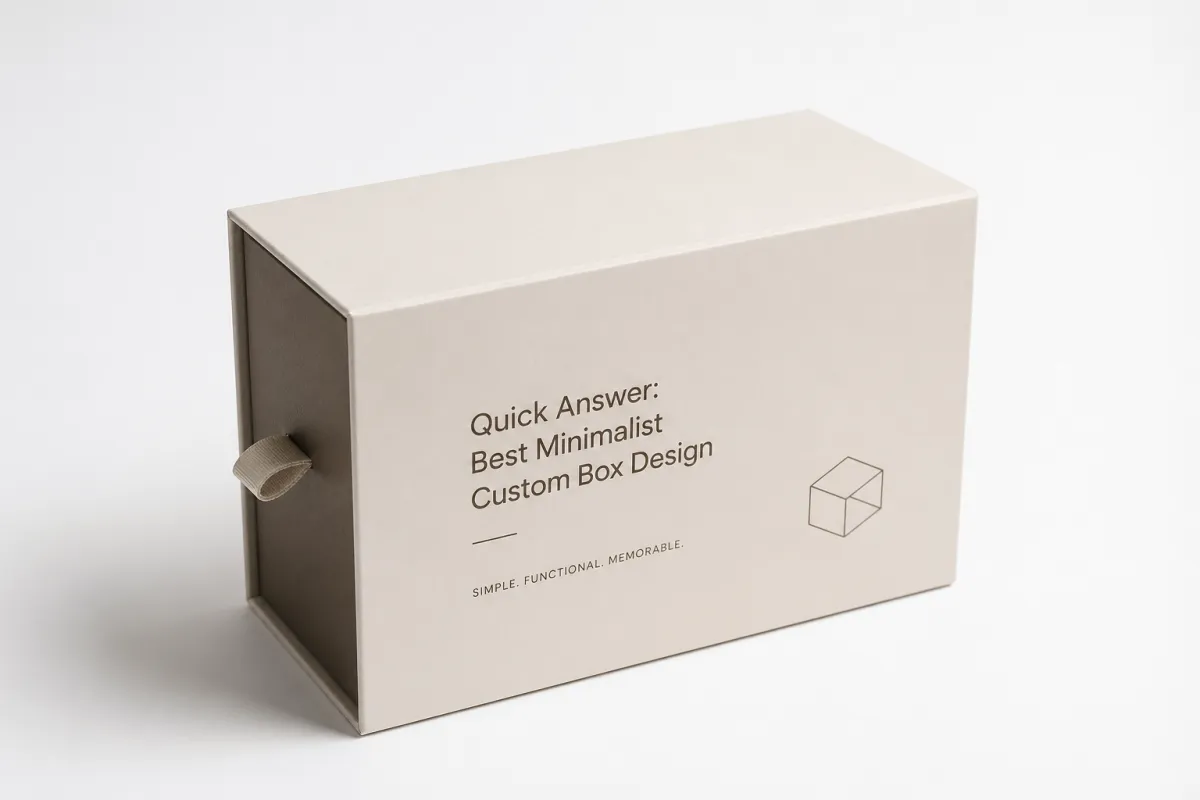
The short answer: the best minimalist custom box design is usually a rigid setup box for premium gifting or a corrugated mailer box for shipping-first brands. I favor one-color print, blind embossing, or a clean blank exterior with a strong logo mark placed at least 12 mm from the edges. If the structure is right and the corners are crisp, the box feels more expensive than a busy print job that spent an extra $0.40 per unit trying too hard to prove a point. That is why the best minimalist custom box design is often the simplest one to explain and the hardest one to execute well.
Why does the best minimalist custom box design work so well? Because minimal packaging leaves less room for visual clutter and fewer places for production errors to hide. A matte finish, a simple typographic lockup, and a balanced lid reveal often look richer than gradients, full-bleed foil, or layered patterns. I have watched a plain kraft mailer in Ningbo outperform a “luxury” sample with three spot colors because the kraft version felt honest and the print alignment held within a tight 0.5 mm tolerance. Honesty sells better than decoration more often than packaging teams want to admit, and the best minimalist custom box design leans into that fact.
When I review packaging for clients, I check six things before I talk about aesthetics: material, structure, print method, unboxing feel, shipping durability, and unit cost. That is the real filter for the best minimalist custom box design. If a box looks good but dents in transit after a 1.2-meter drop test, the design failed. If it ships well but adds $1.10 to cost of goods, the design failed again. Pretty is not the finish line; performance is, especially for brands shipping from Guangzhou, Shenzhen, or Foshan. The same rule applies to retail packaging and product packaging: the box has to earn its keep.
“The sample that won was the boring one,” a brand manager told me after a press check in Dongguan. “It had one black logo, a matte white wrap, and cleaner edges than the fancy version.” She was right. On that job, the winning build used 2.5 mm greyboard, a 157gsm art paper wrap, and a 12 business day turnaround from proof approval. The best minimalist custom box design rarely shouts. It just looks finished, and finished is what buyers trust.
If you want a quick benchmark, use this commercial rule: choose the best minimalist custom box design that looks clean at arm’s length, survives the courier belt, and does not force you into expensive finishing just to feel premium. For most brands, that means one ink, one good substrate, and a structure that fits the product instead of fighting it. In practice, that often means a 350gsm C1S artboard folding carton for lightweight SKUs or a E-flute mailer for products under 1.5 kg. It is a practical way to keep branded packaging from becoming overbuilt.
Top Minimalist Custom Box Options Compared
The best minimalist custom box design depends on what the box has to do. Shipping a candle is not the same job as presenting a $180 skincare set or a pair of limited-edition sneakers that retail in the $120 to $240 range. I break the common formats into five groups because each one solves a different problem in retail packaging and product packaging, and pretending they are interchangeable is how budgets get distorted. A structure that works in Shenzhen for direct-to-consumer orders may be wrong for a display table in London or a boutique shelf in Los Angeles. The best minimalist custom box design starts with use case, then moves to style.
Corrugated mailer boxes are the workhorse. They ship flat, assemble quickly, and protect better than most buyers expect when you specify the right flute. For the best minimalist custom box design in e-commerce, I like E-flute or B-flute with one-color print, water-based ink, and a tight lid flap around 18 to 22 mm deep. They are not glamorous. They are dependable, which is exactly why subscription brands in California and Toronto keep returning to them. A box that simply does its job without drama is underrated, like a competent accountant with a clean spreadsheet.
Rigid setup boxes are the premium play. If the product has margin, the best minimalist custom box design can absolutely be a rigid box with a simple wrap, a soft-touch laminate, and a blind emboss. The box feels dense in hand because a typical build uses 2.0 mm to 3.0 mm greyboard and a 157gsm to 182gsm wrap. It opens with more ceremony, especially with a ribbon pull or magnet closure. It also costs more, usually by $1.90 to $4.80 per unit depending on quantity, and I do not pretend otherwise. The price jump can be annoying, but so is a luxury product arriving in a box that feels flimsy at first touch.
Folding cartons are the volume option. A 350gsm C1S artboard carton with matte aqueous coating can look surprisingly refined when the typography is disciplined and the ink coverage stays under 35% of the panel. For the best minimalist custom box design on a tighter budget, cartons are often the smartest retail packaging choice. They assemble fast, pack compact, and print well at scale in Guangzhou or Wenzhou. I like them when a brand needs elegance without dragging a heavy structure into every unit or paying for a rigid build that the customer will toss in 15 seconds.
Drawer boxes and sleeve-plus-tray formats sit in the middle. Drawer boxes create a gift feel without the weight of a full rigid build, and a 1.5 mm grayboard tray with a paper pull tab can look polished without getting heavy. Sleeves are flexible because you can keep the tray simple and let the sleeve carry campaign branding or seasonal artwork. That is why I keep them in the conversation when a client wants the best minimalist custom box design but still wants a bit of theater. A small reveal, like a 8 mm thumb cut or a 20 mm sliding sleeve, goes a long way; overdo it and you are basically auditioning for a perfume commercial from 2008.
| Box Style | Typical Unit Price | Best Use Case | Shipping Strength | Premium Feel |
|---|---|---|---|---|
| Corrugated mailer box | $0.85-$1.60 at 3,000-5,000 pcs | E-commerce, subscription, apparel | High | Medium |
| Rigid setup box | $1.90-$4.80 at 1,000-3,000 pcs | Luxury gifting, beauty, electronics | Medium | High |
| Folding carton | $0.32-$0.90 at 5,000+ pcs | Retail shelves, lightweight products | Low to medium | Medium |
| Drawer box | $2.40-$5.50 at 1,000-3,000 pcs | Gift sets, seasonal launches | Medium | High |
| Sleeve-plus-tray | $0.65-$1.80 at 3,000-10,000 pcs | Flexible branding, modular kits | Medium | Medium to high |
My ranking stays simple. Best budget pick: corrugated mailer. Best premium pick: rigid setup box. Best shipping-first pick: corrugated mailer with tuned board strength. Best retail shelf impact: folding carton with precise typography and a 1-color Pantone match. Best quick-turn format: sleeve-plus-tray. If a supplier in Shenzhen tries to sell you one “universal” answer, they are probably selling their favorite machine, not the best minimalist custom box design for your product. And yes, I have heard that pitch more times than I care to count.
For brands comparing custom printed boxes, the tradeoffs are rarely about art direction alone. The bigger question is whether the box will sit on a shelf, travel in a courier bag, or arrive inside a larger shipper with 3 to 5 mm of buffer space. A calm design on the wrong structure is still the wrong box. That part seems obvious until someone falls in love with a render from a supplier in Foshan and forgets gravity exists in a 25-kilo carton. The best minimalist custom box design has to survive reality, not just the render stage.
Detailed Reviews of the Best Minimalist Custom Box Design Styles
If I had to narrow the field to the best minimalist custom box design formulas I actually trust, I would start with four looks: matte kraft with black type, soft-touch white rigid with blind emboss, natural board with a single spot color, and sleeve-only branding over a plain tray. Each one can look expensive if the proportions are right and the margins are set at 10 to 14 mm. Each one can also look cheap if the hierarchy is lazy, which is an awkward truth that packaging decks rarely admit out loud. The best minimalist custom box design is often the one that makes restraint feel deliberate.
Matte kraft with black type is the cleanest budget option. It works well for brands that want an earthy, honest tone without pretending they are selling jewelry. I like this version of the best minimalist custom box design for candles, apparel, and subscription kits because it hides scuffs better than bright white and can be produced on 300gsm to 450gsm kraft board in Wenzhou or Shenzhen. Use one ink, keep the logo at least 8 mm from folds, and avoid long sentences on the lid. A kraft box is not a brochure. I have seen teams try to cram a manifesto on the lid and then act surprised when the result looks like a shipping label with ambition.
Soft-touch white rigid with blind emboss is the one that wins a lot of client meetings. I saw it happen with a skincare brand in Austin that sourced the final build from Dongguan. They brought in a foil sample, a full-color floral sample, and one plain white rigid box with a debossed mark. The plain one won because the edges were tighter, the corner wraps stayed under 1 mm of variation, and the hand feel was better. That sample became the best minimalist custom box design for them, and it cut approval rounds from three to one. I remember the founder saying, “I thought the more expensive-looking one would win.” It did not. The cleaner box looked calmer, and calm sells.
Natural board with a single spot color is underrated. When you use a 350gsm kraft board or an uncoated recycled board with a single deep green, black, or rust ink, the result feels thoughtful rather than stripped down. This style of the best minimalist custom box design is especially good for wellness, coffee, and small-batch food products where the buyer wants a calmer, less synthetic package branding story. I personally like it because it feels like the brand made decisions instead of decorating a problem, and because it tends to print cleanly at 500 to 1,000 box test runs before scaling to 10,000+.
Sleeve-only branding is practical when you need flexibility. The tray can stay plain for multiple SKUs, while the sleeve carries campaign graphics or seasonal messaging in 1 or 2 colors. I have used this trick for gift sets where the contents changed every quarter but the outer presentation needed to stay controlled through a 12-month calendar. It is one of my favorite ways to get the best minimalist custom box design without locking yourself into a heavy custom structure every time. It also saves a surprising amount of headache during reorders, which I value almost as much as a strong cup of coffee at 7:30 a.m.
Finishes matter more than most people think. Soft-touch lamination feels rich, but only if the print underneath is crisp and the color density stays even. Matte aqueous coating stays cleaner for shipping and performs better against sleeve rub in transit. Blind emboss gives you relief without visual noise. A tiny amount of foil on a logo can work, but too much foil turns the best minimalist custom box design into something louder than premium. I have watched brands spend an extra $0.38 per unit on decorative foil in Guangzhou and end up with a box that looked less expensive because the gold was too bright. Expensive does not automatically mean elegant; sometimes it just means shiny.
There are a few failure points I see over and over. Weak typography. Too many words. Margins that leave the logo sitting near the edge like it is trying to escape. Bad wrap seams on rigid boxes. And finishes that look beautiful in a rendering but feel plastic in hand. That last one gets people every time. A sample box is not a screenshot, and the screen has lied to more packaging teams than any supplier ever will. I have seen a 450gsm carton become a disappointment because a supplier swapped the coating without warning after the proof was approved in Shanghai. Even the best minimalist custom box design can fail if production drifts.
For inserts, I keep the decision simple. Use paperboard inserts for lighter cosmetics, molded pulp for a more sustainable story and better cushioning, EVA foam only when the product is heavy or precision-fit matters, and no insert at all when the item already sits snugly. The wrong insert can ruin the clean feel of the best minimalist custom box design faster than a bad font choice. I have literally watched a gorgeous box get downgraded by an insert that looked like it came from a broken appliance aisle in Walmart. Not ideal, and definitely not premium.
“We thought the fancy sample was the premium one until we held both,” a procurement manager told me during a factory walk in Ningbo. “The plain version had better corners, better closure, and less nonsense.” On that order, the plain build used 2.2 mm greyboard, cost $2.05 per unit at 3,000 pieces, and shipped in 14 business days after proof sign-off. That is a common outcome, not a fluke, and it is one more reason the best minimalist custom box design often feels almost suspiciously simple.
Best Minimalist Custom Box Design: Price Comparison
Pricing is where the fantasy gets shaved off fast. A lot of people assume the best minimalist custom box design should be cheaper because it looks simpler. Sometimes yes. Sometimes no. If you choose a thick board, a soft-touch surface, a tight emboss, and a custom insert, that “simple” box can cost more than a loud printed carton with four colors and no finishing. Simplicity can be expensive when the materials are doing the talking, especially if the build is coming out of Shenzhen or Dongguan and the metal die needs a separate setup.
Here is the pattern I see most often. On a 5,000-piece run, a basic printed mailer can land in the low single digits per unit, usually around $0.85 to $1.60 depending on board grade and whether the box ships flat. A folding carton may come in lower, especially if you are using standard dielines, a single ink, and a 350gsm C1S artboard from a mill in Zhejiang. Once you add special coating, foil, or complex insert work, the number climbs quickly. That is why the best minimalist custom box design is not just a style choice; it is a cost-control choice with a measurable impact on gross margin. It can also improve the unboxing experience without putting stress on the budget.
Rigid boxes are where buyers get surprised. I have seen quotes swing from $1.90 to $4.80 per unit on the same nominal size because one supplier used a lighter board wrap and another included a thicker base, better magnets, and a fitted paperboard insert. A supplier in Dongguan once quoted me a “clean white rigid” at $2.15 per unit on paper, then added another $0.42 for the insert, $180 for tooling, and a separate sample fee. The box was still a good buy, but only after the numbers were fully exposed. That is how the best minimalist custom box design gets misread: the visible part is simple, the hidden cost stack is not.
One more cost trap is freight. Oversized rigid boxes occupy volume fast, so even if the unit price looks controlled, the carton count can eat your savings. I tell buyers to compare landed cost, not just print cost. Include sample rounds, internal QC, and packing labor. If your team spends 20 extra minutes assembling each box because the structure is awkward, that is real money. That is why the best minimalist custom box design usually favors a structure that packs efficiently and assembles without drama. A box should not become a small office puzzle with a $0.60 solving fee.
For brands comparing quotes from platforms like Packlane, Uline, or a dedicated converter, the gap often comes down to scale. A polished online quote can be convenient for small runs, but a factory in Shenzhen or a converter with the right board inventory may beat it on volume pricing once you cross 3,000 to 5,000 units. I have seen that more than once. I also tell clients to ask for the same spec in writing: board thickness, coating, print sides, insert details, and packing method. If those lines are vague, the quote is not comparable, and you will spend the rest of the week decoding someone else’s shorthand from a sales rep in Guangzhou.
Here is the practical budget rule I give buyers who want the best minimalist custom box design without blowing up margin:
- Spend first on structure and board quality.
- Spend second on finish, but keep it to one or two treatments.
- Spend third on print details, not on extra colors.
- Protect the landed cost with a sample check before production.
If you need a rough benchmark, ask for three versions of the same box: blank, one-color print, and one-color print plus finish. That three-way quote shows you exactly where the money goes and makes it easier to choose the best minimalist custom box design for your margin target. It also prevents the classic “Why is the simple box suddenly not simple?” conversation, which I wish I had fewer reasons to have. A good supplier in Foshan can usually turn those three quotes in 24 to 48 hours if the dieline is already finalized.
Process and Timeline for a Minimalist Custom Box Design
The process for the best minimalist custom box design is not glamorous, but it is where good packaging wins. I start with product dimensions, weight, breakage risk, and the channel. A 220g face serum in a retail display needs a different structure than a 1.8 kg apparel kit going through postal handling. If those basics are wrong, no finish will rescue the box. I have seen beautiful packaging fail because it was designed for a photo in Shanghai, not for a shipper moving through Louisville or Chicago. The best minimalist custom box design starts with the product on the bench, not the render on the screen.
My normal workflow looks like this: brief, dieline selection, structural mockup, print proof, sample approval, production, and freight. If the brand already knows what it wants, a mailer can move faster. A clean folding carton might take 12-15 business days after proof approval. A Custom Rigid Box, especially with magnets or inserts, can take 15-25 business days before shipping. Add ocean freight and customs, and you can easily add another 18-30 days. That is not a problem if you plan for it. It is a mess if you do not. Planning sounds dull right up until a launch date starts chasing you around the office, which is usually the moment everyone suddenly cares about the best minimalist custom box design.
Delays usually happen in the same places. Artwork revision. Dieline mismatch. Color approval. Insert testing. And the classic one: a sample that arrives in good condition, but the packed product rattles because the internal clearances were never checked. When I want the best minimalist custom box design to stay on schedule, I keep the finish count low and the approval chain short. One ink is easier than three. Matte coating is easier than soft-touch plus foil plus emboss. Simple is not lazy. Simple is faster, cheaper, and far less likely to derail a production calendar.
If you want a packaging authority reference for transport testing, the International Safe Transit Association is the place I point buyers to first. I have used ISTA-style thinking for years because it forces everyone to ask the right question: does the box protect the product under real transit conditions, or just in a photo studio? That question matters more than a fancy render when you are building the best minimalist custom box design. A box that only survives the mood board is not really a box; it is a very expensive drawing with a $12 sampling fee.
Here is the communication checklist I use with suppliers before I pay a deposit:
- Confirm the exact material spec and thickness in writing.
- Request the dieline before artwork starts.
- Ask for one plain sample and one printed sample.
- Verify the minimum order quantity and any setup charges.
- Agree on freight terms, packing method, and final carton count.
That checklist sounds boring because it is boring. It also saves money. The best minimalist custom box design is usually the one that avoids rework, and rework is what eats margin faster than a bad board choice. I would rather spend 10 extra minutes on a spec sheet than 2 weeks explaining why the logo is floating somewhere it absolutely should not. A supplier in Dongguan will respect a clean spec sheet more than a vague brand note every time.
How to Choose the Best Minimalist Custom Box Design
Choosing the best minimalist custom box design starts with the product, not the brand deck. Weight, fragility, and size drive the structure. A 120g accessory kit can sit in a folding carton or sleeve. A heavy candle set may need a corrugated mailer or rigid box. If the product can crack, shift, or dent, the packaging has to solve that before it tries to look clever. I have seen a 650g candle duo fail in a thin carton because the insert was built for a render, not for a parcel truck in Los Angeles. The best minimalist custom box design is the one that protects first and decorates second.
I use a simple decision matrix. Mailers for shipping. Rigid boxes for gifting and high perceived value. Folding cartons for retail volume and lower unit cost. Sleeves when you need flexible branding across multiple SKUs. That matrix is not sexy, but it helps brands get to the best minimalist custom box design without overbuilding. I have seen too many teams choose a rigid box because they liked the mood board, then discover the customer was opening it once and throwing it away. That part stings a little, because the box is doing a lot of work for a very short cameo.
The brand fit test matters too. If the brand is calm, modern, premium, or design-led, the best minimalist custom box design usually uses less ink and better materials rather than more decoration. If the brand voice is playful or loud, minimal packaging may still work, but the typography and contrast have to carry more of the story. That is why package branding is not just about logo placement. It is about the total impression from 1 meter away and from 20 cm away. A box should read like the same brand at both distances, not like two different departments made it. The best minimalist custom box design makes that consistency feel deliberate.
In a client meeting last spring, a skincare founder brought me a sample box covered in silver foil, a script font, and a full inner print. She liked the idea of “luxury,” but once I set it beside a matte white rigid with a blind deboss, she changed her mind in under five minutes. The cleaner box looked more expensive because it let the product breathe and reduced the visual noise to one small mark. That is often the difference between a design that looks merely “designed” and the best minimalist custom box design That Actually Sells. I have to say, I enjoy those moments. They are rare little victories for restraint.
There are also sustainability questions to handle honestly. If you want FSC-certified board, ask for it. If you want a recycled content claim, verify the paperwork. I do not recommend making green claims off a vague email from a supplier in Guangzhou. Ask for the certification, ask for the chain-of-custody details, and compare that with your actual budget. Green packaging only helps when the documentation is real and the box still performs like it should. Otherwise it is just a very polite form of marketing with a recycled-looking font.
If you want a second authority reference, the Institute of Packaging Professionals is useful for broader packaging design thinking and manufacturing context. I do not treat any one source like a gospel tablet, but I do like to compare supplier claims against recognized standards before I sign off on the best minimalist custom box design. That habit has saved more than one project from a $600 reprint caused by a mismatched coating spec.
Before you approve a structure, run this quick test:
- Does the box fit the product with 2-4 mm of usable clearance where needed?
- Does the closure feel secure after 10 open-close cycles?
- Does the print stay readable at arm's length?
- Does the finish still look good under warehouse lighting?
- Does the landed cost stay inside the margin plan?
If the answer is yes to all five, you are close. If not, keep refining. The best minimalist custom box design is not the prettiest sample in the room. It is the one that survives product, process, and price all at once. A box built in Shenzhen or Wenzhou should clear all five checks before it leaves the press room. That is the practical standard I use for every serious packaging project.
Our Recommendation and Next Steps
Here is my direct recommendation. For most small brands, the best minimalist custom box design is a corrugated mailer with one-color print and a matte finish. It is the best budget-to-quality ratio when you need shipping strength and a clean look. If the product is giftable and the margin can support it, step up to a rigid box with soft-touch lamination and blind emboss. That is the premium pick. If you need retail volume, go with a folding carton and keep the typography disciplined. Simple idea, practical outcome, fewer headaches, and a cleaner path to reorders in 90 days.
For brands building custom printed boxes for a launch, I usually tell them to order two samples: one plain and one printed. Put the product in both. Close them. Shake them. Stack them. Hand them to someone who has never seen the brand. That test is worth more than three pages of art direction. I have watched the plain version win more than once because the tactile balance was better, which is exactly what you want from the best minimalist custom box design. The box should feel like the brand knew what it was doing before anyone wrote a pitch deck about it.
If you want a concrete next step, do these four things before you spend money on a full run:
- Confirm the exact product dimensions and weight.
- Ask for a dieline with board and finish options.
- Request quotes with and without inserts, magnets, or special coatings.
- Test one packed unit for crush resistance, corner wear, and shelf presentation.
I also like to compare at least two suppliers. One should be a volume-oriented factory quote, and the other can be a platform quote or a local converter. That comparison usually reveals where the value really sits. Sometimes the cheaper box is the right box. Sometimes the more expensive sample saves you a headache on the freight side. The best minimalist custom box design is the one that looks calm, packs well, and does not inflate your packaging budget for no reason. I know that sounds almost too practical, but practical is what keeps the lights on in Shenzhen, Dongguan, and every warehouse that has to ship the final product.
My final rule is simple. Choose the box that looks clean at arm’s length, feels right in the hand, and survives shipping without turning into a disappointment. That is the best minimalist custom box design in the real world, not the fantasy version that lives in a render. If you want premium without the clutter, restraint usually pays better than decoration. And if a supplier tells you otherwise, I would ask them to hold the sample for a minute and say it again with a straight face.
What is the best minimalist custom box design for small brands?
Start with a corrugated mailer or folding carton if you need to keep unit cost low. For the best minimalist custom box design, use one-color print, a clean logo placement, and a matte finish so the box looks intentional instead of cheap. If the product is giftable, upgrade to a rigid box only after you know the margin can support the extra $1.50 to $3.00 per unit that often comes with the premium structure from factories in Dongguan or Shenzhen.
How much does a minimalist custom box design usually cost?
Basic printed mailers can stay relatively affordable, especially at 3,000 to 5,000 pieces. Rigid boxes, inserts, and soft-touch finishes push the price up fast, sometimes by several dollars per unit. I always tell buyers to compare landed cost, not just the printed box price, because freight, setup, and sample rounds can move the number enough to change the best minimalist custom box design for the job. A quote from Guangzhou may look lower until the tooling and freight lines are added.
Which finish looks most premium for a minimalist box?
Soft-touch lamination and blind embossing usually give the strongest premium feel without visual clutter. Matte white or matte kraft also works well when the typography is restrained and the layout is balanced. I would avoid too much foil if the brand goal is calm and modern, because foil can turn the best minimalist custom box design into something louder than premium in both photos and hand feel. A single embossed logo on 2.0 mm greyboard often beats three shiny effects.
How long does a custom minimalist box order take?
Simple structures with limited printing can move faster than complex rigid builds. Expect extra time for sample approval, print proofing, and freight, especially on your first order. If you need a faster launch, reduce finishes and approve the dieline before you finalize artwork; that is usually the quickest path to the best minimalist custom box design without turning the schedule into a mess. In many cases, a folding carton can ship 12-15 business days after proof approval, while a rigid box may need 15-25 business days.
What should I ask a supplier before ordering the best minimalist custom box design?
Ask for the exact material spec, box dimensions, insert options, and minimum order quantity. Request a plain sample and a printed sample so you can compare structure and finish. Confirm lead time, shipping method, and any setup fees before you sign off. If a supplier cannot answer those points cleanly, they are probably not ready to produce the best minimalist custom box design at scale. I also ask where the job will run, whether in Shenzhen, Dongguan, or Ningbo, because regional capability affects both price and turnaround.

