Buyer Fit Snapshot
| Best fit | Custom Perforated Paper Bags Eco Friendly projects where brand print, material claims, artwork control, MOQ, and repeat-order consistency need to be specified before quoting. |
|---|---|
| Quote inputs | Share finished size, material target, print colors, finish, packing count, annual reorder estimate, ship-to region, and any compliance wording. |
| Proofing check | Approve dieline scale, logo placement, barcode or warning zones, color tolerance, closure strength, and carton packing before bulk production. |
| Main risk | Vague material claims, crowded artwork, missing packing details, or unclear freight terms can make a low unit price expensive after revisions. |
Fast answer: Custom Perforated Paper Bags Eco Friendly: How They Work should be specified like a repeatable production item. The safest quote records material, print method, finish, artwork proof, packing count, and reorder notes in one written spec.
Production checks before approval
Compare the actual filled-product size with the drawing, then confirm tolerance on folds, seals, hang holes, label areas, and retail display edges. Reserve space for logos, QR codes, warning copy, and material claims before decorative graphics fill the panel.
Quote comparison points
Review material grade, print process, finish, sampling route, tooling charges, carton quantity, and freight assumptions side by side. A quote is only useful when the supplier can repeat the same color, closure quality, and packing count on the next order.
Custom Perforated Paper Bags Eco friendly earned my respect on a loud second shift at a folding carton plant in Newark, New Jersey, where a tiny tear line solved a problem a $280,000 machine upgrade could not touch. I remember standing there with a clipboard at 9:40 p.m., half listening to a forklift beep its way past a pallet of 4,800 bags, while a line supervisor showed me how one clean perforation shaved 6 to 8 seconds off every open cycle. The setup looked ordinary on paper. In motion, it behaved like a careful shortcut: the right 12 mm pitch, the right 80gsm kraft sheet, the right fold geometry, and suddenly the crew stopped wrestling with stubborn tops and started opening bags in one clean movement. The difference barely registered in a drawing, yet it changed the rhythm of an entire hour. That is the part most buyers miss, usually because no one spends their weekends studying tear patterns or easy-open packaging specs.
At Custom Logo Things, I tell clients that custom perforated paper bags eco friendly are not a decorative extra. They affect pack-out speed, shelf behavior, customer experience, and the story a brand tells before the package is even opened. I think that last part gets overlooked too often, especially when a brief focuses on a Pantone match and ignores how the bag behaves on a line moving 22 units per minute. People obsess over the logo and the color proof, then act surprised when the bag opens badly in the plant. Anyone who has tried to balance packaging aesthetics against a busy production line already knows why this format deserves a real spec sheet. For a broader benchmark across formats, our Custom Packaging Products page is a useful place to compare options, especially if you are choosing between paper bags, cartons, and sleeve wraps. It is also a practical way to weigh recycled kraft paper, tear strip bags, and other easy-open packaging formats side by side.
Years spent on converter floors taught me that custom perforated paper bags eco friendly can look nearly identical in mockup form and still behave very differently once they are filled, stacked 6-high, shipped through a warehouse in 92-degree July heat, and opened by someone who is already 20 minutes late for a meeting. That gap between appearance and performance is where the interesting work lives. Packaging design, material science, and factory discipline meet in a very small strip of paper. If that sounds dramatic, fine, but I have watched enough production problems start with “that should be close enough” to know better. The most expensive mistakes I have seen were not color mistakes; they were 3 mm mistakes on a perforation line.
What Custom Perforated Paper Bags Eco Friendly Really Are
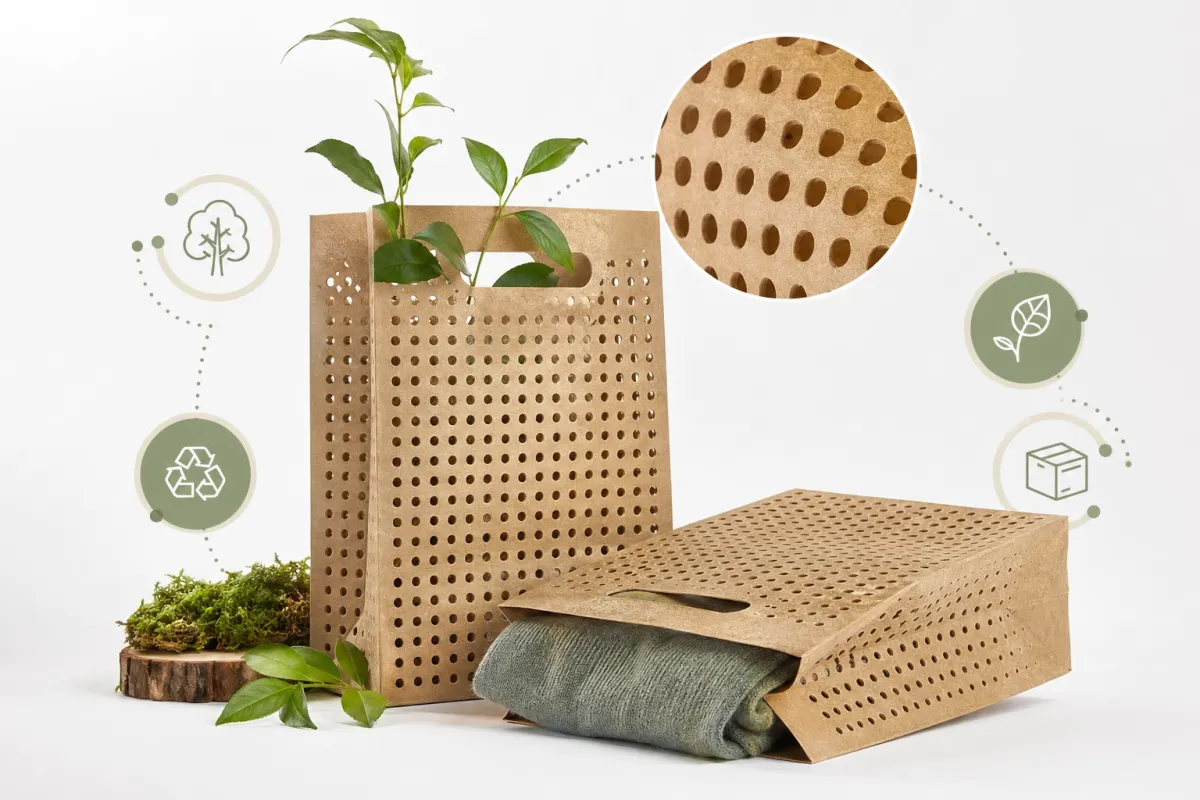
Custom perforated paper bags eco friendly are paper bags built with a controlled line of tiny cuts, arranged so the bag opens, tears, vents, or separates exactly where the converter intended. In plain terms, a perforation is a planned weak point. That sounds backwards until you see it on the floor: the weakest line is often the smartest line. When the spacing, cut depth, and orientation are right, the bag guides the user instead of fighting them, usually with a cut pattern measured in 1.5 mm holes and 2.0 mm bridges rather than something vague and improvised.
I have watched plant managers on a snack-food line lose 18 minutes an hour because a tear strip sat 3 mm too close to a fold. Eighteen minutes does not sound dramatic until you multiply it by a 9-hour shift and then repeat the math across a full week. Suddenly you are paying for a bad decision in labor, frustration, and a stack of annoyed emails nobody wanted to write. The fix was not a new packer. It was a better perforation location and an 80gsm to 100gsm paper spec that matched the actual use. That is the operational logic behind custom perforated paper bags eco friendly: the feature is small, but the effect can be large.
Paper fits this format for a few practical reasons. It comes from renewable fiber sources, usually fits familiar recycling pathways, and gives a cleaner brand story than a mixed-material package with plastic windows, heavy laminations, or unnecessary barrier layers. I stay cautious with sustainability claims, though, because local collection rules vary and the end-of-life path depends on the whole structure, not just the base sheet. A paper bag wrapped in glossy film or loaded with difficult coatings does not behave like plain kraft when it reaches recovery. I have seen brands wave around a “green” claim while quietly hiding the bag under layers that make recycling harder, which is a bit like bragging about a salad after adding three pounds of bacon. For sourcing questions, the FSC site is a solid reference when a team needs a quick check on responsible fiber sourcing, especially for FSC Mix or FSC Recycled paper runs.
Perforated, scored, and die-cut are related, but they solve different problems. A score is a pressed line that helps paper fold cleanly. A die-cut removes material to create a shape or opening. A perforation uses a line of micro-cuts to control separation without fully removing the material. Those distinctions matter on a fast line, where custom perforated paper bags eco friendly usually make the most sense when the project needs a deliberate opening point without weakening the whole bag wall. If the terms get mixed up in a brief, the prototype usually pays the price, and the prototype is usually printed on the first expensive paper the team chose.
Most people get the naming wrong before they get the manufacturing right. A perforated bag might be designed for easy-open access, a vented retail pack, or a multi-pack tear-away format, and each use asks for a different cut pattern, a different paper grade, and a different test plan. Once that is clear, the rest of the project becomes much easier to manage. The bag stops being “a bag” and starts being a mechanical problem with a print job wrapped around it, which is exactly how engineers in Suzhou, Jiangsu or Dongguan, Guangdong tend to think about it.
How Do Custom Perforated Paper Bags Eco Friendly Designs Work?
Custom perforated paper bags eco friendly depend on four variables that matter more than most buyers expect: hole size, spacing, depth, and orientation. Smaller holes with tighter spacing create a more predictable tear path. Wider spacing makes the bag resist opening longer, which sounds harmless until a customer is standing at a counter trying to open it with one hand while the other hand is holding coffee, keys, and a half-finished receipt. On a 180 mm wide bag, even a 2 mm change in the cut gap can alter the opening force enough to show up in testing.
The tear direction matters just as much. If the perforation runs parallel to a stress line such as a fold or a glued edge, the bag may rip early or split unevenly when loaded to 8, 10, or 12 pounds. I have seen a bag pass a flat sample test and fail on a filled sample because the gusset created torque the design team did not model. That is why custom perforated paper bags eco friendly need real handling tests, not just a polished PDF. A neat mockup can hide a lot of bad physics, especially when a pallet is stacked 5 layers high and the bottom tier takes the load.
These bags show up in several jobs: easy-open tear strips, ventilation around fresh goods, controlled opening for display packaging, and multi-pack separation where the shopper needs to tear off one pouch without damaging the rest. Fresh bakery applications are a good example. A small vent pattern can help manage moisture without making the bag feel flimsy, and a bakery in Milwaukee may want 4 to 6 vents per side while a snack producer in Phoenix might ask for a tighter strip to control crumb loss. A display bag may need a cleaner opening so the product stays neat on shelf. In other words, the perforation is doing a job, not decorating the bag for fun.
Kraft paper, bleached paper, coated paper, and specialty barrier papers all respond differently on a flexographic or converting line. Unbleached kraft in the 70gsm to 120gsm range usually tears in a more natural way and gives a stronger handmade look. Bleached stock can carry brighter graphics, though it often shows stress whitening around the perforation. Coated papers improve print sharpness, yet a stiff or slick coating can change how the tear travels. I have seen a beautiful coated sample turn into a stubborn little monster once it met the actual line speed of 180 bags per minute. That is not a technical term, obviously, but it is accurate.
I learned that lesson in a meeting with a bakery supplier in Columbus, Ohio who wanted a high-gloss finish and a very fine tear strip on a 100gsm sheet. The sample looked excellent under showroom lighting. The first drop test exposed a tear that wandered 15 mm off line because the surface finish and the crease were fighting each other. Everyone stared at the bag for a second like it had personally betrayed us. Failures like that are why custom perforated paper bags eco friendly should be judged as a complete system rather than a set of isolated parts, especially when the product will travel 600 miles in a truck before it ever reaches a shelf.
Print coverage, fold lines, seal areas, and gussets all influence final strength. If the perforation lands 2 mm from a seal or too close to a panel edge, the bag may open too early in transit or refuse to open cleanly in the customer’s hands. Good packaging design teams treat the perforation like a structural feature, not a decorative detail. That habit saves rework in product packaging projects and keeps the line moving. It also saves people from having to explain to a manager why 12,000 bags suddenly have a personality problem, which is always a bad Friday.
For a broader look at materials, production methods, and recovery streams, the EPA’s recycling guidance is a useful public reference: EPA recycling guidance. It will not design the bag for you. It does help frame what happens after disposal, which belongs in the conversation whenever custom perforated paper bags eco friendly are part of a branded packaging program, especially if the bags are shipped into states with different municipal recycling rules.
Key Factors That Affect Custom Perforated Paper Bags Eco Friendly Performance and Cost
Pricing for Custom perforated paper bags eco friendly usually starts with paper grade, basis weight, bag size, perforation complexity, print colors, finishing steps, and order quantity. A simple 1-color kraft bag in a common size can land in a very different cost band than a 4-color bleached bag with a precise vent strip and a specialty seal, even if both are labeled “custom bags” in the quote request. Procurement teams sometimes expect those to be close. They are not. A bag made in Chicago, Illinois with domestic converting can price very differently from one produced in Dongguan, Guangdong, even before freight is added.
Heavier paper costs more, but it can reduce waste and rejects by giving the bag better tear resistance and better behavior on the line. I once sat with a converter in Cleveland, Ohio who was comparing 80gsm and 100gsm stock for a meal-kit application. The 100gsm choice raised unit cost by $0.02 and cut misopens by nearly 30% during the pilot run. That is the sort of tradeoff that makes custom perforated paper bags eco friendly worth judging with samples instead of assumptions. Unit cost is one number; line performance is another, and the second one tends to get expensive faster.
Here is a simple comparison I often use when a buyer needs a quick structure for discussion:
| Paper Option | Typical Use | Cost Impact | Operational Notes |
|---|---|---|---|
| 60gsm kraft | Light retail or sample packs under 1 lb | Lower material cost, but more testing risk | Works best for low-load products and short shipping lanes |
| 80gsm kraft | Retail carryout and general product packaging | Mid-range pricing with better durability | Often the balanced choice for custom perforated paper bags eco friendly |
| 100-120gsm kraft | Heavier items, premium branded packaging | Higher paper spend, fewer handling failures | Better for rough warehouse handling and stacked shipping at 6-high |
| Coated specialty paper | High-graphics retail packaging | Highest print and finishing cost | Requires careful perforation testing and color control |
Sustainability claims need careful handling because recycled content, responsible sourcing, and end-of-life behavior are not the same thing. A bag can be made with renewable fiber and still perform poorly if the coating, adhesive, or ink load changes how the fiber breaks down. I say this a lot because people love a neat label, but real life is messier. That is why I ask clients to separate the marketing language from the material spec when we discuss custom perforated paper bags eco friendly, especially if the bag must stay in circulation through a retail packaging chain with rough handling. A 15% recycled-content sheet is not the same as 100% post-consumer kraft, and the spec sheet should say so plainly.
The tradeoff between premium graphics and manufacturing simplicity is real. More ink coverage, tighter color matching, special varnishes, and higher registration demands usually mean more setup time and a higher scrap risk, particularly on smaller runs. On a 5,000-piece order, a plain 80gsm kraft bag might land near $0.15 per unit, while a 4-color coated version with a specialty finish can climb to $0.28 to $0.34 per unit. I always recommend budgeting for freight, proofing, samples, tooling, and possible rework instead of looking only at a unit price. The quote on page one is rarely the whole story. The plant, unfortunately, does not care about page one.
As a rough planning guide, I have seen simple custom perforated paper bags eco friendly land around $0.11 to $0.18 per unit at 10,000 pieces, while more complex printed versions with extra finishing often move into the $0.20 to $0.35 range. Those numbers are not fixed, and I would never promise them without a spec sheet, but they are realistic enough to keep a buyer from getting blindsided in first-round sourcing. On a 25,000-piece run, the same bag can often drop by 8% to 14% simply because tooling and setup costs are spread across more units. It is better to start with a useful range than a fantasy.
One more thing: the lowest quote is not always the best value. If a supplier trims paper weight too far, pushes the perforation too close to a fold, or skips a sample test, the later cost shows up as line downtime, rejected pallets, or customer complaints. That is the hidden math behind custom perforated paper bags eco friendly, and it is why experienced buyers look at total landed cost rather than the print number alone. I would rather pay a little more for a bag that behaves properly than save pennies and spend hours apologizing later, especially if the production site is 700 miles away in another time zone.
Custom Perforated Paper Bags Eco Friendly Production Process and Timeline
The production sequence for custom perforated paper bags eco friendly usually starts with discovery, then structural spec, artwork setup, proofing, tooling, converting, finishing, quality checks, and packing. On a clean project, the brief comes in on day one, the dieline is approved within 48 hours, and the converter can move from proof to production without waiting for five different departments to reconcile conflicting notes. That part sounds tidy. In practice, somebody always finds one more comment, usually at 4:47 p.m. on a Thursday.
Repeat work moves faster, especially when the bag size, paper grade, and perforation pattern already exist in a live production setup. New dimensions, multi-color artwork, custom tear behavior, and any test requirement that asks for actual product loading or drop validation take longer. In my experience, custom perforated paper bags eco friendly with a fresh structural concept need more coordination than a standard print-only update. Design teams often underestimate how much a single opening detail can change the rest of the schedule, especially if the bag is being converted in a facility in Ningbo, Zhejiang while the client approval team sits in Toronto or Dallas.
Timelines can be surprisingly short or surprisingly long. A simple rerun may finish in 10 to 12 business days after approval, while a fully custom project with new tooling, special paper sourcing, and multiple rounds of samples can take 3 to 5 weeks from clean sign-off to shipment. In the most predictable cases, I usually see 12 to 15 business days from proof approval to dock date for a straightforward 1-color rerun. The delay usually has less to do with the printer’s schedule than with the number of approval gates and how complete the original brief was. I have watched a project lose three days because nobody agreed on whether the tear should start from the top edge or the side. Three days, over one line of micro-cuts.
Those approval gates exist for good reasons. Dieline sign-off protects dimensions, color proof approval protects brand accuracy, and sample acceptance protects the final run from a costly mismatch. I have watched a marketing manager approve a bag based on screen color, only to discover that the actual paper stock absorbed ink differently by almost 8% in the red panel. That kind of gap is exactly why custom perforated paper bags eco friendly should not skip a physical sample when the project matters. A monitor is not a paper mill, and a PNG file does not tell you how 100gsm kraft will behave under a blade.
Plant operations matter too. Machine setup, roll changeovers, perforation calibration, and in-line inspection all affect whether the bag tears the same way on unit 1,200 as it did on unit 12. A converter that monitors perforation depth at the line and checks every setup against a master sample usually delivers a steadier result than one that treats the tear line as a secondary operation. That is factory-floor reality, not a polished claim. Also, it is the difference between a calm Tuesday and a very annoying Wednesday at 6:15 a.m.
The best timelines start with complete information on day one. Dimensions, filled weight, paper preference, print count, target quantity, and the opening behavior you want all shorten the back-and-forth that slows a calendar. If you can also tell the converter where the bags are being manufactured, whether that is a plant in New Jersey, a facility in Ohio, or a line in Guangdong, the production plan gets clearer faster. That is exactly how we like to handle custom perforated paper bags eco friendly at Custom Packaging Products: fewer surprises, cleaner approvals, and fewer handoffs between design and production.
Step-by-Step Guide to Specifying Custom Perforated Paper Bags Eco Friendly
Start by identifying the use case, because retail carryout, food service, product sampling, subscription packaging, and warehouse handling each need a different tear profile and strength level. A 1.5 lb sample bag does not behave like a 10 lb grocery carryout bag, and custom perforated paper bags eco friendly should be spec’d with that load difference in mind from the first line of the brief. If you skip that part, the bag will remind you later, usually during a load test on a Friday afternoon.
Choose the paper grade and bag style by balancing load weight, moisture exposure, shelf presentation, and recyclability goals. If the product is dry and light, 70gsm to 80gsm kraft may be enough. If the product has corners, edges, or a little humidity, 100gsm or a coating that keeps the bag stable without compromising the tear line may be the better choice. I prefer this conversation before artwork begins, since packaging design decisions are easier when the structural limits are already clear. It saves everyone from pretending a fragile thing is sturdy just because the art looks nice, which happens more often than people admit.
Measure the dimensions that matter: width, gusset, depth, seal area, perforation location, and any feature that affects filling speed or consumer opening. I have seen teams measure only the visible face of the bag and ignore the gusset expansion, which led to a 6 mm mismatch at the seal and a lot of frustration on press. Custom perforated paper bags eco friendly work best when the spec sheet captures the full geometry, not just the front panel. The hidden parts are usually the parts that break things, and the hidden parts are often where the extra $0.01 per unit disappears.
- Write the product weight and target fill method in plain numbers, such as 8 oz, 2.4 lb, or 14 lb.
- List the opening behavior you want, such as easy-open top, tear-away strip, or vented release.
- Note the print colors, finish, and brand requirements so the bag supports package branding instead of fighting it.
- Ask for a prototype or white sample before you lock quantity, especially if the bag feeds a fast line.
- Send the spec to the converter with the target date and final shipping destination, not just the warehouse ZIP.
Prepare artwork early and decide whether the design should emphasize sustainability messaging, product branding, or operational instructions like “tear here” or “open from top.” The strongest branded packaging projects make that instruction visible without turning the bag into a warning label. For custom perforated paper bags eco friendly, that balance matters because the printed message should support the opening function rather than clutter it. I am biased here: if the instruction needs a paragraph, the design probably needs another pass. A small callout in 9 pt type usually does more than a full sentence in 18 pt type.
Request samples or prototypes before committing to a large run. A real-world test, even on 50 to 100 filled units, will tell you more than a computer proof ever can, especially if the bag needs to survive vibration on a truck route, pallet compression in a warehouse, or repeated handling by store staff. That is how you catch the issues that hide in Custom Printed Boxes and other product packaging formats too, because theory and reality do not always agree. I wish they did. They do not, especially not after a 280-mile freight trip through wet spring weather.
Finalize a spec sheet that includes material, print, perforation pattern, order quantity, target timeline, and packaging requirements for delivery. If you can also include freight terms, pallet count, carton pack-out preferences, and whether the outer carton is 32 ECT or 44 ECT, the production team can plan more accurately and the quote will usually be cleaner. For custom perforated paper bags eco friendly, those operational details matter as much as the art file. Sometimes more, if the line is temperamental or if the pallets need to move through a busy loading dock in Atlanta, Georgia.
Common Mistakes When Ordering Custom Perforated Paper Bags Eco Friendly
The most common mistake is choosing paper that is too light for the product. A 60gsm sheet can look perfectly fine on a table, but once it carries a heavier item, the perforation may behave unpredictably or the bag may fail at the weakest point under load. I have seen that happen in a shipment of specialty tea bags, and the fix was a paper upgrade plus a slightly wider perforation gap, not a graphics change. That is the sort of lesson you only need once if you are lucky. Twice if not, and the second lesson usually costs more.
Another mistake is placing the perforation too close to a fold, seal, or high-stress area. If the tear line sits on a gusset fold or within a stressed corner, the bag can rip early during packing or open messily in the customer’s hands. That kind of failure is especially frustrating because it often shows up only after the first pallet is already in transit, which is a costly way to learn about custom perforated paper bags eco friendly. Nothing humbles a team faster than a pallet of almost-right bags arriving 900 miles from the plant.
Skipping real-world testing is probably the biggest avoidable problem. A printed proof does not tell you how the bag will behave after 40 minutes in a humid dock area, 15 minutes in a chilled storage room, and one rough drop from conveyor height. I always advise a line trial when the product is sensitive, because the converter can tune the perforation pattern only if someone actually checks how the paper releases under stress. Otherwise you are basically guessing with expensive stationery, and expensive stationery has a way of becoming expensive scrap.
“The first sample looked perfect on the desk and failed in the aisle.” That was how a procurement lead at a Midwest snack co-packer described a bad bag spec to me, and he was right to be blunt. The bag was visually clean, but the tear line sat 5 mm off the intended break point, so the opening looked sloppy the moment customers touched it. We fixed it on the second sample with a 90gsm kraft sheet and a 1.8 mm bridge length.
Overcomplicating the artwork is another trap. Extra ink coverage, specialty finishes, and very fine details can add cost, slow setup, and create registration risk, particularly on shorter runs of 3,000 to 7,500 pieces. The more a team tries to make the bag look like a premium flyer, the easier it is to forget that the package still has to run through equipment at line speed. Custom perforated paper bags eco friendly need clarity first and decoration second. I would rather see one strong graphic than four mediocre ideas fighting for attention, especially if the bag is being packed in a plant that checks registration at 2,000-unit intervals.
Humidity, temperature, and shipping conditions matter more than many buyers expect. Paper can hold up well in a dry room and behave differently in a warehouse that swings from 45% to 80% relative humidity across the week. I have seen that shift change tear performance enough to force a small adjustment in the perforation pattern. It is not always dramatic, but it is real, and honest converters will say so. Anyone who claims paper behaves exactly the same in every environment is either selling something or ignoring the floor, and usually both.
Finally, some teams choose the bag without aligning it to the filling process. A beautiful bag that slows the line by 12 seconds per case is still a production problem. Custom perforated paper bags eco friendly should support the operator, the customer, and the shipping team in one design, or the project will create friction somewhere else. You do not want to win the design review and lose the warehouse. A bag that works at 1 bag per minute but fails at 30 bags per minute is not actually working.
What to Do Next With Custom Perforated Paper Bags Eco Friendly
Build a one-page brief with product weight, bag dimensions, branding needs, target quantity, and performance goals before you request a quote. If you include the paper preference, the tear behavior you want, and the final ship-to location, the conversation moves faster and the estimate is usually more accurate. That is the simplest way to move custom perforated paper bags eco friendly from concept to a working plan. It also keeps your inbox from filling up with very polite follow-up questions, which is a pleasant side effect.
Gather three useful reference points for pricing: an approved sample, a competitor bag, or a rough spec from your current pack format. When I sit with clients, I can usually quote more accurately in the first round if I can compare those details against a known structure instead of guessing from a verbal description. It is the same discipline we use for custom packaging products across retail packaging, sample kits, and shipping formats. Good comparisons save everyone time, which is a rare and beautiful thing, especially when the supplier is quoting both domestic and overseas options in the same week.
Ask the converter for a prototype, a timeline estimate, and a landed-cost estimate so you can compare options on equal terms. I would rather see a buyer review three realistic choices than chase the cheapest headline number and discover later that freight, sampling, or extra print setup erased the savings. With custom perforated paper bags eco friendly, the best decision is usually the one that fits the plant, the brand, and the budget at the same time. That sounds obvious. It is astonishing how often people skip it, particularly when a low quote lands 20% below the rest.
Schedule internal review around the sample approval and production milestones so procurement, operations, and marketing are aligned early. A 20-minute review meeting can save a week of back-and-forth if the team agrees on the tear location, the paper feel, and the acceptable color tolerance before the order is released. That matters even more when the bag sits inside a broader branded packaging program that includes cartons, labels, and display materials. One mismatch in that chain can ripple fast, especially if a carton plant in Illinois is waiting for final bag dimensions before it prints outer shippers.
Plan a pilot run or line test if the bag will be used in high-volume operations. A small trial of 250 to 500 units can expose a mismatch in opening force, stacking behavior, or customer handling long before you commit to 20,000 bags. That kind of test costs far less than rework, and in my experience it is one of the smartest ways to protect a product packaging launch. It also gives everyone a chance to complain about the right thing before the budget is spent, which is surprisingly valuable.
When you are ready, use the project to make the package easier to use, easier to ship, and easier to defend. That is the real promise of custom perforated paper bags eco friendly, especially for easy-open packaging and recycled kraft paper programs: not just a paper bag with a tear line, but a package that behaves better in the plant, on the shelf, and in the customer’s hands. If the spec is honest and the testing is real, the format earns its place in the lineup instead of becoming another packaging compromise. And frankly, the packaging world has enough compromises already, from 32 ECT cartons to rushed approvals on a 5,000-piece run.
FAQ
Are custom perforated paper bags eco friendly better than plastic bags for retail packaging?
They can be a stronger fit when your goal is paper-based, renewable, and easier-to-recycle packaging, especially for retail packaging programs that want a cleaner brand story. In my experience, custom perforated paper bags eco friendly also feel more intentional at opening, which matters when the customer is handling the bag at a counter, in an aisle, or at home. The better choice still depends on the product weight, moisture exposure, and how your local recovery stream handles paper materials. I would not force paper where plastic clearly performs better, because a 2 oz snack bag and a 12 oz frozen item do not have the same needs.
How do I know if custom perforated paper bags eco friendly will hold my product weight?
Start with the filled weight, then add a safety margin for stacking, shipping vibration, and handling by staff or end users. A sample test with the real product is the fastest way to check whether custom perforated paper bags eco friendly are strong enough, because an empty bag can mislead you by a wide margin. I also ask for the paper basis weight, the seal style, and the perforation pattern so the structure can be evaluated as a system instead of as a single panel. If the bag must carry 6 lb, say 6 lb, not “moderate weight,” because the bag does not understand adjectives.
What affects the price of custom perforated paper bags eco friendly most?
Paper grade, size, print coverage, perforation complexity, and order volume usually drive the biggest cost differences. If you add specialty coatings, tighter color matching, or custom tooling, the unit price can rise quickly, especially on smaller runs of 2,500 to 5,000 pieces. A plain 80gsm kraft bag might come in near $0.15 per unit for 5,000 pieces, while a more complex 4-color bag can land closer to $0.30. The lowest quote is not always the best value if the bag needs rework, extra freight, or a second production pass.
How long does it take to make custom perforated paper bags eco friendly?
Simple repeat jobs can move quickly, while new structures, new artwork, or special perforation layouts usually add lead time. Proofing and sample approval are the steps most likely to slow a project if decision-makers are not aligned, and that is true whether the bag is for product packaging or a seasonal retail rollout. For a straightforward rerun, I usually expect 10 to 12 business days from proof approval to shipment, while a new custom structure often needs 3 to 5 weeks. The fastest projects usually start with a complete spec sheet, a clear target date, and a fast approval chain. If any of those three are fuzzy, the calendar starts wobbling.
What information should I send for a quote on custom perforated paper bags eco friendly?
Send dimensions, paper type if known, product weight, print requirements, quantity, target timeline, and any sustainability or compliance needs. If you are replacing an existing format, photos or a sample bag help a converter match function much more accurately, especially when the opening behavior is part of the design. If the bag must tear a certain way, describe that behavior explicitly so the perforation pattern is quoted correctly the first time. The more concrete the brief, the fewer surprise conversations you have later, and the closer you get to a quote that reflects reality instead of guesswork.

