Buyer Fit Snapshot
| Best fit | Corrugated Boxes Custom Printed projects where brand print, material claims, artwork control, MOQ, and repeat-order consistency need to be specified before quoting. |
|---|---|
| Quote inputs | Share finished size, material target, print colors, finish, packing count, annual reorder estimate, ship-to region, and any compliance wording. |
| Proofing check | Approve dieline scale, logo placement, barcode or warning zones, color tolerance, closure strength, and carton packing before bulk production. |
| Main risk | Vague material claims, crowded artwork, missing packing details, or unclear freight terms can make a low unit price expensive after revisions. |
Fast answer: Corrugated Boxes Custom Printed: Quote Scope should be specified like a repeatable production item. The safest quote records material, print method, finish, artwork proof, packing count, and reorder notes in one written spec.
Production checks before approval
Compare the actual filled-product size with the drawing, then confirm tolerance on folds, seals, hang holes, label areas, and retail display edges. Reserve space for logos, QR codes, warning copy, and material claims before decorative graphics fill the panel.
Quote comparison points
Review material grade, print process, finish, sampling route, tooling charges, carton quantity, and freight assumptions side by side. A quote is only useful when the supplier can repeat the same color, closure quality, and packing count on the next order.
Corrugated Boxes Custom Printed: Practical Brand Guide I still remember a pallet of plain 24 x 16 x 12 shippers in a Newark fulfillment center. The product inside was already doing healthy numbers, but the packaging looked like it had been chosen by a forklift and a shrug. Then a single black flexo pass on 32 ECT B-flute turned those corrugated boxes custom printed into something people noticed on the dock, in the unboxing video, and in the receiving bay where first impressions are made fast. Not glamorous, sure. But a $0.15 print upgrade at 5,000 units can change the whole tone of the shipment.
That scene is why I take corrugated boxes custom printed seriously. A box is a shipping tool, a shelf signal, a handling cue, and, if you spec it well, a quiet sales rep that moves from the pressroom in Grand Rapids to a doorstep in Austin. I have seen a one-color logo on a top flap do more brand work in four seconds than a paid ad did in four weeks. The trick is consistency: a 32 ECT RSC with a clean 1/8-inch score and a readable return panel tells a more convincing story than a dozen loose brand promises.
If you are comparing options now, you can browse the broader Custom Packaging Products lineup or narrow the search to Custom Shipping Boxes if the job leans toward transit strength and distribution efficiency. I also point clients to ISTA for tests like ISTA 3A and 6-SAMS when parcel damage is a concern, and to FSC when fiber sourcing and chain-of-custody matter to the brand story. I have had clients in Seattle and Atlanta suddenly care about paper origin the minute the packaging was photographed for social. Predictable? Absolutely. Still funny? A little.
Many buyers underestimate how much the board, flute, liner color, and print method shape the final result. Corrugated boxes custom printed are not just a logo upload; they sit at the intersection of packaging design, production discipline, and a few decisions that make a box look considered instead of rushed on a moving conveyor. A 350gsm C1S artboard proof may look luxurious in a presentation, but the real box could be 32 ECT kraft or 44 ECT white-top liner, and those are different animals. Customers may not know the language for it, but they absolutely know when the package feels cheap.
What Are Corrugated Boxes Custom Printed?
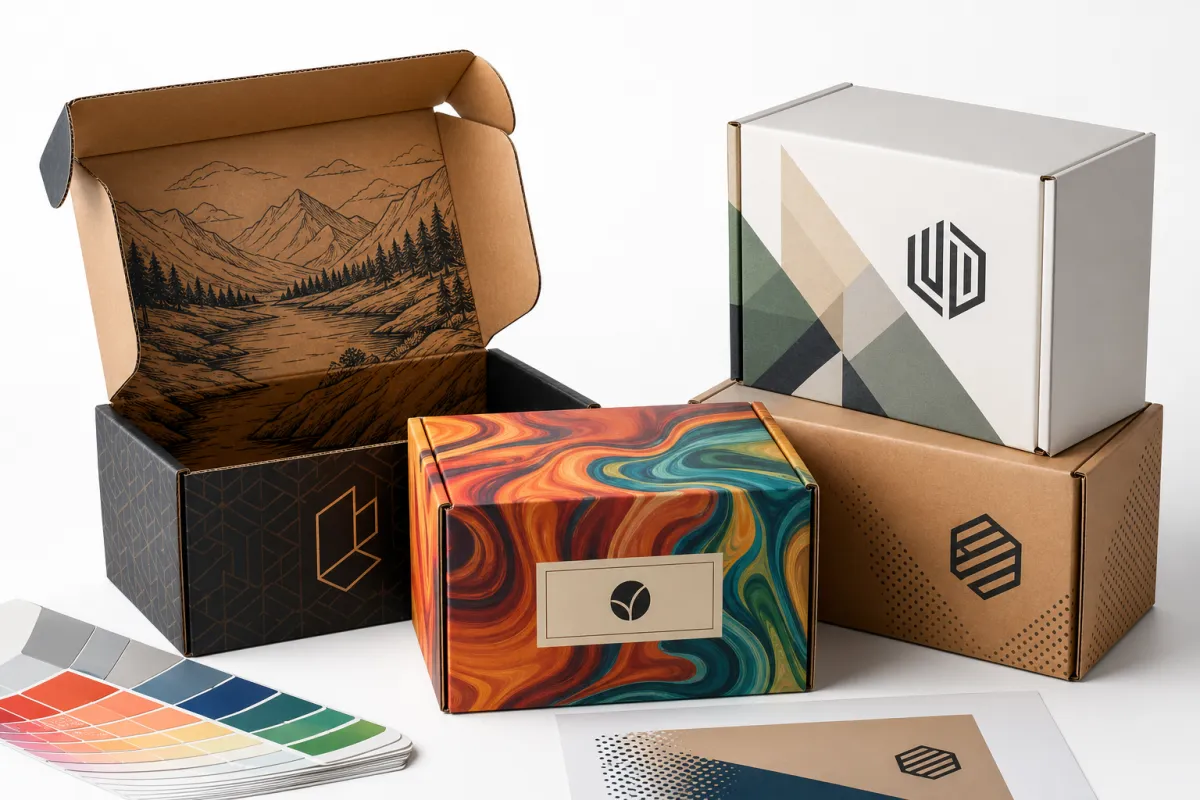
Corrugated board sounds simple until you start buying it. A fluted medium sits between liners, and that structure gives you cushioning, stack strength, and a printable outer surface. When a buyer says corrugated boxes custom printed, they usually mean a shipping box, mailer, or display carton made from that structure with artwork, handling marks, or branding added during production. That sounds straightforward until you are staring at six sample boards on a table in Chicago and realizing they all look “brown” but behave very differently under a tape gun and a stretch wrapper.
I learned that during a supplier meeting outside Chicago, where a client wanted a high-end retail look on kraft liner with tiny serif type. The plant manager held up a test sheet and said, with perfect calm, that the board was doing exactly what it should do for transit, while the artwork was asking the material to behave like coated paper. He was right. Corrugated boxes custom printed can look excellent, but the print has to respect the surface, the flute profile, and the liner color. Otherwise the design starts fighting the substrate, and the substrate usually wins by a wide margin.
The difference between printed corrugated and decorative paperboard matters more than many people expect. Paperboard is usually smoother and more forgiving for dense imagery, while corrugated stock brings texture, fluting, and a tendency to show score lines or seam locations. If you want Custom Printed Boxes that look crisp, Choose the Right board family, the right flute, and the right print process before you worry about Pantone codes or fancy finishes. A signature blue on the wrong liner can turn into a gray-blue compromise that nobody wanted, especially on a B-flute panel with a rough recycled face.
I explain it to buyers on the floor this way: the box is first a structural component, second a logistics tool, and third a branding surface. Reverse that order and the packaging often fails in the warehouse, gets crushed in parcel transit, or prints beautifully and performs poorly. Corrugated boxes custom printed work best when structure and brand are planned together, from the 1/8-inch score line to the two-color logo on the lid. That sounds almost too sensible to say out loud, but packaging has a way of punishing shortcuts within a single freight lane.
"We thought the box was just packaging until the customer reviews started mentioning the unboxing," a fulfillment manager told me after we switched their side panel from plain kraft to a two-color branded print on 32 ECT board for a 2,400-unit weekly run.
- Common board families: single-wall RSC, mailer styles, and double-wall shipping cartons, with 32 ECT and 44 ECT as the most requested specs.
- Common flute profiles: E flute at roughly 1/16 inch for tighter print detail, B flute at about 1/8 inch for general shipping, C flute for stronger cushioning, and BC double-wall for heavier loads.
- Common liner choices: kraft liner for a natural appearance, white-top liner for sharper artwork, and recycled liners when the spec calls for 30% to 100% post-consumer content.
- Common uses: e-commerce fulfillment, subscription kits, retail-ready corrugated displays, industrial parts, foodservice shipping, and sample packs that leave a facility in Cincinnati or San Jose.
Corrugated boxes custom printed show up wherever the carton has to work hard and still carry a brand. I have seen them used on frozen seafood lines in Portland with bold handling marks, on hardware shipments in Dallas with clean one-color logos, and on retail packaging programs where the inside of the lid carried a simple thank-you message printed in black on a white-top liner. The material is humble. The impact is not, and that contrast is part of why I keep coming back to it.
How Corrugated Boxes Custom Printed Move From Art to Box
The production path starts long before ink touches board. First comes the dieline review, where the flat layout is checked against the actual structure. Then artwork gets placed into the safe zones, bleed areas are verified, and the printer checks whether the design crosses a fold, a glue tab, or a score line. Corrugated boxes custom printed look easy from the outside, but the prepress stage is where most of the real decisions happen, usually on a 24 x 18-inch layout or a 2-up nesting sheet. This is also the point where “we’ll fix it later” turns into a line item that costs real money.
On a recent plant visit in the Midwest, I watched a team catch a barcode placed 3/16 inch too close to a fold. If that code had gone to press as-is, the scanner would have struggled on the top flaps after tape application and a 2-inch clear carton sealer pass. That kind of correction saves money, but it also keeps branded packaging from becoming a warehouse problem. Corrugated boxes custom printed need the same discipline whether the run is 500 units or 50,000, because a tiny placement error can ripple into a pallet of complaints.
The print method changes the workflow. Flexographic printing is common for larger runs because the setup cost is spread across volume, and it handles simple logos, handling copy, and solid color blocks very well. Digital printing is attractive for shorter runs and faster changes, especially when a launch team wants 300 to 1,500 boxes without paying plate costs. Litho-laminate is the higher-finish route, usually used when retail packaging needs a smoother image and a more polished presentation, often with a 350gsm C1S artboard face sheet mounted to E-flute or B-flute. Corrugated boxes custom printed can be produced all three ways, but the choice should match the run size and the look you actually need, not the version a sales deck makes sound elegant.
One buying team in Texas asked me why their quote jumped when they added inside print and a custom top flap message. The answer was not mysterious. Every additional print location adds setup, registration checks, and press time, and every additional pass creates a point where the box can drift out of alignment by 1/32 inch or more. Corrugated boxes custom printed on the outside only are simpler, while top panel, side panel, inside panel, and end-panel designs each need their own file prep and production checks. More surfaces mean more opportunities for something to go sideways, which is a polite way of saying the press crew will not thank you for designing a puzzle.
Typical lead times matter more than promises. A straightforward flexo run might move in 12 to 15 business days from proof approval. A digital short run can sometimes ship in 7 to 10 business days if the board is available and the plant has open time. A litho-laminate build or a double-wall structure with Custom Die Cutting may need 20 to 25 business days, especially if sample approval takes more than one round. Corrugated boxes custom printed move at the speed of artwork approvals as much as the speed of the press, and I have watched a perfect production slot sit idle because someone was “just making one more color tweak” for three days.
- Artwork review: confirm dieline, bleed, safe zone, and panel orientation, usually in PDF/X-1a or native AI before plate work starts.
- Proofing: check text, barcodes, color blocks, and any regulatory copy against a physical or soft proof.
- Setup: plates, digital file prep, or laminating sheet prep, often tied to a 24 x 36-inch press sheet.
- Printing: flexo, digital, or litho-laminate run, depending on the order size and finish.
- Converting: die cutting, scoring, gluing, and bundle packing into 25-count or 50-count bundles.
- Shipment: palletizing, labeling, and freight booking for LTL, parcel, or full truckload.
Factory capacity matters too. I have seen a carton line delayed not by the print method, but by paper mill allocation and a pallet configuration issue that forced a re-stack before shipment. If your corrugated boxes custom printed order is tied to a launch date, treat the factory schedule, board supply, and freight lane as part of the lead time. A plant in Dongguan, Guangdong may quote differently from a converting line in Monterrey, Nuevo León or a Midwest facility in Ohio, and the difference usually comes down to board allocation, labor, and truck space rather than the art itself.
What Drives Cost, Lead Time, and Print Quality
Pricing on corrugated boxes custom printed breaks down into a few levers buyers can control. Box size is the first one because bigger boards use more fiber. Board grade comes next, since 32 ECT, 44 ECT, and double-wall constructions each carry different material costs and performance levels. Flute choice matters too, because E flute is usually chosen for tighter print detail, while C flute or BC double-wall is often selected for strength and stacking. I have never once seen a purchasing team regret knowing the flute before they asked for the quote, especially when the pallet count is 48 boxes high.
I once helped a cosmetics client in Atlanta cut unit cost by switching from a heavily covered white-top liner to a simpler two-color design on a standard kraft liner. The branding stayed strong, but the artwork was redesigned around the material instead of fighting it. That job came in around $0.39 per unit on 5,000 pieces after the artwork was simplified, while an earlier version with more coverage and tighter registration had been closer to $0.71 per unit. Corrugated boxes custom printed can move a lot on price depending on a handful of design choices, and the painful part is that the cheapest-looking design on the screen is often the one that behaves worst in production.
Run quantity changes the economics fast. A short run of 250 or 500 boxes can carry a higher per-unit cost because setup is spread over fewer pieces. A 5,000-piece run often gives much better unit pricing because the plate or setup charge gets diluted, and I have seen a flexo quote drop from $0.42 to $0.15 per unit once the order moved from 1,000 to 5,000 pieces. That is not a failure of the printer; it is how corrugated boxes custom printed pricing works. Scale changes everything, including patience.
Lead time changes for reasons that do not always show up in the first quote. Add a custom die cut, a varnish, a second print location, or exact color matching to a legacy brand swatch, and the job often needs more proof rounds. If the design requires a special ink or the plant has to wait on board, the calendar stretches. Corrugated boxes custom printed are sensitive to every extra step, and each extra step creates a place for the schedule to slip by two or three business days. I have seen a “small” revision turn into a week because the revised art moved the logo 1/8 inch and nobody noticed that the new position crossed a score line.
Print quality depends heavily on the substrate. A white-top liner generally gives sharper type and cleaner color than a kraft liner, especially for fine details and small logos. Heavy ink coverage on rough board can make blues look muddy and reds look dull. Fine line art is possible, but it should be tested against the actual board rather than assumed from a screen file. I have watched beautiful packaging design fail because the buyer approved color on a backlit monitor and never asked for a board proof. A monitor is not a box, even if the same blue reads beautifully on both.
| Print Method | Best Use | Typical Setup | Typical Unit Range | Lead Time |
|---|---|---|---|---|
| Flexographic printing | Large runs, simple logos, handling marks, shipping graphics | Plate or cylinder setup, usually 1 to 3 colors | $0.15-$0.45 at 5,000+ pieces; $0.22-$0.60 on larger volumes | 12-15 business days from proof approval |
| Digital printing | Short runs, frequent art changes, pilot launches | File setup with no plates | $0.85-$1.70 depending on size and coverage; $0.92-$1.60 on 250-1,000 pieces | 7-10 business days if capacity is open |
| Litho-laminate | Retail packaging, premium graphics, shelf-facing boxes | Printed sheet laminated to corrugate, often 350gsm C1S artboard face stock | $1.75-$3.50 and sometimes higher | 20-25 business days or more |
Hidden cost factors deserve attention too. Freight can change the landed price more than the print method if the order ships cross-country on a tight timeline from Savannah to Denver or from Dongguan to Los Angeles. Pallet configuration affects how many units fit per truck. Storage matters if you order a quarter’s worth of boxes at once, and kitting can add labor if the box has to ship flat with inserts, labels, or customer-supplied components. Corrugated boxes custom printed should be priced as landed cost, not just box cost, because a carton that looks cheap on paper can be expensive after freight and rework are added.
If you are comparing quotes, ask for the exact board spec, the flute profile, the print method, the quantity break, and whether freight is included. That is how you compare apples to apples. Without those details, one quote may look cheaper simply because it uses a lighter board, fewer colors, or a different pallet count that changes the shipping math. I have sat in more than one meeting where the “cheaper” quote turned into the expensive one after freight, storage, and a second round of proofs got added back in.
There is a reason experienced buyers ask for samples. A flat quote number tells you very little about the final feel of the box in hand. I have seen an $0.18 difference per unit disappear fast once the customer realized the cheaper board crushed on the warehouse rack and cost them more in replacements. Corrugated boxes custom printed should protect the product first and support the brand second. If they do both, the price is usually justified. If they only look nice on a spreadsheet, you are probably buying a problem in a box.
Step-by-Step Ordering Process for Corrugated Boxes Custom Printed
Start with the product, not the art. Measure the packed item or the bundle, then decide whether the box needs to hold one unit, a multi-pack, or a retail-ready assortment. I have seen teams design corrugated boxes custom printed around a brochure mockup only to discover later that the actual bottle height was 11/16 inch taller than the render. That small miss changed the internal fit, the flap overlap, and the whole quote. One tiny measurement error can ripple through the entire project like a bad rumor in a 10-person warehouse.
Once you know the dimensions, gather the basics for quoting: box style, board strength, quantity, target ship date, artwork files, and any compliance copy. If your product is sensitive, include the weight per unit, the shipping method, and whether the box will be stacked in a warehouse or moved through parcel networks. Corrugated boxes custom printed for e-commerce parcels need different thinking than corrugated boxes custom printed for pallet-only freight. A box that survives a pallet might still get chewed up by parcel sorting in Memphis or Indianapolis, and the reverse happens too.
At this stage, I always recommend sending your dieline early. The printer can mark the safe zones, identify fold areas, and show you where the logo should stop so it does not disappear into a seam. It also gives the design team time to decide whether the top panel should carry the main mark, the side should hold handling icons, or the inside lid should carry a message. Good package branding starts with placement, not decoration, and a 1/4-inch shift can be the difference between readable and awkward.
If you are still comparing box programs, it helps to review both the broad Custom Packaging Products catalog and the narrower Custom Shipping Boxes option before you lock the structure. I have seen buyers save a surprising amount of time simply by choosing the right category before they ask for a formal quote. It sounds basic. It is basic. That is also why people skip it and then wonder why the quote does not make sense.
Proof approval is the part that saves or loses money. Check spelling, logo orientation, barcodes, return copy, and the exact panel location of every element. I have watched a brand approve a beautiful proof with the barcode sitting on the wrong flap, and that turned into a reprint because the shipping team could not scan it after tape application. Corrugated boxes custom printed should be proofed in the context of actual use, not just visual appeal. A pretty proof that fails at the scanner is still a failure.
For higher-value launches, request a sample or pilot run. A pilot run of 100 to 300 units can reveal whether the board holds up, whether the ink scuffs during pallet wrap, and whether the print reads well under warehouse lighting. The cost of a pilot is small compared with a missed launch. I have seen one apparel brand spend a little more up front and avoid an entire pallet rework because the first sample exposed a tape-line problem before production began. Nobody likes paying for extra samples, but everybody likes avoiding a mountain of rework even less.
- Measure the product: include width, depth, height, and packed weight, ideally to the nearest 1/16 inch.
- Choose the structure: RSC, mailer, die cut, or display style, and note the flute if you already know it.
- Share the art: vector PDF, AI, or EPS is ideal, and 300 dpi is the minimum for placed raster images.
- Approve the proof: confirm color, text, and panel placement against the real dieline.
- Test the sample: stack, tape, scan, and ship it if possible, using the actual carton sealer and label stock.
That sequence sounds plain, yet it is the sequence that keeps corrugated boxes custom printed on schedule. Skip one step, and the job usually circles back with a delay that could have been avoided by a 20-minute review on the front end. In factory terms, that is the difference between a clean run and a fire drill. In buyer terms, it is the difference between a calm email and a very unpleasant one at 4:58 p.m.
Common Mistakes With Corrugated Box Printing
The biggest mistake I see is designing a box as if it were a flat poster. Corrugated board folds, scores, glues, and wraps around itself, so a logo that looks centered in a mockup may land half on a seam in production. That is how corrugated boxes custom printed end up with awkward type breaks, clipped icons, or handling copy that disappears under tape. The box did not betray the design; the design ignored the box by 1/8 inch or more.
Low-resolution artwork is another regular problem. A logo pulled from a website image might look fine on a laptop, but it falls apart on a 14-inch panel because the edge pixels blur. Fonts should be outlined, images should be high-resolution, and vector artwork should be used whenever possible. If the file is a screen-only mockup, the press room has to rebuild it, and that slows the order. Corrugated boxes custom printed need production-ready files, not marketing screenshots or a blurry JPG someone emailed at 11:47 p.m.
Choosing the wrong board grade can cause real operational pain. I have seen a lightweight single-wall build used for warehouse stacking, and after three weeks the bottom rows started to bow under load. The buyer had focused on the print and forgot the rack. That is a costly lesson. When the box must survive parcel shipping, pallet stacking, or heavy product weight, the board spec is part of the brand promise. A box that collapses is not a branding problem; it is a business problem.
Color approval from a monitor alone is risky. Screen brightness, room lighting, and printer behavior are not the same thing, and the gap is obvious once the box comes off the press. I always push for a physical proof, and for color-sensitive work I want a sample on the actual liner or at least the closest available board. Corrugated boxes custom printed on kraft board will never behave exactly like the same art on white-top liner. Pretending otherwise just delays the argument until the pallet arrives in Phoenix or Philadelphia.
Underestimating lead time is probably the most expensive avoidable mistake. If the launch date is tied to cartons arriving first, then artwork delay becomes launch delay. It is that simple. I have sat in supplier meetings where a buyer wanted a Friday ship date after approving art on Wednesday afternoon, and the answer was no because the press schedule, drying time, and freight cutoff had already closed. Nobody was being dramatic. The calendar had already eaten the opportunity.
There is also a quieter mistake: ignoring handling marks, barcodes, and logistics copy. A box can look great and still create trouble if the return address is too small, the barcode sits in a scuffed area, or the orientation arrow is missing on a product that must remain upright. Corrugated boxes custom printed should support warehouse behavior, not just front-office approval. The warehouse is where the box meets reality, and reality is less forgiving than a mockup slide.
"The box was beautiful, but the scanner hated it," one operations manager said after a side-panel barcode was placed too close to the seam and failed inspection at the receiving dock in Louisville.
- Do not skip the dieline: seam locations and score lines affect placement, especially on 2-up layouts.
- Do not trust low-res files: 300 dpi is a baseline for placed images, not a suggestion.
- Do not choose board by price alone: stack strength and transit risk matter more than a $0.04 savings.
- Do not approve from a phone screen: ask for a material proof or sample before signoff.
- Do not compress the schedule: proofing is faster than a reprint by several business days.
Here is the practical takeaway: corrugated boxes custom printed work best when the artwork respects the structure, the board matches the load, and the timeline includes a real approval cycle. If any one of those three is missing, the order may still ship, but it usually ships with problems attached. And problems attached to packaging have a habit of showing up at the worst possible time, usually after the truck has already left the building.
Expert Tips for Better Corrugated Packaging Results
Build the artwork around the box, not the other way around. Put the strongest brand mark where hands are least likely to cover it, keep fine type away from scores, and leave tape paths clean on the top flaps. That sounds basic, but it remains one of the most effective ways to improve corrugated boxes custom printed without raising the budget. Basic is underrated, and it is also the difference between a box that behaves and a box that sulks under pressure.
Use bold type and disciplined color choices. A narrow serif font at 7 pt may look elegant on a monitor, but on corrugated stock it can soften or fill in, especially on rough kraft liners. High-contrast layouts hold up better during the print run and still read clearly from six to eight feet away on a packing line. When I want a design to survive warehouse lighting and shipping dust, I usually prefer a strong logo, a short message, and one or two support colors rather than a crowded panel. Crowded panels are where good intentions go to get muddy.
Ask for real plant references. I would rather see a supplier’s previous 1-color flexo box from a similar flute than a glossy sales brochure. A proper sample tells you more about registration, ink holdout, and edge quality than a deck full of promises. Corrugated boxes custom printed are a manufacturing product, so the proof should come from manufacturing, not from a polished presentation slide. I trust a scuffed sample with real ink on real board in a plant in Ohio more than I trust a hero mockup with dramatic lighting.
Think about the opening experience too. A customer may see the outside of the box for three seconds, but the inside is visible during the moment that matters. A simple inside print, a product message under the lid, or a clean insert can make retail packaging feel more thoughtful without changing the outer shipper. I have watched a subscription brand increase social shares simply by adding one printed sentence on the inside flap and a tidy insert tray, both produced on a 1,500-unit digital run in Nashville.
Keep the spec sheet as simple as the product allows. Every extra variable makes the order harder to repeat later. If your first run works with a 32 ECT, B flute, white-top liner, and two-color flexo print, document that spec clearly so the next reorder does not drift. In the plants I trust most, consistency comes from clean paperwork as much as from skilled operators. Corrugated boxes custom printed are easier to control when the spec stays stable, and I have seen reorders go sideways because one person wrote “white liner” while another meant “white-top liner,” changing the result by a visible margin.
One of the best moves a buyer can make is to test a box in the real environment. Stack it on a pallet. Tape it with the actual carton sealer. Run the barcode under the actual scanner. Let it travel through the actual UPS or LTL path if the launch is important enough. I have seen otherwise polished custom printed boxes fail because the shipping tape scuffed the art after the wrap cycle, and a 10-minute test would have caught it before the production run in Dallas began.
- Use the material wisely: white-top liners help with detail, kraft liners help with a natural look.
- Match print to volume: digital for short runs, flexo for scale, litho-laminate for premium display.
- Document the repeat: keep the exact board, flute, ink, and carton style on file.
- Test the process: tape, stack, scan, and ship before you release a large order.
In my experience, the best corrugated boxes custom printed are the ones that look simple because the work behind them was careful. They do not shout. They fit the product, survive the route, and reinforce the brand with a clean, confident look that feels planned rather than improvised. That calm, almost boring reliability is a virtue. Packaging should not have a personality crisis every time it meets a conveyor belt in Indianapolis.
Next Steps Before You Quote Corrugated Boxes Custom Printed
Before you ask for pricing, gather the dimensions, quantity targets, product weight, shipping method, and final artwork files. That first packet of information makes the quote useful instead of vague. If you are pricing corrugated boxes custom printed for multiple SKUs, include each size separately so the supplier can compare board usage and setup changes accurately. A quote built on guesses is just a fancy placeholder with a freight charge attached.
Ask for two or three options if you are balancing presentation against price. A flexo version, a digital version, and a more premium litho-laminate version can show you the tradeoffs clearly. I have sat in buyer meetings where a difference of $0.21 per unit suddenly looked reasonable once everyone saw the stronger board and better print definition next to the cheaper version. Corrugated boxes custom printed are easier to approve when the options sit side by side, because the contrast does half the selling for you.
Request a mockup, sample, or printed proof if the order is launch-critical. Then test stack strength, tape adhesion, barcode readability, and scuff resistance. If the box has to move through a warehouse with 52-inch racks, say so. If it rides parcel networks, say that too. The more specific the use case, the better the production spec. Corrugated boxes custom printed need context to be right, and context is usually what gets left out when people rush the quote request.
Confirm ownership of prepress approvals, revision limits, and timeline changes. One client I worked with had three departments touching the proof, and every department added a small note that turned into a two-day delay. That kind of handoff can be managed if someone owns the final signoff and everyone knows the file version. It is boring work, but it protects the schedule better than any promise from sales. Boring, yes. Effective, also yes, especially when the press time is booked in a 6 a.m. window.
If you are still deciding the format, review Custom Packaging Products and compare them with Custom Shipping Boxes. That simple comparison often reveals whether the job is really about presentation, protection, or a balance of both. For many buyers, that clarity is worth more than another round of generic quotes. The right question usually saves more money than the slickest pitch.
Finish by choosing the spec that protects the product, supports the brand, and fits the budget. That might mean 32 ECT with a one-color logo and no frills. It might mean a white-top liner with a cleaner print for retail packaging. It might mean a stronger double-wall build for a heavier industrial part. Whatever the choice, corrugated boxes custom printed should earn their place by doing all three jobs well: protecting the product, carrying the message, and surviving the route from the plant to the receiving dock.
That is the standard I use on the floor, in supplier meetings, and at the quoting table. If the box passes the freight test, the print test, and the brand test, then corrugated boxes custom printed are not just packaging. They are a practical asset that helps the product arrive safely and look like it was meant to be there. And if they happen to make the unboxing feel a little more intentional, even better.
Frequently Asked Questions
How much do corrugated boxes custom printed usually cost?
Pricing depends on box size, board grade, flute choice, print coverage, and order quantity, so two boxes that look similar can price very differently. On a practical level, I have seen simple flexo runs land around $0.15 to $0.48 per unit at 5,000 pieces, while smaller digital runs can be closer to $0.92 to $1.70 per unit because the setup gets spread over fewer boxes. The fastest way to get a meaningful quote for corrugated boxes custom printed is to send dimensions, quantity, artwork, and the intended shipping or storage use. If you want a cleaner comparison, ask for freight and pallet counts too; those sneaky extras can move the final number more than people expect.
What file format should I send for corrugated boxes custom printed?
Vector files such as PDF, AI, or EPS are preferred because they keep logos and type sharp when scaled to the dieline. Fonts should be outlined, images should be high resolution, and the dieline should be provided or approved separately so the printer can place artwork correctly. If your design has barcodes or compliance copy, include those in a clean production file rather than a screen-only mockup. That is the safest path for corrugated boxes custom printed. I would also avoid sending a phone screenshot and calling it “close enough” unless you enjoy art corrections and awkward phone calls from the plant in Ohio.
How long does production take for custom printed corrugated boxes?
Timing usually includes artwork review, proof approval, setup or plate creation, printing, converting, and shipment, so the full process is longer than a simple press run. Digital jobs can move faster on short runs, while flexo and specialty structures may need more setup and scheduling time. The most common delay is waiting for final approval, so having clean files ready up front shortens the path to production for corrugated boxes custom printed. If the launch date matters, build in a little cushion of 3 to 5 business days. Boxes do not care that the meeting ran long.
Are corrugated boxes custom printed better with flexo or digital printing?
Digital printing is often a strong choice for shorter runs, faster changes, and designs with variable data or frequent updates. Flexographic printing usually works well for larger runs and simpler, high-volume packaging where cost per unit matters most. The better method depends on your run size, artwork complexity, color needs, and how quickly you need the boxes in hand. I would not call one universally better; I would call one better for your specific corrugated boxes custom printed order, whether that order is 300 units in Nashville or 30,000 units in Chicago. If you need me to be blunt, the “best” method is the one that fits the actual job instead of the dream version of it.
What should I check before approving corrugated boxes custom printed?
Verify spelling, logo placement, barcode readability, panel orientation, and any handling or shipping instructions that must appear on the box. Confirm that the proof matches the correct dieline and board spec, because even a great-looking design can fail if it is placed on the wrong structure. If the order is important to launch timing or brand presentation, request a printed sample or mockup before the full run begins. That is the last clean checkpoint for corrugated boxes custom printed before production starts, and it is worth the extra five minutes to catch the mistake now instead of discovering it with 800 boxes on a truck.

