Buyer Fit Snapshot
| Best fit | seasonal tea sampler box branding selection review for packaging buyers comparing material specs, print proof, MOQ, unit cost, freight, and repeat-order risk where brand print, material, artwork control, and repeat-order consistency matter. |
|---|---|
| Quote inputs | Share finished size, material target, print colors, finish, packing count, annual reorder estimate, and delivery region. |
| Proofing check | Approve dieline scale, logo placement, barcode or warning zones, color tolerance, and any recyclable or compostable wording before bulk production. |
| Main risk | Vague material claims, crowded artwork, or missing packing details can create delays even when the unit price looks attractive. |
Fast answer: Seasonal Tea Sampler Box Branding Selection Review: Dieline, Finish, Proof, and Buyer Review should be specified like a repeatable production item. The safest quote includes material, print method, finish, artwork proof, carton packing, and reorder notes in one written spec.
What to confirm before approving the packaging proof
Check the product dimensions against the actual filled item, not only the sales mockup. Ask for tolerance on folds, seals, hang holes, label areas, and retail display edges. If the package carries a logo, QR code, warning copy, or legal claim, reserve that space before decorative graphics fill the panel.
How to compare quotes without losing quality
Compare board or film grade, print process, finish, sampling route, tooling charges, carton quantity, and freight assumptions side by side. A lower quote is only useful if the supplier can repeat the same color, closure quality, and packing count on the next order.
Best seasonal tea sampler box branding can turn the same six teas into two very different retail outcomes. I have seen that happen with identical 2.5g sachets, identical fill weights, and identical tea blends sourced from Hangzhou and Assam. The only variable was the box. One version used a 350gsm C1S artboard outer, a rigid shoulder tray, and a tight 2-color flavor grid; the other leaned on a busy full-wrap illustration and a loose insert that rattled in transit. The first box sold faster in a Chicago gift shop because buyers treated it like a present before they had read a single flavor name. One buyer actually rotated the sample twice in her hands, which is the packaging equivalent of a second interview. That is the market in miniature: best seasonal tea sampler box branding has to create shelf pull, protect margin, and make a shopper think, "I could hand this to someone tonight."
The strongest version is rarely the most decorated one. It is the one that combines one tactile finish, one clear information layer, and one seasonal cue without turning the carton into a holiday collage. A rigid lid with a 157gsm art paper wrap, a precise flavor map, and a restrained winter accent can outperform six finishes fighting for attention on the same panel. Seasonal tea lives or dies on that balance because the shopper has maybe 3 seconds at shelf and 12 seconds on a product page before moving on. The box should look curated, not crowded. In my view, crowded packaging is usually fear wearing metallic ink.
What follows is a practical look at the strongest seasonal tea sampler packaging formats, the price ranges I have seen in Guangzhou and Dongguan, the production timing that usually trips brands up, and the small details that separate a polished launch from a costly rerun. If you are comparing suppliers, keep Case Studies open beside your quotes and compare samples against the actual product line, not against a mood board. Mood boards do not pay freight, and a $280 ocean drayage charge from Yantian to Los Angeles will not care how elegant your palette is. For flavor labels and add-on identifiers, Custom Labels & Tags can hold the system together without forcing the main carton to carry every detail.
What makes the best seasonal tea sampler box branding?
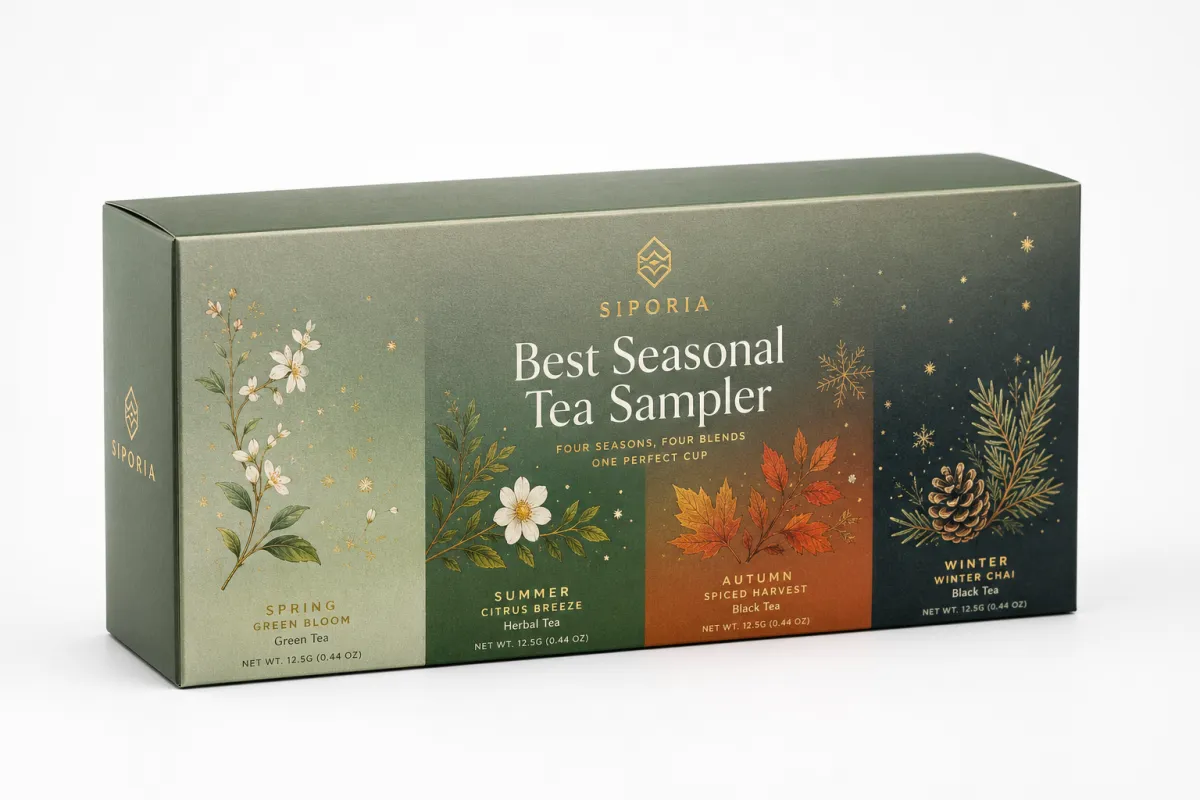
The short version: the best seasonal tea sampler box branding usually combines a rigid or semi-rigid structure, a high-contrast typography system, and one tactile finish such as soft-touch lamination, matte foil, or embossing. I have seen shoppers Choose the Box that felt gift-ready the moment they lifted the lid, even when the tea inside was sourced from the same Fujian region and blended to the same spec. That is not marketing theater. It is how retail tea behaves when it shares a table with candles, biscuits, and seasonal stationery. Tea is sneaky that way. It can look identical in a pouch, then become a completely different object once it gets a proper box and a tight insert.
"Best" has to mean four things at once for a commercial buyer: strong shelf presence, clear flavor hierarchy, easy gifting, and a cost structure that still leaves room for margin. A beautiful box can still fail if the flavors are hard to find, the insert rattles in transit, or the layout has to be rebuilt three times because the copy block is too long. I have been in those review calls on Zoom at 7:30 p.m. after a proof from Shenzhen arrived with the barcode 4 mm too close to the fold. They feel a bit like watching someone build a house and forget the stairs. The best seasonal tea sampler box branding keeps the story simple enough to read from 4 feet away, then rewards a closer look with texture, finish, or a reveal on the inside lid.
My simplest recommendation is this: choose one premium tactile element, one information system, and one seasonal cue. A 350gsm C1S tray wrap with soft-touch overprint, a black-and-gold flavor index, and a small embossed snowflake or botanical motif can do more than a fully illustrated box covered in every holiday symbol available. This kind of seasonal tea sampler branding works when the retail target sits between $24 and $38 and the wholesale spread still has to work at 58% margin. If the box looks like it is trying to win a costume contest, I get suspicious quickly.
I judge the best seasonal tea sampler box branding by five practical markers: visual hierarchy, unboxing experience, print quality, shipping durability, and repeat-purchase potential. A box that only photographs well under studio lights in Brooklyn or Portland is not enough. I want to know if the corners survive a 36-inch drop test, if the insert keeps the sachets from rattling, and if the same structure can carry a spring, autumn, or Lunar New Year variant without a full rebuild. Repeatability matters more than many brands admit in the first meeting. A one-season wonder is charming; a repeatable system is profitable.
Some boxes are louder. Some are prettier. The strongest seasonal tea sampler packaging is the version that sells quickly, arrives intact, and still feels fresh when a buyer sees it again on a shelf or in a subscription shipment. That is the standard I use when I review Packaging for Tea brands from Taipei to Toronto, and it is the standard I would use if the order came out of my own budget. My standards get stricter when the launch window is only 45 days, because seasonal retail does not forgive much and the calendar never discounts itself.
What to expect next: I will compare the main structures, show where each one wins, give realistic per-unit price ranges, and walk through the production timeline so you can plan a launch without betting the season on a late proof or a die cut that tries too hard.
Top Options Compared for Best Seasonal Tea Sampler Box Branding
The strongest seasonal tea packaging formats do different jobs. A rigid gift box signals premium value in a way a flat carton never quite can. A paperboard tuck box keeps shipping costs lower and can still look polished if the typography is disciplined and the board is at least 350gsm C1S. A sleeve-and-tray system gives you a layered reveal, which matters for the best seasonal tea sampler box branding because the buyer gets a small moment of theater before they ever see the tea. I have watched that moment push store staff to recommend a sampler more often, especially in boutique shops in Seattle and Minneapolis where the seller opens one sample on the counter and lets the box do part of the selling. A box that helps the staff is a box that gets remembered.
Here is the comparison I use during client meetings. It is not glamorous, but it keeps the conversation honest about brand consistency, cost, and the real unboxing experience.
| Format | Typical Signal | Best Use Case | Relative Cost | Shipping Durability |
|---|---|---|---|---|
| Rigid gift box | Premium, giftable, high perceived value | Corporate gifting, holiday sets, luxury tea | High | Strong |
| Paperboard tuck box | Accessible, efficient, retail-ready | Subscription add-ons, direct-to-consumer bundles | Low to medium | Moderate |
| Sleeve-and-tray | Layered, crafted, modern | Boutique shop displays, curated samplers | Medium | Good |
| Mailer-style sampler | Practical, modern, online-friendly | Fulfillment-heavy ecommerce launches | Medium | Very strong |
| Kraft presentation box | Earthy, natural, sustainability-first | Artisan tea, farm-to-cup branding | Low to medium | Good |
The rigid box usually wins for corporate gifting because it carries authority the moment someone sets it on a conference table in Boston or Dallas. The paperboard tuck box wins when the brand needs volume and easy fulfillment, especially if the assembly line is in Dongguan and the packing team wants a flat format that nests cleanly. Sleeve-and-tray systems often sit in the sweet spot for the best seasonal tea sampler box branding because they feel custom without requiring the same budget as a full magnetic rigid set. The mailer-style sampler is the underappreciated workhorse: it can protect the tea, reduce outer carton waste, and still support strong visual branding if the print area is handled properly. I have a soft spot for these practical formats. They do the job without making a speech about it.
I learned that lesson during a supplier negotiation in Shenzhen, where one client wanted a full rigid calendar-style insert, twelve compartments, and a gold-foil exterior on a run of 3,000 units. The quoted unit cost jumped from $1.42 to $2.86 before freight, and that was before we added a double-wall shipper and a 48-hour proof turnaround. We cut the insert complexity, kept one foil accent, and the final box still looked premium enough to support a 42% gross margin. That is the kind of tradeoff the best seasonal tea sampler box branding always demands. The funny part is that the simpler version ended up looking more confident. Fancy does not always mean better. Sometimes fancy means, "please charge me extra."
For brands testing shelf behavior, I usually ask three questions: does the box read in 2 seconds, does it gift well in 20 seconds, and does it survive a ship-and-stack workflow through Chicago, Atlanta, or Reno? If the answer is yes to all three, you are close. If not, the design is probably trying too hard to be decorative instead of commercially useful.
Detailed Reviews: Best Seasonal Tea Sampler Box Branding Styles
When I review the best seasonal tea sampler box branding styles, I do not look at them only as mockups. I ask how they will look under a warehouse LED at 4,000K, on a 12-inch retail shelf, and in a customer’s hand after the outer shipper is torn open with kitchen scissors. That is where packaging earns its keep. A design can be gorgeous on screen and still fail because the lid slips, the print blacks out, or the flavor hierarchy is too faint to read from 24 inches away. I have seen all three, and yes, the kitchen scissors are always uglier than people expect.
Premium Matte Rigid
This is the format I see most often in high-ticket gifting. A 1200gsm greyboard wrapped in 157gsm art paper, finished with soft-touch lamination, immediately signals value. Add a blind deboss on the brand mark and a single gold foil line, and the box starts speaking like a $32 product instead of a $14 one. For the best seasonal tea sampler box branding, that matte surface is useful because it photographs cleanly and kills glare, which matters on ecommerce listings and in retail lighting in London, Los Angeles, and Singapore. It also has a kind of quiet authority. You do not need to whisper premium if the box already sounds it.
I trust this style when a brand wants a seasonal release with a short selling window of 6 to 10 weeks. The box holds up, the color field stays calm, and the tactile finish slows the hand down. I watched a buyer at a holiday trade meeting in Atlanta lift three competing tea samplers, and the matte rigid box got a second touch before the others got a price question. That is not magic. It is packaging doing its job. It is also a little annoying in the best way, because a good box can delay the buyer just long enough to let the brand story do some work.
Botanical Illustration-Led
This style works best when the tea flavors themselves are narrative-driven: spiced plum, bergamot citrus, lavender mint, or rosemary lemon. Botanical artwork makes the product feel seasonal without shouting "holiday." I have seen a botanically illustrated sampler outperform a red-and-gold competitor because the illustration set felt closer to editorial design than to a generic festive box. That mattered to the retailer in Portland, who told me the box looked "giftable in March, not just December." I still think that was one of the better compliments a box has ever received.
The risk is clutter. Too many illustrated leaves, stems, snowflakes, and ribbon motifs can flatten the hierarchy and make the sampler look like an aisle filler. For the best seasonal tea sampler box branding, the illustration should lead the eye toward the tea list, not fight it. If the artwork is doing gymnastics while the flavors are hiding behind it, the whole thing starts to feel like a poster instead of packaging. A strong illustration system usually needs at least 6 mm of quiet margin around the type block so the label can breathe.
Minimalist Luxe
Minimalist luxe is for brands that sell on confidence. A deep charcoal box, warm white type, a small metallic accent, and a disciplined grid can feel more expensive than a fully illustrated package. I have seen a client pay $0.24 more per unit for a cleaner 2-color build and raise retail by $4 because the shelf signal improved. That math is real, and it explains why the best seasonal tea sampler box branding often looks simpler than the art department expected at the start. Clean work is deceptive like that. It looks easy after the hard part is done.
This style needs excellent print control. Weak ink coverage or loose spacing collapses the whole thing into blandness. Use a 0.5 pt keyline, keep the flavor labels at a consistent 8.5 pt minimum, and leave enough negative space for the eye to breathe. If the box feels like it is holding its breath, you have gone too far. A good minimal box can still include a 1.5 mm embossed border or a small matte foil stamp without losing restraint.
Rustic Craft
Kraft stock, fiber-fleck texture, black soy ink, and a restrained seasonal stamp can be powerful for artisanal tea brands. The box says earthy, honest, and small-batch without needing a speech. I visited a co-packer in Suzhou where a 4-compartment kraft sampler, printed in one color and sealed with a paper belly band, outsold a glossy full-color version because buyers trusted the material story more. That was a direct lesson in customer perception. People read material as much as they read copy, and sometimes they trust the paper before they trust the brand promise.
Rustic craft works best when the structural build is clean. If the edges are soft, the folds uneven, or the insert sloppy, the box stops feeling authentic and starts looking unfinished. The best seasonal tea sampler box branding can be earthy, but it cannot be careless. There is a thin line between "natural" and "we ran out of time." A 300gsm kraft outer with a 2 mm chipboard insert can work well here if the print registration stays tight.
Eco-Labeled Seasonal Packaging
This style puts sustainability claims in the foreground with FSC-certified board, water-based inks, recyclable trays, and minimal plastic. If you want verified material sourcing, the FSC standards are worth reviewing at fsc.org. I recommend this route when the tea brand already has a compostable or low-waste product story, because the package should reinforce the promise rather than invent it. Otherwise, the branding sounds like it is borrowing credibility from the paper stock, and buyers can feel that trick from a mile away.
Eco-labeled branding can fail if it looks too bare. Buyers still expect a gift to feel special. I have seen brands strip away all ornamentation in the name of sustainability, then wonder why the box looked cheaper than its $26 price. The answer was simple: restraint is not the same thing as underdevelopment. The best seasonal tea sampler box branding can be sustainable and still feel finished. In fact, it has to. Nobody wants a packaging lecture with their chamomile. A recyclable mailer with a 100% paper insert and water-based varnish can still look rich if the typography is disciplined.
"The box has to carry the story before the label gets read. If it does not, the tea is already fighting uphill." That was a line a retail buyer gave me in a review at a New York gift show, and she was right.
For standards around packaging durability and transit testing, I often point teams to ISTA. Seasonal tea sampler boxes are not rocket parts, but they still face drops, compression, and vibration in fulfillment from Nashville to Oakland. If the structure cannot handle a 12-unit case pack without edge crush issues, the pretty finish will not save it. The tea might survive emotionally, but the box will not.
On the floor, I keep returning to the same pattern: the styles that win are the ones that make the tea legible, make the gift obvious, and make the brand feel consistent across box, insert, and label. That is the quiet architecture behind the best seasonal tea sampler box branding. It looks simple because the hard decisions already happened upstream, often in a conference room with six mockups, two coffees, and one supplier quote from Dongguan.
Price Comparison: What Seasonal Tea Sampler Box Branding Costs
Price is where the romance usually dies, and that is healthy. The best seasonal tea sampler box branding is the version you can actually afford to repeat, not the version that wins applause in a prototype review and breaks the margin at 5,000 units. I have sat through enough pricing calls to know that many teams underestimate three buckets: setup, structure, and hidden finishing cost. The tricky part is that each one hides behind a nice sentence in a quote from Guangzhou or Ningbo.
For a simple printed paperboard sampler, I have seen costs around $0.38 to $0.92 per unit at 5,000 pieces, depending on size, print coverage, and insert complexity. A sleeve-and-tray system may land around $0.72 to $1.45 per unit. Rigid gift boxes often run from $1.25 to $3.20 per unit, and that range can climb quickly if you add foil, embossing, custom foam, or a magnetic closure. Those numbers are not theoretical; they reflect quote ranges I have reviewed across multiple supplier bids for the best seasonal tea sampler box branding.
| Cost Element | Typical Range | What It Covers | Where Brands Get Burned |
|---|---|---|---|
| Design setup | $250 to $1,500 | Artwork, dieline placement, file prep | Revisions after final copy changes |
| Proofs and samples | $60 to $350 | Digital proof, physical mockup, color check | Skipping physical samples on premium boxes |
| Paperboard carton | $0.38 to $0.92/unit | Printed board, folding, standard finish | Too much ink coverage, too many spot colors |
| Rigid box | $1.25 to $3.20/unit | Greyboard, wrap, specialty closure | Custom inserts and excessive finishing |
| Foil or embossing | $0.08 to $0.40/unit | One premium accent | Using two or three accents at once |
| Freight and case packing | Varies by lane | Outer cartons, labor, shipment | Ignoring landed cost |
The hidden cost is where many teams lose the economics. Dieline prep can cost $125 to $500 if the structure is unusual. A new insert can add tooling or sampling time. Plate fees, if you are using certain print processes, can creep in quietly. If the box is overdesigned, spoilage rises because the assembly line has to wrestle with the structure. I have seen one client lose nearly 7% of a run because the insert tabs were too tight for hand insertion in a factory outside Dongguan, which turned a promising concept into a production headache. Nothing humbles a brand faster than a beautiful box that refuses to be assembled.
Here is where I usually advise spending and saving. Spend on structural quality, print clarity, and one premium finish. Save by limiting the palette to two or three ink colors, keeping the insert simple, and avoiding a closure mechanism that adds labor every time a pack is assembled. In practice, a strong sub-$2.00 unit box with a disciplined layout can outperform a $3.80 unit box that tries to do too much. That is the kind of disciplined choice that keeps the best seasonal tea sampler box branding financially sensible.
MOQ matters more than many buyers expect. A beautiful rigid box at 1,000 units can become unprofitable if the setup cost is spread too thin. At 10,000 units, the same box may suddenly make sense because the per-unit cost drops into a workable range. In my experience, the sweet spot for many seasonal tea launches sits between 3,000 and 8,000 units, depending on channel mix and reprint risk. The best seasonal tea sampler box branding should fit the business model, not just the mood board. A 5,000-piece run in Zhejiang can also make the shipping math cleaner because you can fill a pallet without splitting cartons across multiple warehouses.
Process and Timeline for Seasonal Tea Sampler Box Branding
The production timeline for the best seasonal tea sampler box branding is usually more fragile than the design itself. I map it in six steps: discovery, concept direction, dieline selection, artwork placement, proofing, and manufacturing. If any one of those steps gets rushed, the launch window narrows fast. On a seasonal product, losing 2 weeks can mean losing the entire retail moment. I have seen a late proof erase a whole holiday opportunity in October, and the frustration in the room was almost theatrical.
A realistic timeline for a standard paperboard sampler is often 4 to 6 weeks from approved artwork to finished goods, assuming the dieline is already approved and there are no structural changes. Add 2 to 4 weeks if you need custom inserts or specialty finishing. Rigid boxes can push the schedule closer to 6 to 10 weeks, especially if the supplier is sourcing greyboard, wrap paper, and a custom tray from separate mills. For the best seasonal tea sampler box branding, I tell clients to build buffer, not hope. Hope is not a scheduling method, no matter how many Gantt charts get printed.
One of the most common delays I have seen came from flavor changes after artwork approval. A buyer added a seventh blend, which shifted the internal balance, which then required a new insert, which then forced a new proof cycle. The box was beautiful and the launch was late by 11 business days. That kind of chain reaction is why the best seasonal tea sampler box branding should lock the tea list before the visual system is finalized. Changing the flavor count late is the packaging equivalent of moving the kitchen after the cabinets arrive.
Another delay came in a supplier meeting where barcode placement was left until the end. That sounds minor until the production team tells you the barcode crosses a fold line and no scanner can read it at the warehouse in Reno. Then everyone loses an afternoon. Small details like that are exactly why the best seasonal tea sampler box branding needs a real preflight checklist, not just a design review. I know that sounds obvious, but obvious things are usually the ones people skip while chasing a prettier mockup.
Seasonal timing also matters. If you want a holiday launch, I would start concept work at least 12 to 16 weeks before the selling window opens. That gives room for sampling, transit, and retail intake. If the box is meant for a short seasonal burst, late inventory is almost as bad as no inventory. The buyer who finds your product after the season has already shifted will not wait around for a beautiful package. They will buy the competitor sitting one shelf over with a 3-day replenishment promise and a cleaner delivery date.
For launches tied to ecommerce, I also recommend a practical stress test: one shipper drop, one shelf test, and one gift test. A box that survives a 24-inch shelf drop and still opens cleanly in the hand is closer to ready than a box that only looks good under studio lights in a photo tent. The best seasonal tea sampler box branding earns its value by behaving well in the real supply chain, from the factory in East China to the consumer’s kitchen table.
How to Choose the Right Seasonal Tea Sampler Box Branding
Choosing the best seasonal tea sampler box branding starts with five questions: who is buying it, where will it be sold, how will it ship, what price point does it need to support, and whether the product is a gift, a trial pack, or a premium bundle. I have seen teams pick a luxury rigid box for an entry-level sampler, then wonder why retail partners resisted it. The packaging was not wrong. The economics were. A beautiful box can still be a terrible fit if the channel cannot carry it at $18 wholesale and a 35% sell-through target.
Flavor count changes everything. Six teas can fit a neat 2-by-3 layout, nine teas often need a balanced grid, and twelve teas can force a larger footprint or a smarter insert system. If the sampler has tasting notes or steeping guidance on the front, the hierarchy still has to leave room for the flavor names to breathe. The best seasonal tea sampler box branding is clear enough that a customer can identify peppermint, spiced chai, or jasmine without hunting for the legend. If they need a decoder ring, the design missed the point by at least one step.
Brand personality should guide the structural choice. A heritage tea company may do well with a book-style rigid box and classic serif type. A modern wellness brand may prefer a minimal carton with a botanical accent and a clean color band. An earthy artisan label might use kraft board and a one-color seasonal stamp. A luxury gifting brand can justify foil, embossing, and a soft-touch finish if the price supports it. The best seasonal tea sampler box branding reflects the brand identity instead of borrowing someone else's holiday language. That borrowed language always shows up eventually, usually next to a competitor’s best seller in the same aisle.
Sustainability is a material decision, not a slogan. FSC-certified board, recyclable inserts, and water-based inks can support the story, but they should still look intentional. I have seen boxes that announced "eco" yet used awkward uncoated stock, oversized copy blocks, and low-contrast ink that made the whole pack feel unfinished. That is not how trust gets built. If you want sustainability to strengthen customer perception, the design has to stay polished. If you want to verify sourcing language, the FSC site at fsc.org is a good reference point.
To narrow the choices, I use a simple scoring method with clients. Rate each option from 1 to 5 on shelf impact, shipping durability, gift appeal, production cost, and brand consistency. Anything that lands below 18 out of 25 usually needs revision. That framework keeps the discussion honest and prevents the team from falling in love with a structure that cannot survive the real order volume. It also keeps the best seasonal tea sampler box branding grounded in business reality instead of wishful thinking.
One more practical check: ask how the box will look next to your other packaging. If the seasonal sampler looks like it came from a different company, the brand system is too loose. Strong visual branding should feel related across the lineup, even when the colors shift for winter, spring, or harvest. The best seasonal tea sampler box branding builds recognition by staying flexible without drifting into inconsistency.
If you want a reference point for how structural choices play out in finished programs, I would study supplier photos and real packaged samples rather than only presentation renders. That is how I avoid false positives. A render can hide a weak flap; a sample cannot. And yes, I have been fooled by a gorgeous render before. It was embarrassing for about 5 minutes, which is a long time in packaging when the factory in Ningbo is waiting for approval.
Next Steps: Turn Best Seasonal Tea Sampler Box Branding Into a Print-Ready Spec
To move the best seasonal tea sampler box branding from idea to production, gather five items first: the tea list, the target unit count, the sales price, the shipping deadline, and three visual references that feel aligned with your brand. That five-part brief is usually enough to get meaningful quotes instead of vague estimates. I have seen brands waste 10 days because they sent a "winter tea vibe" note and expected a factory in Guangdong to read their minds. Factories are many things. Mind readers are not one of them.
Request at least two or three physical samples, even if that means paying for a prototype. Compare the finish in hand, not only on screen. Check whether the lid opens with resistance, whether the insert is secure, and whether the box still feels premium after one rough edge on the shipper. The best seasonal tea sampler box branding earns its reputation by surviving that first real handling test. If it squeaks, scratches, or sheds glitter, you already know more than the render told you.
Then test the box under conditions that resemble actual use. A short drop test, a shelf test, and a gift-unboxing test will reveal more than an hour of design commentary. If a loose sachet rattles, if the opening is awkward, or if the flavor labels disappear under glare, you will catch it before the full run. That is money saved, not money spent. I cannot tell you how many times a $100 sample from Suzhou or Yiwu has prevented a much more expensive production mistake.
Your final approval checklist should include barcode placement, tasting notes, legal copy, carton dimensions for fulfillment, and color accuracy against the approved proof. Add one more line for margin. If the box still supports the wholesale and retail math after freight, assembly, and spoilage assumptions, you are ready. If not, simplify. The best seasonal tea sampler box branding is the version you can sample, price, ship, and repeat without surprises. It should also survive a reprint in 6 months if spring demand outperforms the forecast.
My honest view? The strongest seasonal tea box is usually not the most elaborate one. It is the one that looks thoughtful, feels tactile, ships cleanly, and repeats reliably from one season to the next. That is where brand consistency becomes brand recognition, and where the packaging finally does what it was supposed to do: help the tea sell itself. I know that sounds almost too neat, but after enough launch cycles, the neat answer is often the true one. A $0.15 per unit reduction at 5,000 pieces can matter more than a second foil pass, and that is the kind of detail that keeps a seasonal line alive.
FAQ
What is the best seasonal tea sampler box branding for small brands?
For small brands, I usually recommend a well-printed paperboard box with one strong finish, such as matte lamination or a single foil accent. It keeps the structure manageable, supports a clean unboxing experience, and avoids the cost shock of a fully custom rigid build. Keep the flavor labels clear, use a tight 2-color or 3-color system, and choose a format that can be reordered easily without changing the whole specification. A 350gsm C1S carton with a 2 mm paperboard insert is often enough for a 6-tea sampler, and it can be produced in 12 to 15 business days after proof approval if the art is final. Small brands need options that are repeatable, not just pretty for one launch.
How much does best seasonal tea sampler box branding usually cost per unit?
Pricing depends on structure, quantity, insert complexity, and finish. In practice, paperboard samplers often start around $0.38 per unit at 5,000 pieces, sleeve-and-tray systems can land around $0.72 to $1.45, and rigid gift boxes commonly run from $1.25 to $3.20 or more. Ask for a quote that separates setup, printing, inserts, and freight so you can compare true landed cost instead of a headline number. I always push for landed cost because it is the number that actually hits the margin, especially if the line ships from Shenzhen to the West Coast. If a quote feels suspiciously tidy, there is usually a missing line item hiding somewhere.
How long does a seasonal tea sampler box branding project take?
If the dieline is ready and the artwork is approved early, a simple project may move through production in about 4 to 6 weeks. Custom structures, foil, embossing, or multiple proof rounds can extend that to 6 to 10 weeks. The safest plan is to build extra buffer for sampling, color correction, and shipping so the launch does not slip past the selling window. Seasonal timing is unforgiving, and the calendar does not care how good the mockup looked. In a tighter factory slot, I have seen rigid boxes take 18 business days from deposit to ship date in Dongguan. That sounds kinda specific because, honestly, it is.
What materials work best for premium tea sampler packaging?
Rigid board, high-quality paperboard, and textured uncoated stocks usually signal premium value best. Soft-touch lamination, embossing, and foil can help if they are used sparingly. I also pay attention to whether the material protects the tea and photographs well, because tea samplers often sell through gifting and online images at the same time. A 1200gsm greyboard rigid wrapped in 157gsm art paper is a strong premium combination, while 350gsm C1S works well for a lower-cost retail pack. The best material is the one that supports all three jobs without making the box feel overworked.
How do I make seasonal tea sampler box branding feel gift-ready without overspending?
Use one standout visual element, such as a seasonal color palette or refined illustration, instead of layering on too many finishes. Keep the copy short, keep the structure tidy, and spend on the first-touch experience. A clean opening, strong typography, and one premium detail usually do more for customer perception than a crowded box with too many effects. I have seen plain boxes win because they felt calm and certain, which is a lot more attractive than flashy confusion. If you can hold the unit cost near $1.10 at 3,000 pieces, the gift feel usually survives the budget meeting. The trick is not to make it cheaper-looking in the process.


