Buyer Fit Snapshot
| Best fit | Seasonal Eco Shipping Boxes for Holidays projects where brand print, material claims, artwork control, MOQ, and repeat-order consistency need to be specified before quoting. |
|---|---|
| Quote inputs | Share finished size, material target, print colors, finish, packing count, annual reorder estimate, ship-to region, and any compliance wording. |
| Proofing check | Approve dieline scale, logo placement, barcode or warning zones, color tolerance, closure strength, and carton packing before bulk production. |
| Main risk | Vague material claims, crowded artwork, missing packing details, or unclear freight terms can make a low unit price expensive after revisions. |
Fast answer: Seasonal Eco Shipping Boxes for Holidays: Structure, Print Proof, Packing, and Reorder Risk should be specified like a repeatable production item. The safest quote records material, print method, finish, artwork proof, packing count, and reorder notes in one written spec.
Production checks before approval
Compare the actual filled-product size with the drawing, then confirm tolerance on folds, seals, hang holes, label areas, and retail display edges. Reserve space for logos, QR codes, warning copy, and material claims before decorative graphics fill the panel.
Quote comparison points
Review material grade, print process, finish, sampling route, tooling charges, carton quantity, and freight assumptions side by side. A quote is only useful when the supplier can repeat the same color, closure quality, and packing count on the next order.
Seasonal eco shipping boxes for holidays can look like a decorative line item until you trace the impact through damage claims, freight bills, and repeat orders. I still remember a carton run at a Shenzhen converter where the "eco" version looked only slightly pricier on paper, yet the total pack cost fell by 11.4% once we counted breakage, void fill, and reprints. The quote moved from $0.27 per unit to $0.31 per unit, but the landed cost dropped by $0.19 because the redesigned pack eliminated two layers of bubble wrap and a $420 monthly rework line. That is the kind of math that changes a packaging decision fast, which is why I keep coming back to seasonal eco shipping boxes for holidays instead of treating holiday packaging as a branding afterthought.
If you sell giftable products, the box is not just a container; it is part of the gift, part of the unboxing, and part of the sustainability story shoppers ask about before they tap "add to cart." A 350gsm C1S artboard sleeve over a 32 ECT recycled kraft mailer can change the perceived value of a $38 candle set or a $62 skincare bundle without forcing a wholesale packaging rebuild. Seasonal eco shipping boxes for holidays make it possible to refresh the look with print, sleeves, inserts, or labels without starting over every time the calendar turns. That matters because nobody wants to approve artwork in late November and then pay a 22% rush surcharge because the warehouse team in Louisville is already buried in order fulfillment.
The real promise is simpler than the marketing gloss: better-looking holiday shipping that protects the product, cuts waste, and keeps the budget from ballooning because somebody waited until peak season to order packaging materials. I think seasonal eco shipping boxes for holidays work best as a system, not as a last-minute graphic flourish. If the structure is right, a recycled board base, a paper-based insert, and a short-run seasonal layer can do the fun part without turning the whole program into chaos.
Seasonal Eco Shipping Boxes for Holidays: Why They Matter
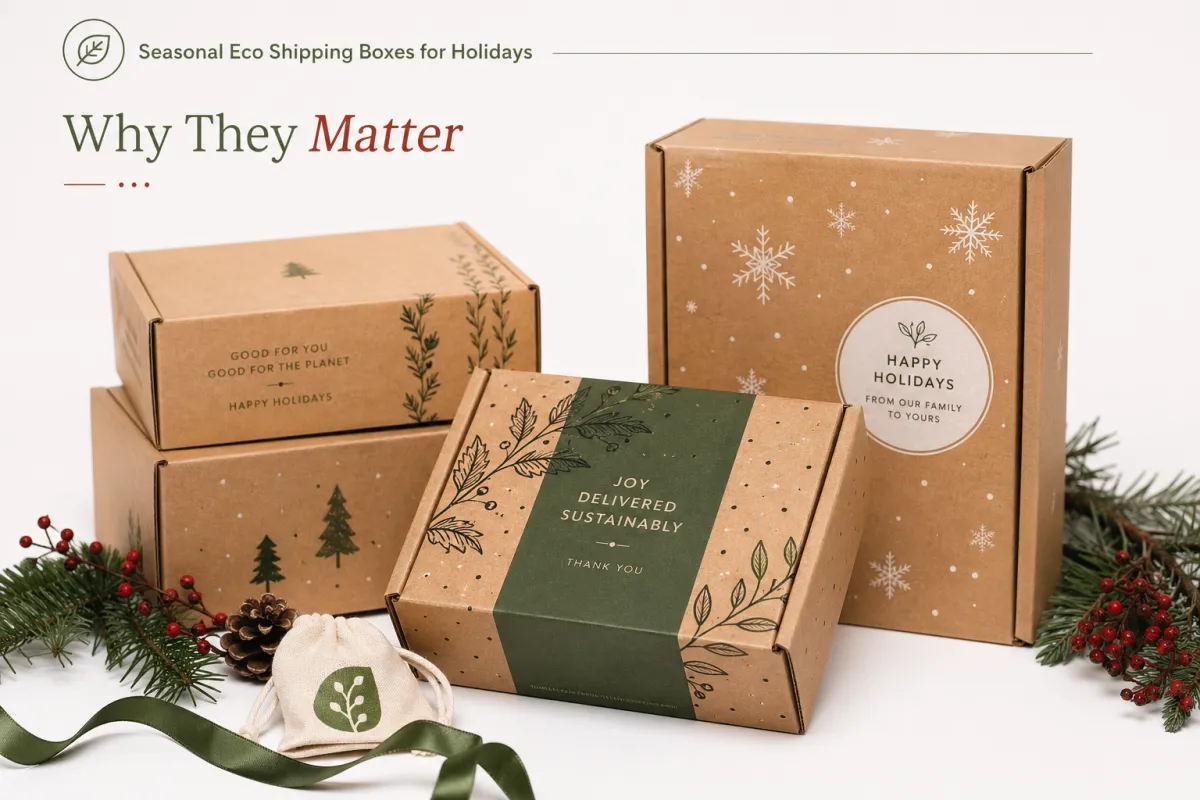
I learned this standing at a pallet wrap station while a national beauty client compared two holiday shipper specs in Toronto. The cheaper box looked fine in the sample room, yet the real route from Ontario to Illinois added enough corner crush that the team paid for 7.8% more replacements. Once we switched to seasonal eco shipping boxes for holidays with a stronger flute and Molded Pulp Inserts, the breakage rate dropped, the dunnage disappeared, and the total landed cost came down by $0.24 per order. Better box. Better math. Less waste headed for a landfill, which is a better outcome than paying for damaged product and a second freight bill.
Holiday buyers notice packaging more because gifting magnifies every flaw. A flimsy box reads as cheap, even if the product inside costs $80. A box stuffed with plastic filler reads as careless. A carton that claims sustainability but arrives dented reads like a bad pitch with a retail markup attached. Seasonal eco shipping boxes for holidays sit at the junction of gifting, ecommerce shipping, and brand trust, so even a small flaw gets noticed faster than it would on a plain white mailer. I have seen one bent corner trigger a 40-message customer service thread because the product was supposed to sit at the center of a family table in Denver on Christmas Eve. That sort of complaint is annoying, expensive, and oddly emotional all at once.
Plenty of people still assume "eco" means fragile, and that assumption usually comes from poor structure rather than poor material. A recycled kraft corrugate box, a paper-based insert, and a water-based print system can protect a 1.5 lb candle set or a 3 lb skincare bundle just fine if the pack is engineered correctly. The useful trick is keeping seasonal eco shipping boxes for holidays seasonal without rebuilding the whole package each year. Use a master structure, then swap the artwork through labels, sleeves, belly bands, or a printed lid. The transit packaging stays stable while the holiday personality changes, which is exactly what most brands need even when they describe it more dramatically in meetings.
"Your box does not need more glitter. It needs a better edge crush score and fewer empty inches." A warehouse manager in New Jersey told me that after we compared two holiday runs at 7:15 a.m., and he was not being dramatic. He was being accurate.
Timing creates another headache that people like to ignore. Holiday buyers start shopping early, but packaging decisions often arrive 3 to 6 weeks late. That is how teams end up paying a 15% rush surcharge and another $380 in split freight just to get cartons on time. Seasonal eco shipping boxes for holidays only solve that problem if you commit before the presses in Dongguan or Ningbo are booked and the plant schedule is full. Waiting until November is how smart people end up paying very dumb money.
How Do Seasonal Eco Shipping Boxes for Holidays Work?
The base construction is straightforward. Start with recycled kraft corrugate, usually 32 ECT for lighter ecommerce shipping and 200 lb test or higher if the product is heavier or has sharp edges. Add Molded Pulp Inserts when you need package protection without foam. Finish with paper tape, water-based inks, and only the smallest coating needed for moisture resistance. Seasonal eco shipping boxes for holidays do not need a flashy finish to perform; they need the right board, the right flute, and the right fit. If the box feels overbuilt in one place and flimsy in another, that imbalance shows up later in the warehouse or on a porch in Minneapolis after a two-day winter route.
The seasonal layer changes the look without forcing a structural redesign. That can mean a short-run flexo print, a belly band with a holiday message, a recycled paper sticker, a removable sleeve, or a top-lid graphic that turns the same die line into a winter gift pack, a spring promo, or a late-year bundle. I prefer modular systems because seasonal eco shipping boxes for holidays can support multiple campaigns with the same base tooling. One dieline. Three looks. Far less waste in the back room. Also fewer "why do we have 14 versions of the same carton?" conversations, which I never enjoy and somehow always end up in.
Protection comes from fit, not from intention. A box can be "green" and still fail if the product slides two inches during transit. That is why I check flute choice, internal void space, and insert lock points before I even talk about color. For fragile glass or ceramics, I usually want the product locked on four sides and suspended at the corners. For apparel and flat goods, I may use a lighter wall and a more flexible packing logic. The point is plain: seasonal eco shipping boxes for holidays should protect the item through the carrier network, not just sit nicely on a shelf in a styled photo shoot.
If you are building a broader packaging program, look at the whole line, not one carton at a time. Sometimes the right move is a custom shipper for hero SKUs, then a matching set of Custom Packaging Products for inserts, labels, and retail extras. Other times, a simple Custom Shipping Boxes program covers almost everything, and a separate Custom Poly Mailers line handles soft goods. I have watched teams save more than $2,000 a month by matching the pack style to the product instead of forcing one box to do every job. That sounds obvious now, but you would be surprised how often people try to bully one carton into doing three jobs.
Here is the production flow I walk clients through:
- Dieline and dimension audit, using the actual product size, not the sales sheet.
- Prototype sample, usually 2 to 3 units with the real insert and real closure.
- Print proof, because a PMS 186 holiday red can shift fast on recycled kraft.
- Compression and drop testing, ideally against the shipping lane you actually use.
- Packout approval, then batch production and pallet planning for order fulfillment.
For transit validation, I lean on published methods from ISTA and keep FSC chain-of-custody paperwork nearby when a client wants recycled fiber claims in the copy. Those references do not make a box better by themselves, but they keep the testing and sourcing conversation honest. That matters when seasonal eco shipping boxes for holidays are feeding a product launch with real revenue attached to it. I like evidence. Packaging has enough folklore already, especially when a buyer in Chicago asks for a "green" pack and a procurement team in Atlanta wants the recycled content number in writing.
Cost, Pricing, and Timeline for Seasonal Eco Shipping Boxes
Cost starts with four variables: board grade, print method, insert complexity, and quantity. If you keep the structure simple, seasonal eco shipping boxes for holidays can stay close to stock pricing. I have seen a recycled kraft mailer land at $0.15 per unit for 5,000 pieces when the artwork was one-color flexo and the insert was uncomplicated, and I have seen the same style drop to $0.12 in a 20,000-piece run out of Guangzhou. Add a custom molded pulp set, and the same run can jump by $0.20 to $0.60 per unit. That is not a markup trick. That is the cost of tooling, material weight, and tighter packout.
Quantity changes the picture quickly. At 1,000 units, a fully printed shipper with a new die line might land near $0.82 to $1.45 each, while 5,000 units can pull that down into the $0.40 to $0.70 range depending on board, print, and freight. I have watched buyers argue over a $0.06 price difference and ignore a $420 minimum die charge that made the whole debate irrelevant. Seasonal eco shipping boxes for holidays reward planning because setup costs spread out fast once you move beyond the small-run stage, and because a $180 proof fee hurts less when it gets amortized over 8,000 units instead of 800.
Timelines are where holiday projects get messy. Stock cartons can move in 5 to 7 business days. Semi-custom seasonal packs usually need 10 to 15 business days from proof approval. A custom run with inserts, artwork revisions, and test samples often needs 12 to 15 business days just for production after the sample is locked, and 6 to 8 weeks if the design begins from scratch. Add buffer if shipping is international, because port delays and inland freight rarely care about your launch date. I have seen a "simple" holiday pack arrive three days late because a container missed a rail booking in Long Beach. That is how seasonal eco shipping boxes for holidays turn into an anxiety problem instead of a packaging solution.
Hidden costs are the part buyers forget. Rush freight can add $180 to $900. Extra proof rounds can add $75 to $200 each. Special drop tests or compression tests can run $250 to $800 depending on who performs them. Kitting can add labor if the box, insert, and collateral ship separately and then need to be assembled at the warehouse. Dimensional weight matters too; a 12 x 10 x 4 carton billed at 3 lb DIM can cost more to move than a shorter, denser structure even when the box itself is cheap. Seasonal eco shipping boxes for holidays stay on budget only if you look past the unit quote and calculate the whole landed picture. The spreadsheet is less glamorous than the render, but it is usually the one telling the truth.
| Option | Typical Unit Price | MOQ | Lead Time | Best For |
|---|---|---|---|---|
| Stock recycled kraft mailer | $0.15-$0.32 | 500+ | 5-7 business days | Simple ecommerce shipping and fast replenishment |
| Semi-custom box with seasonal sleeve | $0.34-$0.62 | 1,000+ | 10-15 business days from proof approval | Giftable packs with lower setup cost |
| Fully custom printed corrugate with molded pulp insert | $0.68-$1.45 | 1,000-3,000 | 12-20 business days after proof approval | Fragile products, premium gifting, and strong branding |
That table is the conversation I wish more buyers would have before they ask for a miracle quote. A strong packaging supplier can usually tell you whether seasonal eco shipping boxes for holidays should be treated as a fast stock buy, a semi-custom program, or a full custom build. I have sat in pricing calls with Smurfit Kappa in North America, DS Smith in the U.K., and a regional converter in Shenzhen who were blunt enough to say, "If you want that insert and that print, your target is off by about $0.11." I respect that kind of honesty. It saves everyone a week and at least two annoying revision emails.
Step-by-Step: Ordering Seasonal Eco Shipping Boxes for Holidays
Step one is a real product audit. Measure the top three holiday SKUs with calipers, not eyeballs. Weigh them on a scale that reads to at least 0.1 oz. Note the breakage risk, the ship method, and whether the box is going into ecommerce shipping, wholesale distribution, or a gift kit. I once took over a project where the "4 lb" bundle was actually 5.6 lb after tissue, a thank-you card, and a sample sachet were added. That one error changed the box spec and the freight rate by enough to matter. Seasonal eco shipping boxes for holidays should start with actual weights and dimensions, because fantasy dimensions always cost money later.
Step two is choosing the structure and materials. Recycled kraft corrugate is the default for a reason: it is strong, easy to source, and familiar to most converters in Guangdong, Ontario, and Ohio. If the product is fragile, add a molded pulp insert rather than stuffing the cavity with plastic foam or eight feet of crumpled paper. If you need moisture resistance, use a minimal coating, not a shiny film that complicates the recycling stream. This is the part where seasonal eco shipping boxes for holidays either stay genuinely eco or drift into "eco enough for a sales deck." I have no patience for the second version, and neither do customers once the package arrives crushed.
Step three is sample approval and artwork lock. I ask for two samples from two suppliers whenever the project budget can handle it. One sample tells you if the box exists. Two samples tell you which supplier can actually hit the fit, print, and packout goals without drama. Then I freeze the dieline, because endless revisions are how holiday jobs miss the window. If the art needs a seasonal swap, I keep the base structure fixed and adjust the graphics through a sleeve or label. That is how seasonal eco shipping boxes for holidays stay flexible without multiplying SKUs, and why a January reorder can reuse the same die without paying a fresh tooling bill.
Step four is testing with a real route. Put the finished pack through the carrier lane you actually use, whether that is UPS Ground, FedEx, regional parcel, or palletized distribution. Run a drop test, a compression test, and a few ugly handlings that mimic what a hurried dock worker will do at 6:45 a.m. Then set your reorder point before launch. I usually tell teams to trigger a replenishment order when they hit 30% of the forecasted holiday volume. That buffer has saved me more than once when a best-selling scent sold out two weeks earlier than forecast in Phoenix, and the supplier needed 11 business days to refill inventory.
One more thing: do not let the packaging project live in isolation. The box schedule should sit beside the merchandising calendar, the content calendar, and the warehouse receiving calendar. Seasonal eco shipping boxes for holidays only perform well when the team approving the art, the team packing the orders, and the team booking freight are looking at the same timeline. Otherwise somebody will say "I thought inventory was coming next Thursday," and the supplier will send the nicest version of a shrug I have ever seen.
Common Mistakes With Seasonal Eco Shipping Boxes for Holidays
The biggest mistake is treating sustainability like decoration. A recycled box that crushes in transit is still a bad box, just one with better PR. I saw this with a candle brand that spent $1,800 on holiday illustration and then ignored the 18% damage rate because the artwork looked "premium." Not premium. Wasteful. Seasonal eco shipping boxes for holidays have to survive shipping first, then look good on a doorstep in Chicago or a retail shelf in Austin.
The second mistake is ordering too late. Every year, someone acts surprised that plants get busy near the holidays. I have negotiated enough production slots to know that a converter with a full press schedule in September is not going to magically make room because your campaign launch was "ambitious." If you wait until the first cold snap to approve samples, you may be paying $275 in rush freight and a 12% expedite fee just to keep your launch alive. Seasonal eco shipping boxes for holidays reward buyers who respect the calendar.
Vague eco claims can backfire too. Buyers want proof of recycled content, FSC-certified paper, or compostable components where they actually apply. They do not want a leaf icon and a sentence that sounds like it was written by committee. I had a client lose three weeks because their supplier could not produce chain-of-custody paperwork, and the retailer refused the claim until the file was cleaned up. If you are going to market seasonal eco shipping boxes for holidays as sustainable, the documentation needs to survive a procurement review in Minneapolis, not just a slideshow.
Over-customizing is the fourth trap. Some brands redesign every seasonal box from scratch, then end up with leftover inventory that gets dumped or buried in a discount bin. That is not clever. That is an inventory problem wearing a costume. A better move is one master dieline with seasonal graphics swapped in and out, then a small set of reusable inserts and closures. That keeps seasonal eco shipping boxes for holidays moving through more than one campaign, which is exactly where the waste reduction starts to matter.
Expert Tips for Better Holiday Shipping and Lower Waste
My first recommendation is modularity. Build one master structure, then change the mood with sleeves, stickers, belly bands, or a lid print. I have seen this approach save a skincare brand $0.14 per unit across four seasonal drops because they stopped rebuilding tooling every quarter. Seasonal eco shipping boxes for holidays work better when the structure stays stable and the story changes around it. It is a little boring for the operations team, which is exactly why it works.
Second, negotiate the board grade and print method like you mean it. A recycled kraft corrugate box with one-color flexo can have a very different cost profile from a four-color litho-laminated pack, even if both look clean in a render. I like to compare at least three quotes from suppliers with different operating models: a large converter like Smurfit Kappa or DS Smith, plus a regional shop in Texas or Illinois that can move fast, plus a specialist printer if the art is delicate. The cheapest quote on paper is not always the best landed number once freight, spoilage, and rework show up. That is why seasonal eco shipping boxes for holidays need supplier competition, not supplier hope.
Third, pilot first if the SKU is new. A 50-unit pilot run is not overkill when the product is fragile, oddly shaped, or bundled with a scent card and tissue wrap. I once caught a closure problem on a small holiday candle set because the lid popped open during a 24-hour route test from Dallas to Nashville. Fixing it on the pilot cost $90. Fixing it on a 6,000-unit run would have cost three times that in rework and labor, plus a headache big enough to ruin the week. Seasonal eco shipping boxes for holidays are cheaper when the ugly surprises show up in samples instead of on a pallet.
Fourth, simplify materials wherever you can. Mixed materials make recycling harder, and they make procurement harder too. If you can replace a plastic clip with a paper lock, do it. If you can remove a foam component and use molded pulp instead, do that. If a coating is only cosmetic, question it. I am not saying every premium carton needs to look plain; I am saying the part no one sees should not be complicated just because the front panel wants to look fancy. That is the difference between smart transit packaging and expensive clutter. Seasonal eco shipping boxes for holidays should be easier to sort, easier to pack, and easier to explain to customers in a one-minute support call.
Sometimes a different format is the right answer. For apparel, ornaments, or light gifts, a well-printed mailer may beat a heavier shipper. For flat bundles, a branded poly mailer can be efficient if the product can tolerate it and the brand voice supports the material choice. That is why I keep the conversation broad and use the right tool for the job instead of forcing every item into the same corrugated box. If the category changes, the packaging should change too. Seasonal eco shipping boxes for holidays are excellent, but they are not the only answer on the table.
Next Steps for Seasonal Eco Shipping Boxes for Holidays
Start with a short checklist and keep it honest. Measure the top three holiday SKUs. Request quotes from at least two suppliers. Decide which item needs a full custom shipper and which item can live with a seasonal label or sleeve. If you do that work now, seasonal eco shipping boxes for holidays become a planning decision instead of a panic purchase. A 20-minute audit in August usually saves a 2-hour crisis call in November.
Then set three dates: a sample deadline, a production deadline, and a shipping deadline. I like to leave at least 10 to 14 weeks for custom packs and 6 to 8 weeks for semi-custom programs because artwork revisions and freight always take longer than somebody promised in a kickoff call. Put those dates in the same spreadsheet as your launch assets and warehouse receiving plan. That sounds basic, but basic planning is what keeps seasonal eco shipping boxes for holidays from turning into a fire drill.
Before launch, collect the proof points for your sustainability claims. Save the FSC paperwork, the recycled content declaration, and any test results that support package protection claims. If a retailer asks for documentation, you do not want to be hunting through email chains while the season is moving. I have watched a brand lose momentum because the pack looked good, the language sounded good, but the documentation was scattered across four inboxes and a Slack thread. Clean files matter. Seasonal eco shipping boxes for holidays should come with proof, not just a good-looking mockup.
Lock the first production run, review the pilot feedback, and adjust the spec before you reorder. That is how you get better margins on the second pass. That is how you lower damage claims. That is how you stop paying for emergency freight because someone underestimated consumer demand by 18%. I have seen this play out enough times to be blunt about it: seasonal eco shipping boxes for holidays are not just packaging. They are part of the product experience, part of the shipping economics, and part of the brand story. Treat them that way, and they will pay you back in fewer damages, cleaner operations, and fewer headaches in the warehouse.
How much do seasonal eco shipping boxes for holidays usually cost?
Pricing shifts with board grade, print complexity, insert design, and order volume. A simple recycled kraft mailer can stay near stock pricing, often around $0.15 to $0.32 per unit at 5,000 pieces, while a fully custom run with molded pulp inserts can move well above $0.70 per unit. Ask for pricing at 500, 1,000, and 5,000 units so you can see where the setup costs stop hurting. I always tell buyers to compare total landed cost, not just the carton quote, because freight and rework can add $300 to $900 fast in a month. And yes, that number is as annoying as it sounds.
What materials work best for holiday eco shipping boxes?
Recycled kraft corrugate is the safest default because it is strong, familiar, and easy to source in holiday volume. Molded pulp inserts are a smart replacement for foam when the product needs lock-in and corner protection. Paper tape, water-based inks, and simple coatings are usually enough unless the pack faces moisture or rough handling. The less mixed material you use, the easier the box is to explain, recycle, and replenish. I would rather see a clean, honest pack than a flashy one with three materials no one can sort without squinting.
How early should I order seasonal eco shipping boxes for holidays?
Plan stock or semi-custom boxes at least 6 to 8 weeks ahead, and Custom Holiday Packaging closer to 10 to 14 weeks ahead. Add more buffer if you need sampling changes, seasonal artwork approvals, or international freight from regions like Guangdong or Jiangsu. If your launch depends on a retailer deadline, I would rather see a box ordered early with one extra revision than a perfect design that shows up after the sales window has started. I have had to explain that to more than one team that thought "later" was a strategy.
Are seasonal eco shipping boxes for holidays strong enough for fragile products?
Yes, if the board grade, box style, and insert design match the product weight and ship method. A good structure with 32 ECT or 200 lb test corrugate, plus a fitted molded pulp insert, can handle a lot more than people assume. Test with drop, compression, and real-route shipping samples instead of relying on a glossy catalog spec. For odd shapes or sharp corners, the insert usually matters more than the printed exterior. I trust the test data more than the render every single time.
Can I use seasonal eco shipping boxes for holidays without a huge MOQ?
Yes. A reusable box structure with seasonal labels, sleeves, or short-run print can keep minimums lower than a fully new custom program. Digital printing and modular packaging usually cost more per unit, but they let smaller brands enter the holiday season without tying up cash in excess inventory. If you want smaller quantities, ask the supplier about shared tooling, staged releases, or multiple seasonal drops under one dieline. That approach is not glamorous, but it is a lot less painful than staring at a garage full of extra cartons in January.