Buyer Fit Snapshot
| Best fit | Biodegradable Packaging for Ecommerce projects where brand print, material claims, artwork control, MOQ, and repeat-order consistency need to be specified before quoting. |
|---|---|
| Quote inputs | Share finished size, material target, print colors, finish, packing count, annual reorder estimate, ship-to region, and any compliance wording. |
| Proofing check | Approve dieline scale, logo placement, barcode or warning zones, color tolerance, closure strength, and carton packing before bulk production. |
| Main risk | Vague material claims, crowded artwork, missing packing details, or unclear freight terms can make a low unit price expensive after revisions. |
Fast answer: Biodegradable Packaging for Ecommerce: Production Review should be specified like a repeatable production item. The safest quote records material, print method, finish, artwork proof, packing count, and reorder notes in one written spec.
Production checks before approval
Compare the actual filled-product size with the drawing, then confirm tolerance on folds, seals, hang holes, label areas, and retail display edges. Reserve space for logos, QR codes, warning copy, and material claims before decorative graphics fill the panel.
Quote comparison points
Review material grade, print process, finish, sampling route, tooling charges, carton quantity, and freight assumptions side by side. A quote is only useful when the supplier can repeat the same color, closure quality, and packing count on the next order.
Biodegradable Packaging for Ecommerce: What to Know Before You Order
Biodegradable packaging for ecommerce sounds straightforward until the adhesive, liner, coating, or print finish turns a simple claim into a compliance headache. That happens more often than brands like to admit. The base material might be fine. The whole package still isn’t. One stubborn layer can change how the thing behaves after delivery, which is why biodegradable packaging for ecommerce needs a lot more scrutiny than a nice-looking sales sheet.
If you are trying to balance branding, shipping protection, and disposal claims, you are in good company. Teams want packaging that feels cleaner and more responsible while still holding up as product packaging and retail packaging. That means looking past the label and asking what the material is, how it breaks down, where it can be disposed of, and what the landed cost looks like. If you want to compare formats while you read, you can also browse Custom Packaging Products for a sense of what can be customized.
What Biodegradable Packaging for Ecommerce Really Means
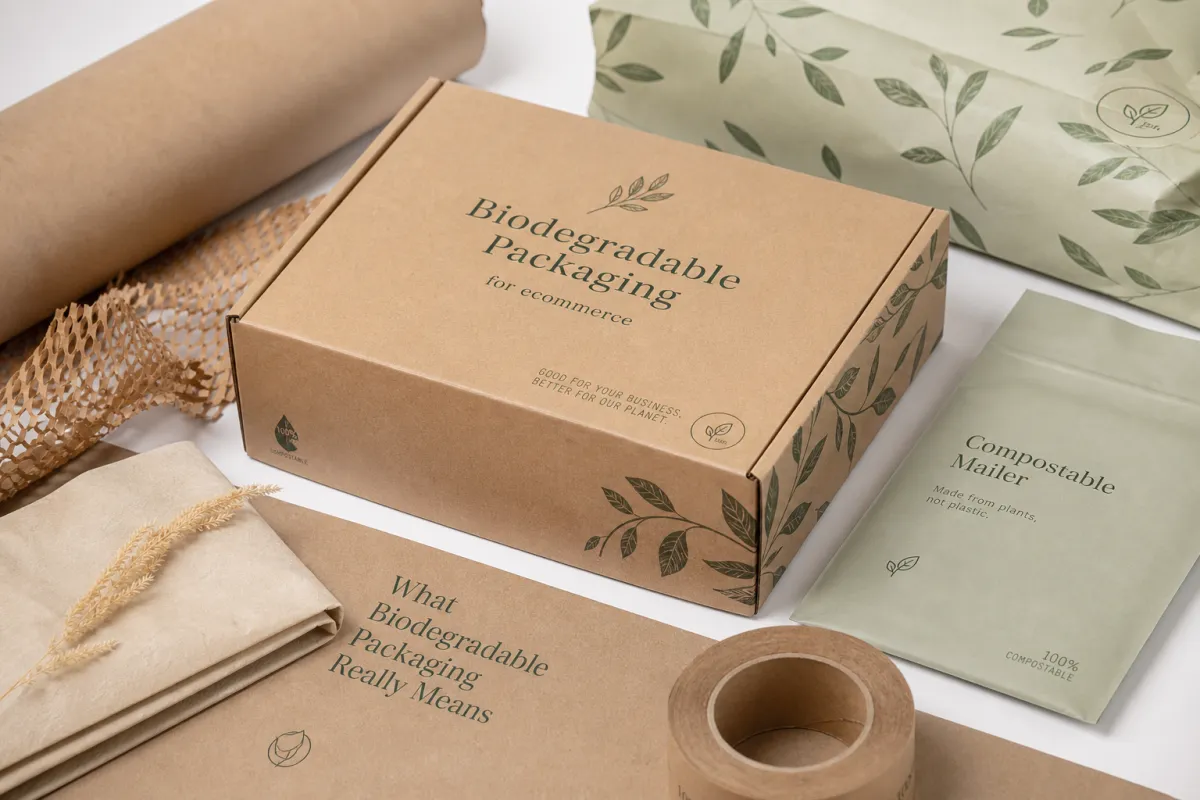
Biodegradable packaging for ecommerce means the package can be broken down by microorganisms into simpler compounds over time. Plain-English version: the material can decay. The part people skip is the fine print. “Biodegradable” does not tell you where that happens, how fast it happens, or what conditions make it happen. A mailer may be technically biodegradable in a controlled lab and still be a terrible fit for shipping, storage, or customer disposal habits. I have seen suppliers wave around a broad sustainability claim like it settles everything. It doesn’t.
Buyers get tangled up because biodegradable, compostable, recyclable, and recycled content do not mean the same thing. Biodegradable packaging for ecommerce can overlap with compostable materials, but compostable usually follows stricter standards and a more specific disposal path. Recyclable means a material can enter a recycling stream, but only if local facilities actually take it. Recycled content means the package contains recovered material, which says nothing about how it breaks down later. Those are different claims, and mixing them up is how brands end up with awkward customer service scripts and, worse, shaky marketing language.
That distinction matters because marketing language is cheap. Performance is not. For biodegradable packaging for ecommerce, the main material might be kraft paper, molded fiber, plant-based film, or corrugated cardboard with a bio-based component. If the adhesive is synthetic, the barrier coating is persistent, or the label stock is wrong, the claim gets muddy fast. I would rather see a modest claim that can be defended than a big sustainability promise nobody can prove. That’s not cynicism. That’s just basic risk management.
Disposal reality gets ignored way too often. Some materials only break down in industrial composting conditions, not in a backyard pile and definitely not in a landfill with limited oxygen. Other materials degrade slowly when moisture, microbes, oxygen, and heat line up, but that does not mean a customer should expect them to vanish in a few weeks. Biodegradable packaging for ecommerce is less about wishful thinking and more about matching the material to the disposal path. If the package can only work under specific conditions, say that clearly. Customers deserve the truth, not a fuzzy promise.
If you are vetting suppliers, ask for specific standards and test methods instead of vague language. For compostable claims, ASTM D6400 and ASTM D6868 are part of the conversation. In some markets, EN 13432 matters as well. For paper-based material sourcing, FSC certification matters more than many buyers realize. The point is not to sound technical for sport. The point is to make sure biodegradable packaging for ecommerce is something you can defend when someone asks a direct question. And someone will ask. Probably a customer first, then a buyer, then legal.
Simple rule: if a vendor cannot explain what happens to the adhesive, coating, and print system, the package is not ready for a serious sustainability claim.
How Biodegradable Packaging for Ecommerce Breaks Down
Biodegradable packaging for ecommerce breaks down through heat, moisture, oxygen, microbes, and time. Leave one out and the process slows down a lot. That is why a package can behave one way in a compost facility and a completely different way in a warehouse or landfill. The environment does the work, not the label. Packaging people love to talk about material science until it gets inconvenient. Then suddenly it is “eco” and everybody hopes for the best.
Home compost and industrial compost are not interchangeable. Home compost systems usually run cooler and less consistently, so only some materials will break down well there. Industrial composting can reach higher temperatures and more controlled conditions, which is why certain compostable materials are designed for that route. Landfill is the least friendly environment for degradation because oxygen is limited and layers of waste bury the material. Curbside recycling is a separate path entirely; biodegradable packaging for ecommerce only belongs there if the full material structure fits local recycling rules, which often does not happen. The EPA has a useful overview of composting basics here: EPA composting guidance.
The trouble usually starts with the extras. Inks, labels, barrier coatings, and mixed-material laminations can slow degradation or stop it altogether. A paper mailer may look harmless, but a glossy coating or pressure-sensitive label can change the whole disposal story. The same issue shows up with fiber inserts wrapped in film that nobody mentioned during procurement. Biodegradable packaging for ecommerce should be reviewed as a system, not as one hero material with a nice marketing line. I’ve sat in review meetings where everyone admired the outer shell and nobody asked about the liner. That’s how you end up with a claim that sounds cleaner than the actual package.
Different ecommerce formats behave differently. Mailers need tear strength and some moisture tolerance. Void fill needs resilience without turning into a mountain of waste. Wraps need flexibility and enough surface integrity to survive conveyor handling. Protective inserts need structure, compression resistance, and dimensional consistency. If the package fails too early, the customer blames you, not the compost pile. Fair or not, that’s the reality. Packaging gets judged by the worst moment in the journey, not the spec sheet.
The practical lens is simple. Ask how long the package needs to last in transit, then ask what condition it will meet after the box is opened. Biodegradable packaging for ecommerce should survive the shipping window first. A material that degrades too early is just bad packaging with green branding. A lot of brands spend months trying to sound responsible and then undo the whole effort because the mailer gets soggy in a humid route. That is not progress. That is an expensive lesson.
Shipping reality: if the package will move through humid trucks, unconditioned warehouses, or cross-country routes, test it for more than the ideal scenario on a spec sheet.
Cost and Pricing Factors You Need to Budget For
Biodegradable packaging for ecommerce is usually priced badly when people stare at unit cost and stop there. That is how teams get tricked by a cheap quote that looks great for five minutes and then falls apart once freight, storage, sampling, and waste are added. The number that matters is landed cost per shipped order. That shows what You Actually Pay after the package leaves your dock and reaches the customer. If a quote ignores that, it is not a real quote. It is a teaser.
Material choice drives a lot of the price gap. Plain kraft paper mailers are usually less expensive than molded fiber inserts or custom-fit structures. Heavy print coverage can add cost because inks, setup, and drying requirements change. Barrier coatings, water resistance, custom sizes, and special certifications can push the price higher again. Biodegradable packaging for ecommerce can be affordable, but it is rarely the cheapest option on a basic quote sheet. The cheap thing often gets expensive in the warehouse, and then more expensive again when it damages goods in transit.
MOQ matters more than most buyers expect. At low volumes, setup cost per unit gets ugly fast. At higher volumes, unit price improves, but only if the design stays stable and your forecast is decent. Sample fees are common. Tooling fees show up with custom molds or specialty inserts. Freight can eat the savings if the format ships poorly. Order the wrong size and sit on excess inventory, and the “green” packaging turns into expensive dead stock. I know that sounds boring. It is. It is also where budgets go to die.
For a realistic snapshot, here is how pricing often looks at around 5,000 units, depending on print coverage, spec, and freight:
| Format | Typical Unit Range | Best Use | Main Tradeoff |
|---|---|---|---|
| Kraft paper mailers | $0.18 - $0.42 | Apparel, soft goods, light accessories | Less structure for fragile products |
| Custom printed boxes | $0.45 - $1.20 | Brand-forward ecommerce shipments | Higher freight and storage impact |
| Compostable tissue or wraps | $0.03 - $0.10 | Presentation and light protection | Needs pairing with stronger outer packaging |
| Molded fiber inserts | $0.18 - $0.60 | Fragile electronics, glass, premium goods | Tooling and setup can be significant |
| Plant-based cushioning or void fill | $0.10 - $0.40 | Protection for mixed-SKU shipments | Bulky and less elegant for branding |
That table is directional, not a quote. Still, the pattern is clear. Biodegradable packaging for ecommerce often costs more where structural performance or custom print is involved, and it can save money where a tighter fit replaces oversized packaging. A better-sized mailer can reduce DIM weight, which matters more than many buyers admit. Smaller cartons also reduce void fill. Less empty space means lower shipping cost and fewer damage claims. That’s the part people tend to miss while they are busy debating whether the box looks “premium enough.”
Ask vendors what the quote includes. Is print one side or two? Is freight included? Is there a charge for plates, dies, or molds? Are samples credited back if you place the order? Can they support repeat runs without changing the material blend? Those questions sound boring. They are also the difference between a clean rollout and a budget surprise. If you have ever had to explain a 12% overrun because the truck freight changed and the second sample wasn’t included, you know exactly what I mean.
For teams comparing formats side by side, it helps to map the packaging against the shipped order, not the warehouse shelf. A strong branded packaging decision keeps product packaging, cost, and claim integrity in balance. If you need a starting point, compare options through Custom Packaging Products and then pressure-test the numbers against your actual order mix.
How to Choose the Right Material and Format
Start with the product, not the packaging trend. That sounds obvious, yet people still buy biodegradable packaging for ecommerce because it looks nice on a mood board and then act shocked when the item arrives dented. Weight, fragility, moisture sensitivity, shipping distance, and return rate should drive the spec. Packaging design should protect the product first and support the brand second. If it does both, great. If it only looks sustainable, you have a display piece, not packaging.
Climate matters more than many teams think. A package that holds up in a dry, mild region may behave badly in humid lanes or in warehouses with temperature swings. Corrugated cardboard can be a strong base for many ecommerce programs, but the flute, liner, and coating all affect performance. Kraft paper works well for many soft goods and accessory shipments, but it is not a cure-all. Molded fiber is strong for protection and presentation, yet it adds tooling complexity. Plant-based films may help with flexibility, but they need careful evaluation for moisture and seal performance. Biodegradable packaging for ecommerce is a material choice and an operations choice at the same time.
Branding goals should change the spec, not bulldoze it. If the unboxing moment matters, custom printed boxes can carry the visual story better than plain mailers, but they also cost more and take more planning. If the brand wants a lighter, natural look, kraft paper and restrained print coverage can feel honest and still look premium. If the product is fragile, a molded insert may be worth the extra tooling because it cuts breakage. The right answer depends on what you are shipping and what your customer expects. There is no prize for pretending every product needs the same package.
Claim-checking matters here too. Ask what can be claimed on the package itself, what can live on the website, and what cannot be promised at all. If a package is compostable only in industrial facilities, say that clearly. If the paper is FSC-certified, say that accurately. If the package is made with recycled content but is not biodegradable packaging for ecommerce in the way customers assume, do not blur those lines. FSC’s certification framework is a good reference point for responsible fiber sourcing: FSC certification information. Honestly, a clean and narrow claim is usually stronger than a shiny one.
Here is a simple short list I use when matching material to format:
- Soft goods: kraft paper mailers, paper wraps, light tissue, and minimal void fill.
- Fragile goods: corrugated cardboard with molded fiber inserts or engineered paper cushioning.
- Premium gift-style shipments: custom printed boxes, branded tissue, and restrained interior presentation.
- Moisture-sensitive items: carefully tested coatings, tighter sealing, and honest disposal claims.
Ask for certification and test documentation before you commit. Not all suppliers keep clean paperwork, and not every claim is backed by the same standard. Biodegradable packaging for ecommerce should be selected with a file folder in mind, not just a design deck. That is how you avoid explaining a weak claim later to a customer service team that did nothing wrong. It also keeps procurement from having to play detective six months down the line.
Rollout Timeline: From Samples to Shipping
A smart rollout for biodegradable packaging for ecommerce usually starts with a brief, not an order. The brief should define the product weight, dimensions, ship zone, print needs, and the claim you want to make. Then you move to samples. That sounds slow, and honestly, it should be. Sample before you promise. Test before you print. Ship before you scale. The fastest teams I know are usually the ones that took the time to be annoyingly specific at the start.
For a straightforward project, the path from brief to first production run is often 3 to 8 weeks. Custom printed boxes with new tooling or specialty inserts can take longer, especially if you need structural samples, revised artwork, or certification checks. The details matter because packaging is not just a design file. It is a physical object that has to survive production, freight, warehouse handling, and delivery trucks. Biodegradable packaging for ecommerce adds another layer because the claim itself needs proof. A pretty mockup is nice. It is not a substitute for a real object moving through a real supply chain.
Delays show up in predictable places. Artwork approvals slow things down when the brand team wants one more tweak to the logo size. Sizing issues show up when the product measurements were “close enough” instead of exact. Certification review takes time if the vendor has to pull documentation. Supply chain lead times stretch if the material is imported or made in a small batch. And yes, if everyone waits until launch week to think about this, the timeline will be ugly. Gonna be ugly, actually. That is not me being dramatic. That is just how packaging projects work.
A phased rollout is usually safer than flipping the whole store at once. Start with one SKU or one order tier. A pilot might cover 500 to 2,000 units, depending on sales volume and the number of shipping lanes. Use that run to verify fit, unboxing, print quality, and damage rates. If the package is for a premium product line, test it with real handling conditions instead of babying it in-house. Biodegradable packaging for ecommerce should be judged under actual stress, not only under office lighting. A box that looks perfect on a conference table can still fail in a trailer in August.
For testing, I would build in three checks before launch:
- Drop and compression tests: run basic transit abuse checks or a standard aligned with your freight profile. ISTA test methods are a common reference point for package testing; see ISTA testing standards.
- Moisture and handling checks: simulate humid storage, a rainy delivery window, or cold-to-warm transitions if those are realistic for your route.
- Internal sign-off: get operations, brand, and customer support aligned on the disposal claim and the customer-facing language.
That last piece gets skipped too often. The package might be technically sound, but if customer support cannot explain what happens after disposal, the rollout is incomplete. Biodegradable packaging for ecommerce works best when operations, branding, and the website tell the same story. Otherwise you are just paying extra to create confusion. And confusion is expensive. It shows up as support tickets, returns, and awkward emails from people who thought “eco-friendly” was supposed to answer everything.
Common Mistakes with Biodegradable Ecommerce Packaging
Greenwashing language is the fastest way to lose trust. If the quote says “eco-friendly” and nothing else, keep walking. Biodegradable packaging for ecommerce needs specific claims, specific standards, and specific disposal instructions. Vague language sounds nice and answers nothing. Customers notice that faster than brands think. Regulators do too, and they are not in a mood for poetic packaging copy.
The second mistake is choosing packaging that looks sustainable but fails in the shipping lane. A thin mailer that tears, a paper sleeve that absorbs moisture, or a box that crushes under stacking pressure will cost more than the greener material ever saved. Returns, replacements, and support tickets eat margins. That is why product packaging should be tested as a protective system, not judged on appearance alone. A pretty box that arrives mangled is a bad box. Full stop.
Mixed materials create another headache. Paper bonded to a non-recyclable film, labels with aggressive adhesive, or inserts assembled with the wrong coating can make biodegradable packaging for ecommerce much harder to dispose of correctly. This is where package branding and operations collide. The brand wants a polished finish. The materials team wants a package that can actually be processed. Someone has to win, and the winner should be reality. Not the mood board.
Customer behavior is the final weak link. Not everyone reads disposal instructions. Not everyone has access to composting. Not every city accepts the same materials. If your customer base is spread across regions with different waste systems, the package claim has to be honest enough to survive that inconsistency. You cannot assume the same outcome for every order just because the packaging looks clean on a landing page. That is the sort of assumption that sounds tidy and turns messy in the real world.
Here are the mistakes I see most often:
- Claiming too much: calling a package compostable or biodegradable without proof from the supplier.
- Ignoring coatings: forgetting that a film layer or finish can change the disposal path.
- Picking the wrong format: using a sustainable material that cannot handle the product’s weight or moisture exposure.
- Skipping disposal language: leaving customers to guess what to do after unboxing.
- Buying on unit price only: forgetting freight, damage, and inventory carrying cost.
There is also a sneaky branding mistake. Some teams make the outer box too plain, then try to carry all the brand personality in the website copy. That can work, but it often weakens the unboxing moment. Better to align the material, print style, and claim language so the packaging itself feels intentional. Good packaging design does not scream sustainability. It makes the choice look considered. Quiet confidence beats a loud moral speech every time.
Practical test: if a customer picked up the used package and asked, “What exactly do I do with this?”, your answer should be short, true, and specific.
Expert Tips and Next Steps for a Smart Pilot
My strongest advice is simple: start small. Pick one product line, one packaging format, and one success metric. If you try to fix every shipping problem, every brand complaint, and every sustainability goal in a single rollout, you will end up with a bloated project and a very tired team. Biodegradable packaging for ecommerce is easier to manage as a controlled pilot than as a grand announcement. Big rollouts look impressive right up until the first damage report lands.
For most brands, a good pilot includes real shipping tests, a few customer feedback points, and a damage-rate comparison against the current packout. If breakage drops, great. If the package costs a little more but cuts returns or improves repeat purchase sentiment, that can still be a win. Biodegradable packaging for ecommerce should be judged on total program value, not only on whether the material sounds more responsible in a meeting. A package that saves one refund and one replacement shipment can pay for a surprising amount of material difference.
The best package is usually the one that protects the product, keeps the claim defensible, and does not create a disposal headache for the customer.
If you are building a rollout plan, ask these questions before you place the order:
- What exact standard supports the claim?
- What happens to the adhesive, coating, and label?
- Can the package survive humidity, stacking, and rough handling?
- What is the landed cost at my actual order volume?
- Can customer support explain the disposal path in one sentence?
Then request samples and test them with real products. Do not use a light demo item if your actual SKU weighs twice as much. Do not test in perfect office air if your fulfillment center runs hot and dry. And do not approve a finish just because it looks premium under showroom lighting. Biodegradable packaging for ecommerce has to earn the right to go live. It also has to keep earning it after the first truck leaves the dock.
If you are comparing structures, a focused sourcing session through Custom Packaging Products can help you narrow down options for branded packaging, custom printed boxes, and more durable retail packaging formats. That is usually better than buying ten different things and hoping one of them works. Hope is not a sourcing strategy.
One last note: make your rollout checklist boring and specific. Include dimensions, substrate, print method, standard, sample approval, transit test, moisture check, disposal copy, and reordering trigger. Boring checklists save money. Fancy slogans do not. That checklist is also your best defense if someone six months later asks why the package was chosen in the first place.
Biodegradable packaging for ecommerce can be a strong choice, but only if the material, claim, cost, and shipping reality all line up. Treat it like a packaging system instead of a trend, and you will make better decisions, fewer promises, and fewer expensive mistakes. If you need one takeaway to carry into the next supplier call, make it this: pick the format that survives transit, supports a claim you can defend, and fits the disposal route your customer can actually use. Everything else is decoration.
Frequently Asked Questions
Is biodegradable packaging for ecommerce better than compostable packaging?
Not always. Biodegradable packaging for ecommerce means the material can break down over time, but compostable packaging usually follows stricter standards and clearer disposal conditions. If you want a defensible claim, verify the exact standard, the certification, and the disposal path Before You Buy. The right choice depends on where the package will actually end up. A material that sounds greener on paper can be less useful in practice.
How long does biodegradable ecommerce packaging take to break down?
It depends on the material and the environment. Heat, moisture, oxygen, and microbes all change the timeline. Some materials are built for industrial composting and can break down there much faster than they would in a landfill. Do not promise a quick timeline unless the material and disposal conditions support it. Biodegradable packaging for ecommerce is not a magic disappearing act, no matter how slick the brochure looks.
What does biodegradable packaging for ecommerce usually cost?
Expect a range, not one neat number. The total cost depends on substrate, print coverage, MOQ, freight, storage, and waste. Simple mailers and wraps are usually less expensive than molded inserts or custom-fit structures. The smartest comparison is landed cost per shipped order, not unit price alone. If someone only gives you a unit number, keep asking questions.
Can biodegradable packaging protect fragile ecommerce products?
Yes, if the format is matched to the product. Fragile items need structure, compression resistance, and real transit testing. A sustainable material label does not protect glass or electronics by itself. Use drop testing, compression checks, and real shipping routes before you commit to a full rollout of biodegradable packaging for ecommerce. Otherwise you are just dressing up risk.
How should I test biodegradable packaging before switching my store?
Start with samples, then run shipping tests using real products, real routes, and real handling conditions. Check for damage, print durability, moisture resistance, and customer feedback after unboxing. Pilot one SKU first, measure returns and breakage, then scale only after the numbers look good. That is the safest way to evaluate biodegradable packaging for ecommerce without turning your launch into a lesson.


