Buyer Fit Snapshot
| Best fit | Biodegradable Packaging Manufacturer projects where brand print, material claims, artwork control, MOQ, and repeat-order consistency need to be specified before quoting. |
|---|---|
| Quote inputs | Share finished size, material target, print colors, finish, packing count, annual reorder estimate, ship-to region, and any compliance wording. |
| Proofing check | Approve dieline scale, logo placement, barcode or warning zones, color tolerance, closure strength, and carton packing before bulk production. |
| Main risk | Vague material claims, crowded artwork, missing packing details, or unclear freight terms can make a low unit price expensive after revisions. |
Fast answer: Biodegradable Packaging Manufacturer: Quote Scope, Sample Proof, MOQ, and Lead Time should be specified like a repeatable production item. The safest quote records material, print method, finish, artwork proof, packing count, and reorder notes in one written spec.
Production checks before approval
Compare the actual filled-product size with the drawing, then confirm tolerance on folds, seals, hang holes, label areas, and retail display edges. Reserve space for logos, QR codes, warning copy, and material claims before decorative graphics fill the panel.
Quote comparison points
Review material grade, print process, finish, sampling route, tooling charges, carton quantity, and freight assumptions side by side. A quote is only useful when the supplier can repeat the same color, closure quality, and packing count on the next order.
Biodegradable Packaging Manufacturer: The Cost-Truth Guide
One startup picked a glossy biodegradable bottle line because the sample photos looked premium, then the launch got stuck fast: shelf-life assumptions from the supplier clashed with actual warehouse humidity, cartons stacked past recommended density, returns spiked, and the Budget That Looked safe turned into damage-control mode. I keep seeing this pattern because teams treat a biodegradable packaging manufacturer like a decorator, not a systems partner. A strong partner is where chemistry, conversion behavior, and legal claims hold together instead of fighting each other. If that alignment fails, your brand gets the reputational hit and the procurement team gets the bill.
Here is the practical test: if a supplier cannot explain resin behavior, process window, and certification path in plain terms, pause and reset. A biodegradable packaging manufacturer should separate biodegradable, compostable, and recyclable paths before artwork is finalized, because classification errors cause rework, repeat testing, and redesign loops that nobody wants to pay for. For teams handling branded packaging, Custom Printed Boxes, retail packaging, or product packaging, material choices affect much more than a sustainability claim—they change seal integrity, print adhesion, freight damage tolerance, and inventory carry-over.
Think in four filters only: environmental intent, functional performance, commercial feasibility, and legal defensibility. Miss one and the whole case weakens. A biodegradable packaging manufacturer can still be the right partner when your brief is sharp and tied to product behavior, channel constraints, and a realistic test plan. That is where "looks sustainable" stops and "defensible in operations and law" starts.
The biodegradable packaging manufacturer reality check that surprises most buyers
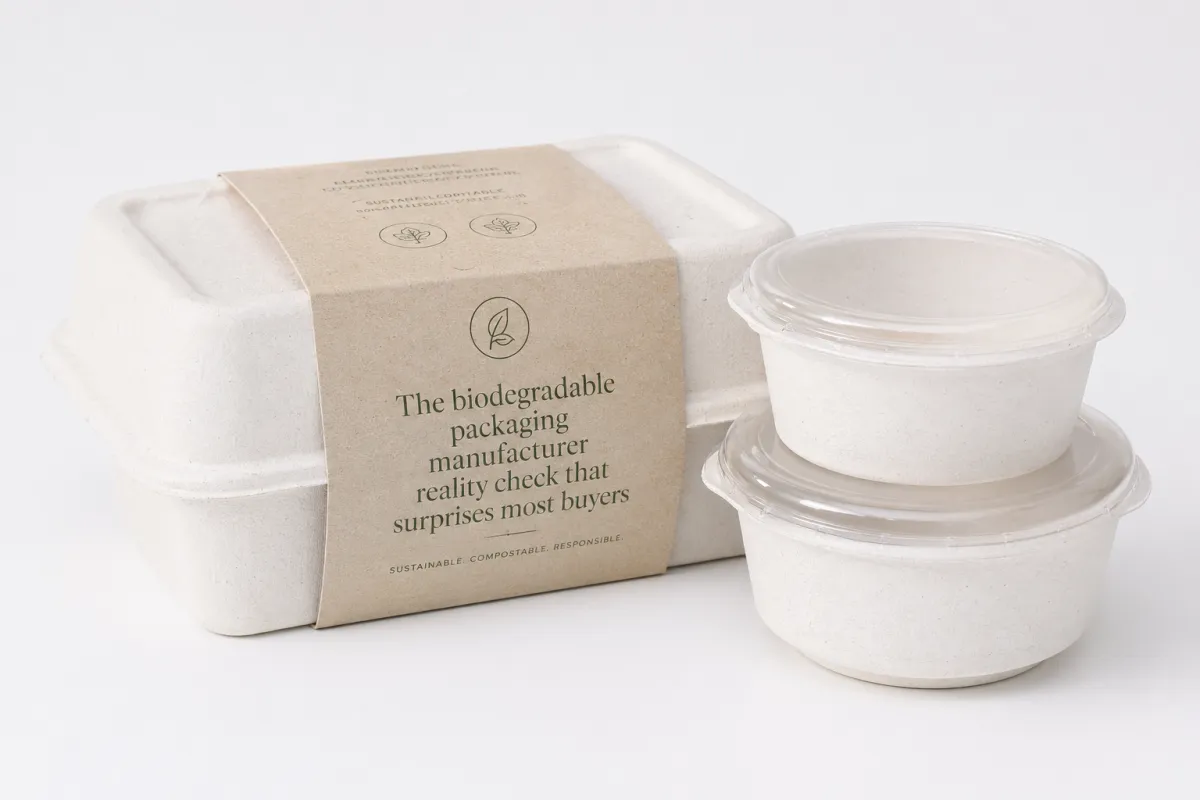
Most buyers hear biodegradable packaging manufacturer and assume the strategy is basically done. It is not. Some materials break down quickly under controlled conditions and then behave less politely in real transport and storage environments. A film that passes one compost protocol may fail under different humidity, and a moldable sample that impressed in a showroom can lose rigidity after a few weeks in a warm warehouse.
Vocabulary is where the first tripwire appears. Biodegradable means the material can be broken down biologically over time. Compostable means it meets agreed criteria for disintegration, biodegradation, and ecotoxicity under defined conditions. Recyclable means it can go into a recovery process where quality is preserved for reprocessing. A capable biodegradable packaging manufacturer should explain those differences without sounding fuzzy.
That distinction gets expensive when people forget it in the RFP. A request that says "eco-friendly bottle" is basically a shopping list with no measurements. One supplier quotes PLA blends, another starch compounds, another coated paper. Prices and timelines become impossible to compare unless the brief includes barrier targets, fill weight, shelf-life needs, temperature profile, and exact claim language. A biodegradable packaging manufacturer cannot give you a clean commercial read without that level of input.
Most teams should stop asking if the move is "green enough" and start proving whether it is operationally rational. A biodegradable packaging manufacturer partnership earns a spot if it answers the four checks consistently:
- Is the disposal route realistic for the geographies and customer behaviors you actually serve?
- Will the structure protect the product through transport, display, and consumer handling?
- Can the economics absorb MOQ, tooling, and lab work without a painful margin tax?
- Can legal, sustainability, and sales teams defend claims with one version of the truth?
If any answer is uncertain, the concept is still in discovery mode, not procurement-ready. A biodegradable packaging manufacturer delivers value only when material behavior, packaging performance, and claim behavior line up. Otherwise teams pay for a sustainability narrative without hard proof.
A supplier may be technically compliant and still fail in the real world when shelf performance, transit handling, or claim auditing breaks in practice.
Timeline expectations are the next blind spot. A biodegradable packaging manufacturer usually needs a longer validation cycle than standard print-and-pack routes: shelf-life studies, migration checks, drop and vibration tests, seal validation, and artwork sign-off each add friction if done properly. Teams that assume a normal carton schedule often face avoidable delays and then discover the supplier wasn't to blame.
What does a biodegradable packaging manufacturer do from resin to regulation filing?
The chain starts at raw materials. Depending on format, the menu often includes PLA, PBAT blends, starch-based compounds, cellulose, molded fiber, and coated kraft structures. Each option has a distinct moisture profile, thermal tolerance, and print compatibility. A supplier with conversion strength but weak formulation expertise can create very pretty pilot pieces and still lose control during scale-up.
Next comes compounding, where resin, stabilizers, and additives are tuned for toughness, flexibility, runnability, and visual appearance. Then the material moves into film extrusion, injection molding, thermoforming, coating, lamination, or paper conversion. A strong biodegradable packaging manufacturer should say clearly which steps are in-house and which are subcontracted, because each handoff increases variation risk.
In-house development matters when the program needs tight barrier control, repeatable sealability, or better print anchoring. A personal-care pouch often needs a seal window that matches production speed without causing seam failures. A food-service tray may need stiffness without brittle cracking under impact. A biodegradable packaging manufacturer with joint development resources can usually cut failure loops faster than a provider that only converts submitted drawings.
Manufacturing method choice sets the limit of what can be promised. Film extrusion supports flexible formats, liners, and wraps. Injection molding handles closures, inserts, and rigid parts. Thermoforming supports trays and clamshells. Coating and lamination are often essential for moisture and oxygen control, which are the two issues that sink most biodegradable programs. A biodegradable packaging manufacturer that cannot manage these methods may still work for simple packages but not for high-barrier or shelf-stable needs.
Performance is made in process, not PowerPoint. Moisture barriers affect shelf life. Tensile strength governs drop resistance. Heat stability determines whether a bottle warps in transit and whether a tray softens in hot-fill use. Print adhesion determines if graphics survive condensation and handling in distribution. If packaging is tied to a brand system, material design has to protect both product safety and brand expression. That is why sourcing, quality, and brand teams should review together.
Responsibility does not end at the factory gate. A biodegradable packaging manufacturer usually owns resin selection, conversion execution, and certificate-backed test data for the selected SKU. Buyer-side teams still own artwork governance, shelf studies, claims language, and post-launch surveillance. For food, pharma, and some home-care products, contact safety and local labeling compliance remain buyer responsibilities with legal oversight; a supplier can support, not replace your compliance decision.
That boundary is where confusion explodes. Teams assume vendors can "handle compliance" from start to finish, then discover each market has different proof points. For kraft sleeves, chain-of-custody documentation can be decisive. In molded fiber trays, fiber-source declarations can matter. In flexible films, thickness, coating type, and inks can shift legal interpretation. A biodegradable packaging manufacturer can guide, but discipline in documentation is still a team duty.
Key factors in a biodegradable packaging manufacturer partnership
First stop: certificate hygiene. A biodegradable packaging manufacturer may have a valid certificate for one resin family, then quote another formulation under the same project name. That mismatch is a silent deal killer. Test reports must match exact SKU, thickness, and processing conditions, not just a reference sample. Accreditation is evidence, not decoration.
Standards language is often under-read, so use care. In many projects teams reference ASTM D6400, ASTM D6868, EN 13432, or ISO 17088 for compostability and biodegradation claims depending on format and market. For transport resilience, ISTA methods become critical, especially in retail packaging with multiple handling stages. For claim consistency, epa.gov is a helpful baseline and ista.org offers practical transport testing structure. A biodegradable packaging manufacturer fluent in these references understands the gap between lab pass rates and production realities.
Second, compare process control before marketing language. Ask how they track batch traceability, melt index, moisture control, print variation, and reject segregation. A biodegradable packaging manufacturer with a clean visual brand can still produce inconsistent outcomes if traceability is weak. When complaints happen, you need a root cause path: lot A material, line shift B, or a design change that skipped change control.
Third, compare capacity and geography side by side. Specialty biopolymers are not always as easy to source as generic materials. Single-source resin or coating dependencies can turn into shortages, port congestion, or allocation delays before you see them. A dependable biodegradable packaging manufacturer should outline fallback suppliers, dual-source pathways, and explicit lead-time buffers. If that conversation is vague, schedule resilience should be treated as an open risk, not a small note.
Communication matters as much as capability. Fast response to nonconformance reports and clear corrective action plans reduce hidden delay cost more than a lower quoted setup fee. A biodegradable packaging manufacturer that follows a defined service rhythm tends to reduce launch turbulence better than one that is cheap and silent. Response speed and corrective transparency are operational capabilities, not communication style.
Use this scorecard when comparing alternatives:
| Evaluation area | Strong signal | Risk signal | Why it matters |
|---|---|---|---|
| Certifications | Current, SKU-specific, test-house backed | Generic brochure badges | Protects legal and claims review |
| Manufacturing method | Clear line ownership for film, molded fiber, or thermoforming | Vague "we can make it" claims | Predicts consistency and scale limits |
| Traceability | Batch genealogy, lot records, change control | Manual notes and missing samples | Speeds root-cause analysis |
| Commercial support | Response SLAs, re-run protocol, escalation path | Slow replies and no owner names | Reduces launch delay risk |
Apply the same rigor to conventional alternatives too; the scorecard logic does not disappear if your first supplier has a green badge and a loud website. Price matters, but price without process control is a weak benchmark and usually a hidden risk. If you are still validating structure, the portfolio at Custom Packaging Products helps frame concrete questions around material choice, print complexity, and fulfillment pressure. For context on operational style and execution posture, the background at About Custom Logo Things gives a better sense of how the team works.
Step-by-step process and timeline with a biodegradable packaging manufacturer
The journey usually starts with discovery. In the first one to two weeks, a biodegradable packaging manufacturer should lock use case, target market, claim intent, volume bands, and key performance thresholds. That means clarifying whether the pack is for food, beauty, or household channels; whether shelf life, visual finish, or disposal claim carries the most weight; and whether production starts in a controlled line or multiple plants.
Formulation and sample development often take two to four weeks, depending on format. A biodegradable packaging manufacturer can run several variants using different wall profiles, barrier stacks, and print systems. This is the right stage for accelerated aging, heat resistance checks, drop tests, and decomposition checks where relevant. Skip this and failures move into full production, where recovery is expensive and loud.
The pilot loop commonly runs one to three weeks on stable programs, longer for complex geometries. The goal is not a pretty sample book. The goal is sustained production behavior at realistic speed, temperature, and uptime. A biodegradable packaging manufacturer should define pass/fail gates before pilot start: dimensional tolerance, seal integrity, visual consistency, and breakage rate. Version control for design and process changes prevents endless rounds of rework when QA and design are not aligned.
Tool validation and ramp-up follow once pilot stability is proven. In custom tooling projects, suppliers must demonstrate performance across expected machine speeds and temperature bands. A capable biodegradable packaging manufacturer should present a clear gate path: first article approval, process validation, quality release, and production sign-off, each with one owner, one source document, and one date. That sounds bureaucratic, but it is cheaper than a full-scale reset.
Complexity shifts timing more than nearly any other factor:
- Simple label replacement: often 6-8 weeks when baseline package history is already validated.
- Rigid insert or tray: often 8-12 weeks due to tooling and fit iterations.
- Flexible pouch: often 8-14 weeks when barrier and seal performance need iterative tuning.
- Custom rigid geometry: often 10-16 weeks when molds, print registration, and drop resistance demand tuning.
Delay patterns repeat across most teams. Artwork changes after proofing, lab failures addressed by changing too many variables at once, and final price comparisons done too late often force fresh tooling quotes and restart cycles. A biodegradable packaging manufacturer can reduce part of that mess, but it cannot solve it alone.
Pause points need to be explicit from day one. If barrier performance misses target, stop and redesign. If pilot scrap breaches tolerance, reset before scale. If claim language remains vague, bring legal in before campaign materials and sales collateral lock. A biodegradable packaging manufacturer is most useful when teams know when to pause, not when to force the line to run with unresolved assumptions.
One non-negotiable rule protects most buyers: never move from sample to launch unless changes between sample, pilot, and production are fully documented. That trail protects brand review, plant troubleshooting, and legal defensibility. A mature biodegradable packaging manufacturer accepts documentation and often welcomes it.
The real cost picture with a biodegradable packaging manufacturer
Direct materials are only the first layer. A biodegradable packaging manufacturer quote also bundles additives, coatings, print coverage, tooling, setup effort, and minimum order quantities. Barrier adjustments can move cost quickly. A kraft sleeve can stay in a moderate range, while high-barrier pouches and complex molded designs can move much higher. Buyers who compare only headline unit cost often miss the economics under the hood.
The fixed-versus-variable split is where budgets fracture. Tooling, prepress, die setup, and first-pass samples are fixed or semi-fixed. Scrap, freight, rework, and line changeovers move with volume and process stability. A biodegradable packaging manufacturer that models this split clearly helps teams predict true cost at 5,000, 25,000, and 50,000 units. Finance teams then understand why a lower unit price can still produce a higher all-in cost.
Unit cost only drops at volume inflection points if design is stable. A geometry change after second tool revision can trigger repeated tooling, delayed builds, and wasted production windows. A biodegradable packaging manufacturer can improve unit economics after the third cycle only when the specification is already tight enough for stable production. That is not theoretical; it is the same pattern we see on almost every pilot where late edits sneak in.
Compliance and audit spend needs separate tracking. Certification updates, annual revalidation, lab reruns, traceability systems, and claims review create recurring overhead. Teams often overlook these because they hide behind an initial quote line. A seasoned biodegradable packaging manufacturer usually flags these costs up front so procurement does not discover them after launch.
Use a switching model, not a unit-only model. Add redesign labor, artwork revisions, stock write-downs, extra QA support, line-side support, and realistic disposal assumptions. A two-cent unit reduction becomes irrelevant if returns rise by seven percent. A biodegradable packaging manufacturer should be evaluated on total economics, not a single number on day one.
Compare common formats with that lens:
| Format | Typical unit cost at 5,000 units | Strength / barrier profile | Best fit |
|---|---|---|---|
| Kraft paper sleeve with compostable coating | $0.12-$0.24 | Good print surface, moderate moisture resistance | Retail packaging, secondary wraps, branded packaging |
| Molded fiber tray | $0.18-$0.36 | Stiff and protective, lower barrier unless lined | Inserts, food service, transit protection |
| PLA-based flexible pouch | $0.22-$0.48 | Higher visual polish, barrier depends on structure | Dry goods, sample packs, light retail packaging |
| Custom molded rigid part | $0.30-$0.70 | Strong fit, tooling sensitive, higher setup burden | Closures, inserts, specialty product packaging |
These figures are directional, not promises. Actual quotes rise when ink layers are heavy, effects are metallic, tamper-evidence is required, or MOQ drops. The useful signal is how cost behavior changes as design requirements change. Buyers who track that pattern negotiate more realistically and avoid false savings.
Hidden cost traps hide in overspecified performance, late design direction, and premium visual choices that hurt conversion yield. Rare resin blends can also increase documentation load, testing volume, and legal review time. A biodegradable packaging manufacturer that recommends simpler architecture may look less flashy on launch week but usually performs better in total cost after three to six months.
Quick disclaimer: if you are in a regulated category, run these numbers with your compliance and legal team before making commitments, because legal acceptance and local disposal infrastructure can materially alter the business case.
Common mistakes buyers make with a biodegradable packaging manufacturer
The biggest mistake is treating marketing collateral as production validation. A biodegradable packaging manufacturer may show polished samples and certifications, yet nothing guarantees performance in your climate, line, and route-to-market. Independent data and pilot evidence matter more than polished brochures. Weak evidence leaves risk on your balance sheet.
A second error is pushing claim writing to the back end. Legal, sustainability, operations, and product teams should participate early. A biodegradable packaging manufacturer only manufactures what you specify; changing claims later often requires process or material shifts. A small wording adjustment can trigger seal and barrier changes if package architecture is affected.
Cheap tooling is another expensive habit. Teams chase the lowest mold or die quote, then absorb scrap spikes, quality failures, and rushed logistics when production starts. A biodegradable packaging manufacturer with stronger process discipline can justify a higher tooling quote because it often lowers scrap and raises consistency across time.
Regulatory nuance remains the recurring miss. Municipal compost acceptance is not the same as industrial certification, and a technically compostable structure can still fail local collection logistics. A biodegradable packaging manufacturer should only support broad claims after verifying both claim scope and market infrastructure.
Design teams frequently optimize appearance first and leave design-for-manufacturing for later. Overhangs, sharp folds, weak seam geometries, and decorative extras usually add scrap and reduce yield with little user value. A biodegradable packaging manufacturer might accept these designs, but production yields then drift. Early conversion engineering review prevents most of that pain.
Return economics are often under-modeled, especially in first-year programs. Teams applaud per-unit material savings while ignoring damage returns, reverse logistics, stock turnover, and buyer dissatisfaction. A three-cent saving can disappear when return rates move up. A biodegradable packaging manufacturer should be scored by outcomes, not just initial PO economics.
A sustainability move succeeds when it survives plant reality, shelf-life testing, and audit scrutiny without turning into a hidden cost sink.
Expert tips for long-term performance from a biodegradable packaging manufacturer
Use a three-layer due diligence approach: chemistry credibility, production capability, and commercial discipline. A biodegradable packaging manufacturer that passes only one layer is a partial solution, and partial solutions are where hidden costs grow. Resin logic, line readiness, and service structure must all align.
Ask for scenario-based proposals, not one-off quotes. A practical model should include 10,000, 50,000, and 100,000 unit volumes with explicit setup, waste, and freight behavior. If a biodegradable packaging manufacturer only gives one number, your forecast is probably blind in at least one direction.
Demand visible traceability. Ask for lot genealogy, version control on test reports, and shelf-life linkage between batches. A biodegradable packaging manufacturer with lot-level records supports faster complaint triage and cleaner root-cause analysis. You can tell instantly whether a quality issue sits in one run or is systemic.
Build a 90-day transition playbook. Include line-side training, quality cadence, and complaint triage. A biodegradable packaging manufacturer cannot absorb every operational handoff; it can reduce launch chaos if expectations and responsibilities are documented. Launch turbulence usually shows up in the first month, so rhythm matters.
Track return rate by shipment lane before and after conversion. This metric often surfaces issues that sales and margin dashboards hide. A biodegradable packaging manufacturer can improve your sustainability story while quietly weakening operations if packaging remains moisture-sensitive or transport-fragile. Lower return and lower rework are the clearest indicators of practical performance.
Keep a pre-qualified backup biodegradable packaging manufacturer. That is not alarmism; it is operational planning. A second-source option reduces single-point exposure when resin allocation tightens or transport lanes get hit. Redundancy is about continuity and schedule stability, not distrust.
For teams still deciding package architecture, connect supplier selection with brand planning. Branded packaging depends on print strategy, fulfillment flow, and retail behavior. If Custom Printed Boxes, corrugated cartons, and outer shippers are part of the program, build one system-level architecture rather than treating each component as a separate purchase order. Kraft structures, molded inserts, and outer protection can reinforce each other when designed together.
Honest note: I have seen strong design teams fail on this because they assume one excellent supplier will solve every gap. It is kinda naïve. No single partner can replace clear ownership for claims and quality governance.
Actionable next steps with a biodegradable packaging manufacturer
Start with one plain sentence. Define performance target, channel, shelf life, and claim intent in one line. Convert that into a one-page technical brief with dimensions, expected volumes, print coverage, storage conditions, and a measurable success metric. A biodegradable packaging manufacturer responds much faster to crisp requirements.
In week two, publish an RFP with explicit pass/fail criteria. Include strength, compostability or biodegradation requirements, print quality, setup fees, tooling ownership, and an acceptance test matrix. A biodegradable packaging manufacturer should be judged against that framework before samples begin. Ambiguity creates fuzzy quotes.
Run a controlled sample challenge in weeks three to four with at least two suppliers. Use weighted scoring for reliability, lab transparency, and change control—not just first quote price. A biodegradable packaging manufacturer that wins on those outcomes can still be the better long-term selection even with a slightly higher unit cost.
By month two, choose the preferred partner, lock revision limits, and define QA reporting cadence. Add written claim-approval workflows for legal and sustainability messaging. A biodegradable packaging manufacturer should actively contribute to implementation, while your team keeps final control of approvals, storage protocols, and sign-off schedule.
By month three, run a controlled pilot launch and measure return rate, defect trend, and complaint volume before scaling. A biodegradable packaging manufacturer relationship works best when launch is staged like a controlled experiment, not a blind rollout. That protects margin, lowers chaos, and gives your team time to improve instead of emergency-fixing at scale.
The bigger lesson is simple and practical: a biodegradable packaging manufacturer is a strategic operations partner, not a one-time sustainability checkbox. Pick it with the same seriousness you would pick a plant partner, and it can support compliance, brand consistency, manufacturing flow, and total cost at once. The quickest signal this is working is this: claims are defendable, performance is stable, and returns are not quietly climbing.
FAQs
How do you evaluate a biodegradable packaging manufacturer before placing the first order?
Start with at least three suppliers, same use case, same test matrix, same timeline, and same MOQ range. A biodegradable packaging manufacturer should return sample reports with failure thresholds, re-run protocols, and clear ownership for each approval step. Build a qualification checklist for certifications, lab capability, manufacturing method, and service discipline so the decision is evidence-based rather than preference-based.
What is a realistic cost model when using a biodegradable packaging manufacturer?
Separate one-time tooling and setup from recurring unit cost, then model three volume levels to capture conversion behavior. A biodegradable packaging manufacturer estimate should include compliance spend, audit cycles, and claim substantiation, because those obligations keep recurring. A contingency buffer of about 10-15% of pilot cost is usually realistic for revisions and scrap while the process stabilizes.
How long should a biodegradable packaging manufacturer project timeline be for pilot and mass production?
For straightforward formats, approved brief to commercial launch often runs around 6-10 weeks when prior validated history exists. Complex geometry or high-barrier requirements add 2-4 weeks for mold tuning, seal validation, and stability testing. A biodegradable packaging manufacturer should provide a gated schedule with explicit sign-off dates; missing gates raises delay risk.
How can you verify a biodegradable packaging manufacturer's sustainability claims before marketing them?
Demand independent reports tied to exact SKU, thickness, and intended disposal route—not generic claim bundles. A biodegradable packaging manufacturer should provide current, region-specific certifications and explain where each claim is legally valid. Route legal and sustainability review into artwork early and keep all supporting documentation in one audit-ready place.
Can a biodegradable packaging manufacturer reduce cost while keeping a strong environmental message?
Yes, if design-for-manufacturing starts early and architecture stays disciplined. A biodegradable packaging manufacturer can support cost improvements through larger runs, simpler constructions, and tighter tooling control. Savings are genuine only when return rates and rejection rates stay low after conversion, because a lower unit price is not a win if failures rise.
For packaging teams aiming to improve waste outcomes and keep operations in control, the smartest move is treating the biodegradable packaging manufacturer as core supply-chain infrastructure, not a decorative afterthought. That mindset turns sustainable packaging into a defendable operating choice that can actually run at speed, not just in a press release.

