For buyers comparing biodegradable poly mailers Lead Time and MOQ, the fastest way to narrow options is to define size, artwork, proof timing, freight method, and whether the order is a stock structure with print or a custom build. Simple mailers move faster; custom dimensions, broad print coverage, and certification language add coordination, and that affects schedule as much as cost. If you are still narrowing the format, the Custom Poly Mailers page is a useful reference for structure and sizing.
Biodegradable Poly Mailers Lead Time and MOQ: What Changes First
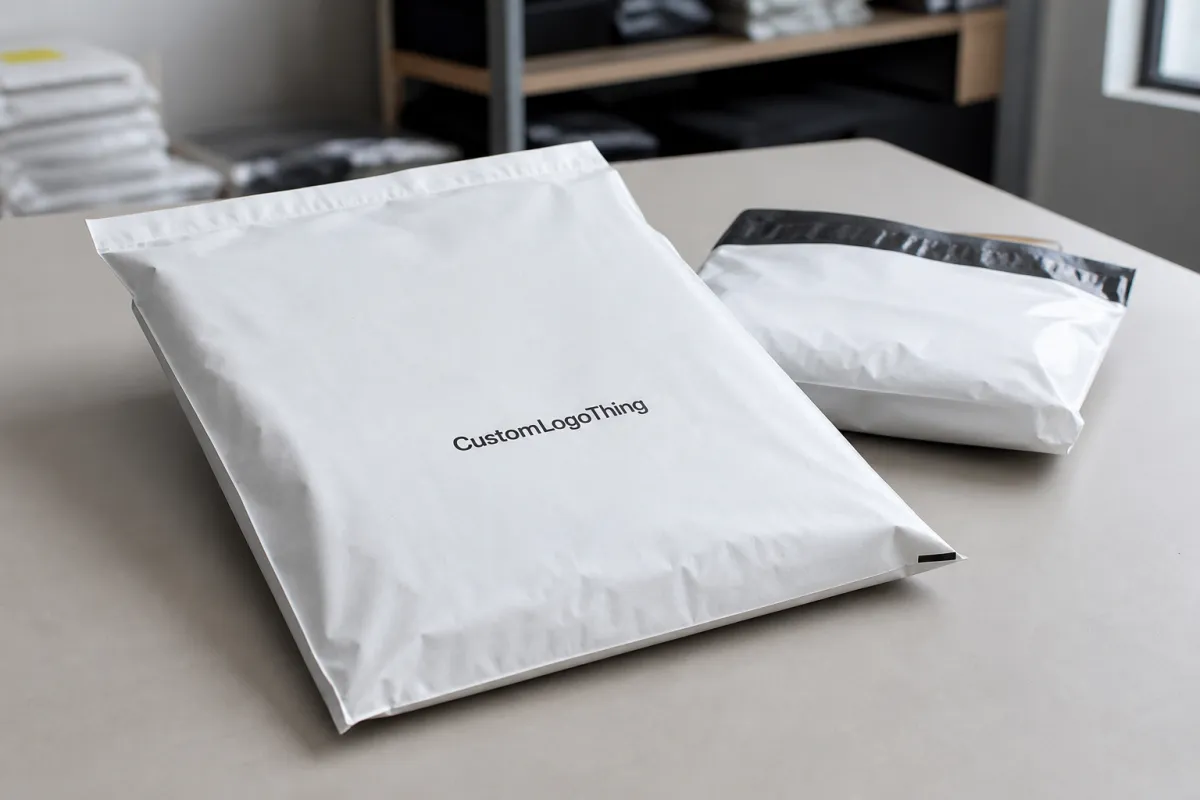
Lead Time and MOQ are driven less by the eco label than by the production choices behind it. The main delays are usually ordinary: waiting on artwork approval, confirming a nonstandard width, or adding print colors that need tighter registration. Those choices affect setup, waste allowance, and whether the job fits a standard production window.
Standard sizes with simple graphics are usually the quickest to approve and produce. A custom gusset, heavier film, or matte finish can add time because the factory has to recalibrate sealing, printing, and packing. Once the bag size, contents, and print scope are clear, the quote becomes much easier to trust.
A test order can still be efficient if the specs are close to a factory’s normal format. A larger run can still slow down if the artwork changes late or if the buyer wants a finish that needs extra inspection. For launch planning, the useful question is not how fast the bags can be made, but what combination of spec, proofing, and freight will actually arrive on time.
What the Mailer Is Made From and How It Performs in Transit
Most compostable or biodegradable mailers use a film system built around materials such as PBAT and PLA, or a related resin blend designed to meet a specific end-of-life standard. The important point is that the claim should be tied to evidence, not just print on the outer surface. Some materials are certified to ASTM D6400 or an equivalent compostability standard; others are only described as biodegradable under industrial composting conditions.
Ask where the material breaks down, under what conditions, and which part of the package is covered by the claim. A film can behave differently depending on whether the seal layer, printed layer, and additives are included in the certification paperwork. The EPA’s sustainable materials guidance is a useful reference when wording has to stay accurate.
Performance in transit still matters more than the story. A mailer has to resist puncture, keep moisture out, and hold a clean seal through sorting, parcel movement, and rough handling between warehouse and doorstep. Opacity matters for privacy and presentation, and scuff resistance matters for apparel or subscription kits. Light soft goods usually fit well in this format; sharp edges, heavy books, and dense merchandise may need a thicker film or a different pack.
Size, Gauge, Seal, and Print Specs Buyers Need to Lock In
Before price comparisons become useful, the buyer needs four things pinned down: flat size, film thickness, seal style, and print coverage. Side gussets, tear strips, and adhesive flap width also matter. Those details affect material use, carton count, and how the finished bag packs on a warehouse line. A bag that is too small risks split seams or product damage; a bag that is too large raises cost per piece and makes the package feel loose.
Thickness is one of the clearest cost and performance levers. Many mailers sit in a moderate film range suitable for apparel and light accessories, but the right gauge depends on product weight, edge profile, and shipping conditions. A cosmetic pouch does not stress the film the same way a boxed accessory does. If a buyer does not specify the actual contents, the factory has to make a cautious assumption, and that can push the quote upward.
Print setup deserves the same attention. A one-color logo on a single panel is far easier to run than full-wrap artwork, certification text, or a design that crosses the fold. The more coverage requested, the more the production team has to manage registration, ink consistency, and curing. Clean artwork files, color references, and a clear printable area save more time than most buyers expect.
A precise spec sheet usually saves more time than chasing a lower MOQ, because the first correct quote is the one most likely to stay on schedule.
Biodegradable Poly Mailers Cost, MOQ, and Unit Price Drivers
Biodegradable Poly Mailers cost, MOQ, and unit price move together. The same decisions that shape the production timeline also shape the economics of the order. Size, thickness, print count, certification work, and finishing all affect the quote. A standard printed mailer usually sits in a lower-cost lane than a custom dimension with full coverage and compliance paperwork attached.
MOQ is not an arbitrary hurdle. It reflects the point at which a custom job becomes efficient enough to justify material allocation, printing setup, and packing labor. For a buyer, that means the right MOQ depends on the use case. A launch test may justify a smaller run and a higher unit price. A replenishment order with repeat demand can support a larger quantity and lower cost per piece.
Typical pricing for printed biodegradable mailers varies by region, resin blend, film thickness, and order size, but a useful working range for a 5,000-piece order is often around $0.18 to $0.38 per unit. Smaller custom orders can rise above that range quickly, especially when the bag size is unusual or the print coverage is heavy. If the supplier cannot separate material cost from plates, tooling, and freight, the quote is harder to compare.
| Order profile | Typical MOQ | Typical lead time after proof approval | Common price driver |
|---|---|---|---|
| Standard size, single-color logo | 3,000 to 5,000 pieces | 10 to 15 business days | Lower setup charges, simpler print |
| Custom size, 2-color print | 5,000 to 10,000 pieces | 12 to 18 business days | Additional plate or tool prep, more handling |
| Full-coverage print or compliance-heavy job | 10,000 pieces and up | 15 to 25 business days | More proofing, tighter QC, higher material use |
Those numbers are production-only estimates. Freight, customs, and warehouse receiving time sit outside the factory schedule and can add several days. If the order needs split shipments or a narrow in-hand date, the landed cost should be checked before approval, not after. The Custom Packaging Products page can help compare related formats if a buyer is balancing mailers against other branded packaging in the same program.
Production Process and Lead Time From Artwork to Shipment
Lead time becomes easier to judge once the job is broken into stages: spec review, quote, artwork check, proof approval, production, inspection, packing, and freight. Each stage can be fast on its own, but a delay in one step pushes the rest of the timeline. That is especially true when the buyer sends a file that still needs resizing, when a Pantone match is undecided, or when the quantity changes after the first quote.
Artwork is the most common hold-up. Print-ready files reduce risk; loose mockups increase it. If the order includes legal copy, certification marks, or retailer language, those elements should be reviewed before the proof is signed. Once plates or print setup are prepared, later changes become expensive and slow.
Lead time also depends on the printing method and bag structure. A standard format with straightforward artwork can move quickly because the factory already knows the sealing temperature, film width, and packing method. A custom build takes longer because each variable has to be verified. If the shipment must arrive before a warehouse appointment or retail launch, the buyer should work backward from the receiving date and leave room for freight. The ISTA standards library is helpful for buyers who want to think about transit stress in a more structured way.
How We Keep Orders Stable: QC, Packaging, and Reorder Planning
Stable orders depend on quality control that catches issues before cartons leave the floor. For mailers, the checks that matter most are film consistency, seal strength, print alignment, odor or finish, count accuracy, and carton labeling. A weak seal can slow a packing line. A registration shift can make a finished bag look off even if the print is technically usable. A count error creates receiving problems and forces the buyer to reconcile inventory later.
Packaging details matter more than they look on paper. Bundle count, carton size, palletization, and shipping marks all affect how the shipment is received. If the mailers are going straight into a fulfillment center, clean carton labeling and consistent pack counts reduce questions at intake. Reorder planning matters too. Once a spec is locked and kept on file, a repeat order can usually move faster than the first one because artwork and structure no longer need to be rebuilt from scratch.
Many buyers keep a modest safety buffer for that reason. It is cheaper to reorder before the last pallet is gone than to pay for a rush shipment after stock has already dipped below the next production minimum. The goal is not excess inventory. It is continuity.
Common Buyer Mistakes That Stretch Lead Time or Raise MOQ
The most common mistake is asking for pricing before the size, print area, and quantity are finalized. That usually triggers a second quote and can push the order out of the current production slot. A close second is changing artwork after the proof has already been prepared, especially if the change affects a logo, a certification mark, or legal copy. At that point, the schedule starts to slip and setup costs may rise.
Shipping is another place where buyers lose time. Manufacturing lead time is only part of the story. Customs clearance, warehouse receiving windows, and transit time can add several days, sometimes more if the destination is not on a direct route. If the in-hand date matters, freight belongs in the discussion from the start.
There is also a strategic mistake that shows up often: trying to optimize for the lowest MOQ and the lowest unit price at the same time. Those goals do not always align. A small run protects cash flow and reduces inventory risk, but it rarely delivers the best per-unit cost. A larger replenishment order improves pricing, but only if the buyer can actually store and use the inventory before it ages out of the plan.
Next Steps to Quote Biodegradable Poly Mailers for Your Launch
To Get an Accurate Quote quickly, send the finished size, product weight, quantity, print colors, artwork files, shipping destination, and target delivery date. If you already have a sample bag, a photo, or a previous spec sheet, include that too. That lets the supplier verify the structure instead of guessing from a rough description. The more complete the request, the easier it is to confirm MOQ, production window, and landed cost.
Ask for three things together: a spec review, proof timeline, and freight option. That gives a clearer picture of the total order cost and the real date the mailers will be usable. It also makes supplier comparisons more honest, because a low quote that misses freight or proofing is not actually a low quote.
For buyers comparing branded packaging across categories, keeping mailers, cartons, labels, and inserts on the same calendar can reduce approval delays. If you need another reference point, the FAQ page is a useful companion for common ordering questions.
For biodegradable poly mailers Lead Time and MOQ, the best decision usually balances material clarity, schedule certainty, and repeatability. If the claim is clear, the specs are locked, and the freight plan is real, the order is much less likely to turn into an expensive rush.
What is the typical lead time for a custom order?
Custom orders often land in the 10 to 25 business day range after proof approval, depending on quantity, print complexity, and whether the bag is standard or fully custom. Freight and customs are separate from production time. If the artwork is ready and the specs are fixed, the schedule is usually easier to hold.
What MOQ should I expect for printed mailers?
Many printed orders start around 3,000 to 5,000 pieces for standard formats and move higher for custom sizes or more detailed printing. The MOQ reflects setup, waste allowance, and the point where the run becomes efficient. A lower MOQ is possible, but the unit price often rises.
How does pricing change when I change thickness or print coverage?
Thicker film, larger dimensions, and wider print coverage usually increase material use and setup complexity. Multi-color artwork and full-wrap designs can also add proofing time. If budget is tight, the best place to simplify is often print coverage before film performance.
Can I get a proof before production starts?
Yes. A proof is the right place to confirm layout, size, copy, and color placement before the run is released. Approving it promptly helps protect the production window and reduces the chance of costly corrections later. For retailer-facing packaging, proof review should include any required marks or legal text.
What should I send to get an accurate quote fast?
Send the finished size, quantity, material preference, print colors, artwork files, shipping destination, and target in-hand date. A sample or photo of the target style helps too. Clear input reduces guesswork, and less guesswork usually means a cleaner MOQ and a more reliable lead time.

