Washed Cotton Caps Lead Time and MOQ for Bulk Buyers
Washed cotton caps Lead Time and MOQ are usually the first two numbers a buyer needs to pin down. The wash finish changes the production path, the sample approval flow, and sometimes the packing sequence, so a cap that looks simple on a board can still need several decisions before a supplier can lock timing and price.
That matters because these caps are often tied to retail launches, hospitality programs, club assortments, or private-label drops with fixed ship dates. Buyers need to know the minimum quantity, the unit cost at that quantity, and how long the factory needs after artwork and sample approval. If those three items do not line up, the order can miss the selling window even when the cap itself is straightforward.
The cleanest quote separates stock availability, finishing, decoration, and packing. A supplier who blends those steps together can hide a delay or make a minimum order look lower than it really is. Ask for each step in writing so you can compare apples to apples across factories. For washed cotton caps lead time and moq for bulk buyers, that written breakdown is the fastest way to avoid a bad comparison.
Why Washed Cotton Caps Make Sense for Retail Programs
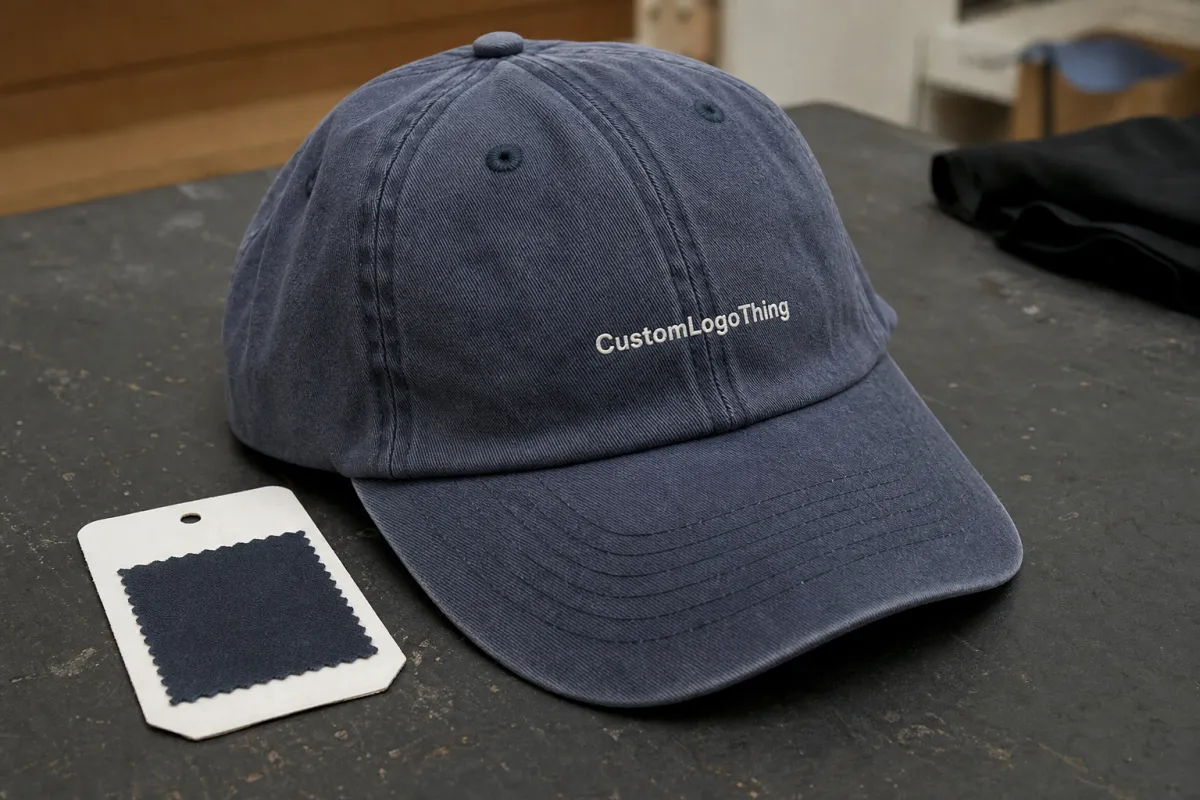
Washed cotton gives a cap a broken-in look that is easier to place in lifestyle, gift, and branded merchandise assortments than a stiff promotional blank. A low-profile 6-panel cap with a curved brim and self-fabric strap usually feels relaxed without looking generic, which is useful when the product needs to read as retail-ready on day one.
The finish also changes how the cap sells visually. Two caps can share the same shape and logo placement, yet the washed version often feels more premium because the crown sits softer and the fabric breaks up light differently. That effect is small on paper and obvious on a shelf, especially next to a clean, unwashed twill cap.
Repeatability is the real retail test. A seasonal program needs the same wash tone, brim curve, and logo placement across reorders. If the finish drifts from one run to the next, the line stops looking intentional. A stable wash is only valuable if it can be reproduced without constant re-approval.
Two caps with the same artwork can still read as different products if one has a flatter wash, a softer brim, or a looser crown.
Construction Details That Change Fit, Finish, and Approval
Construction drives more of the final result than many buyers expect. Panel count changes how the front sits on the head: a 5-panel cap gives a broader front canvas, while a 6-panel cap usually feels more traditional. Structured crowns hold shape better after washing; unstructured crowns look softer and more broken in.
Brim style also changes the product's retail position. A flat visor and a pre-curved visor send different signals, and even a slight change in curve can affect how a logo reads from a distance. If the artwork sits too close to the seam or visor break, the design can feel cramped rather than deliberate.
Closure choice affects both cost and fit. Metal buckle, self-fabric strap, snapback, and hook-and-loop closures each carry different labor and trim costs. Simpler closures can help keep MOQ lower; more branded trims improve shelf appeal but often add setup and approval time.
Decoration should match the fabric. Flat embroidery is usually the safest option on washed cotton because it keeps the logo readable without making the front panel too stiff. Dense 3D embroidery can work, but it needs careful stitch planning. Woven patches and prints are often better for fine detail or for softer crowns that would not support heavy stitch volume.
Garment washing introduces variation, so the approved sample should reflect the finished process, not just the pre-wash body. Shade shifts, seam movement, and small changes in crown feel are normal. The useful question is not whether variation exists, but how much is acceptable and where that tolerance is written down.
Specs to Confirm Before You Request Pricing
Accurate pricing starts with a complete spec sheet. Send fabric blend, fabric weight, panel count, visor style, closure type, color reference, and target quantity in one brief. If the supplier has to infer even one item, the quote usually takes longer and the final number is less reliable.
Artwork details need the same discipline. Include logo placement, decoration size, stitch count if embroidery is involved, and whether the mark is a flat patch, woven patch, or print. Packaging belongs in the same brief: polybags, barcode labels, hangtags, and carton instructions all affect labor and materials.
Material references help more than long descriptions. A physical sample or a clear reference cap gives the factory a target for wash tone, crown height, brim curve, and logo scale. If one feature matters more than the others, say so. That helps the supplier know whether exact tone matching matters most or whether decoration placement is the real priority.
For retail programs, packaging standards can matter as much as the cap. Some buyers want FSC-certified paper for tags or inserts, and some want cartons aligned with specific transit expectations. Those requirements do not guarantee a perfect shipment, but they give both sides a common reference point for quoting and inspection.
A complete brief also protects reorders. If the supplier keeps the approved wash tone, trim, and decoration notes on file, the second run becomes easier to quote and easier to repeat. That is not glamorous work, but it is often what keeps a line profitable after the first season.
Pricing, MOQ, and Unit Cost for Bulk Orders
Pricing for Washed Cotton Caps usually comes down to fabric source, wash process, decoration method, packaging, and whether the cap begins as a stock blank or a custom build. If the body already exists in inventory, setup is often lighter. If the order needs custom labels, special trim, or a made-to-order pattern, the minimum quantity usually rises. That is the core tradeoff in washed cotton caps lead time and moq for bulk buyers: more control almost always adds time or volume.
MOQ increases as the spec gets more specific. A stock blank with one-location embroidery may be offered at a lower minimum than a cap with a custom patch, a specific wash tone, and retail-ready packaging. That is normal. Suppliers are balancing labor, materials, and the risk of leftover components that cannot be reused easily.
Use landed cost, not headline price, when comparing quotes. The lowest unit price can look less attractive once sample charges, packaging, freight, and any setup fees are included. The best comparison is always the same cap spec, the same decoration size, and the same shipping assumption.
| Order Type | Typical MOQ | Unit Cost Range | Best Fit | Common Tradeoff |
|---|---|---|---|---|
| Stock blank, flat embroidery | 100-300 pcs | $5.50-$8.50 | Test programs and simple retail drops | Less control over wash tone and trim details |
| Washed cotton, patch or multi-color logo | 300-500 pcs | $6.80-$10.50 | Private-label assortments and branded merch | Higher setup charges and more approval steps |
| Retail-ready packaging, branded labels | 500-1,000 pcs | $7.20-$12.00 | Store programs and distributor orders | Packaging labor adds to cost per piece |
Those ranges are planning numbers, not fixed quotes. Heavier fabric, more embroidery stitches, custom patches, or special packaging can push the price higher. A simpler build, stable stock body, and clean artwork can pull it down.
There is also a tradeoff between MOQ and unit cost. A smaller run protects cash flow and works for an event or a short seasonal test. A larger run spreads setup costs more efficiently and can lower the per-piece price if the product has repeat demand. The right choice depends on whether the buyer is testing demand or supporting a known reorder path.
2026 Sourcing Notes for Washed Cotton Caps Lead Time and MOQ for Bulk Buyers
In 2026, the biggest shift is not the cap itself but the way suppliers structure the order. More factories are separating stock-body programs from fully custom wash runs, which makes the quote cleaner but also exposes where the real cost sits. Buyers asking for washed cotton caps lead time and moq for bulk buyers should expect tighter rules around trim selection, label placement, and packaging, especially when the order includes retail presentation.
Recent supplier quotes show three common trends. First, embroidery-only programs remain the fastest and lowest-risk path because the factory can work from a stocked body and keep the decoration stage simple. Second, custom wash tones and pigment-dyed finishes now carry more lead-time sensitivity because finishing houses are scheduling smaller batches more tightly than they did a few seasons ago. Third, recycled cotton blends and lower-impact washing methods are showing up more often, but they usually need a sample round before the production quote is final.
We are also seeing more buyers request a split approach: a small pre-production sample for fit and finish, then a larger bulk run once the wash tone is signed off. That can reduce reorder risk and make the final line easier to keep consistent. If your program has a fixed launch date, build that sample step into the calendar before you compare unit cost. A lower quote loses value quickly if the approval cycle adds another week.
For 2026 planning, the most practical move is to ask suppliers which elements are fixed, which are flexible, and which ones change MOQ. That answer tells you whether the order is truly custom or just dressed up as custom. It also helps you decide whether the extra spend belongs in decoration, packaging, or a better wash finish.
Process, Lead Time, and Production Steps
The workflow usually runs from quote approval to artwork proofing, sample production, sample approval, bulk sourcing or cutting, washing, decoration, quality control, and final packing. Lead time is often won or lost at the sample stage. If the sample is slow to approve, the whole schedule slips. If the artwork is unclear, another proof round is usually needed before production can begin.
Wash finishing and decoration order matter. Some methods are safer before the wash stage, while others hold better after the fabric has stabilized. A good supplier should be able to explain the sequence plainly and tell you whether the logo is applied to the finished cap or to components that will be washed later.
For a stock-based order, production may take roughly 10 to 20 business days after approval, depending on decoration and packing. A more custom washed build often needs 20 to 35 business days, especially if there is color matching, special labeling, or heavier embroidery. Shipping time is separate. Air freight suits a rush launch; ocean freight is more efficient for larger orders that can wait.
The schedule should be written as milestones: sample dispatch date, bulk completion date, and shipment booking date. If the caps must reach multiple distribution centers, build in extra time for transit and receiving. A factory can finish on time and still miss the launch if freight and delivery are not planned correctly. For buyers managing washed cotton caps lead time and moq for bulk buyers, milestone tracking is more useful than a single promised ship date.
Supplier Checks That Reduce Reorder Risk
A reliable supplier should document the approved sample, spec sheet, acceptable tolerances, and reorder reference. Washed cotton is not a laboratory product, so small shade changes, seam shifts, and slight crown differences can happen. The point is to define what counts as acceptable before the bulk order starts.
Communication speed matters too. If sample review, decoration, and packaging sit with different departments, a buyer can lose days waiting for one answer at a time. Clear suppliers move the process one decision at a time and confirm each approval in writing.
Quality control should focus on visible, repeatable points: shade consistency within the approved range, stitch stability, brim shape, label placement, and the final appearance after washing. If the cap has embroidery, check that the threads do not pull or pucker. If there is a patch, check the edge finish and placement against the centerline.
Reorders deserve special attention. Ask whether the factory can repeat the same wash tone and decoration placement without treating the second run like a new product. For multi-season programs, that question is often more useful than asking about general experience. A supplier that can reference prior samples properly is easier to manage over time than one that relies on memory. If you want to compare a similar product path, review the nylon camp hat lead time guide alongside this one.
Next Steps to Move From Quote to Purchase Order
The fastest path from inquiry to order is a complete message: target quantity, logo files, preferred closure, color reference, packaging needs, and requested ship date. If samples are needed first, say so separately so the sample timeline does not get confused with the bulk timeline.
Ask for a written quote that spells out MOQ, unit price, sample cost, freight assumptions, and approval steps. The quote should show whether packaging is included, whether setup charges apply, and how reorders will be handled. If those points are unclear, the uncertainty usually shows up later in the schedule or the invoice.
For buyers comparing suppliers, the most useful filter is whether each quote is built on the same spec and the same shipping assumption. Once those variables are aligned, the real differences become easier to see and the lowest number is not always the best value. If you need a quick reference before sending an RFQ, jump back to the pricing section and match your spec against the table first.
What is the usual washed cotton cap MOQ for a custom order?
MOQ depends on whether the cap starts from stock blanks or needs a more custom build. Decoration method, trim, wash tone, and packaging all affect the minimum, so the most useful quote is tied to a specific spec rather than a broad estimate. For washed cotton caps lead time and moq for bulk buyers, the MOQ usually drops when the body is stocked and rises when the wash, labels, and packaging are fully custom.
How long is the typical washed cotton cap lead time after approval?
Lead time usually starts after artwork and sample approval, not after the first inquiry. Stock-based orders can often be completed in about 10 to 20 business days, while more customized washed builds may take 20 to 35 business days before shipping.
What affects washed cotton cap pricing the most?
Fabric source, wash process, decoration method, and packaging have the biggest impact. Lower MOQs often carry a higher unit cost because setup is spread across fewer pieces, and freight should be included when comparing landed cost.
Can washed cotton caps vary in color after washing?
Yes. Light shade variation is normal in garment-washed fabric, especially with pigment-dyed or heavily washed finishes. The approved sample should reflect the final process, and reorder notes should keep the same fabric lot and production details where possible.
What should I send to get an accurate quote for washed cotton caps?
Send artwork, quantity, closure preference, color reference, decoration placement, packaging needs, and target delivery date. If samples are required, say so clearly. The more complete the spec sheet, the easier it is to quote MOQ, unit cost, and timeline accurately.