Buyer Fit Snapshot
| Best fit | Biodegradable Retail Boxes with Logo projects where brand print, material claims, artwork control, MOQ, and repeat-order consistency need to be specified before quoting. |
|---|---|
| Quote inputs | Share finished size, material target, print colors, finish, packing count, annual reorder estimate, ship-to region, and any compliance wording. |
| Proofing check | Approve dieline scale, logo placement, barcode or warning zones, color tolerance, closure strength, and carton packing before bulk production. |
| Main risk | Vague material claims, crowded artwork, missing packing details, or unclear freight terms can make a low unit price expensive after revisions. |
Fast answer: Biodegradable Retail Boxes with Logo: Board, Finish, Dieline, and Unit Cost should be specified like a repeatable production item. The safest quote records material, print method, finish, artwork proof, packing count, and reorder notes in one written spec.
Production checks before approval
Compare the actual filled-product size with the drawing, then confirm tolerance on folds, seals, hang holes, label areas, and retail display edges. Reserve space for logos, QR codes, warning copy, and material claims before decorative graphics fill the panel.
Quote comparison points
Review material grade, print process, finish, sampling route, tooling charges, carton quantity, and freight assumptions side by side. A quote is only useful when the supplier can repeat the same color, closure quality, and packing count on the next order.
Biodegradable retail Boxes With Logo sound simple until the packaging brief gets passed around the room and everybody suddenly has an opinion. The brand wants something That Feels Premium on shelf. Procurement wants numbers that do not make finance choke. Operations wants boxes that do not collapse in transit. And the sustainability team wants language that can survive an actual audit, not just a polished sales deck.
That tension is the real story behind biodegradable retail boxes with logo. The box is not just a carton. It is a product wrapper, a brand signal, and sometimes the only part of the purchase a customer keeps staring at before they decide whether the item feels worth the money. If the material is chosen well, it can also fit a cleaner end-of-life path. If it is chosen badly, you get a nice-looking box that creates confusion later. Which, honestly, happens more often than anyone wants to admit.
There is a catch. A package can be called biodegradable and still behave very differently depending on the board, coating, adhesive, print system, and disposal route. I have seen samples that looked perfect on a desk and then fell apart in the wrong place for the wrong reason. That is why biodegradable retail boxes with logo need a real review instead of a quick green checkbox.
Biodegradable Retail Boxes with Logo: What They Are
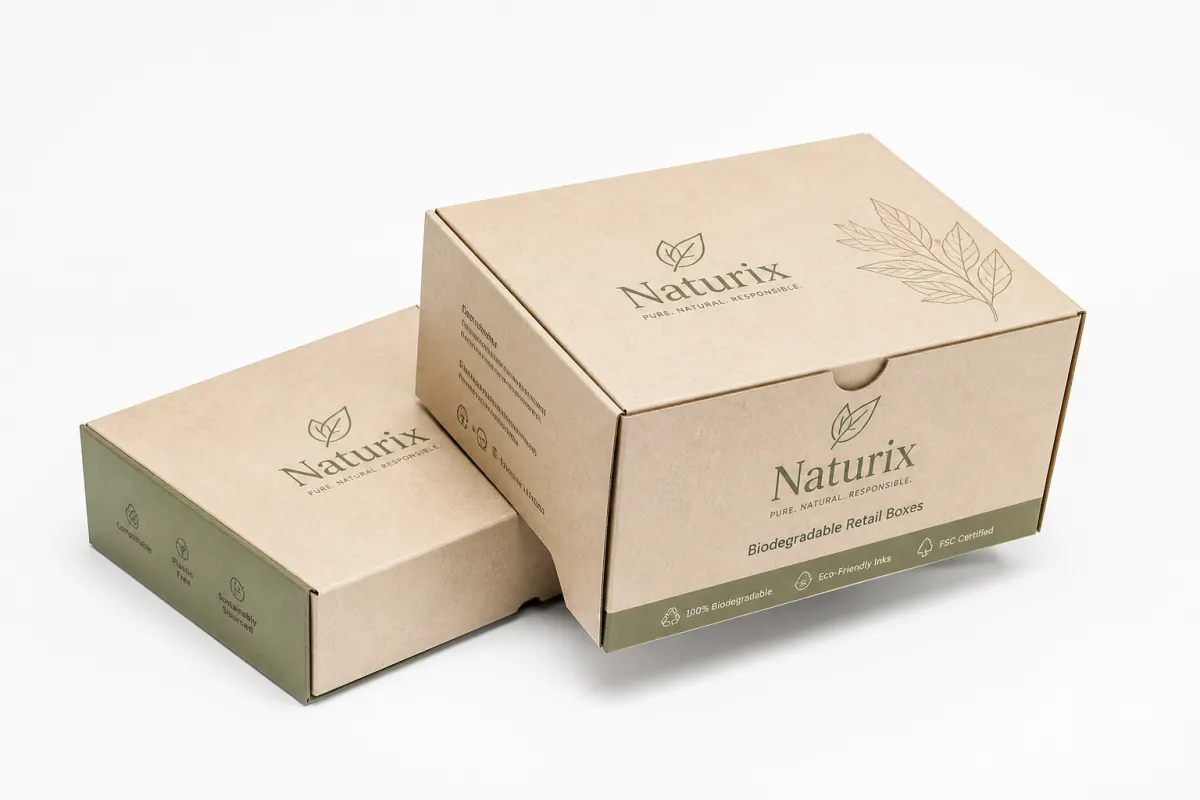
Biodegradable retail boxes with logo are retail cartons made from fiber-based or plant-derived materials and printed with brand artwork, with the idea that they can break down under the right conditions. The phrase is broad because the category is broad. A kraft folding carton, a rigid paper-wrapped box, and a molded fiber sleeve can all sit under the same sustainability umbrella, but they do not behave the same way in production, shipping, or disposal.
From a buyer's perspective, the material choice is about a lot more than waste. It affects print contrast, texture, scuff resistance, stack strength, and how the logo reads under store lighting. A skincare brand may want a bright white surface with sharp registration. A soap brand might be better served by a natural kraft board with a simple two-color mark. Same keyword. Very different results on shelf.
The phrase biodegradable retail boxes with logo should be treated as a claim that needs support, not a decorative line on a spec sheet. Some materials biodegrade under industrial composting conditions. Some break down much more slowly in a landfill, where oxygen is limited and microbial activity barely gets a vote. That difference matters because a claim only helps if it matches the disposal route people are actually going to use.
Buyers hear "eco-friendly" and assume the end-of-life story is identical for every package. It is not. A retailer may want curbside recyclability. A food brand may want industrial compostability. A DTC skincare brand may only need an FSC-certified paperboard carton with a low-ink print system. Each path changes the design brief for biodegradable retail boxes with logo.
A box can look expensive and still be a weak sustainability choice if the coating, adhesive, or finish blocks the disposal route you claimed.
So the first question is practical: what job is the box doing? If the answer is brand presentation plus lower packaging waste, then biodegradable retail boxes with logo can make a lot of sense. If the answer is "we need luxury no matter what," then the material conversation needs to get more specific, because luxury and lower-impact packaging can work together, just not by accident.
How Biodegradable Retail Boxes with Logo Break Down
The breakdown process behind biodegradable retail boxes with logo depends on moisture, oxygen, microbes, temperature, and time. That means the same box can behave differently in compost, landfill, backyard soil, or even a dry storage area. A fiber carton that decomposes reasonably well in an industrial compost facility may sit for a very long time in a landfill where the conditions are too dry and too low in oxygen for fast biological activity.
That is why the words biodegradable, compostable, recyclable, and industrial-compostable are not interchangeable. A box may be biodegradable without being home-compostable. It may be recyclable if the fiber is clean enough, yet fail compost standards because of a plastic-based coating. This is not wordplay. It changes how a buyer writes product-page copy, carton instructions, and disposal language for biodegradable retail boxes with logo.
If you want to verify claims, ask for recognized standards and clear supplier documentation. In the U.S., compostability claims often reference ASTM standards such as ASTM D6400 or ASTM D6868. International programs may reference EN 13432. For public guidance on composting and waste reduction, the EPA has a useful overview at EPA composting guidance. For fiber sourcing, FSC certification is another useful reference at fsc.org. Those links do not replace a supplier spec sheet, but they do help you ask the right questions before you approve biodegradable retail boxes with logo.
In practice, inks and finishing matter almost as much as the board itself. Heavy lamination, metalized foils, thick UV varnish, and some plastic coatings can slow decomposition or make a carton unsuitable for compostability claims. Water-based inks, lower ink coverage, and paper-friendly coatings usually fit the sustainability brief better than high-build decorative finishes. That is one reason biodegradable retail boxes with logo often look cleaner and more restrained than conventional luxury cartons. Not always. But often enough.
Here are the variables that most often change performance:
- Moisture exposure: Damp conditions speed biological activity, while dry environments slow it down.
- Oxygen access: Compost systems with airflow behave very differently from sealed landfill environments.
- Print coverage: Heavy ink coverage can affect recyclability and sometimes compostability.
- Adhesives and tapes: Glue lines, labels, and closures can become the weak point in disposal.
- Finish type: Plastic lamination and metallic effects often work against simpler end-of-life paths.
One more practical point: a box that breaks down easily is not automatically a strong retail box. That is the balancing act. Biodegradable retail boxes with logo still need to survive filling, palletizing, transport vibration, store handling, and shelf stacking. If the carton crushes early, the environmental benefit gets swallowed by damaged goods and replacement shipments. Not exactly the hero ending the marketing team had in mind.
From a packaging test perspective, I would rather see a box that passes a realistic compression test and a basic scuff test than one that depends on a fragile finish and a vague green claim. The best biodegradable retail boxes with logo hold up long enough to do their job, then move into the right disposal stream without confusion.
Biodegradable Retail Boxes with Logo: Cost and Materials
Cost is where enthusiasm meets arithmetic. Biodegradable retail boxes with logo usually cost more than plain stock cartons because the material, print system, and setup all affect the final unit price. The premium is not random. It comes from board selection, box style, print complexity, finishing, and the number of units spread across the setup charge.
At modest quantities, the spread can be wide. A simple kraft folding carton might land around $0.18-$0.28 per unit at 5,000 pieces depending on size and print coverage, while a more customized structure with special coating or a heavier board could move closer to $0.30-$0.55 per unit or more. Smaller runs often cost notably more per box because plate, die, and press setup are divided across fewer units. That is normal, but it still catches buyers off guard. Every time.
The material choice matters just as much as the decoration. If you are comparing biodegradable retail boxes with logo to standard retail cartons, the premium usually comes from one of four places: the substrate itself, the finish, the print process, or the certification and testing needed to support the claim. A buyer can trim cost without flattening the brand effect if the design gets controlled early instead of being layered on late by committee.
One useful starting point is to look at Custom Packaging Products that already match your target size and structure. A standard dieline often saves more than a fancy finish ever will. A compact logo, one or two ink colors, and a clean kraft surface can still look premium if the typography is confident and the box proportions are right. Fancy is not the same thing as effective, no matter how hard the render tries to convince you otherwise.
| Option | Typical Look | Approx. Unit Cost at 5,000 | Best Fit | Notes |
|---|---|---|---|---|
| FSC-certified kraft folding carton | Natural, minimal, brand-forward | $0.18-$0.28 | Soap, snacks, candles, accessories | Works well with low-ink coverage and simple logo layouts |
| White paperboard with eco inks | Cleaner contrast, brighter graphics | $0.22-$0.36 | Skincare, cosmetics, supplements | Better for detailed logos, but surface prep matters |
| Heavier natural fiber board | More tactile, premium, sturdy | $0.30-$0.45 | Gift sets, candles, specialty retail | Often improves shelf feel and crush resistance |
| Specialty wrapped carton with minimal finishing | Luxury feel with controlled decoration | $0.38-$0.55 | Premium launches, seasonal retail lines | Higher cost, but still possible to keep a paper-based sustainability story |
The table is not a quote sheet. It is a reality check. Biodegradable retail boxes with logo can sit in a surprisingly wide price band, even when two samples look similar on a desk. The final number depends on the board caliper, the number of print colors, how much of the surface is covered, and whether the box needs a special coating or a verification step.
Hidden costs can matter more than the headline unit price:
- Sampling: Physical prototypes or short-run samples can add cost before production starts.
- Setup charges: Die cutting, plates, and press setup often appear as separate line items.
- Rush fees: Tight timelines usually cost more, especially if proofing is shortened.
- Freight: Heavy cartons and bulky shipments can make landed cost jump fast.
- Testing or certification: Written support for compostability or fiber sourcing may add administrative cost.
There is a second cost that buyers sometimes ignore: design complexity. Dense logos, tiny typography, full-bleed color, and multiple finishes can make biodegradable retail boxes with logo more expensive and less dependable at the same time. A cleaner design often saves money and improves the sustainability story because it reduces ink load and simplifies production. Less drama. Fewer headaches. Better odds that the box actually runs the way it should.
If you are comparing suppliers, ask for the quote in a way that lets you compare like with like. Same board. Same dimensions. Same print method. Same finish. Same carton count. Otherwise, one supplier may look cheaper simply because the spec is softer. That is not a fair comparison, and it can hide the true cost of biodegradable retail boxes with logo.
Step-by-Step Timeline for Ordering Biodegradable Retail Boxes with Logo
A realistic timeline keeps the project calm. A rushed packaging job turns into a chain reaction: artwork changes late, samples arrive too close to launch, and the production run gets approved with too little scrutiny. For biodegradable retail boxes with logo, the cleanest workflow starts with dimensions and ends with a final inspection against the approved proof.
Here is a typical path:
- Define the product dimensions: Measure the filled product, not just the item itself, so the box has enough tolerance for inserts, closures, and shelf presentation.
- Choose the board and structure: Decide whether you need a folding carton, tuck end, sleeve, mailer-style retail box, or a more rigid presentation style.
- Prepare the artwork: Supply vector logo files, Pantone references, and a print-ready layout that respects safe zones and fold lines.
- Request samples: Review the board, print contrast, and closure fit before full production.
- Approve proofs: Confirm measurements, copy, disposal language, barcode placement, and finish details.
- Move to production: The run begins only after the proof is signed off.
- Inspect the first cartons: Check for color shift, score quality, glue adhesion, and scuffing.
For many buyers, stock structures can move faster than full custom projects. A standard box with simple printing might move in 7-12 business days after proof approval, while a custom structure or a finish-heavy version can take 12-18 business days or more. Add time if the supplier needs special certification checks, if you are requesting a short-run prototype, or if the artwork is not final on day one. Biodegradable retail boxes with logo are rarely slow because of the box itself; they are usually delayed by decisions that arrive late and then somehow become urgent.
Prototype samples matter more than many teams admit. A render on a screen cannot tell you whether the board will crack at the score, whether the logo will disappear against a textured kraft surface, or whether the box will stay tidy after a courier run. If you are testing biodegradable retail boxes with logo for candles, skincare, or snack products, check three things in the sample stage:
- Fold strength: The carton should open and close cleanly without tearing at the seams.
- Print contrast: The logo should still read clearly under retail lighting and on textured stock.
- Transit durability: The box should survive vibration, pressure, and light scuffing in the supply chain.
"We approved the art too early and found the logo lost definition on the natural board." That is the kind of problem a sample catches, and it is far cheaper to catch it before the run.
If you want the project to move faster, send complete information up front. Exact measurements. Preferred board weight. Print colors. Reference photos. Disposal claim language. The more precise the brief, the fewer questions later, and the smoother the ordering path for biodegradable retail boxes with logo. Nobody likes going back and forth on a dieline because the product dimension turned out to be "roughly" the size everyone guessed it was.
Common Mistakes with Biodegradable Retail Boxes with Logo
The most expensive mistakes are usually the ones that look harmless on paper. A carton can be technically biodegradable and still be a poor fit for retail, compliance, or brand presentation. With biodegradable retail boxes with logo, the same handful of errors shows up again and again.
Buyers use the word biodegradable too loosely. If the supplier cannot tell you whether the material meets a recognized standard or whether it needs industrial composting, the claim is not ready for packaging copy. A vague label can create legal risk, customer confusion, and a disposal story that falls apart the moment someone asks for specifics. That is a bad look for biodegradable retail boxes with logo, and it is avoidable.
The finish can undermine the whole effort. Plastic lamination, heavy foil stamping, and thick varnish can make a box feel more polished, but they can also block the disposal route the brand wants to support. The cleaner route is often a paper-friendly coating, restrained ink coverage, and a logo that works with the natural texture of the board rather than fighting it. I have seen teams spend extra to make a box look "more premium" and accidentally make it less believable on the sustainability front. Strange choice, but common.
Some designs try to do too much. Tiny type, crowded panels, and full-coverage artwork can look busy on a mockup and muddy in production. A strong logo needs breathing room. If the surface is textured, the print gains and losses become even more obvious. That is why biodegradable retail boxes with logo tend to reward simple typography, careful contrast, and deliberate white space.
The supply chain gets ignored too often. A retail box still needs to survive stacking pressure, pallet movement, and temperature changes. If the box is too thin, the corners crush. If it is too soft, the lid bows. If it is too fragile, the product returns as damaged goods. Sustainability does not cancel physics. It has to work with it, or the whole idea gets expensive fast.
Common missteps to avoid:
- Assuming all green claims are equal: Biodegradable is not the same as compostable or recyclable.
- Over-finishing the box: Too much decoration can weaken the sustainability story.
- Ignoring shipping stress: A box that fails in transit creates waste, returns, and extra cost.
- Using unreadable logo sizes: Small type and thin lines can disappear on natural fiber board.
The practical fix is simple: build the packaging around the product, not around a slogan. Biodegradable retail boxes with logo should be designed to protect the item, present the brand clearly, and match a disposal route you can actually explain. If any one of those three parts is weak, the project needs another round of review.
Expert Tips for Better Biodegradable Retail Boxes with Logo
There is a smart way to make biodegradable retail boxes with logo feel premium without piling on unnecessary material. The trick is to spend the design effort where the shopper sees it first. That usually means the front panel, the top flap, and the key information zone near the logo. Everything else can often be quieter, simpler, and less ink-heavy.
One of the strongest moves is to match the board strength to the product. A candle in a glass jar needs more crush resistance than a lightweight soap bar. A skincare serum with a heavy cap may need a tighter internal fit than a powder sachet. Overbuilding the carton wastes material and increases cost. Underbuilding it creates damage. The right target is usually somewhere in between, and it makes biodegradable retail boxes with logo easier to defend financially and environmentally.
Another practical habit: test the box in real lighting. Natural-fiber board, eco inks, and soft coatings can shift in appearance under warm store lights, cool LED lighting, and daylight near a storefront window. A box that reads beautifully on a monitor may look flat on the shelf. A sample in context tells you more than a digital proof ever will.
That is also why I like a simple sustainability checklist before approval. It keeps the conversation grounded when there are too many moving parts. For biodegradable retail boxes with logo, the checklist should cover material, finish, print method, certification, and disposal instructions. If one of those five is unclear, stop and clarify it before the order goes live. Guessing is not a strategy. It is how people end up rewriting labels after the cartons are already on the water.
Here is a practical checklist you can use internally:
- Material: Is the board fiber-based, plant-derived, or otherwise documented?
- Finish: Does the coating support the claimed disposal route?
- Print: Are the inks low-impact and the coverage reasonable?
- Certification: Is there written proof for compostability or FSC sourcing where needed?
- Messaging: Do the carton, product page, and customer instructions say the same thing?
You can also simplify the visual hierarchy. In many cases, a single logo, a short product descriptor, and one supporting color are enough. That approach often reduces cost and improves shelf clarity. It also makes biodegradable retail boxes with logo easier to produce consistently across SKUs, which matters if you are planning a line extension or a seasonal variant.
If you are still refining the broader package program, it may help to review other Custom Packaging Products as a baseline for structure, board weight, and print style. The goal is not to copy a template. The goal is to choose a format that fits the brand without adding decoration just because the option exists.
Finally, remember that sustainability claims live or die on consistency. A box, a website banner, and a store display that all tell slightly different stories will confuse shoppers faster than any technical debate. The best biodegradable retail boxes with logo support a claim that is easy to explain, easy to defend, and easy to repeat across channels.
What to Do Next Before You Order Biodegradable Retail Boxes with Logo
If you are close to buying, start with an audit of the packaging you already use. Measure the current carton, note the visible surfaces, and identify where the product sees the most stress in shipping. That simple review usually reveals whether biodegradable retail boxes with logo need a new structure, a lighter board, or just a better print layout.
Then collect at least three quotes using the same spec. Ask each supplier to quote the same dimensions, board weight, print colors, finish, carton count, and shipping destination. That is the only way to get a fair comparison. A lower unit price means very little if the setup fee is high or the lead time forces you into rush freight. With biodegradable retail boxes with logo, landed cost matters more than the headline number.
After that, ask for samples of the exact board and finish combination. Test them for print clarity, scuff resistance, fold behavior, and how they look next to the product in real light. If the box is going to sit in a boutique, a salon, or a grocery aisle, the final proof needs to match that environment. That is especially true for biodegradable retail boxes with logo, because natural surfaces can look warmer, flatter, or more textured than expected.
You should also update your product-page language and carton copy at the same time. The box, the website, and the customer instructions need to say the same thing about disposal, sourcing, and brand values. If the packaging says one thing and the product page says another, shoppers notice. Clarity builds trust faster than a glossy promise ever will.
If you need a launch starting point, browse Custom Packaging Products and choose a structure that already matches your product size and handling needs. That way, your creative budget goes into the parts that shoppers actually see: logo placement, typography, and print quality. It is a better use of effort than forcing a custom format when a standard one would do the job well.
Biodegradable retail boxes with logo work best when they are treated as a system, not a slogan. The material, the finish, the print, the freight plan, and the disposal message all have to line up. If they do, the box supports the product and the brand. If they do not, the packaging becomes another place where good intentions get expensive.
The smartest next step is usually the least flashy one: lock the exact board spec, request a sample in the real finish, and verify the claim language before production starts. Do that, and your biodegradable retail boxes with logo will have a much better shot at looking right, shipping right, and ending up in the disposal stream you actually promised.
Frequently Asked Questions
Are biodegradable retail boxes with logo really compostable?
Only if the material, inks, adhesives, and coatings meet the right composting standard. Biodegradable retail boxes with logo are not automatically home-compostable, and they are not automatically industrial-compostable either. Ask for the certification path in writing, then match your packaging copy to that specific route.
How much do biodegradable retail boxes with logo usually cost?
Price depends on board type, print method, finishing, and quantity. Two boxes that look similar can still land in very different ranges once setup, sampling, and freight are included. At common mid-size runs, biodegradable retail boxes with logo often fall somewhere in the low cents to mid-cents per unit range, but a final quote should always be checked against the exact spec.
What print methods work best for biodegradable retail boxes with logo?
Water-based inks and low-coverage designs are often the best fit because they support a cleaner material story and usually work well on natural fiber board. Fewer colors can also reduce cost. Even so, sample a proof first, because textured stock can change color density and logo sharpness. That is true for biodegradable retail boxes with logo more than many teams expect.
How long does it take to produce biodegradable retail boxes with logo?
Simple stock structures can move quickly, while custom sizes, special finishes, and certification checks add time. Sampling and proof approvals are often the biggest schedule variables. If you share artwork, dimensions, and material preferences early, biodegradable retail boxes with logo can usually move through the process with fewer delays.
What should I ask a supplier before ordering biodegradable retail boxes with logo?
Ask for exact material specs, coating details, any certifications tied to the biodegradability claim, minimum order quantity, setup charges, and lead time. Also request disposal guidance in writing so your packaging copy, product page, and customer instructions all match. That is the simplest way to keep biodegradable retail boxes with logo accurate and defensible.


