Buyer Fit Snapshot
| Best fit | Custom Rigid Boxes with Logo Pricing projects where brand print, material claims, artwork control, MOQ, and repeat-order consistency need to be specified before quoting. |
|---|---|
| Quote inputs | Share finished size, material target, print colors, finish, packing count, annual reorder estimate, ship-to region, and any compliance wording. |
| Proofing check | Approve dieline scale, logo placement, barcode or warning zones, color tolerance, closure strength, and carton packing before bulk production. |
| Main risk | Vague material claims, crowded artwork, missing packing details, or unclear freight terms can make a low unit price expensive after revisions. |
Fast answer: Custom Rigid Boxes with Logo Pricing: Board, Finish, Dieline, and Unit Cost should be specified like a repeatable production item. The safest quote records material, print method, finish, artwork proof, packing count, and reorder notes in one written spec.
Production checks before approval
Compare the actual filled-product size with the drawing, then confirm tolerance on folds, seals, hang holes, label areas, and retail display edges. Reserve space for logos, QR codes, warning copy, and material claims before decorative graphics fill the panel.
Quote comparison points
Review material grade, print process, finish, sampling route, tooling charges, carton quantity, and freight assumptions side by side. A quote is only useful when the supplier can repeat the same color, closure quality, and packing count on the next order.
Custom rigid Boxes with Logo pricing can feel vague until you break the quote into parts. The logo is rarely the main cost driver. Structure, board thickness, wrap paper, inserts, and finishing usually move the number much more than the mark on the lid.
That catches a lot of brand teams off guard, especially the first time they compare rigid packaging with folding cartons or mailer boxes. A rigid box uses thick chipboard or paperboard, then gets wrapped in printed or specialty paper. That is why it feels heavier, cleaner, and more gift-ready in hand. For premium retail packaging, cosmetics, tech accessories, subscription gifts, and launch kits, that extra weight is not just visual. It changes how the product is perceived before anyone opens it.
From a packaging buyer’s point of view, Custom Rigid Boxes with logo pricing is a mix of materials, labor, setup, sampling, and logistics. Warehousing sometimes shows up in the quote. Freight sometimes does not. Inserts may be included in one estimate and treated as a separate line in another. I’ve sat through enough packaging reviews to know that two quotes can look wildly different even when the finished box seems nearly identical.
If you are still sorting through options, compare the structure first and the decoration second. Browse Custom Packaging Products to see how different box formats change the customer experience before you lock in a spec. Good package branding usually starts with the box that fits the product, not the one that only looks good in a mockup.
The cleanest pricing conversations happen when brands treat Custom Rigid Boxes with logo pricing as a construction decision, a branding decision, and an operations decision at the same time. That keeps the discussion grounded. It also keeps you from paying for decorative extras that do not improve the unboxing moment in any meaningful way.
What Custom Rigid Boxes With Logo Pricing Really Means
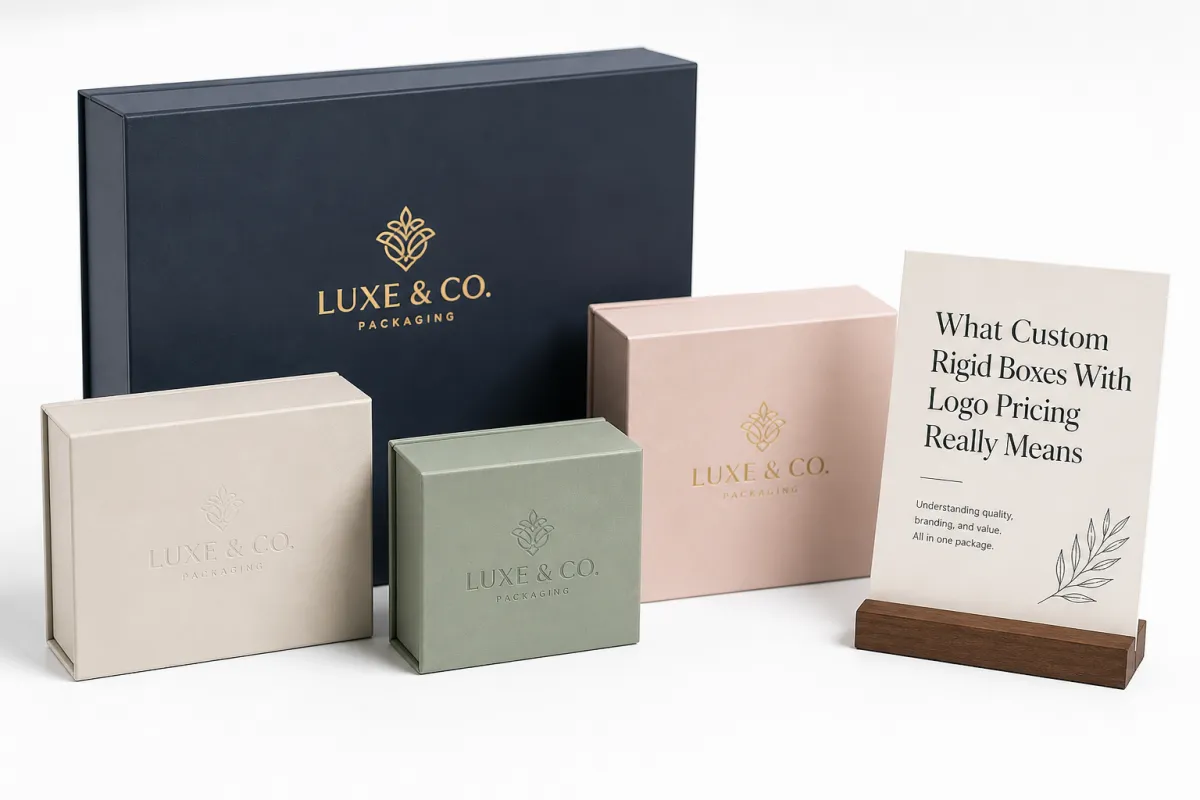
A rigid box is not just a folding carton with a stronger attitude. It is a built-up structure, usually made from grayboard, chipboard, or another stiff substrate, then wrapped with paper or specialty stock. That extra construction gives the box its shape and helps it hold up better under handling, stacking, and shipping. When people ask about Custom Rigid Boxes with logo pricing, they are usually asking a much simpler question: what am I paying for beyond basic containment?
The answer usually comes from materials, labor, finishing, and production setup. Add a lid, a shoulder, a magnetic flap, a pull ribbon, or a custom insert, and the cost rises because each feature changes assembly time and material yield. A one-color logo may add very little by itself. Foil stamping, embossing, or full-wrap printing can add more. Even then, the logo is only one piece of the equation.
That is why custom rigid boxes with logo pricing often surprises first-time buyers. They expect decoration to be the biggest line item. It usually is not. Structure, board grade, wrap paper, and insert type tend to carry more weight, especially in small and medium runs. If a supplier labels a box “premium,” ask what that means in real terms: board thickness, paper gsm, print process, and assembly method.
These boxes show up where presentation has to earn its keep. Think luxury skincare, fragrance, collectible electronics, jewelry, premium beverages, corporate gift sets, influencer kits, and high-margin promotional launches. In those categories, packaging is not background noise. It is part of the product story. A sturdy, refined box can support retail packaging goals better than a basic printed carton because it slows the reveal down and makes it feel intentional.
- Luxury retail: where the box needs to feel substantial on shelf and in hand.
- Cosmetics and beauty: where brand color, texture, and finish carry a lot of perceived value.
- Tech accessories: where protection, fit, and clean presentation matter equally.
- Subscription and gifting: where the unboxing moment is part of the product experience.
- Promotional launches: where package branding has to look polished under event pressure.
The fastest way to get a realistic quote is to send a spec sheet, not a mood board. A sketch helps, but dimensions, insert needs, and finish choices decide custom rigid boxes with logo pricing.
A good mental model helps here. Custom rigid boxes with logo pricing is the sum of everything you do to the base structure. The logo treatment sits on top of that base. If the base is simple, the box can still feel premium. If the base is overbuilt, the logo is just a small piece of a much larger bill.
For brands comparing custom printed boxes across several formats, rigid packaging usually sits near the top of the cost range. That does not make it a bad choice. It just means the performance has to justify the spend. When product price, margin, and presentation goals line up, the math usually works.
How Custom Rigid Boxes With Logo Pricing Is Calculated
Custom rigid boxes with logo pricing is built from a few predictable components. Once you know the parts, the quote stops looking mysterious. Board grade is the first piece. Wrap paper is the second. Printing or logo application comes next. Inserts, embellishment, sampling, tooling, and freight follow behind. Every one of those pieces can move the final number.
Size matters more than many buyers expect. A box that is only 15 millimeters taller can use more board, more wrap, and a slightly larger insert, which affects both material usage and labor. Bigger boxes can also raise shipping and storage costs because they consume more cubic space. That means custom rigid boxes with logo pricing depends on the box itself and the supply chain around it.
Logo application changes the budget too. A one-color logo printed on the wrap paper is usually modest. Foil stamping, embossing, debossing, spot UV, or multi-pass printing can push the price higher because those effects require more setup and tighter quality control. In many cases, the difference between plain and premium branding is obvious to the customer while the unit cost difference is smaller than people fear.
Quantity changes the equation fast. At low quantities, setup and die work get spread across fewer boxes, so custom rigid boxes with logo pricing looks steep per unit. At higher quantities, those fixed costs dilute. That is why a 500-unit order can look expensive while a 5,000-unit order for the same box feels far more efficient. The box did not get simpler. The math just got kinder.
Suppliers also quote differently. Some include inserts, proofs, and delivery. Others separate every line. Some bundle prototype costs into the order if production moves ahead. Others charge sampling as a standalone item. If one estimate looks dramatically lower, do not assume it is cheaper until you compare the assumptions line by line.
| Box Style | Typical Cost at 500 Units | Typical Cost at 5,000 Units | What Drives the Price |
|---|---|---|---|
| Two-piece rigid box, one-color logo, standard wrap | $2.25-$5.25 | $0.95-$2.10 | Simple structure, limited finishing, moderate labor |
| Magnetic closure rigid box, foil logo, EVA insert | $4.75-$9.50 | $2.10-$4.25 | Extra assembly, closure hardware, insert cutting, embellishment |
| Book-style rigid box, printed wrap, custom tray | $5.50-$12.00 | $2.80-$6.20 | Complex construction, higher wrap coverage, more finishing steps |
| Luxury rigid box with specialty paper and mixed finish | $6.50-$14.00 | $3.50-$7.50 | Premium paper stock, multiple effects, tighter quality control |
Those numbers are illustrative, not universal. Location, freight, material source, and revision count can change the final quote. Still, they give you a practical frame for custom rigid boxes with logo pricing so you can see whether a proposal sits in a normal range or carries avoidable padding.
A useful comparison is simple branding versus premium branding. A clean logo on a textured wrap can look polished without a huge decoration bill. Full-coverage art turns the box into a branded canvas, but it also raises print coverage, setup complexity, and rejection risk if registration drifts. That is why custom rigid boxes with logo pricing should always be read alongside the artwork plan.
Packaging teams often ask whether a custom logo automatically makes the box expensive. Not really. A basic mark can be a small add-on. The structure is often the real cost center. For buyers trying to balance branded packaging with margin, the lesson is straightforward: know where the fixed costs sit before you optimize the visible finish.
For shipping-sensitive projects, it helps to think beyond the factory floor. A beautiful box that is awkward to pack, store, or palletize can create hidden expense later. That is why a quote should include the operational details you will actually need, not just the cosmetic ones.
Key Factors That Move Custom Rigid Boxes With Logo Pricing
If you want to predict custom rigid boxes with logo pricing, start with the biggest levers. Size comes first. Construction style comes second. Paper choice, finish complexity, insert design, and quantity follow close behind. Each lever Changes the Quote in a different way, and the combination matters more than any single feature.
A two-piece lift-off lid is usually the most straightforward rigid format. A magnetic closure box, a hinged lid, or a ribbon-pull design costs more because the assembly is more involved and the closure system adds material and labor. A shoulder box or book-style structure can cost even more because the layers need tighter tolerances. In plain terms, the more the box behaves like a presentation object, the more custom rigid boxes with logo pricing moves upward.
Inserts are a hidden cost center. Foam inserts, molded pulp, EVA trays, paperboard partitions, and velvet-lined nests all sit in different price bands. A simple die-cut paperboard insert may be enough for a lightweight accessory. A premium fragrance set may need a cut-to-fit tray to keep components from shifting. The insert choice affects protection, presentation, and cost all at once.
Paper wrap matters too. Textured paper, laminated art paper, soft-touch finishes, metallic stocks, and FSC-certified boards each carry different pricing profiles. A premium paper stock can elevate a simple box faster than adding a second logo treatment. That is one reason custom rigid boxes with logo pricing often looks better when the design team chooses one strong material instead of several medium-impact extras.
External variables matter as well. Supplier location affects labor rates and freight distance. Rush fees can appear if the project compresses the schedule. Sampling revisions can add cost if the proof changes after the dieline is approved. Seasonal demand can tighten capacity, which may shift pricing or extend lead times. None of those details are glamorous, but they do affect the final invoice.
- Structure: magnetic closures, book styles, shoulders, and hinged lids all increase complexity.
- Wrap: specialty paper and full print coverage usually cost more than plain wraps.
- Finish: foil, embossing, debossing, and spot UV each add process steps.
- Insert: paperboard is usually simpler than EVA or molded pulp with tight cavities.
- Volume: higher quantities spread setup costs more efficiently.
There is also a subtle tradeoff between perceived value and actual cost. A premium paper choice can lift the unboxing more noticeably than an extra logo color. On the flip side, a highly decorated lid may sell the box before the customer ever touches it. Good packaging design does not always spend more. It spends more wisely.
If you are quoting retail packaging for a new line, ask the supplier to separate the cost of each feature. That lets you see whether a magnetic flap adds more value than a foil logo, or whether a custom insert is worth more than specialty wrap. The answer changes by category, but the comparison itself is always useful.
For brands trying to reduce custom rigid boxes with logo pricing, standardizing dimensions across product lines can be powerful. Shared tooling, repeatable inserts, and common wrap sizes reduce waste and simplify reorders. The savings are not abstract. They show up in fewer setup steps, less inventory friction, and cleaner production planning.
Step-by-Step Guide to Pricing a Custom Rigid Box Order
There is a practical way to approach custom rigid boxes with logo pricing without getting buried in vendor language. Start with the product. Then choose the structure. Then define the branding. Finally, test whether the budget still fits the launch plan. That order matters because the product should drive the package, not the other way around.
- Measure the product carefully. Capture length, width, height, weight, and any awkward protrusions. If the item needs accessory space, include that too. A charger, cable, card, or sample insert can change the internal layout more than people expect.
- Pick the box format first. A lift-off lid, magnetic closure, book-style opening, or drawer-style rigid box each sends a different signal. More importantly, each one carries a different cost profile. Picking the format early makes custom rigid boxes with logo pricing far easier to control.
- Define the logo treatment. Decide whether the mark should be printed, foil stamped, embossed, debossed, or kept to a subtle one-color application. A simple logo can keep the quote lean. A complex logo can raise both setup and approval time.
- Prepare artwork early. Clean vector files, exact color references, and clear placement instructions reduce back-and-forth. If the supplier has to guess where the logo sits, custom rigid boxes with logo pricing becomes less stable and proof rounds multiply.
- Ask for itemized quotes. Compare board, wrap, insert, finishing, sampling, and freight separately. That is the only fair way to compare one supplier against another.
One detail that gets overlooked often is the role of samples. A physical prototype usually costs more than a printed mockup, but it also tells you whether the lid aligns, the insert holds the product, and the logo lands where it should. In other words, sampling protects the budget later. Fixing a full production run is far more expensive than approving a slightly slower proof stage.
Tip: Ask for three versions of the same project: value, balanced, and premium. The value version might use a standard wrap and paperboard insert. The balanced version might add a foil logo or a better paper stock. The premium version can show what happens if you choose specialty paper, a magnetic closure, or a more elaborate insert. That comparison makes custom rigid boxes with logo pricing much easier to read.
If you are already browsing Custom Packaging Products, use the examples as a reference point rather than a final answer. What matters is not whether a box looks nice in isolation. What matters is whether the structure, finish, and box price align with the product margin and the customer promise.
Here is the part many brands skip: write down your target use case in plain language. Is the box meant for shelf display, gifting, shipping, influencer kits, or protected storage? That answer can change the spec. A box meant to survive transit should be tested differently than a box meant to sit inside another shipper. Packaging teams that are clear on use case usually get more realistic custom rigid boxes with logo pricing on the first round.
A strong quote tells you what is included, what is optional, and what will change if the artwork changes. If that is missing, the quote is incomplete.
Custom Rigid Boxes With Logo Pricing Timelines and Production Steps
Price and time are tied together in packaging. A more complex box does not just cost more to make; it also takes longer to assemble, inspect, and pack. That is why custom rigid boxes with logo pricing should always be discussed alongside the production timeline. If the deadline is tight, the quote may rise even when the structure stays the same.
The usual workflow is easy to map. Discovery comes first, followed by spec review, dieline creation, artwork prep, sampling, production, quality control, and shipping. Each step can move quickly or stall. The most common delays are unclear measurements, repeated proof changes, and late decisions on finishes. A project that looks simple on paper can lose a week because one measurement was off.
Typical lead times vary with complexity, but many rigid box programs run about 12-15 business days from proof approval to production completion for straightforward designs, then another 3-7 business days for packing and transit, depending on destination. More elaborate builds, especially those with custom inserts or specialty finishes, can stretch into 20-30 business days or longer. Rush work compresses the schedule, and that often increases custom rigid boxes with logo pricing because the plant has less room to batch materials efficiently.
There is also a quality-control angle. Boxes intended for shipping should be reviewed against practical transport tests, and teams often look to ISTA test methods as a benchmark for package performance. You can review the organization’s resources at ISTA. That matters because a box that looks perfect on a sample table can behave differently after stacking, vibration, or temperature shifts in transit.
Timelines also affect cash flow. If you need seasonal inventory or an event launch, a late box can erase the benefit of a better unit price. The cheapest quote is not the cheapest project if it misses the selling window. That is especially true for custom printed boxes tied to a campaign date, product release, or retail reset.
- Short projects: simpler structures, fewer proof rounds, and standard materials keep lead times tighter.
- Moderate projects: custom inserts and mixed finishes usually require more review time.
- Complex projects: specialty paper, multiple effects, and strict color matching add both time and risk.
Freight deserves a mention here too. A factory quote that excludes delivery can look attractive, but the landed cost may not be. That includes transport, palletization, and sometimes storage if the goods arrive before the launch date. A careful buyer treats custom rigid boxes with logo pricing as a delivered-cost question, not just a manufacturing question.
For eco-sensitive programs, material sourcing can influence both timeline and quote. FSC-certified paper is a common request in branded packaging, and the certification standards are published at FSC. If sustainability is part of the brief, ask about certification status early. It is easier to spec it in from the start than to retrofit it after artwork and structure are already locked.
There is a practical reason for all of this. Packaging schedules are rarely isolated. They sit inside product launches, freight bookings, warehouse receiving windows, and retail resets. A quote that saves a few cents per box but adds a week to the schedule may not be the better choice.
Common Mistakes That Distort Custom Rigid Boxes With Logo Pricing
Most pricing confusion comes from comparing the wrong things. One supplier includes inserts, sampling, and shipping. Another quotes only the shell. One uses premium wrap paper. Another uses a standard stock. On paper the quotes do not match, but many buyers do not notice until the difference is already locked into procurement. That is the fastest way to misread custom rigid boxes with logo pricing.
The second mistake is focusing only on unit price. A lower unit quote can hide higher freight, extra proof charges, or more waste in production. Total landed cost is the number that matters. If a supplier can make the box cheaper only by charging more somewhere else, the headline savings are an illusion. Better to ask for one fully itemized quote than three incomplete ones.
Overdesign is another common trap. It is easy to keep adding features because each one sounds premium in isolation. Foil on the logo. Spot UV on the lid. A magnetic closure. A custom cavity. A soft-touch wrap. After a point, the box stops feeling intentional and starts feeling crowded. Custom rigid boxes with logo pricing climbs quickly in that scenario, and the customer may not notice the extra spend.
Vague artwork instructions create real cost later. If the logo placement is unclear, the supplier may need more proof rounds. If the color targets are loose, the match may drift. If finish coverage is not defined, the wrong panel can get the treatment. Every one of those issues can turn a clean quote into a moving target.
Underestimating quantity is the quiet budget killer. If a launch needs 5,000 boxes and the first order is only 1,000, the setup cost gets spread too thin. That is why short runs can look expensive even when the materials are ordinary. Custom rigid boxes with logo pricing usually improves as volume rises, but only if the estimate is tied to a realistic forecast.
- Spec mismatch: comparing different board thicknesses or insert types as if they were the same box.
- Hidden freight: ignoring transport, pallet costs, or import handling fees.
- Artwork drift: changing finish coverage after proof approval.
- Feature creep: adding premium details that do not improve the customer experience enough to justify the spend.
- Low quantity bias: assuming a small run should price like a large run.
Another point worth watching is material sourcing. If your brand wants recycled content or responsibly sourced paper, ask for proof of chain-of-custody or certification documentation up front. That does not always change the price dramatically, but it can affect availability and lead time. In a tighter market, those supply questions matter just as much as the finish choice.
For sustainability-minded brands, the packaging conversation gets more interesting here. The best eco decision is not always the lightest box. Sometimes it is the box that ships efficiently, protects the product better, and uses fewer replacements over time. That is a packaging design choice, not just a material choice.
Expert Tips for Better Value and Smarter Next Steps
Good packaging buyers do not ask, “How do I make custom rigid boxes with logo pricing as low as possible?” They ask, “How do I get the strongest box for the budget I have?” That shift changes everything. It keeps the project focused on value instead of raw cost cutting.
Start with the simplest structure that still protects the product and supports the brand story. If a two-piece box does the job, do not jump to a magnetic closure just because it sounds more luxurious. In many cases, elegant restraint beats a box that tries to do too much. A clean wrap, a sharp logo, and a precise insert can look far more premium than layers of extra decoration.
Standardizing sizes across a product family is another strong move. If three SKUs can share one outer dimension and just swap the insert, you reduce tooling friction and simplify reorders. That kind of decision can soften custom rigid boxes with logo pricing over time because it removes repeated setup work from the process.
Ask for quote versions that isolate the impact of each upgrade. A value version shows the base. A balanced version adds one meaningful feature. A premium version pushes the top end. That comparison is useful because it reveals which details actually move perception. Sometimes a logo treatment matters more than a second finish. Sometimes the opposite is true. You do not know until you compare.
From a packaging buyer’s point of view, the smartest upgrade is usually the one the customer can feel immediately. That might be a better insert, a stronger opening mechanism, or a more tactile wrap paper. Spending across five small features often produces less impact than spending the same amount on one memorable detail.
Here is a practical next-step checklist for custom rigid boxes with logo pricing:
- Gather exact outer and inner dimensions.
- Note the product weight, fragility, and accessories.
- Decide on the box structure and insert type.
- Prepare logo files, color references, and finish preferences.
- Set a quantity target and a backup quantity range.
- Ask for itemized quotes with delivery assumptions spelled out.
If you are still comparing formats, revisit Custom Packaging Products and separate the “nice to have” choices from the “must have” choices. That is where custom rigid boxes with logo pricing becomes manageable. The numbers stop feeling random once you see how structure, material, and branding interact.
Honestly, the best packaging programs respect the tradeoffs instead of pretending they do not exist. Rigid packaging costs more than a folding carton for a reason. It protects better, presents better, and usually feels better in the hand. The job is not to eliminate those costs. It is to direct them where customers will actually notice them.
So if you are planning a launch, a gift set, or a premium retail refresh, bring the project back to basics: product dimensions, box structure, finish level, insert design, quantity, and timeline. That is the shortest path to a believable quote and a better box. If you want the clearest read on custom rigid boxes with logo pricing, compare itemized quotes on the same terms, not just the same headline.
FAQ
What affects custom rigid boxes with logo pricing the most?
Box size, construction style, insert complexity, finish level, and quantity usually have the biggest impact. The logo matters, but it is often a smaller driver than the structure around it. In many quotes, custom rigid boxes with logo pricing moves more because of board, wrap, and labor than because of the mark on the lid.
How do I get an accurate quote for custom rigid boxes with logo pricing?
Share exact dimensions, product weight, insert needs, logo files, finish preferences, quantity, and shipping destination. Ask for an itemized quote so you can compare board, wrap, printing, finishing, sampling, and freight separately. That keeps custom rigid boxes with logo pricing honest and easier to compare.
Does adding a logo always make rigid boxes much more expensive?
Not necessarily. A simple one-color logo is often a modest add-on. Foil stamping, embossing, debossing, or full-coverage print can increase the price more noticeably, but the logo alone is rarely the biggest cost line in custom rigid boxes with logo pricing.
How long does it usually take to produce custom rigid boxes with a logo?
Timeline depends on sampling, approval rounds, box complexity, and order volume. Straightforward projects may move in a few weeks, while more complex builds can take longer. Rush orders can shorten the schedule, but they often raise costs and leave less room for revision, which can affect custom rigid boxes with logo pricing as well.
How can I lower custom rigid boxes with logo pricing without making the box look cheap?
Simplify the structure, reduce insert complexity, standardize sizes, and choose one standout finish instead of several. Ask for alternate quotes so you can trade small details for a better overall budget while keeping the box premium. That approach usually produces better value than trimming every feature at once, and it keeps custom rigid boxes with logo pricing under control.

