Buyer Fit Snapshot
| Best fit | Biodegradable Subscription Boxes for Sustainable Brands projects where brand print, material claims, artwork control, MOQ, and repeat-order consistency need to be specified before quoting. |
|---|---|
| Quote inputs | Share finished size, material target, print colors, finish, packing count, annual reorder estimate, ship-to region, and any compliance wording. |
| Proofing check | Approve dieline scale, logo placement, barcode or warning zones, color tolerance, closure strength, and carton packing before bulk production. |
| Main risk | Vague material claims, crowded artwork, missing packing details, or unclear freight terms can make a low unit price expensive after revisions. |
Fast answer: Biodegradable Subscription Boxes for Sustainable Brands should be specified like a repeatable production item. The safest quote records material, print method, finish, artwork proof, packing count, and reorder notes in one written spec.
Production checks before approval
Compare the actual filled-product size with the drawing, then confirm tolerance on folds, seals, hang holes, label areas, and retail display edges. Reserve space for logos, QR codes, warning copy, and material claims before decorative graphics fill the panel.
Quote comparison points
Review material grade, print process, finish, sampling route, tooling charges, carton quantity, and freight assumptions side by side. A quote is only useful when the supplier can repeat the same color, closure quality, and packing count on the next order.
Biodegradable subscription boxes are not magic. They are packaging systems with hard limits, real costs, and very specific disposal conditions. The annoying part is simple: a box can look eco-friendly and still fail the actual breakdown test because of the coating, tape, insert, or finish. I have seen brands spend weeks polishing the outer carton while the adhesive quietly ruined the claim. That is a very expensive way to learn a very boring lesson.
If you are building a subscription brand, the question is not whether biodegradable subscription boxes sound good in a pitch deck. It is whether they protect the product, survive transit, and end up in the waste stream they were designed for. That means the box, the insert, the closure system, the print finish, and the disposal instructions all need to point in the same direction. If one piece fights the rest, the whole story gets shaky fast.
Biodegradable Subscription Boxes: What They Really Are
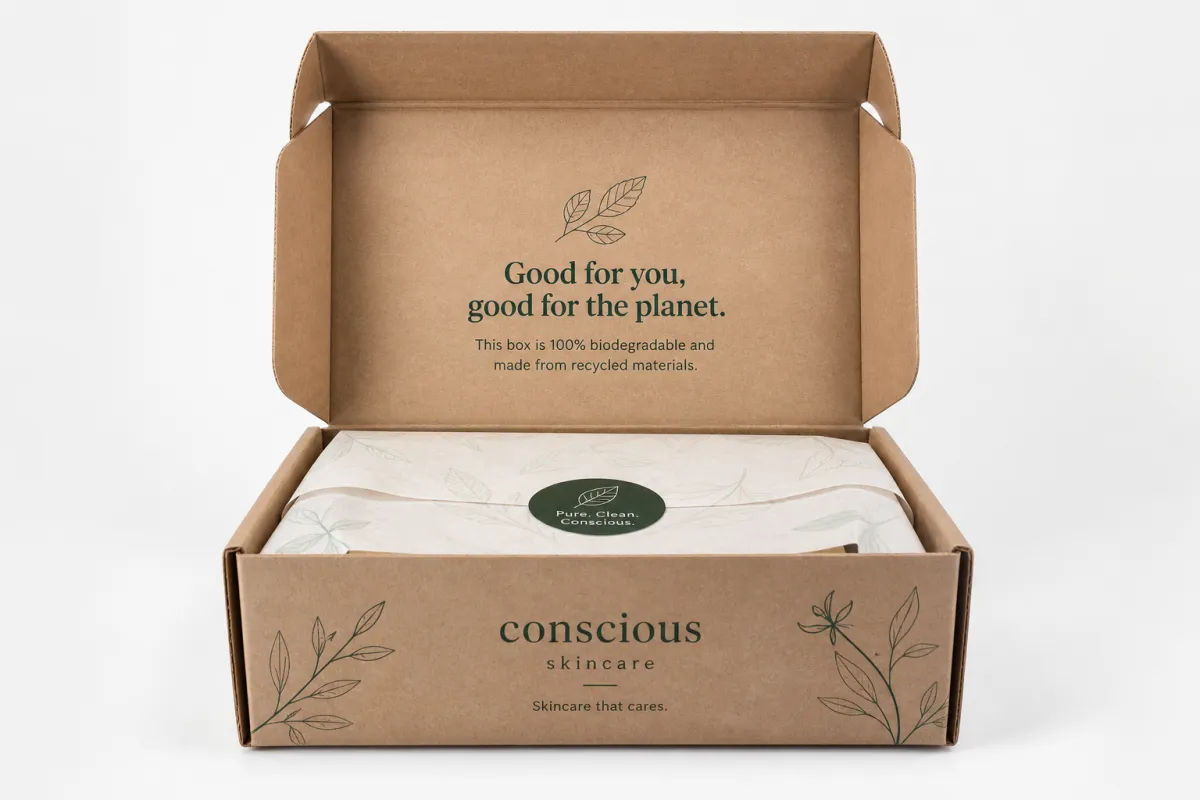
Biodegradable subscription boxes are boxes made from materials that microorganisms can break down over time, usually into water, carbon dioxide, biomass, and other natural compounds. Clean idea. Messy reality. The whole package matters, not just the carton. A box with biodegradable board can still fail if it uses plastic tape, a polyethylene window, a glossy lamination, or a liner that does not break down at the same pace.
People mix up biodegradable, compostable, recyclable, and recycled-content packaging all the time. That is how bad buying decisions get dressed up as sustainability wins. Biodegradable means a material can break down biologically. Compostable means it meets a defined composting standard, usually under controlled conditions. Recyclable means it can re-enter a recycling stream if the local system accepts it. Recycled-content means some portion of the material came from post-consumer or post-industrial feedstock. Those labels are not interchangeable, no matter how often marketing tries to blur them.
For subscription packaging, the bar is higher than for a static retail carton. The box gets handled by a fulfillment team, tossed into a parcel network, opened in seconds, judged immediately, and then sent to a kitchen bin or a recycling cart if the customer can be bothered. That means biodegradable subscription boxes need to do two jobs at once: survive shipping and still make sense at end of life. If either side fails, the sustainability story starts to wobble.
So the real question is not whether biodegradable subscription boxes are good or bad. It is whether they are engineered for the right disposal path, with the right structure, and with honest labeling. A brand that sells refills or consumables can get this right. A brand that slaps an eco badge on a box and ignores the tape probably cannot.
A box is only as sustainable as its least sustainable component. The board can be perfect, and the plastic-coated label can still ruin the claim.
For brands comparing structural options, it helps to think in terms of the full pack-out system. If you are also redesigning inserts, sleeves, or shipping cartons, our Custom Packaging Products page is a useful place to compare structures without guessing what each component does in transit.
How Biodegradable Subscription Boxes Break Down
Biodegradable subscription boxes do not disappear because someone printed a leaf icon on the lid. Decomposition depends on moisture, heat, oxygen, microbes, and time. In an industrial composting facility, you usually see temperatures around 55-60 C, active aeration, and controlled moisture. In a home compost pile, the process is slower, less consistent, and much more sensitive to what else is in the bin. If the material never reaches the right conditions, it may just sit there and age politely.
The first thing to break down is usually the easiest-to-access fiber, not the entire structure at once. Edges, uncoated paperboard, and loose paper inserts tend to go sooner. Coatings, pressure-sensitive adhesives, dense print coverage, window films, and wet-strength additives slow things down. A water-based ink can be fine, but a heavy UV coating or a plastic film layer can change the story fast. That is why biodegradable subscription boxes have to be judged by component, not by the outer carton alone.
Industrial composting and home composting are not the same game. A material that is certified for industrial composting may still be a terrible fit for a backyard bin. The difference matters because many brands assume "biodegradable" means "throw it in any compost and nature will handle the paperwork." That is not how it works. If your customer is in a city with no commercial compost pickup, your disposal instructions have to match reality, not wishful thinking.
Here is a practical example: a monthly skincare brand ships a kraft mailer with molded fiber inserts, a PLA film sachet, and paper labels. The mailer body may break down well in composting conditions, but the sachet and label adhesive could be the slowest pieces in the stack. If the brand ships nationwide, the box may also spend several days in heat, cold, and compression before it is opened. So biodegradable subscription boxes are not just a materials decision. They are also a shipping, fulfillment, and consumer-instruction decision.
I have also seen the opposite happen: a brand approved a beautiful compostable mailer, then switched to a cheaper tape midway through production because the procurement team was trying to save pennies. That tiny change turned into a support headache, because customers were left guessing what could go in compost and what had to be removed first. Small substitutions are where these programs get kinda messy.
If you want a basic external reference on end-of-life systems, the EPA's composting guidance is a useful starting point. It will not make the packaging decisions for you, but at least it reminds people that disposal systems have rules.
Key Materials and Design Factors That Change the Result
Biodegradable subscription boxes usually start with a substrate choice, and that choice sets the tone for everything else. Molded fiber works well for inserts and protective trays because it is strong, light, and easy to justify at end of life. Kraft board is the workhorse for folding cartons and mailers, especially when you want a clean, matte look without extra plastic. Bagasse, which comes from sugarcane fiber, can be a good fit for food-adjacent kits or compartments. PLA-based films can work for windows or pouches, but they need careful specification because "plant-based" is not the same as "will vanish anywhere."
Then come the design decisions that either protect the package or quietly sabotage it. Box thickness affects crush resistance and shipping survival. Closure style affects how much tape you need. Print coverage affects drying time, cost, and sometimes breakdown performance. Inserts matter because a beautiful outer carton does nothing if the product rattles around inside and arrives damaged. With biodegradable subscription boxes, the most expensive mistake is usually not the material itself. It is a pretty design that ignores compression, edge crush, or drop behavior.
Finish is where brands often get slippery. A soft-touch plastic lamination feels nice, sure, but it also creates a barrier that can undermine biodegradation. Spot UV can look premium, but it is another layer that needs a reason. Foil stamping is not automatically disqualifying, yet it should be treated like a design tax, not a default choice. If the goal is truly sustainable packaging, every decorative layer has to justify its existence in performance terms. That is a less glamorous sentence, but it is the correct one.
Ask suppliers for documentation before you approve anything. You want substrate specs, adhesive type, ink system, coating details, and proof of certification where appropriate. For paper-based packaging, FSC certification can help confirm the fiber comes from responsibly managed forests. For compostability claims, ask whether the system meets standards such as ASTM D6400 or ASTM D6868, and ask whether that claim applies to the whole package or only to one component. Biodegradable subscription boxes are credible only when the paperwork matches the physical build.
| Material option | Typical unit cost at mid-volume | Best use case | Tradeoffs |
|---|---|---|---|
| FSC kraft mailer, no lamination | $0.45-$0.90 | Light-to-medium subscription shipments | Simple, affordable, but less moisture resistant |
| Molded fiber insert with kraft sleeve | $0.70-$1.40 | Fragile products, premium presentation | Higher tooling and setup time |
| Bagasse tray or clamshell | $0.80-$1.60 | Food, wellness, and product compartments | Bulkier, less flexible for dense pack-outs |
| PLA film window or pouch | $0.65-$1.25 | Visibility without a full plastic tray | Needs careful end-of-life validation |
That table is not a quote sheet. It is a buying map. Low-volume custom work usually lands at the top of those ranges, and better print coverage, custom inserts, or specialty tooling can push prices higher. With biodegradable subscription boxes, the smarter move is often to simplify the structure first and spend money where it actually protects the product.
Biodegradable Subscription Boxes: Costs, Pricing, and Tradeoffs
Biodegradable subscription boxes cost more when the spec gets fussy. That is not a moral judgment. It is manufacturing. Material choice, structure complexity, printing method, coating, inserts, and volume all affect the unit price. A plain kraft mailer at 10,000 units may be far cheaper per unit than a custom rigid-style subscription kit at 2,500 units, because setup work and tooling get spread over fewer boxes. Small orders pay the custom tax. Large orders start to calm down.
For many brands, the realistic range looks something like this: a simple Custom Eco Mailer might sit around $0.45-$0.90 per unit at healthy quantities, while a more detailed kit with inserts, multiple print colors, or special die-cuts can land between $0.90-$2.00 or more. That is before freight, warehousing, assembly labor, and any tests you need to prove the design holds up. Biodegradable subscription boxes are rarely expensive for one reason. They get expensive because a lot of little choices stack up.
The obvious tradeoff is price versus proof. A cheaper box that merely looks green is not a savings if it forces you to reprint, replace damaged goods, or walk back a claim after customer complaints. A better spec can cost more upfront and save money later by reducing transit damage, chargebacks, and support tickets. That is especially true for subscription brands with recurring shipments, because a weak pack-out keeps making the same mistake every month. Nobody needs that kind of loyalty.
Hidden costs are where the budget usually gets surprised. Storage space matters if the box ships flat but the inserts do not. Freight matters because larger fiber-based structures can be bulky. Testing matters because an ISTA transit failure can wreck a launch schedule. Customer education inserts also matter; if you need to explain compostability, recycling, or disposal, that extra card costs money but can prevent misuse. For a brand refining its assortment, looking through Custom Packaging Products can help compare structures before the final quote lands on your desk.
There is also a brand tradeoff that buyers should say out loud: the most sustainable box is not always the fanciest one. Sometimes a straightforward kraft mailer with smart internal protection beats a decorative build with three materials and a glossy finish. Biodegradable subscription boxes work best when the design stays honest, the structure stays efficient, and the marketing team resists the urge to add flourishes just because they look nice in a slide deck. That restraint is not boring. It is usually what keeps the whole thing from getting weird.
Step-by-Step Process and Production Timeline
Biodegradable subscription boxes should be planned in stages, not guessed into existence. Start with the brief: product weight, dimensions, shipping method, unboxing goals, and disposal target. If the brand wants compostable packaging, say whether that means industrial composting or home composting. If the product is fragile, say that too. Vague goals produce vague packaging, and vague packaging is expensive in a very boring way.
Next comes structure and material selection. That stage is where the biggest sustainability choices should happen, before artwork gets too far along. If you lock in a full-bleed design on a board that cannot tolerate the ink load or the coating you wanted, you will spend time revising the spec later. Typical sample turnaround is often 5-10 business days for straightforward structures and longer for custom tooling. Production lead times after approval are commonly 12-20 business days for simpler runs, though complex packs can take longer. Biodegradable subscription boxes do not punish patience, but they absolutely punish late changes.
Then test. Not someday. Now. A decent packaging program checks dimensional fit, edge crush, closure security, and shipping durability before launch. For parcel distribution, ask for drop, vibration, and compression testing, and align it with an ISTA method where appropriate, such as ISTA 3A for parcel shipments. If the box fails transit, the fact that it is biodegradable will not console the damaged serum, broken jar, or bent candle.
A practical launch checklist can keep the process sane:
- Confirm product dimensions, weight, and breakability.
- Choose the disposal path: industrial compost, home compost, recycling, or a mixed system with clear instructions.
- Approve board, coating, tape, and insert materials together.
- Request a physical sample before final artwork sign-off.
- Run a transit test with filled packs.
- Check assembly speed at fulfillment.
- Print disposal copy on the box or insert.
That checklist sounds basic because it is. The problem is that people skip basic steps and then act surprised when the box does not perform. Biodegradable subscription boxes are one of those categories where the boring work is the expensive work, and the expensive work is usually the only work that matters after launch.
Common Mistakes With Biodegradable Subscription Boxes
Biodegradable subscription boxes fail most often because one component was ignored. The classic mistake is claiming the box is biodegradable while the tape, label adhesive, coating, or window film is not. That is not a small miss. It can change how the whole package is treated by composting facilities and how customers interpret the claim. If the promise covers only the board, say that plainly. If the promise covers the full pack, you need proof for the full pack.
Another common issue is overdesign. Too many layers, too much ink, too many decorative add-ons, too much of the packaging equivalent of a costume. Every extra layer adds cost and can reduce the environmental benefit. Brands often think more embellishment equals better perceived value, but customers usually care more about product protection and clear sustainability than about one more fancy finish. For biodegradable subscription boxes, clean structure usually beats busy structure.
Disposal instructions are another weak spot. If the box belongs in industrial compost only, say that. If the customer needs to remove a label or window first, say that too. If the packaging is recyclable only after tape removal, say it in plain language. Customers are not waste-sorting experts, and they should not have to decode a riddle on the side panel. Vague language like "eco-friendly" or "planet-safe" tells people nothing useful.
Supplier blind spots also cause trouble. Some buyers never ask for test data, never confirm end-of-life conditions, and never check whether the local waste system can actually handle the material. Others rely on a single certificate and ignore the rest of the build. A paperboard shell with the wrong adhesive can still undercut the claim. Biodegradable subscription boxes need a component-by-component review, not a guess and a prayer.
There is a final mistake that hurts the most: choosing a box because it sounds good, not because it works for the product. If the carton crushes in transit, the packaging loses credibility no matter how virtuous the fiber source is. If the insert is too loose, the product rattles. If the box is hard to assemble, fulfillment slows down. All of that is more expensive than it looks, and it usually shows up after launch, which is the worst possible time.
Expert Tips for Launching Biodegradable Subscription Boxes
Biodegradable subscription boxes are easier to get right when you start with the simplest structure that protects the product. That usually means one outer carton, one insert system, and one clear disposal path. Every extra layer needs a reason. If the reason is "it looks premium," that is not enough. If the reason is "it protects a glass jar in parcel shipping," now we are talking.
Test the box in transit before you scale. A pretty prototype that survives a desk demo is not the same thing as a filled carton on a real parcel route. Run drop tests, compression checks, and vibration tests with actual product weight inside. If you are shipping monthly kits, test a few packs with dense and light fill states, because subscription assortments often change from month to month. Biodegradable subscription boxes should be measured against the worst-case pack-out, not the nicest one.
Put disposal copy where people can see it. On-box instructions work better than tiny legal disclaimers hidden on the bottom panel. If the packaging is home compostable, say so clearly and state the conditions. If it is industrial compostable, do not blur that with "biodegradable" unless the spec supports the claim and the labels are precise. A short line like "Remove label and place in industrial composting where accepted" can save a lot of confusion.
Shortlist two or three materials, request samples, and compare landed cost, not just unit price. Landed cost includes freight, storage, damage risk, and assembly time. A slightly pricier board may still win if it folds faster and ships flatter. A cheaper insert may lose if it creates product breakage. If you are rebuilding a whole packaging line, reviewing Custom Packaging Products alongside the sustainability spec can keep the structure and the budget in the same conversation, which is where they belong.
Here is the order of operations I recommend: define the disposal target, select the substrate, lock the structure, sample the box, run the transit test, and then finalize artwork. Do not flip that sequence just because a deadline is staring at you. Biodegradable subscription boxes reward careful spec work, and they punish shortcuts with the kind of problems that look small on paper and expensive in a warehouse.
For brands that want the unboxing to feel considered without pretending the package is doing environmental miracles, biodegradable subscription boxes are a solid path. Choose the Right board, verify the tape and coatings, test the shipping performance, and keep the disposal story honest. Then build the final spec around the real-world route your customers will actually use: the bin, the cart, or the composter, not the fantasy version on the mood board.
FAQ
Are biodegradable subscription boxes the same as compostable boxes?
Not always. Biodegradable means the material can break down over time, while compostable usually means it breaks down under defined composting conditions and within a set timeframe. A box can be biodegradable and still be a bad fit for home compost, so the disposal path matters just as much as the material label.
How much do biodegradable subscription boxes usually cost?
Cost depends on material, print complexity, size, and quantity. A simple custom mailer can land in the lower range at higher volumes, while inserts, specialty coatings, and custom tooling push the price up fast. The bigger the run, the lower the unit price usually gets.
What materials work best for biodegradable subscription boxes?
Molded fiber, kraft board, bagasse, and certain plant-based films are common options. The right one depends on the product weight, shipping route, and disposal system. If the material cannot protect the product or cannot be handled by the intended waste stream, it is the wrong material.
How long does it take to make biodegradable subscription boxes?
A simple project can move from brief to production in a few weeks, but custom structures, samples, revisions, and testing often add time. Delays usually come from approvals, sourcing, and transit testing rather than the run itself.
How can I prove my biodegradable subscription boxes are credible?
Ask for certifications, written specs, and test data for every component, including the board, adhesive, coating, tape, and inserts. If a supplier only offers vague language like "eco-friendly," keep asking until they show exactly what breaks down, where it breaks down, and under what conditions.


