Buyer Fit Snapshot
| Best fit | Branded Carton Dividers Bulk projects where brand print, material claims, artwork control, MOQ, and repeat-order consistency need to be specified before quoting. |
|---|---|
| Quote inputs | Share finished size, material target, print colors, finish, packing count, annual reorder estimate, ship-to region, and any compliance wording. |
| Proofing check | Approve dieline scale, logo placement, barcode or warning zones, color tolerance, closure strength, and carton packing before bulk production. |
| Main risk | Vague material claims, crowded artwork, missing packing details, or unclear freight terms can make a low unit price expensive after revisions. |
Fast answer: Branded Carton Dividers Bulk: Specs, Pricing, Lead Time should be specified like a repeatable production item. The safest quote records material, print method, finish, artwork proof, packing count, and reorder notes in one written spec.
Production checks before approval
Compare the actual filled-product size with the drawing, then confirm tolerance on folds, seals, hang holes, label areas, and retail display edges. Reserve space for logos, QR codes, warning copy, and material claims before decorative graphics fill the panel.
Quote comparison points
Review material grade, print process, finish, sampling route, tooling charges, carton quantity, and freight assumptions side by side. A quote is only useful when the supplier can repeat the same color, closure quality, and packing count on the next order.
Branded Carton Dividers Bulk: Specs, Pricing, Lead Time
If you are buying branded carton dividers bulk, the first number that matters is not the print price. It is the cost of one damaged case. A divider that fits badly, crushes too easily, or shifts in transit can wipe out the savings from a cheap run faster than most procurement teams expect. Packaging does not care that the spreadsheet looked tidy.
The outer carton gets blamed first. In a lot of bad packs, the divider was the real problem.
That is why serious bulk buyers start with fit, board grade, and pack stability before they start arguing about artwork. The right divider keeps products separated, protects the finish, and still gives you a clean branded surface when the carton opens. The wrong one is expensive confetti with a logo on it.
Branded Carton Dividers Bulk: Why They Pay Off Fast
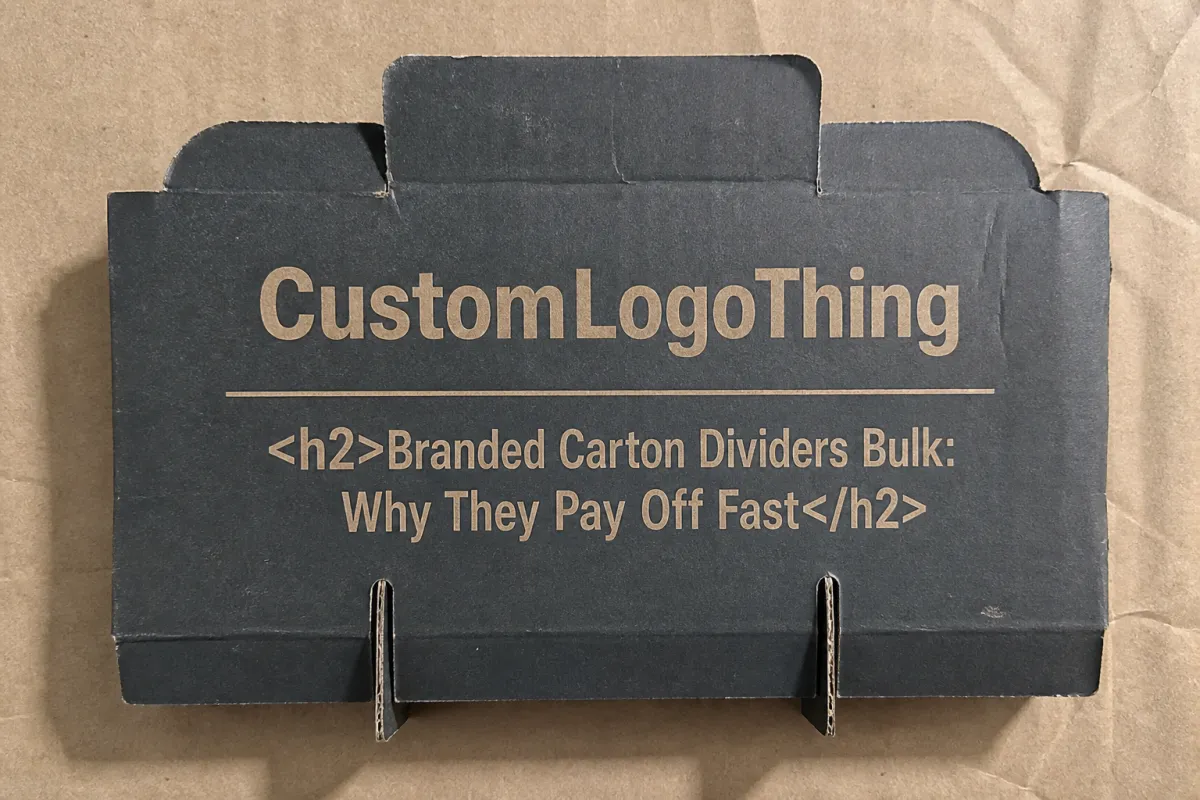
A single damaged shipment can erase the margin on a large order. That is not drama. That is packaging math. If a divider keeps bottles upright, stops glass from knocking together, or prevents cosmetic jars from rubbing during transit, it pays for itself in fewer breaks, fewer returns, and fewer angry emails from customers who expected a usable product.
The branded part matters too, but only after protection is solved. If the structure is weak, a nice logo does nothing except decorate the failure.
Most divider problems do not start with the outer carton. They start with a cell size that is off by a few millimeters or a board that is too soft for the stack load. A carton can look fine on a pallet and still fail if the internal partitions let the product move. Bulk buyers usually notice this the hard way: crushed corners, scuffed labels, broken closures, or one item leaning into another after a long freight leg.
From a buyer's point of view, branded divider inserts are a protection-and-presentation purchase. You are trying to do three things at once:
- Keep products separated and stable in the shipper.
- Keep the branded surface visible where it helps.
- Keep landed cost low enough that the pack still makes sense at scale.
That tradeoff is why branded carton dividers bulk orders can work well for both shipping and retail presentation. A simple printed mark, handling instruction, or logo can make a pack feel more organized without forcing you into heavy ink coverage or special finishes. Clean branding usually ages better than trying to turn an insert into a billboard.
I see the same mistake over and over: buyers compare divider quotes as if the only variable is unit price. It is not. A divider that saves three cents but causes a two percent damage rate is not cheap. It is a problem with invoice formatting.
Product Details: What Branded Carton Dividers Actually Are
Carton dividers are internal packaging components that separate products inside a shipper or retail carton. They may be flat sheets, cross-grid partitions, removable inserts, or custom layouts built around a specific item size. Their job is simple: stop contact, reduce rattling, and keep the contents aligned during packing and transit.
The design changes a lot depending on the product. A divider for wine bottles is not the same as one for glass vials, small electronics, or jarred cosmetics. Bottle packs often use cross-grid structures that create individual cells. Electronics may need more cushioning and tighter tolerance. Cosmetics usually need a cleaner presentation and better print visibility because the opening experience matters almost as much as the shipping result.
Here are the most common configurations buyers request:
- Full cross-grid dividers for bottles, jars, and other upright items that need cell-by-cell separation.
- Half-slotted partitions for packs that need quick assembly and a simpler blank layout.
- Removable divider sets for reusable cartons or refill packs.
- Custom inserts for odd-sized products, mixed SKUs, or fragile items with specific clearance needs.
Branding can be subtle or highly visible. A simple logo, SKU mark, QR code, handling icon, or short printed message is often enough. For many buyers, the best result is a divider that quietly reinforces the brand while doing its real job. The divider should not fight the packaging workflow. It should make it cleaner.
Compatibility matters more than decoration. You need the divider to match carton internal dimensions, product weight, stacking pressure, and the way the line packs the box. If the divider has to lock into a tray, that changes the design. If it only sits inside the carton, tolerance becomes even more important because loose fit creates movement. A pretty graphic does nothing if the load shifts before it reaches the customer.
One practical rule helps in almost every project: choose the divider for the product, not the other way around. Start with the item size, pack weight, and transit risk. Then design the insert. That order saves time, money, and a pile of sample revisions.
Material, Size, and Print Specifications
If you want a quote that is actually useful, lock down the specs first. The biggest variables are board grade, flute or sheet thickness, sheet dimensions, cell count, and print coverage. Leave those fuzzy and every supplier will make different assumptions. That is how quotes turn into arguments.
Material choice usually falls into a few practical buckets. Corrugated board is the workhorse for strength and crush resistance. Paperboard is lighter and usually better for cleaner print, but it is not the first choice for heavy loads. Coated or treated options make sense when moisture resistance or graphic sharpness matters more than raw stiffness. Recycled content can be a good call too, as long as the structure still holds up.
Moisture resistance deserves a reality check. It helps, but it is not the same as waterproofing. If the cartons will sit in a humid warehouse, travel through cold-chain conditions, or get handled on a damp dock, specify the environment up front. That detail changes the stock recommendation and the print method.
| Material Option | Typical Spec | Best Use | Tradeoff |
|---|---|---|---|
| Single-wall corrugated | E-flute, B-flute, or similar light-to-medium board | General shipping, lighter bottles, retail shipper inserts | Good protection, but bulkier than paperboard |
| Double-wall corrugated | BC-flute or similar heavy-duty construction | Heavy glass, stacked cartons, long-distance freight | Higher cost and more space in the pack |
| Paperboard | Approx. 18pt to 24pt SBS or kraft board | Lighter products, retail-facing inserts, cleaner print | Less compression strength than corrugated |
| Coated or moisture-resistant board | Printed or treated surface with added protection | Humidity exposure, warehouse storage, clean branding | Usually costs more than uncoated stock |
Size tolerance is not a small detail. It is the thing that decides whether the divider feels precise or sloppy. In bulk production, even a few millimeters of error can create loose cells, pinched product, or assembly problems. If the insert has multiple pockets, the cumulative error gets worse as the count rises. One pocket a little off is annoying. Twenty pockets a little off is a production miss.
Print choices are usually straightforward, but the tradeoffs are real. One-color flexo keeps costs down and works well for handling marks, simple logos, or line identifiers. Spot-color branding is a good middle ground when you want a cleaner look without paying for full coverage. Full print can look sharp, but it adds setup, ink usage, and approval time. Double-sided printing is possible too, though it usually makes sense only if both sides are visible during opening or packing.
A few practical spec questions deserve answers before production starts:
- Does the divider need to survive humidity or cold-chain storage?
- Is the product food-related, and if so, does it need food-contact-safe materials?
- Does the retailer require a specific board grade or recycling claim?
- Will the pack be tested to an ISTA profile or a retailer drop spec?
For shipping validation, it helps to check the expected distribution environment against recognized standards such as ISTA test methods and common carton performance expectations. If recycled sourcing or chain-of-custody matters, ask for documentation tied to FSC requirements. That is the boring paperwork that keeps procurement teams out of trouble later.
The more complex the insert, the more scrutiny it needs before bulk production. Custom die lines, tight cell geometry, coated stock, and multi-color print all deserve sample approval. Skipping that step to save a few days usually costs more than it saves.
Pricing, MOQ, and Unit Cost Factors
Price depends on material, print method, divider complexity, sheet size, and total order volume. That list is not glamorous, but it is real. If someone gives you a price without asking about the carton dimensions or product weight, they are guessing. A quote built on guesses is not a quote. It is a future correction.
MOQ changes the math fast. Simple unprinted dividers may start at lower quantities because the tooling and setup are lighter. Custom-printed inserts, especially those with tight dimensions or multiple cut lines, often need a higher starting quantity to make production sensible. That is why branded carton dividers bulk pricing usually improves sharply as volume rises. The setup gets spread across more units, and the unit cost stops looking ugly.
| Order Volume | Simple Unprinted Divider | Printed Custom Divider | Notes |
|---|---|---|---|
| 500-1,000 units | $0.18-$0.45 | $0.30-$0.75 | Setup cost has a big effect; good for test runs |
| 2,000-5,000 units | $0.10-$0.28 | $0.20-$0.50 | Better balance of setup and per-unit cost |
| 10,000+ units | $0.05-$0.18 | $0.12-$0.35 | Volume starts doing the heavy lifting |
Those are working ranges, not promises. Heavy board, double-sided print, moisture resistance, and custom die work can push prices higher. Very simple layouts, single-color branding, and repeat orders can push them lower. Freight also matters. A low factory price can still land badly once pallet count, carton packout, and delivery distance are added in.
Buyers sometimes miss the hidden cost of the cheap divider. The unit price looks attractive, then the pack line slows down because the insert is awkward to fold. Or the product needs extra void fill because the cells are loose. Or damage claims go up. Suddenly the "savings" are just budget theater.
Ask for a quote that shows more than one number. Good suppliers should be able to give you:
- Tiered pricing by quantity, so you can see where the real breakpoints are.
- Sample cost if a physical prototype or pre-production sample is needed.
- Lead time from proof approval, not just from the date of inquiry.
- Freight terms so you know whether the number includes shipping or only ex-works production.
- Assembly assumptions if the divider ships flat, nested, or pre-glued.
There is one tradeoff nobody likes to hear but everybody learns eventually: the cheapest divider can become the most expensive option if it causes product damage or slows packing. That is why the quote comparison should include landed cost, packing efficiency, and risk, not just the factory number on the page.
Process, Timeline, and Production Steps
A clean divider order usually follows a predictable path. First comes spec review. Then artwork check. Then structural confirmation. Then sampling. Then approval. Then production. Then packing and shipment. The order looks basic because it is basic. The trouble starts when people skip a step and hope the carton will forgive them later.
- Inquiry and spec review - carton size, product dimensions, quantity, and print needs.
- Artwork and structure check - logo placement, barcode or QR code needs, cell count, and die line confirmation.
- Sampling or proofing - physical sample or pre-production proof, depending on complexity.
- Approval - final sign-off on dimensions, print, and pack method.
- Production - cutting, printing, folding, and any glue or assembly steps.
- QC and packing - dimensional checks, count verification, bundle packing, palletizing.
- Shipment - freight booking, export packing if needed, delivery coordination.
Most delays come from a short list of avoidable problems: unclear carton dimensions, artwork that is not final, late revisions after sampling, or vague expectations about how the divider should assemble. If the customer changes the carton size after the sample is approved, the timeline resets. That is not bad luck. That is a scope change.
A realistic timeline depends on the job. Repeat orders with locked specifications can move quickly because the tooling already exists and the print setup is known. Custom die-cut inserts with printed surfaces take longer because the design has to be validated first. A typical bulk run might look like this:
- Proof approval: 1-3 business days if artwork is ready.
- Physical sampling: 3-7 business days, depending on complexity.
- Production: often 10-20 business days after approval for standard bulk jobs.
- Freight: additional time based on destination and mode.
There are simple ways to speed things up. Send clean dielines. Use approved brand assets. Include the actual internal carton dimensions, not the outer shipping box. Tell the supplier whether you need a sample before production starts. Decide early whether the order is meant for a one-time launch or repeat replenishment. That last point affects how the lot is packed and how the run is planned.
Production control matters as much as production speed. A pre-production proof catches layout mistakes before the full run starts. First article inspection confirms the first units match the approved sample. Final QC checks dimensions, print registration, and pack count. If the supplier cannot explain where those checks happen, keep looking.
Timeline confidence depends on locked specs, not optimism. Hope is nice. Measurements are better.
Why Choose Us for Bulk Divider Orders
Bulk divider orders should feel boringly reliable. That is the target. No surprises. No mystery spec changes. No pile of rework because the insert looked good on screen but failed in the carton. The value here is practical: custom sizing, print support, bulk consistency, and packaging advice that helps you avoid mistakes before they get expensive.
Good manufacturing experience shows up in the details. Better board recommendations reduce collapse risk. Better cell sizing reduces movement. Better print guidance keeps the branding readable without making the part harder to produce. Those are not flashy benefits. They are the reasons one supplier gets reorder business and another gets ignored after the first mess.
Quality control should be easy to understand. Dimensions should stay consistent across the run. Cuts should be clean. Fold lines should hold. Stacks should pack square. Bundles should survive transit without warping, splitting, or absorbing too much moisture. If the order is for shipping cartons, the divider has to arrive ready for use, not ready for a second round of sorting.
For buyers who place repeat orders, we can support replenishment without reworking the entire setup every time. That matters more than people admit. A stable spec saves procurement time, reduces approval cycles, and keeps the line running when volume picks up. If you need a recurring supply plan, our Wholesale Programs are built for exactly that kind of repeat buying.
If you want proof instead of promises, our Case Studies show how different packaging jobs get handled in the real world. Beverage brands need one kind of cell structure. Cosmetic brands need another. Electronics are their own headache. The point is not to force one style onto every carton. The point is to match the structure to the job.
We also pay attention to packaging logistics that are easy to overlook: export-friendly packing, clear pallet counts, and documentation support when a buyer needs it. A neat production run is useful. A neat production run that arrives correctly and clears the receiving dock is better.
How to Order: Next Steps Before You Request a Quote
Before you request pricing, gather the basics. The more complete your brief, the faster the quote will be and the fewer revisions you will need later. Start with the carton internal dimensions, then add product dimensions, product weight, branding needs, and target quantity. If the product is fragile or unusually heavy, say so right away.
If possible, send reference photos or a sample carton. Real packaging problems are easier to solve when someone can see the actual pack-out, not just a spreadsheet. A photo of the product inside the carton can reveal clearance issues, orientation problems, or a handling problem that is not obvious from measurements alone.
The three decisions that make quoting faster are simple:
- Board choice - corrugated, paperboard, coated stock, or moisture-resistant material.
- Print requirement - one-color mark, spot branding, or full print coverage.
- Sampling need - proof only, or physical sample before full production.
Once those are fixed, comparing quotes gets easier. Do not compare the low number alone. Check MOQ, tiered Pricing, Lead Time, sample cost, and whether freight is included. A quote with a slightly higher unit price can still win if it ships faster, needs less hand assembly, or reduces product loss.
A good buying sequence looks like this: choose the spec, request a tiered quote, approve a sample if needed, then move into production. That is the whole thing. The rest is paperwork and patience. If you are ordering branded carton dividers bulk, lock the spec first and the run becomes straightforward. Guess first, and you will pay for the guess later.
Frequently Asked Questions
What is the typical MOQ for branded carton dividers bulk orders?
MOQ depends on material, print complexity, and whether a custom die is required. Simple unprinted or lightly printed dividers can often start lower, while highly customized inserts usually need a larger starting quantity to make the setup worthwhile. Ask for tiered pricing so you can see how the unit cost drops as volume increases.
How do I choose the right size for branded carton dividers bulk?
Start with the carton's internal dimensions, not the outer box size. Then measure the product pocket or cell size based on item width, height, and the clearance needed to stop movement. If the product shifts in transit, the divider size is wrong, no matter how good the print looks.
Can branded carton dividers bulk be printed on both sides?
Yes, but both-side printing usually increases setup and production costs. Double-sided print makes sense when the divider is visible during opening or packing. If one side is hidden inside the carton, print only the exposed face and keep the money in the budget where it belongs.
What affects lead time for branded carton dividers bulk orders?
Lead time is driven by artwork approval, sampling needs, material availability, and production volume. Complex die cuts or custom print setups add time before the run starts. The fastest orders are the ones with locked specs and no last-minute revisions.
Are branded carton dividers bulk suitable for fragile or heavy products?
Yes, if the board grade, cell structure, and carton fit are specified correctly. Fragile items need tighter spacing and stronger retention, while heavy items need better compression resistance. For glass, cosmetics, or electronics, sample testing is worth it before full production, because branded carton dividers bulk only pay off when they actually control movement and protect the product.