Buyer Fit Snapshot
| Best fit | Branded Edge Protectors for Pallets projects where brand print, material claims, artwork control, MOQ, and repeat-order consistency need to be specified before quoting. |
|---|---|
| Quote inputs | Share finished size, material target, print colors, finish, packing count, annual reorder estimate, ship-to region, and any compliance wording. |
| Proofing check | Approve dieline scale, logo placement, barcode or warning zones, color tolerance, closure strength, and carton packing before bulk production. |
| Main risk | Vague material claims, crowded artwork, missing packing details, or unclear freight terms can make a low unit price expensive after revisions. |
Fast answer: Branded Edge Protectors for Pallets: Design to Delivery should be specified like a repeatable production item. The safest quote records material, print method, finish, artwork proof, packing count, and reorder notes in one written spec.
Production checks before approval
Compare the actual filled-product size with the drawing, then confirm tolerance on folds, seals, hang holes, label areas, and retail display edges. Reserve space for logos, QR codes, warning copy, and material claims before decorative graphics fill the panel.
Quote comparison points
Review material grade, print process, finish, sampling route, tooling charges, carton quantity, and freight assumptions side by side. A quote is only useful when the supplier can repeat the same color, closure quality, and packing count on the next order.
Branded Edge Protectors for Pallets: Design to Delivery
Branded Edge Protectors for pallets usually get treated like background noise. Small part. Small budget. Easy to ignore. Then a corner crushes, a strap bites through a carton, and a shipment that looked fine at wrap-up arrives looking like it lost an argument with gravity. Not ideal brand theater.
Damage tends to start at the edges. One weak corner can trigger load shift, torn film, broken product, and a receiving team that now has to deal with a problem that should have been prevented before the truck moved. That is the real value of a good edge protector. It handles the ugly physics so the rest of the load can stay boring.
Branded edge protectors for pallets do more than carry ink. They reinforce corners, guide handling, and keep the shipment looking deliberate instead of improvised. A printed protector can carry a logo, a lot code, a handling cue, or a color band that makes sorting easier at the dock. The piece is small. The effect is not.
For packaging buyers, the real test is simple: does the spec fit the load, does the print survive the lane, and does the program earn its keep? Pretty artwork is nice. Pretty artwork that survives compression, wrap tension, and warehouse abuse is better. That is the bar here.
What branded edge protectors for pallets do and why they matter
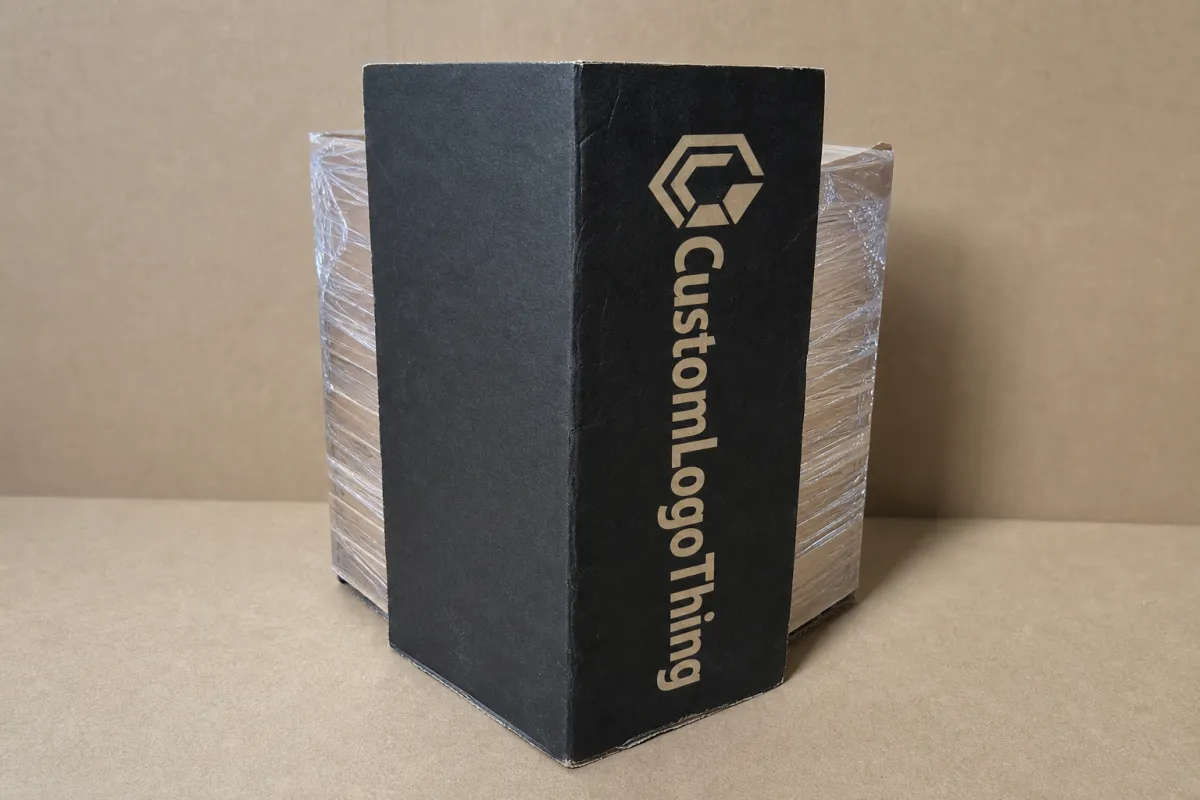
At a basic level, edge protectors are reinforced paperboard or corrugated angles placed on the corners and edges of a palletized load. Their job is to spread force across a wider surface so straps, stretch film, and stacking pressure do not crush one narrow point. Load distribution comes first. Branding comes after. If the structure fails, the print is just decoration on a damaged shipment.
That order matters more than people want to admit. A pallet can look neatly wrapped and still fail under tension. A strap can cut into the edge of a carton. A top load can press down unevenly. One corner can buckle just enough to loosen wrap and start a chain reaction. After that, the stack leans, the film slips, and the receiving dock gets stuck dealing with the mess.
Printed versions add a second layer of value. The logo or message turns a utility component into a visible brand signal. On a dock, in a cross-dock lane, or at retail receiving, the protector may be one of the few things still visible once the cartons are plain and the wrap has gone cloudy. That makes branded edge protectors for pallets useful for recognition, lot identification, and a cleaner presentation without changing the palletizing process.
They also work as part of a larger packaging system. In many programs, the protector sits alongside stretch wrap, straps, slip sheets, top caps, or corner posts. Used properly, it supports the whole load. Used lazily, it becomes a board with a logo on it and little else. That is why teams should spec it as part of the shipment, not as an afterthought.
Compared with unbranded versions, the physical protection may be the same idea, but the business impact changes. Plain corner boards do the quiet work. Printed boards do the same work and also signal ownership, handling discipline, and supply chain control. For brands that care how a shipment reads before anyone opens it, that difference matters.
Procurement rule of thumb: if the protector cannot survive the same force that damaged the load, the artwork is not the problem. The structure is.
Branded edge protectors for pallets are not about dressing up cardboard. They are about keeping loads square, cutting damage, and making every shipment look like someone actually planned it.
How branded edge protectors for pallets work in transit
The mechanics are simple, which is part of the appeal. An edge protector increases the contact area at the corner, so force gets spread instead of concentrated. A strap that would normally bite into a carton edge now presses against a broader, stiffer profile. Stretch film pulling inward gets more resistance. Stack pressure has a harder time crushing the upper layer.
In the warehouse, the sequence usually runs like this: palletizing, protector placement, wrapping or banding, staging, loading, transit, unloading, and receiving. Every one of those steps adds vibration, movement, or pressure. Even a load that starts square can drift. A well-chosen protector helps keep the structure where it belongs.
The printed surface usually lasts better than people expect. The graphic is not sitting on a carton face that gets rubbed by conveyors, pallet forks, or neighboring boxes. It is on the protector itself, so the message remains visible even when the outer packaging is plain or the wrap is scratched. A logo, a color strip, or a handling cue can still be readable when the shipment reaches receiving. That is more than many carton panels can claim after a trip through distribution.
Operationally, the print can do more than mark the brand. It can carry a lot ID, a lane color, a top-load warning, or a simple receiver cue. That matters in facilities where multiple SKUs travel to different customers or where receiving teams need to sort fast without squinting at tiny labels through film.
Geometry deserves attention too. Long loads need longer legs or extended angles. Tall stacks often need heavier caliper board because the top layers create more compression. Fragile corners may need a protector that reaches far enough to cover the real impact zone, not the one that looks good on a sketch. Too short leaves the edge exposed. Too long or too stiff can interfere with wrap patterns, labels, or automated handling.
Testing keeps the spec honest. Transit simulation from ISTA gives useful clues about how the pack behaves under distribution hazards, while compression and top-load behavior can be checked with standard methods such as ASTM protocols like D642 or D4169, depending on the program. If your supply chain depends on recycled or certified fiber, FSC documentation may also matter when a retailer or customer wants proof instead of a promise.
The practical answer is simple: the best branded edge protectors for pallets are matched to product weight, wrap force, stack height, transport route, and handling style. The art matters. The physics decides whether the art gets to stay in one piece.
Key factors that shape performance, branding, and durability
Material choice sets the baseline. Recycled paperboard is common because it balances stiffness, cost, and recyclability. Corrugated board can add thickness and some cushioning. Laminated surfaces can improve print quality and moisture resistance. Coated stock can make graphics look sharper, but it can also change how the board behaves in humidity or after a cold-to-warm temperature swing.
Board grade is not a throwaway detail. A light-duty protector may look fine in a sample book and still collapse under strap pressure. A heavier grade adds rigidity, but it also adds cost and can be harder to fold or fit around the load. Buyers should ask for basis weight, caliper, recycled content, and any moisture-treatment details instead of settling for a vague “heavy duty” label.
Print method changes the result too. Flexographic printing usually makes sense for longer runs and straightforward graphics, especially when the design uses one or two colors with bold type. Digital printing is often a better fit for short runs, variable data, complex artwork, or frequent updates. If the logo includes tiny text or thin lines, ask how it reads at dock distance. A clean screen proof can turn muddy once it is squeezed onto a narrow pallet edge.
There is a reason many buyers keep the design simple. More colors mean more setup, more room for registration drift, and more chances for the final part to look busy instead of useful. A clean logo, strong contrast, and one clear message usually beat a crowded layout trying to impress marketing. On a pallet edge, clarity wins.
Structural variables deserve the same attention.
- Leg length: Needs to cover the real contact zone where straps, wrap, or stack pressure hit.
- Thickness: Should resist crushing without making the protector awkward for the load geometry.
- Moisture resistance: Matters in cold chain, humid transit, or on docks where loads sit longer than planned.
- Finish: Affects print sharpness, scuff resistance, and sometimes how the protector behaves against film.
- Compatibility: Must work with manual palletizing, semi-automatic wrapping, or a fully automated line.
Branding hierarchy helps make decisions faster. If the protector mainly supports warehouse handling, a logo and a handling cue may be enough. If the load reaches customers or retail distribution centers, the visible face can carry a stronger brand signal. If the shipment is mostly industrial, subtle branding with traceability marks may be smarter than shouting across the pallet. The right answer depends on who sees it first and what action you want them to take.
Sustainability and compliance are practical requirements, not decoration. Recycled content helps if it can be documented. Recyclability claims need to match the actual build. Coatings, adhesives, and laminates can change the end-of-life story in ways that matter to recyclers and to the buyer on the other side of the contract. Clear claims beat broad ones every time.
There is also a commercial upside to getting the spec right. If a retailer requires certain inks, if a food or pharma partner wants cleaner handling marks, or if a supply chain team wants standardized pallet IDs, the protector can carry that information in one place. That turns it into a small piece of operational control, not just a corner guard.
For more examples of how packaging choices show up in real shipping lanes, our case studies show how small shifts in material and print decisions change the final result. The same pattern shows up again and again: the best spec is usually the one that fits the lane you actually run, not the one that sounds polished in a meeting.
Cost and pricing: what drives branded edge protector quotes
Pricing depends on several variables at once, which is why two quotes that look close can land miles apart in practice. Material grade, protector size, print complexity, order volume, coatings, moisture barriers, and whether the shape is standard or custom all pull the number in different directions. Move any one of them, and the unit price moves too.
Branding changes the math in predictable ways. A one-color logo on a standard board usually adds less than buyers expect, especially at higher volumes. Multi-panel art, exact color matching, variable data, or frequent design changes can raise setup costs because the supplier has to handle plates, proofing, or digital workflows differently. That is not a penalty. It is the price of getting it right.
Volume matters just as much. On a small run, setup fees get spread across fewer units, so the per-piece number looks high. On a larger program, the same setup gets diluted and the unit cost usually drops. The catch is that bigger minimums can create storage and cash-flow headaches. A cheap unit price is not cheap if it forces you to warehouse half a year of inventory.
Here is a practical way to compare common options. The ranges below are indicative only, not a universal price card. Real quotes depend on dimensions, board grade, print area, and freight.
| Option | Typical use case | Indicative unit price | Lead-time profile | Notes |
|---|---|---|---|---|
| Plain standard edge protector | Basic pallet loads with no branding requirement | $0.10-$0.20 per unit at mid-volume | Often fastest | Lowest decoration cost, but no logo or handling cue |
| One-color branded edge protector | Most common branded program | $0.14-$0.28 per unit, depending on size and quantity | Usually moderate | Good balance of visibility, cost, and production simplicity |
| Multi-color printed protector | Retail-facing or customer-visible shipments | $0.20-$0.40 per unit | Longer if proofing is detailed | Higher setup and tighter registration control, but stronger visual impact |
| Heavy-duty or moisture-resistant branded protector | Cold chain, humid transit, or high-compression loads | $0.24-$0.55+ per unit | Can extend with sample approval | Better durability, though material choice and finishing raise cost |
Hidden cost drivers show up fast if nobody looks for them. Case pack quantity changes freight density. Minimum order quantity changes how attractive the quote feels. Storage space matters if the product is custom and has to be staged before launch. Production sequence matters too if the supplier has to wait for press time or board supply.
The cleanest way to budget is to price the protector by shipment scenario instead of only by piece price. What does a damaged load cost? What does a customer complaint cost? What does a repack labor event cost? What does a missed receiving window cost? In many operations, one bad shipment wipes out the price difference between a lower-cost plain protector and a slightly better printed one across dozens of loads.
If you want a real-world reference point, our packaging case studies are a useful way to compare what different specs solved and what they missed. A spreadsheet is fine. A spreadsheet plus actual field results is better.
Process and timeline: from artwork to production steps
A good program follows a clear sequence. First comes the brief: pallet size, product weight, stack height, and the route the load will travel. Next comes structural selection, then artwork review, proofing, sample approval, and production. That order matters because the print should follow the physical spec, not the other way around.
- Define the load: Document pallet footprint, carton size, stack height, strap pattern, and any warehouse constraints.
- Choose the board structure: Select leg length, caliper, and finish based on compression and handling conditions.
- Prepare artwork: Keep logos bold, limit tiny copy, and make sure brand colors fit the print method.
- Review proofs: Check bleed, safe zones, registration, and whether the graphic lands where dock workers and receivers will actually see it.
- Approve samples: Test fit on a real pallet if possible, then verify how the protector interacts with wrap and straps.
- Run production: Confirm quantity, packaging format, pallet count, and delivery date before the job releases.
The details that speed things up are dull, which is probably why they are often missing. Pallet dimensions. Product weight. Target compression load. Warehouse conditions. Print file format. Order quantity. If those are ready on day one, the supplier can move faster and burn fewer proof cycles. If they are not, the project slows while everyone waits for the same answers.
Lead times vary, but many standard custom runs land in the 12-15 business day range after proof approval. Add a few days if the job needs physical samples, color adjustments, or special board sourcing. Custom dimensions can extend timing because the cut and form spec is no longer a stock template. If the project has seasonal pressure, pad the schedule. Internal approvals usually eat more time than the vendor ever will.
One practical warning: packaging, operations, and brand teams should sign off together. Packaging cares about load performance. Operations cares about line speed and handling. Brand cares about visibility and consistency. If one group approves alone, the final protector can look polished in a conference room and behave badly on a dock.
Samples are worth the effort. A flat proof tells you almost nothing about how the piece behaves once it is bent, strapped, compressed, and wrapped. A real mockup shows whether the corners sit correctly, whether the print is readable from a distance, and whether the protector fights with label placement or film tension. Fixing that before production is cheap. Fixing it after a truck is booked is not.
Development works best when it sits inside the full shipping program. If the branded protector is launching alongside a new pallet pattern, a new wrap gauge, or a new carton spec, test the whole system together. The protector may be the visible part, but it is only one piece of the load strategy.
Common mistakes when specifying branded edge protectors
The most common mistake is choosing by artwork first. A strong logo cannot rescue a protector that crushes under strap pressure or slides around on the load. Good graphics are fine. They just do not come before fit, strength, and handling compatibility.
Underspecifying dimensions is another expensive miss. If the protector does not cover the actual contact point, the corner still gets damaged. If it is too wide or too rigid, it can fight the wrap or create awkward overlap with labels and carton seams. That sort of mistake looks harmless on a drawing and obvious on the dock.
Overly detailed graphics are risky too. Fine lines, low-contrast text, and delicate gradients often disappear at warehouse distance or on narrow faces. A pallet edge is not a billboard. It is a working industrial surface that has to be read fast, sometimes in poor light, sometimes through film. Strong contrast and a simple layout usually win.
Skipping sample testing is another trap. The real test is not whether the protector looks good in the proof. It is how it behaves under wrap tension, vibration, and handling. One load might survive because conditions are gentle. Another load will expose the weakness immediately. Small differences in product weight or pallet quality can be enough to change the outcome.
Sustainability claims should stay grounded. If the board is recycled content, recyclable, or FSC-certified, the supplier should have the paperwork ready. If there is a coating or laminate, ask whether it changes the recycling story in your market. Vague claims create avoidable risk, especially if the product is going to a retailer with packaging compliance rules.
The easiest way to waste budget is to buy branded edge protectors for pallets without matching the spec to the shipping environment. A load moving twenty miles on a local route is not the same as a load crossing regions with temperature swings, humidity, and multiple handoffs. The spec should reflect that difference.
Expert tips and next steps for a smarter packaging spec
Start with a pilot. One lane. One SKU family. One receiving profile. That gives you a clean read on durability, print visibility, and operator feedback before you expand the program. It also keeps the learning loop short, which matters when packaging changes need to prove themselves fast.
Ask for a spec sheet that ties protector dimensions to pallet type, strap pattern, and product weight. Keep that sheet as a reusable standard. The strongest packaging programs do not re-litigate the same decision every quarter. They document it, use it, and only revise it when the load changes.
Use branding with discipline. Put the logo where receivers see it first. Use high-contrast panels for handling instructions or traceability marks. If the message is trying to do five jobs at once, it probably does none of them well. A clear hierarchy usually beats a crowded design.
- Build a comparison grid: Include protection performance, print quality, unit cost, lead time, and sustainability notes for each quote.
- Test against your actual lane: A warehouse trial beats a mock scenario because it captures the handling pattern you really have.
- Keep visual standards tight: Use the same logo placement and color logic across palletized products so the system feels consistent.
- Review the freight event: Damage that happens during loading or receiving often points to a packaging spec issue, not only a carrier issue.
If the pilot works, extend it. The same visual system can move across other palletized products, which helps purchasing, operations, and receiving teams recognize loads faster. Consistency is underrated. It cuts confusion, and confusion costs money.
For a deeper look at how packaging specs translate into field results, the case studies page is a useful next stop. The best programs usually come from comparing what was promised with what the shipment actually did.
The next move is simple: review one current pallet lane, request a sample, and compare branded edge protectors for pallets against your current unbranded option under the same conditions. If the printed version protects the load, improves recognition, and stays inside budget, it earns the spot. If it does not, the spec needs another pass. Either way, the decision gets better when it is based on real handling, not guesswork.
Frequently asked questions
How do branded edge protectors for pallets differ from plain corner boards?
They perform the same core job of spreading pressure and protecting edges, but branded versions add logos, handling cues, or traceability marks. The printed surface turns a utility item into a visible brand touchpoint without changing the basic shipment flow.
What size should I choose for branded pallet edge protectors?
Base the size on pallet footprint, stack height, and where straps or stretch film will contact the load. A supplier should match leg length and thickness to product weight, compression risk, and shipping conditions instead of guessing from the artwork.
Will printing affect the strength of the edge protector?
Printing itself usually does not weaken the protector if the design stays within the substrate's limits. Heavy ink coverage, special coatings, or decorative finishes can affect cost and may influence material selection, so it helps to review those details early.
What is the usual MOQ or quote driver for custom branded edge protectors?
MOQ often depends on whether the item is a standard size or a fully custom build, plus the print method used. Quotes are usually driven by volume, dimensions, color count, and any special performance requirements such as moisture resistance or higher compression strength.
How long does production usually take for branded edge protectors for pallets?
Lead time depends on proof approval, sampling, artwork revisions, and whether the size is standard or custom. Planning ahead usually shortens turnaround because artwork and structural details can move in parallel instead of waiting on one another.
For packaging buyers, the best result is rarely the cheapest board and rarely the loudest graphic. It is the version that survives the route, keeps the load square, and carries the brand in a way that makes sense to the people receiving it. That is the real value of branded edge protectors for pallets.