Buyer Fit Snapshot
| Best fit | branded jewelry boxes wholesale packaging for packaging buyers comparing material specs, print proof, MOQ, unit cost, freight, and repeat-order risk where brand print, material, artwork control, and repeat-order consistency matter. |
|---|---|
| Quote inputs | Share finished size, material target, print colors, finish, packing count, annual reorder estimate, and delivery region. |
| Proofing check | Approve dieline scale, logo placement, barcode or warning zones, color tolerance, and any recyclable or compostable wording before bulk production. |
| Main risk | Vague material claims, crowded artwork, or missing packing details can create delays even when the unit price looks attractive. |
Fast answer: Branded Jewelry Boxes Wholesale Packaging: MOQ, Samples, Lead Time, and Quote Checks should be specified like a repeatable production item. The safest quote includes material, print method, finish, artwork proof, carton packing, and reorder notes in one written spec.
What to confirm before approving the packaging proof
Check the product dimensions against the actual filled item, not only the sales mockup. Ask for tolerance on folds, seals, hang holes, label areas, and retail display edges. If the package carries a logo, QR code, warning copy, or legal claim, reserve that space before decorative graphics fill the panel.
How to compare quotes without losing quality
Compare board or film grade, print process, finish, sampling route, tooling charges, carton quantity, and freight assumptions side by side. A lower quote is only useful if the supplier can repeat the same color, closure quality, and packing count on the next order.
Branded jewelry boxes wholesale: Packaging That Sells
Branded jewelry boxes wholesale can look like a small line item until you compare the numbers, the shelf impact, and the way customers talk about the package after the purchase. The box gets handled, photographed, gifted, stored, and remembered. The insert card usually gets dropped into a bag or tucked aside. From a packaging buyer’s point of view, the box is never just a container. It shapes margin, presentation, and first impression long before the jewelry itself gets any attention.
A ring in a thin generic carton can read like a low-ticket item even when the piece is well made. Put that same ring in a rigid branded box with a clean logo, a solid closure, and an insert that holds the item snugly, and the perceived value changes fast. That is why branded jewelry boxes wholesale matters for retail counters, gift sets, subscription orders, and ecommerce shipments. You are buying more than packaging. You are buying consistency, protection, and a more polished story at the point of sale.
Branded jewelry boxes wholesale also changes the buying math in a very literal way. Larger orders lower unit cost, cut down on last-minute packaging fixes, and keep the line looking like one brand instead of a mix of unrelated cartons. That matters when you manage multiple SKUs, seasonal collections, or several retail locations. Nobody wants six shades of black because one buyer found a bargain from a supplier that did not match the rest of the program.
The practical version comes next: box styles, materials, print methods, pricing ranges, production timing, and the details that actually move a quote. If you already know your dimensions, you can compare options on our Custom Packaging Products page, review repeat-order support through our Wholesale Programs, or scan setup examples in our Case Studies.
Why branded jewelry boxes wholesale changes the buying math
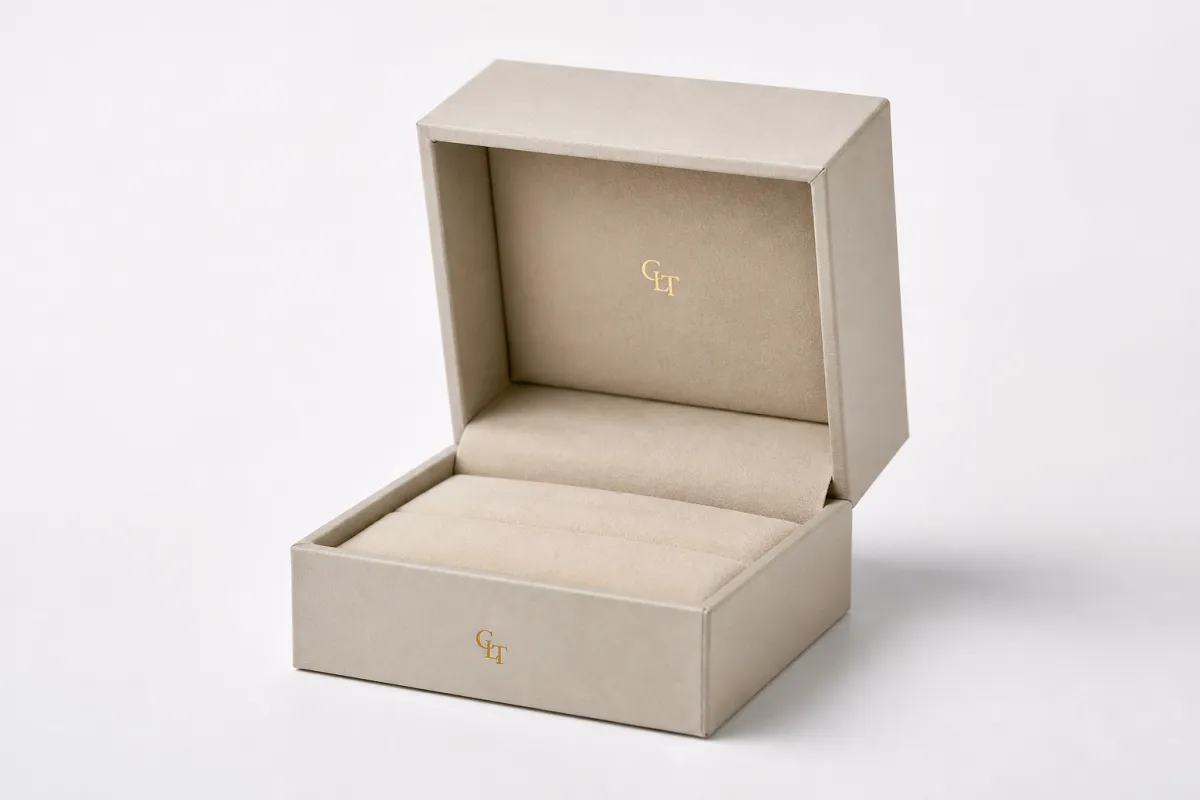
Packaging does more selling than most brands want to admit. In stores, the box sits in a display, gets opened by staff, and gets judged before the jewelry is even touched. Online, the box is photographed, unpacked, shared, and reviewed. Branded jewelry boxes wholesale has a direct effect on conversion, returns, and giftability. A customer may forget the insert card. They rarely forget a box that feels thin, crooked, or flimsy.
Wholesale ordering also gives you control over consistency. Small runs from different vendors tend to drift in color, finish, size, and print quality. The result is a brand presentation that looks scattered, especially when the same collection appears across multiple stores or channels. With branded jewelry boxes wholesale, you lock in one structure, one artwork file, one insert format, and one visual standard. That makes the program easier to manage and keeps brand perception from sliding every quarter.
There is a real customer psychology piece here as well. Jewelry is often bought as a gift, and gifts are judged by presentation. A $40 pendant in a rigid matte box with foil stamping can feel more premium than the same pendant in a plain folding carton. The box does not create value out of thin air, but it strongly affects how much value the customer thinks the item has. That is not fluff. That is retail behavior.
A thin carton can save pennies and cost you the sale. Packaging is usually the first thing the customer touches and the last thing they remember.
Branded jewelry boxes wholesale also lets you build around different sales channels without redesigning everything from scratch. Store display boxes can favor presentation. Ecommerce boxes can put more weight on crush resistance. Gift sets can use a heavier rigid structure. Across a mixed product line, the smartest move is usually to keep the brand look consistent while adjusting the structure by use case. That keeps the line recognizable without forcing every SKU into the same oversized package.
One detail buyers often miss: premium packaging is not always about expensive finishes. Better sizing, cleaner inserts, and stronger closure behavior can matter more than a flashy surface treatment. A ring that rattles in transit looks cheap no matter what the outer box costs. A well-fit box with a consistent close feels deliberate. Branded jewelry boxes wholesale works best when it is planned as a system instead of a random box purchase.
- Retail effect: the box is seen before the jewelry is handled.
- Brand effect: consistent packaging keeps collections looking connected.
- Gift effect: better presentation supports higher perceived value.
- Operational effect: fewer one-off fixes mean fewer headaches later.
Product details that make branded jewelry boxes wholesale work in retail
Branded jewelry boxes wholesale works best when the box type matches the jewelry type. That sounds obvious, yet a surprising number of orders start with the wrong structure. Rings need tight cavities and a low profile. Necklaces need room for chain management. Earrings need a secure insert that keeps pairs aligned. Bracelets and bangles often need a wider footprint so the piece does not press against the lid or sit at a strange angle.
The main box styles break down like this. Lift-off lid rigid boxes remain the classic premium option. Magnetic closure boxes feel upscale and open with a satisfying snap that customers notice immediately. Drawer boxes are useful for layered presentation and gift sets, though they add a little complexity. Folding cartons are cheaper to ship and easier to store flat, but they do not deliver the same weight or tactile feel. Branded jewelry boxes wholesale does not mean choosing the most expensive structure. It means choosing the structure that fits the product, the margin, and the channel.
Interior fit matters just as much as the outside. A loose ring box is a small disaster. The product slides, the presentation looks sloppy, and the customer assumes the piece is lower value than it really is. Common insert options include foam, velvet-wrapped foam, flocked trays, cardboard cavities, and custom-cut holders. For most jewelry, the safest route is a custom insert built to the exact item dimensions, because it holds shape during transport and keeps the unboxing clean.
Exterior branding is where the box starts doing real visual work. Logo printing is straightforward and cost-effective for larger runs. Foil stamping gives you contrast and a more formal feel. Embossing and debossing add depth without relying on heavy ink coverage. Spot UV can highlight logos or patterns, but it works best when the artwork is simple and the base surface is controlled. For branded jewelry boxes wholesale, the strongest finish is usually the one that supports the logo without making the box look busy.
Retail reality matters too. A box has to survive shelf handling, stack pressure, and shipping abuse. If you sell online, the outer presentation has to look polished even after parcel transit. That is where packaging testing earns its keep. A supplier who understands distribution testing, including basic ISTA-style handling logic, is usually safer than one who only talks about “premium feel.” For general packaging principles, the Packaging Association and ISTA are useful references when you want a more technical view of materials and shipping performance.
Common box styles buyers request
- Ring boxes: small, tight-fit structures with a single cavity or mini insert.
- Necklace boxes: wider interior space, often with a carded insert or chain tuck.
- Earring boxes: paired cavities or a tray that keeps sets aligned.
- Bracelet boxes: longer profiles that protect against bending and pressure.
- Set boxes: larger gift boxes for coordinated collections or bundle offers.
When people ask for branded jewelry boxes wholesale, the first question worth asking is simple: what has to happen to this box after it leaves your warehouse? If the answer is “go straight to a boutique shelf,” you can lean harder into display value. If the answer is “ship through parcel carriers,” you need more crush resistance and smarter packing. The clearer the use case, the fewer surprises show up later.
Side by side, the decision usually comes down to presentation, protection, storage, and freight. Those four factors explain most of the price difference. Everything else is decoration pretending to be strategy.
| Box style | Best use | Typical MOQ | Typical unit price | Tradeoff |
|---|---|---|---|---|
| Folding paperboard carton | High-volume retail, light items, lower freight | 500-1,000 pcs | $0.18-$0.45 | Lower cost, lower perceived value |
| Rigid lift-off box | Premium jewelry, gifting, boutique presentation | 300-500 pcs | $0.75-$2.20 | Better feel, bulkier to ship |
| Magnetic closure box | Upscale retail, gift sets, brand launches | 500 pcs | $1.10-$3.50 | Strong presentation, higher material cost |
| Drawer box | Collections, layered unboxing, premium gifting | 500 pcs | $1.20-$3.80 | Nice reveal, more assembly steps |
Specifications, materials, finishes, inserts, and print options
Materials are where branded jewelry boxes wholesale either gains credibility or falls apart. Rigid board is the standard for premium presentation because it holds shape and feels substantial in the hand. Paperboard works better when cost, shipping weight, and flat storage matter more than tactile heft. Specialty wraps, microfiber, faux leather, and soft-touch coated surfaces each bring a different look and feel, but they are not interchangeable. A surface that looks luxurious in a sample can become a poor fit if the print detail is too busy or if the finish hides your logo.
Thickness is not just a line item on a spec sheet. It changes the whole customer experience. A rigid box often uses board in the 1.5 mm to 2.5 mm range, sometimes a little more for larger formats. Paperboard can be much lighter, which helps freight and storage, but it will not give you the same wall strength or closure feel. If you want branded jewelry boxes wholesale to support a premium price point, rigid construction usually makes sense. If your product line moves in volume and margin is tight, a high-quality folding carton may be the smarter tradeoff.
Finishes shape perception very quickly. Matte tends to feel restrained and modern. Gloss can make colors pop, though it shows fingerprints more easily. Textured wraps add tactile interest and hide small handling marks better than smooth coated surfaces. Foil stamping creates contrast and works especially well on dark backgrounds. Embossing adds depth when you want the logo to be noticed without flooding the box with ink. Spot UV can look sharp, but it needs careful artwork control. The more layers you add, the more proofing matters.
Insert choice deserves real attention. Foam is lightweight and simple. Velvet-wrapped foam looks richer. Flocked trays work well for rings and earrings. Cardboard inserts are economical and more recyclable, which some brands prefer. Custom cavities are ideal when you need repeatable fit across a collection. The wrong insert color can make the whole package feel off. A deep black box with a gray insert, for example, can read as unfinished if the brand language is supposed to feel luxurious. In branded jewelry boxes wholesale, the color inside matters almost as much as the logo outside.
Print rules are where many first-time buyers get burned. Logo placement should be fixed early. Pantone references help the factory control color more accurately than loose RGB files. Heavy artwork coverage changes drying, folding, and surface behavior. If your logo has fine lines or tiny type, ask for a proof that shows real size. Some artwork simply does not survive embossing, foil, and tiny registration tolerances at the same time. That is not the factory being difficult. That is print physics.
For brands that care about sourcing, FSC-certified paperboard is worth requesting when the product structure allows it. It does not make a box luxurious by itself, but it does give buyers and retailers a cleaner story about responsible sourcing. If your shipping strategy also matters, look at broader transit guidance from EPA sustainable materials guidance and ask whether the packaging can be right-sized to reduce wasted freight volume. A box that ships efficiently and still looks good is usually the better business decision.
- Rigid board: best for weight, shape retention, and premium feel.
- Paperboard: better for flat packing and lower shipping cost.
- Foil stamping: strong for logos and contrast on dark or matte wraps.
- Embossing/debossing: adds depth without extra color coverage.
- Soft-touch lamination: gives a smooth hand feel, but fingerprints and scuff resistance vary by material.
Branded jewelry boxes wholesale pricing, MOQ, and unit cost
Pricing for branded jewelry boxes wholesale is driven by a short list of variables, and most of them make sense once you stop reading the quote as a single number. Box size matters because larger boxes use more board and more wrap material. Structure matters because rigid boxes require more labor than folding cartons. Finish complexity matters because every extra step adds time, setup, and spoilage risk. Insert type, logo method, and packing requirements also move the price. A simple box with a one-color print and a basic insert will always sit in a different range than a foil-stamped magnetic rigid box with a velvet tray.
MOQ is just as practical. Lower minimums are easier with folding cartons or simpler constructions because the setup burden is lighter. Complex rigid boxes, specialty wraps, or unusual inserts usually push minimums higher. If you want several sizes, colors, or finishes under one brand family, the MOQ can climb because each variation adds its own setup and material allocation. That is why branded jewelry boxes wholesale should be planned around the fewest possible variations that still serve the line well.
Some buyers assume larger runs always create better value. Not always. There is a point where savings flatten out, especially if the design is overbuilt for the product. If you are paying for oversized board, unnecessary foil coverage, or an insert that is far more complex than the jewelry needs, unit cost can stay stubbornly high even at a large quantity. The better move is often to simplify the structure and use the savings to improve the finish or the fit.
Several costs get forgotten in the first round of quoting. Sample fees are common, especially when a pre-production version is needed. Tooling or plate charges apply to some print and foil setups. Insert upgrades can add more than expected if the cavity is custom-cut or velvet wrapped. Shipping cartons matter, because bulky rigid packaging can consume freight quickly. Freight itself can outrun packaging cost if the boxes are large and the lane is expensive. Branded jewelry boxes wholesale only looks cheap if you ignore how it gets packed and shipped.
Quote comparison has to be disciplined. Ask every supplier for the same box size, same material spec, same finish, same insert, same packing method, and the same delivery term. Then compare. If one supplier gives you a low number but leaves out the insert upgrade, the export carton spec, or the sample stage, the quote is not lower. It is incomplete.
A practical way to think about the decision appears below.
| Option | Best fit | Approx. cost driver | Good tradeoff |
|---|---|---|---|
| Simple folded carton | Volume sales, light jewelry, tight margin | Lowest board and labor cost | Easy storage and lower freight |
| Rigid box with paper wrap | Premium retail and gifting | Board, wrap, assembly time | Strong perceived value |
| Rigid box with foil and insert | Brand launch, higher-ticket pieces | Print setup, insert labor, finish complexity | Best presentation-to-cost balance for many brands |
| Specialty surface and custom cavity | Luxury sets, signature collections | Higher material waste and tighter QC | Tailored look, precise fit |
For many buyers, branded jewelry boxes wholesale lands in a rough range of a few tenths of a dollar for simple cartons to several dollars for premium rigid builds, depending on quantity and finish. That range is wide because the design choices are wide. Anyone who gives you one “standard price” without asking about dimensions, insert type, and logo method is not quoting packaging. They are guessing.
Process, timeline, and production steps from proof to shipment
Good packaging work starts with a clean intake. Before anyone quotes branded jewelry boxes wholesale, the supplier should know the product dimensions, item weight, jewelry type, target quantity, logo file format, finish preference, and required delivery date. If those details are missing, the quote will be vague or wrong, sometimes both. The fastest way to slow down a project is to ask for pricing before you know whether the box is meant for a ring, a pendant, or a full gift set.
Proofing is the stage that saves money later. A proper proof includes dieline confirmation, digital mockups, and, for more complex work, a pre-production sample. That sample is not a luxury. It is the cheapest insurance you can buy when the design uses tight insert tolerances, custom foil, odd closures, or exact color matching. One corrected sample is far cheaper than thousands of misfit boxes.
The production flow is usually straightforward: material sourcing, printing, cutting, laminating, wrapping, assembling, quality control, and final packing. Sequencing matters because delays usually happen at the handoff between those steps. If the printed wrap is off-spec, the whole batch stalls. If the insert die is wrong, assembly slows down. If the box closes unevenly, QC catches it late unless the factory is strict. Branded jewelry boxes wholesale should never be treated as a “send file, get boxes” transaction.
Timeline depends on complexity. Simple cartons can move quickly once artwork is approved. Rigid boxes with custom inserts take longer because there are more steps and more chances for rework. Special finishes, unusual board wraps, and multi-part gift sets add lead time. In practical terms, a simple order may run in the 10-15 business day range after proof approval, while more complex rigid builds often need 15-25 business days or more. Shipping time is separate, and nobody should pretend otherwise.
Rushed jobs create avoidable problems. Color drift shows up when the press is pushed. Fit issues appear when dielines are not checked against the actual jewelry sample. Transit damage grows when shipping cartons are too soft or too crowded. If you need branded jewelry boxes wholesale for a launch date, plan backward from the launch date instead of forward from the PO date. That sounds basic, yet it saves more projects than any fancy production promise ever will.
A final note on transit: if your boxes will be parcel shipped, ask whether the packaging has been considered against common distribution stress patterns. The ISTA framework exists for a reason. It helps teams think beyond the shelf and into the abuse that happens between warehouse and customer. If the box is only tested on a desk, it is not really tested.
- Fastest orders: simple structures, limited colors, standard inserts.
- Slower orders: rigid boxes, foil, embossing, custom cavities.
- Best risk reducer: sample approval before mass production.
- Most common delay: artwork revisions after quoting.
Why choose us for branded jewelry boxes wholesale
What buyers usually want is not the most expensive box. They want the right box, delivered on time, at a cost that still leaves room for margin. That is the practical value we bring to branded jewelry boxes wholesale. We match structure to product instead of pushing every customer into a rigid box just because it looks attractive in a sample drawer. Sometimes a well-built paperboard carton with a strong insert is the smarter choice. Sometimes a magnetic closure box is the right move because the brand needs a more elevated unboxing. The point is to fit the packaging to the business, not the other way around.
Repeatable quality control is a big part of that. Jewelry packaging has a short tolerance window. If the lid does not sit straight, the logo is off center, or the insert shifts, the whole package reads as cheap. That is why we pay close attention to closure behavior, print alignment, and insert fit on branded jewelry boxes wholesale orders. Clean packaging makes the jewelry look better. Messy packaging makes the customer wonder what else was rushed.
Communication matters too. A lot of packaging delays come from unnecessary back-and-forth on artwork, finish notes, or unclear size information. Clear intake shortens the process. If you send dimensions, product photos, logo files, finish preferences, and destination details up front, the quoting and sample stages move faster. That is the boring part of packaging, and it is also the part that saves the most time and avoids the most expensive mistakes.
We also support a range of styles and branding methods so you can scale gradually. Some brands start with lower-cost printed cartons, then move into rigid gift packaging as the collection grows. Others need a premium look from day one. Branded jewelry boxes wholesale should support both paths without forcing a supplier change every time your positioning shifts. If you want a closer look at repeat-order structures and program options, our Wholesale Programs page breaks that down in more detail.
For support details, buyers usually care about sample guidance, insert recommendations, carton planning, and export-ready packing. Those are not extras. They are part of a packaging order that lands correctly. If you want proof that those details matter in practice, the patterns in our Case Studies page show how different box structures solve different presentation and transit problems. A good supplier should be able to explain those tradeoffs without hiding behind buzzwords.
And if you need to compare our broader packaging range, our Custom Packaging Products page is the quickest place to see how branded jewelry boxes wholesale fits into a wider packaging lineup.
What buyers usually notice first
- Closure quality: the lid should close evenly and stay shut.
- Print consistency: logos need to stay sharp across the run.
- Insert fit: the jewelry should sit tight, not bounce around.
- Surface feel: the box should feel intentional, not generic.
That is the real difference. Branded jewelry boxes wholesale is not about piling on more decoration. It is about making every box behave the same way, every time, with enough polish that the jewelry inside feels more valuable the moment the lid opens.
Next steps for branded jewelry boxes wholesale orders
If you want branded jewelry boxes wholesale to move smoothly, gather the basics first. You need product dimensions, item weight, jewelry type, logo artwork, finish preference, quantity, and target delivery date. If you already have a reference box or sample photo, include that too. It cuts down on guesswork. A clear brief is usually worth more than a long email thread full of vague adjectives.
Order a sample if the design uses tight tolerances, unusual inserts, or premium finishes that need visual confirmation. That is especially true for magnetic closures, drawer structures, and anything with foil or embossed branding. A small pre-production cost can save a large production mistake. In branded jewelry boxes wholesale, that is not caution. That is basic buying discipline.
When comparing quotes, use the same checklist every time. Structure, board thickness, finish, insert material, logo method, packing method, and freight terms all need to match. If one quote includes a custom insert and another one does not, the numbers are not comparable. If one supplier is quoting a high end rigid box and another is quietly quoting a lighter build, you are not comparing pricing. You are comparing category confusion.
For a first order, keep the scope focused. Choose one core style, one or two finishes, and a realistic MOQ. Trying to customize every SKU at once usually creates delays and weakens the quality control process. Branded jewelry boxes wholesale works best when the first run establishes a reliable standard. After that, expansion gets easier. The brand language is already set, and the production team knows what “good” is supposed to look like.
So here is the short version: send your specs, request a sample, confirm the quote, and move branded jewelry boxes wholesale into production with a timeline you can actually trust. If you want a cleaner premium feel, tighter margins, and fewer complaints about damaged or sloppy packaging, that is the path. Not glamorous. Just effective.
What MOQ should I expect for branded jewelry boxes wholesale?
MOQ depends on box structure, print method, and finish complexity. Simple folding cartons usually allow lower minimums than Rigid Gift Boxes. If you want multiple sizes or colors, expect the MOQ to rise because setup is split across more SKUs.
Which box style is best for branded jewelry boxes wholesale?
Rigid boxes work best for premium gifting and higher perceived value. Drawer and magnetic styles feel upscale, while folding cartons are better for volume and lower freight cost. The right choice depends on the jewelry type, the sales channel, and how much protection the product needs.
How long does branded jewelry boxes wholesale production usually take?
Sample approval can take a few days to a couple of weeks depending on the design. Mass production usually takes longer for rigid boxes, custom inserts, and special finishes. Shipping time is separate, so buyers should plan backward from their launch or restock date.
What do I need for an accurate branded jewelry boxes wholesale quote?
Send box dimensions, product type, quantity, logo artwork, finish request, and insert preference. Include destination and target delivery date so freight and scheduling are realistic. If you already have a sample or reference photo, that usually speeds up quoting and reduces mistakes.
Can you match my brand colors and logo finish exactly?
Pantone references help the factory get much closer to your target color. Foil, embossing, and print coverage all affect the final appearance, so finish choice matters. A pre-production sample is the safest way to confirm color and logo placement before the full run.


