The handle is usually what buyers notice first, and for jewelry packaging that matters. In a jewelry ribbon handle paper Bags Unit Cost Review, that small detail can change the whole value story because it changes how the bag feels, how it photographs, and how premium it appears at checkout. A plain paper bag does the job. A ribbon-handle bag signals gift packaging and helps the purchase feel more finished.
That puts these bags in a useful middle ground. They cost more than a basic kraft carrier and far less than a rigid box, which makes them practical for boutique counters, seasonal gift sets, launches, and branded retail packaging that needs a polished look without a heavy spend. The best buying decision is usually not the fanciest build. It is the lightest spec that still carries well and presents cleanly.
Buyer reality: ribbon handles shape the first impression before the customer even opens the bag.
Why ribbon handles change the jewelry bag value story
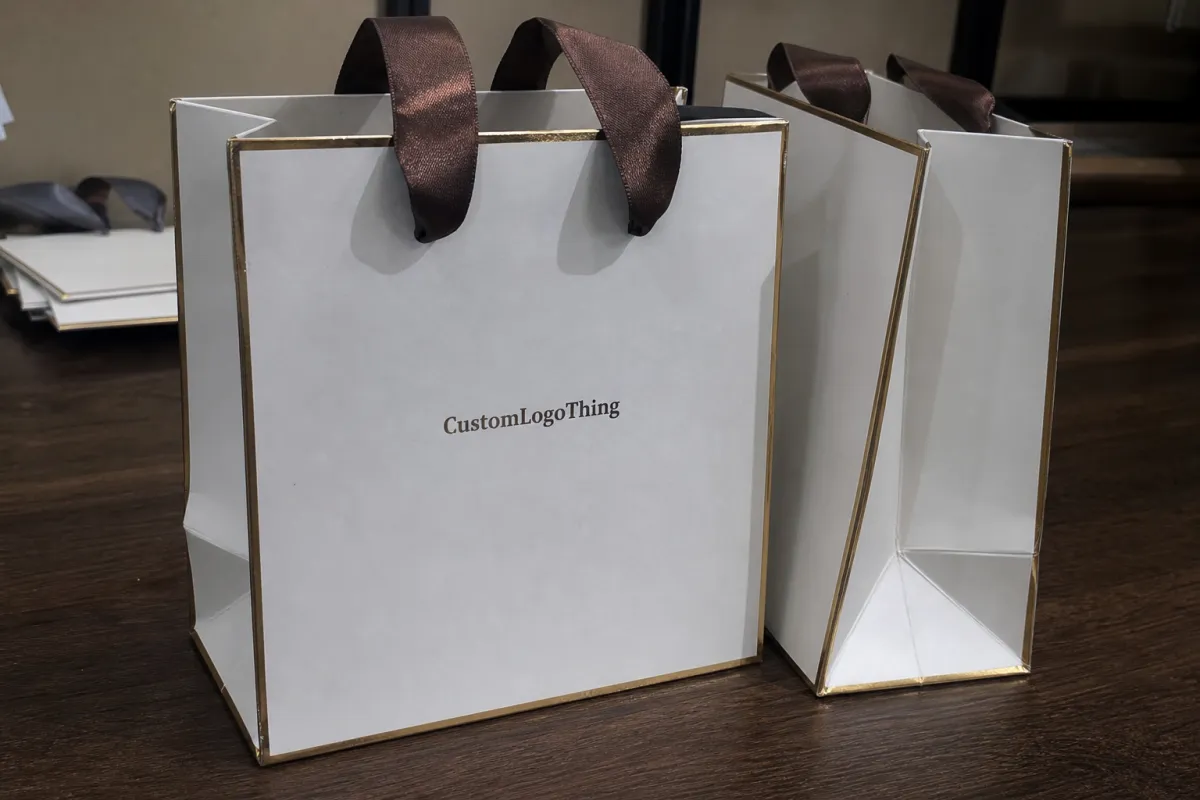
A ribbon handle does more than provide a carrying point. It changes the signal. Satin reads soft and gift-like. Grosgrain feels firmer and a little more structured. Either one tells the customer this is not a disposable retail sack. For jewelry, that matters because the packaging often carries part of the product value. A ring box or necklace pouch inside a plain bag can feel underdressed. The same item in a well-proportioned ribbon-handle bag feels more complete.
That shift affects cost decisions too. You are not only paying for paper and ink. You are paying for presentation value, and that value may be reused when the shopper carries the bag again, keeps it for gifting, or shares it in a photo. For many brands, that visibility is worth more than the price gap versus a standard carrier.
Still, the upgrade has limits. Ribbon handles add labor, some setup, and often a higher defect risk if attachment is rushed. Special finishes on top of that raise cost again. That is not a reason to avoid the format. It just means each feature should have a clear purpose.
In most cases, the strongest program is simple: paper stock with enough stiffness, a clean logo, a handle that feels comfortable, and a structure that does not collapse under a small jewelry box. Everything beyond that should tie to a real sales goal, not a vague wish for “better packaging.”
Sized for boxes, pouches, and gift sets without bulk
Size mistakes are costly because they affect both presentation and freight. A bag that is too small wrinkles at the top and makes the product look crammed in. A bag that is too large wastes paper, costs more to ship, and makes a delicate item seem undersized. Either way, the bag works against the jewelry instead of supporting it.
The right size is based on the packed item, not the bare product. A ring box is compact on its own, but tissue, a card, or a pouch can change the footprint. Necklace boxes usually need more width. Bracelet sets may need extra depth. Mixed gift kits are the hardest because the deepest item controls the format. Many buyers lose money by quoting to the product instead of the final packed unit.
In most jewelry programs, three size bands cover the common range:
- Compact boutique: for ring boxes, charms, and very small gift items.
- Mid-size gift: for necklaces, bracelets, and small boxed sets.
- Wide presentation: for layered gift kits or larger branded boxes that need a cleaner carry profile.
Those categories only work if the bag still closes cleanly and carries without distortion. The handle placement matters too. If the top fold is too narrow, the ribbon can sit awkwardly. If the bag is too tall for the item, the handle can make it feel top-heavy. Small geometry choices determine whether the final piece looks polished or improvised.
Transport conditions matter as well. Paper can soften, edges can curl, and matte finishes show wear faster than many buyers expect. If the bags will sit in a humid stockroom or travel through long shipping lanes, that should shape material choice up front. Cheap sizing becomes expensive if the bag arrives flattened or warped before it is ever used.
Paper, ribbon, print, and reinforcement specs to lock in
Specs are where quality is won or lost. For smaller jewelry bags, paper in the 200-250gsm range is a common starting point. That is not a magic number. It is a practical one. Lighter stock can work for very small items, but once the bag needs to hold a box with some weight, the structure has to resist bowing and edge crush. A stronger board, reinforced top fold, and solid bottom construction usually matter more than a decorative finish.
Ribbon choice should be treated the same way. Satin gives a smoother, more polished look. Grosgrain has texture and usually feels a touch more secure in the hand. Width changes both comfort and balance. Narrow ribbon can look delicate, but if the bag carries a heavier boxed item it can feel flimsy. Wider ribbon spreads pressure better and tends to read more substantial. For many boutique bags, 10-15 mm is a sensible range.
Printing should stay disciplined. A front logo in one or two colors usually keeps the bag clean and the quote manageable. Wraparound print looks attractive in a mockup and then quietly raises the price because it adds press time, registration checks, and more room for variation. Foil stamping, embossing, and spot UV can work well on jewelry packaging, but only if the rest of the design stays restrained.
Ask how the handles are attached. Ribbon glued into a weak top fold can tear out under load. Better builds use reinforced attachment points or stronger internal structure so the stress does not sit on one thin paper layer. The bottom should be checked too. A bag can look fine empty and fail as soon as a box is added.
If sustainability claims matter, verify the paper source rather than accepting a vague statement. If the retail story depends on FSC-certified materials, ask for documentation. The certification information is available at fsc.org.
It also helps to think about transport testing. If the bags will ship inside cartons, ask whether the supplier follows test logic aligned with groups like ISTA. The goal is not to overengineer a shopping bag. It is to keep corners from collapsing and ribbon handles from arriving bent or marked up.
Ribbon-handle paper bag unit cost, pricing, and MOQ
A useful jewelry ribbon handle paper bags Unit Cost Review starts with the variables, not the headline price. Paper grade, ribbon material, print coverage, finish, size, assembly method, and quantity all move the number. The cheapest first line item is not always the cheapest final invoice. Manual assembly, special finishes, and tight tolerances often push the total higher than expected.
MOQ changes the economics quickly. Setup charges and proofing costs spread better at higher volumes, so the per-piece price drops as the run grows. At 500 pieces, even a modest custom bag can feel expensive. At 3,000 or 5,000 pieces, the same structure usually becomes easier to justify. Someone still has to set up the print, prepare the ribbon, check the die, and manage the line.
These ranges are useful for planning, even if exact quotes vary by size, market, and finish:
| Option | Typical MOQ | Unit cost at 1,000 pcs | Unit cost at 5,000 pcs | Best use |
|---|---|---|---|---|
| Plain paper bag with standard print | 500-1,000 | $0.18-$0.30 | $0.12-$0.22 | Entry-level retail carry bag |
| Ribbon handle bag with one-color logo | 1,000 | $0.28-$0.45 | $0.20-$0.34 | Boutique jewelry purchases |
| Ribbon handle bag with foil or embossing | 1,000-3,000 | $0.42-$0.70 | $0.30-$0.52 | Gift presentation and brand launches |
| Premium build with custom ribbon color and reinforced structure | 3,000+ | $0.60-$0.95 | $0.42-$0.68 | High-margin or seasonal retail programs |
Those figures are broad on purpose. A small change in paper stock or finish can move the quote quickly. A matte laminated bag with simple print may cost more than a glossy bag with stronger paper. A custom ribbon color may add more than a second ink color. The parts that look cosmetic are often the parts that create the most manual work.
One common mistake is overspecifying the order because the product is jewelry. Thicker paper, full-wrap printing, metallic foil, and custom color matching sound premium. Sometimes they are worth it. Sometimes they just eat margin. A clean, well-executed bag with a restrained logo often performs better than a crowded design with too many effects.
Tooling is another point worth clarifying. Standard paper bag construction often carries setup charges rather than heavy tooling fees. Custom shapes, unusual handles, or structural changes can introduce new costs, but not every quote line that looks like tooling really is tooling. A supplier that can explain where setup ends and tooling begins is easier to trust than one that hides everything inside a vague “custom fee.”
From dieline to delivery: production steps and lead time
The production flow should stay simple. Request the specs. Confirm the size or dieline. Approve the artwork. Review a sample or proof. Then move into bulk production, inspection, and shipping. If those steps blur together, the odds of a mistake go up fast. The more premium the bag, the less room there is for ambiguity.
Lead time is usually lost in predictable places: artwork revisions, sample approval, special finishes, and freight booking. A plain bag with locked dimensions and final art can move much faster than a bag with foil, ribbon matching, or structural tweaks. That does not make the premium option unrealistic. It just means the calendar has to be built around reality, not optimism.
A typical production window after artwork approval often looks like this:
- Proofing: 1-3 business days for clean artwork.
- Sampling: 5-10 business days if a physical sample is needed.
- Bulk production: 10-18 business days for standard builds, longer for premium finishes.
- Shipping: depends on lane, carton size, and season.
That timeline can stretch during peak seasons, especially when factories are balancing multiple custom runs. The fastest orders arrive with final dimensions, cleaned-up artwork, confirmed ribbon color, and clear delivery expectations. If any of those items is still open, somebody will be waiting on a revision.
It also helps to think about use case before approving the bag. Retail counter packaging and gift packaging are not identical. Counter bags may need more durability because they are handled repeatedly. Gift bags may care more about presentation than load cycles. That difference changes the right paper weight, handle style, and reinforcement level.
Supplier checks that cut defects, delays, and rework
A serious supplier should be able to show paper samples, ribbon options, print tolerances, and a clear list of what is standard versus optional. That should be basic, but plenty of quotes still blur important details until the order is already moving. By then, the buyer is arguing over whether something was included or merely implied.
The checks that matter are practical. Handle attachment should be tested for pull strength. Glue lines should be consistent. Corners should stay square. The print should remain centered across the run. If the bag uses foil, registration needs to be tight, because off-center metallic elements look cheap immediately. A premium jewelry bag with a crooked logo is still a crooked logo.
Use a simple risk checklist before approval:
- Weak ribbon color control: batches can arrive mismatched and look inconsistent on the shelf.
- Crushed edges in transit: poor outer packing can damage presentation before the bags are used.
- Loose handle attachment: the cheapest failure is also the most visible one.
- Unclear spec language: leads to rework, delays, and disputes over what was approved.
Good suppliers do not pretend every premium feature is cheap. They tell you what adds cost and why. That honesty matters because it protects margin. If a factory can explain the cost gap between a standard shopping bag and a ribbon-handle jewelry bag without wandering into marketing fluff, that is usually a better sign than a quote that sounds too good to be true.
For general packaging standards and material guidance, packaging.org is a useful reference point. It will not replace sample checks, but it gives buyers a clearer way to compare construction choices without getting trapped in glossy supplier language.
Next steps to quote jewelry ribbon handle paper bags fast
If the goal is a quote that can actually be used, the request needs a few hard facts: bag size, jewelry box dimensions, quantity, print colors, ribbon preference, finish, and delivery target. If the bag has to carry a heavy box or a mixed gift set, include the filled weight too. Otherwise the supplier is guessing, and guesses make pricing noisy.
The cleanest quoting sequence is simple:
- Set the target unit cost range before debating finishes.
- Cut any feature that does not improve shelf appeal or handling.
- Lock the paper stock, ribbon style, and MOQ together.
- Approve the proof or sample before bulk production starts.
That order keeps the decision grounded. Premium options can stay on the table, but each one needs to earn its place. If a foil logo does not strengthen the brand enough to justify the added cost, leave it out. If a custom ribbon color changes nothing for the customer, skip it. That is how buyers protect margin without making the packaging look cheap.
Ribbon handles are worth the extra spend only when the bag is doing a real presentation job. For smaller, lower-margin items, a simpler build may be the smarter buy. For gift sets, launches, and boutique retail, the ribbon-handle format often gives a better return than a more expensive box. Keep the structure sized to the product, keep the finish choices controlled, and keep the quote tied to actual use. That is how a jewelry ribbon handle paper bags Unit Cost Review becomes a buying decision instead of an endless email thread.
What affects jewelry ribbon handle paper bags unit cost the most?
Paper grade, ribbon type, print coverage, and special finishes usually have the biggest impact on unit cost. Low MOQ Orders also raise the per-piece price because setup charges get spread across fewer bags.
What MOQ should I expect for custom jewelry ribbon handle paper bags?
Most custom runs start around 500 to 1,000 pieces, depending on size, print complexity, and handle construction. Simple specs can sometimes go lower; premium finishes and custom ribbon matching usually push MOQ higher.
Can these paper bags hold small jewelry boxes without sagging?
Yes, if the bag size, paper weight, bottom reinforcement, and handle attachment are matched to the actual box weight. A bag that looks fine empty can still fail in use, so ask for load guidance before approving production.
How long does production usually take after artwork approval?
Lead time depends on sample approval, finishing, and order size, but the production clock starts after final confirmation. Fastest timelines happen when the dieline, artwork, and materials are already locked.
What details should I send to get an accurate quote?
Send size, quantity, artwork, print colors, ribbon choice, finish, and shipping deadline. If you have the jewelry box dimensions, include those too so the supplier can recommend the right bag structure.

