Buyer Fit Snapshot
| Best fit | Branded Kraft Bags Wholesale projects where brand print, material claims, artwork control, MOQ, and repeat-order consistency need to be specified before quoting. |
|---|---|
| Quote inputs | Share finished size, material target, print colors, finish, packing count, annual reorder estimate, ship-to region, and any compliance wording. |
| Proofing check | Approve dieline scale, logo placement, barcode or warning zones, color tolerance, closure strength, and carton packing before bulk production. |
| Main risk | Vague material claims, crowded artwork, missing packing details, or unclear freight terms can make a low unit price expensive after revisions. |
Fast answer: Branded Kraft Bags Wholesale: Film, Print, MOQ, and Carton Packing should be specified like a repeatable production item. The safest quote records material, print method, finish, artwork proof, packing count, and reorder notes in one written spec.
Production checks before approval
Compare the actual filled-product size with the drawing, then confirm tolerance on folds, seals, hang holes, label areas, and retail display edges. Reserve space for logos, QR codes, warning copy, and material claims before decorative graphics fill the panel.
Quote comparison points
Review material grade, print process, finish, sampling route, tooling charges, carton quantity, and freight assumptions side by side. A quote is only useful when the supplier can repeat the same color, closure quality, and packing count on the next order.
Branded Kraft Bags Wholesale: Smart Ordering Guide
Branded kraft bags wholesale gives retailers a practical place to put the logo, the message, and the paper texture customers actually touch. That matters. A lot of packaging disappears into the background. A kraft bag does not. It leaves the counter fast, then keeps working in the street, in the car, at the office, and anywhere else a customer decides to carry it.
That is useful for boutiques, gift shops, cafes, markets, trade shows, and event teams that need packaging to do more than hold product. The bag has to ship flat, stack neatly, feel solid in hand, and still look intentional once it reaches the register. Buyers trying to balance presentation with cost control usually end up here, because kraft bags hit a practical middle ground between plain disposable packaging and rigid gift packaging that can chew through budget with very little payoff.
From a packaging buyer's point of view, the value is simple. One bag can support brand visibility, speed up checkout, and make the purchase feel finished instead of improvised. If the artwork is clean and the construction holds up, branded kraft bags wholesale turns a basic supply item into a repeatable part of the customer experience.
Why branded kraft bags wholesale works for everyday retail
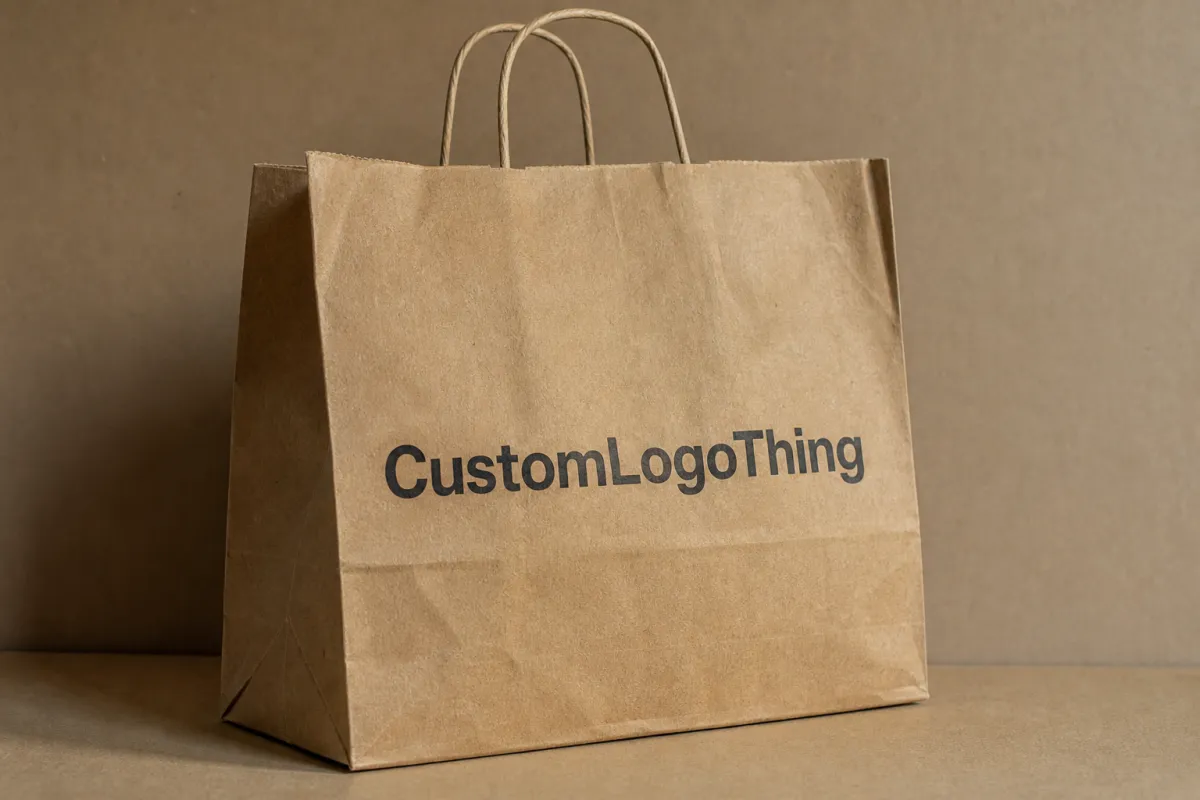
Most retail packaging only gets one job. A kraft bag can do several at once. It carries the product, frames the transaction, and acts as a moving ad after the customer walks out the door. That is why branded kraft bags wholesale works so well for businesses that want a tidy, recognizable presentation without overbuilding the package.
In practice, the bag is often the last thing a shopper touches before leaving the store. That touchpoint matters. A bag with the right paper feel, the right handle, and a clear logo can make a modest purchase feel more deliberate. The branding does not need to shout. It just needs to read cleanly, hold up under normal carry weight, and match the rest of the retail environment.
Kraft also gives operators room to choose a tone. Natural kraft reads earthy and practical. Bleached kraft looks brighter and more polished. A bakery may want the warmer feel of natural paper, while a boutique may prefer the cleaner backdrop of bleached stock for sharper logo contrast. Either way, the bag can be ordered flat, packed efficiently, and handed out without eating shelf space.
There is another reason buyers keep coming back to kraft bags. They are easy to standardize. The same bag can work across seasons, across locations, and across product categories if the sizing and print area were chosen properly at the start. That consistency helps stores avoid a messy mixed look at the counter, which is usually where brand discipline gets judged first.
A useful way to think about the bag is this: it is not just packaging, it is retail packaging with a public-facing surface. If the logo stays legible after a customer leaves the store, the packaging has already earned part of its keep.
Product details: paper weight, handles, print, and finish
Construction drives performance. Two bags can look nearly identical from a distance and behave very differently at the counter. When comparing branded kraft bags wholesale options, start with the paper stock, then check the handle, print method, and finish. That order usually explains why one quote is higher than another.
Paper weight is the first real decision. Light retail bags often use paper around 120-150 gsm, while heavier apparel or boxed goods may do better at 170-200 gsm. Heavier stock adds body and resistance to tearing, but it also raises cost and changes how the bag folds, prints, and stores. Natural kraft is often chosen for a softer, recycled look; bleached kraft is better when the brand needs whiter contrast and cleaner color reading.
Handle type changes both appearance and carrying comfort. Twisted paper handles are common because they are economical and work well for everyday retail. Flat paper handles can feel simple and practical, and they often suit grocery-style or value-focused programs. Rope handles, while less common in basic wholesale paper bag programs, can make the bag feel more gift-like if the brand wants a slightly more elevated presentation. Handle attachment also matters. A bag that will carry boxed candles or ceramic goods needs more confidence at the connection points than a bag carrying folded apparel.
Print method should match the artwork. One-color flexographic printing is usually the most straightforward choice for simple logos, icons, and text. Two-color work can still be efficient if the artwork stays clean and the register is not too tight. If the design relies on fine line work, gradients, or rich photographic detail, that is a sign to rethink the decoration method or the packaging format. On kraft stock, bold shapes and clear letterforms usually outperform delicate effects, especially when the paper tone softens lighter ink colors.
Finish affects both feel and brand tone. Uncoated kraft keeps the natural texture visible and is often the best fit for eco-minded retail, markets, and food service. A light coating can improve print sharpness and reduce scuffing, but too much coating can flatten the paper character that many buyers specifically want from kraft. Matte generally feels more understated. Gloss reads brighter, though it can look less natural and may show fingerprints or handling marks faster.
One practical design point gets missed a lot: logo size should be set for the paper tone, not just the artwork file. A logo that looks crisp on white cardstock may need stronger outlines or a darker ink color on brown kraft. Warm neutrals, black, deep green, and navy tend to hold up well. Very pale colors can disappear unless the design has strong contrast and enough visual weight.
For brands that want to compare materials more formally, fiber sourcing can matter too. If that is part of the purchasing brief, ask whether the stock is FSC-certified, and check the chain-of-custody details at FSC. For shipping-heavy programs or cartons that will be handled across multiple legs, it also makes sense to ask whether the pack-out approach was designed with the transit expectations common in ISTA testing in mind.
That detail does not make the bag flashy. It makes the bag dependable, which is usually what wholesale buyers actually need.
Specifications to lock in before you request samples
Before you ask for samples or a quote, tighten the spec sheet. The more complete the brief, the fewer surprises later. With branded kraft bags wholesale, the finished result depends on a handful of measurements and construction choices that should be settled early rather than guessed at after artwork starts moving around.
The first item is finished bag size. Width, gusset depth, and height need to fit the product with enough room for easy loading, but not so much extra space that the item slumps around inside the bag. A bag that is too large can look wasteful and can make a modest purchase feel under-packed. A bag that is too tight can wrinkle, strain the handles, and wreck the presentation before the customer reaches the door. Not ideal.
Next comes gusset width and bottom reinforcement. A wider gusset supports bulkier merchandise, while a reinforced bottom helps the bag stay square and hold shape when it is set on a counter or loaded into a cart. If the item is boxed, stacked, or irregularly shaped, these structural details matter more than most buyers expect.
Handle choice should be tied to the actual contents, not just the design style. A small gift bag may look fine with a lightweight handle, but an apparel bag or sample kit may need a stronger build to protect the customer experience. If the bag is likely to be carried for longer distances, comfort in the hand becomes part of the spec, not an afterthought.
Artwork should be prepared in vector format whenever possible. PDF, AI, or EPS files are easier to proof correctly than a low-resolution image pulled from a website. Confirm the number of print colors, the exact placement of the logo, and any clear space around the mark. On kraft stock, those margins are not decoration. They keep the print readable once the paper texture and bag folds are taken into account.
Capacity and use case should also be written into the brief. Retail apparel, bakery items, books, brochures, sample kits, and trade show collateral all load differently. A bag that handles a folded shirt well may not be ideal for a bakery box or a stack of catalogs. If the order has food contact requirements, humidity exposure, or display conditions where the bags will sit open for long periods, say that up front.
A simple rule helps here: if the bag will be touched by the public, stacked in a stockroom, and carried in real weather, the spec needs to reflect all three conditions. That usually surfaces the useful answers.
Quick spec checklist:
- Finished bag dimensions
- Gusset width
- Paper weight and kraft type
- Handle style and reinforcement
- Print colors and logo placement
- Quantity and delivery location
- Intended product weight and use environment
Cost, pricing, and MOQ: what changes the quote
Price is never just about the bag itself. It is about the stock, the print, the setup, the run length, and the way the finished cartons move through production. When buyers ask for branded kraft bags wholesale pricing, the quote is usually shaped by six factors: size, paper weight, print complexity, number of colors, handle style, and quantity.
As quantity rises, the unit cost usually drops because the fixed setup work is spread across more pieces. That setup can include plate making, press preparation, color matching, and line setup. Smaller runs carry those costs more heavily, which is why a 500-piece order often looks expensive on a per-unit basis compared with a 5,000-piece order using the same spec.
MOQ, or minimum order quantity, exists because packaging production has real startup costs. Material needs to be sourced, the line needs to be prepared, and the finished bags need to be packed into usable carton counts. Some suppliers can quote lower minimums, but the buyer should expect a higher unit price when the run is short.
Here is a practical way to compare wholesale kraft bag options. The numbers below are broad planning ranges, not fixed quotes, because region, paper availability, and print layout all affect the final price.
| Bag Type | Common Use | Typical Wholesale Unit Range | Notes |
|---|---|---|---|
| Natural kraft, one-color print, twisted handle | Boutiques, small retail, events | $0.18-$0.35 at higher quantities; $0.40-$0.80 at smaller runs | Popular for simple branding and everyday carry |
| Bleached kraft, one- to two-color print, reinforced handle | Gift shops, cosmetics, premium retail | $0.24-$0.45 at higher quantities; $0.50-$0.95 at smaller runs | Cleaner background for logos that need contrast |
| Heavy-gauge kraft, larger size, stronger handle | Apparel, boxed goods, heavier purchases | $0.30-$0.60 at higher quantities; $0.65-$1.20 at smaller runs | Better for weight and repeated use |
| Custom size or specialty finish | Brand programs with exact fit requirements | Quoted case by case | Tooling, coating, and print detail can raise cost quickly |
Those ranges are useful because they frame the conversation before sampling begins. They also help buyers understand why a quote can move even when the bag looks similar at first glance. A slightly heavier paper, a deeper gusset, or a stronger handle can change the economics more than a logo file ever will.
"A low quote is only a good quote if the spec is fixed and the bag still does its job in the store."
There are also hidden cost drivers worth watching. Multiple artwork versions can add setup time. Rush schedules can increase freight or overtime pressure. Custom sizing may require additional tooling or line adjustments. Shipping to several destinations can turn one clean production run into a more complicated logistics order. Buyers get the best results when they compare the same paper stock, the same print coverage, the same handle, and the same delivery terms before judging price.
If you are building a recurring program rather than a one-time event order, it helps to look at the whole buying cycle. Our Wholesale Programs page explains how repeat runs are typically handled, and our Case Studies page shows how different formats can support different brand goals without guesswork at the end of the process.
Process, timeline, and production steps from proof to delivery
The cleanest projects follow a predictable sequence. For branded kraft bags wholesale, the path usually runs from quote to proof to production to shipping, with a quality check at each stage. Buyers who understand that flow can answer approval questions quickly and keep the schedule moving.
The normal workflow starts with a quote request. The supplier reviews the size, paper stock, print area, handle style, and quantity, then sends pricing or asks for missing details. Once the spec is confirmed, artwork goes into proofing. That proof is the first real checkpoint, because it shows how the logo sits on the bag, how much space surrounds the mark, and whether the print can hold cleanly on kraft stock.
Proofing should never be treated as a formality. It is the place where small problems become visible before material is committed. A logo that sits too close to a fold line can disappear in use. A light color can wash out on brown stock. A badge or icon may need to shift slightly so the final bag reads correctly from arm's length. First-time buyers often save time by asking for a sample or a preproduction check when the design includes fine type or a precise color expectation.
Once the proof is approved, production is scheduled. Lead time depends on order size, print complexity, paper availability, and how quickly the buyer responds to questions. For a straightforward order with standard stock and fast approvals, production is often in the range of 12-20 business days after proof approval. More complex artwork, custom finishes, or a larger quantity can extend that window. Freight time then needs to be added on top, and that can range from a few business days to more than a week depending on the destination.
Quality checks should cover print registration, handle attachment, bag squareness, and carton counts. If the bags are destined for retail shelves or repeated counter use, the final packaging also matters. Cartons should stack well, be labeled clearly, and arrive in a condition that allows the team to stock them quickly.
For shipping-heavy programs, it is worth asking how the cartons will be palletized and whether the pack-out plan protects the bags from crushing or edge wear. Distribution details matter more than most buyers expect. Bags that look great on press can still disappoint if they arrive scuffed, bowed, or packed in a way that makes the stockroom harder to manage.
If you want the order to stay on schedule, send complete files early and return proofs promptly. That simple behavior usually does more for lead time than any promise attached to a rush fee.
Why choose us for consistent branded packaging
Consistency is the real test in wholesale packaging. One good sample is nice. Fifty thousand bags that all match the same print tone, handle feel, and fold quality is what matters when the program becomes part of the brand system. That is why buyers looking at branded kraft bags wholesale should pay close attention to repeatability, not just the first mockup.
Good packaging support starts with practical feedback. A supplier should be able to tell you whether the logo needs a stronger outline, whether the paper stock is right for the carrying weight, and whether the bag size is doing the brand any favors. Straight answers save money because they keep the order aligned with real use instead of wishful thinking.
Color control matters more on kraft than many buyers expect. The paper tone changes how ink reads. Black usually stays crisp. Deep green, navy, and warm reds can work well. Pale colors can look muted unless they are adjusted on purpose. A partner who understands that behavior can help the brand look deliberate instead of merely printed.
There is also value in keeping the packaging family together. If the bag, tissue, labels, and boxes are all speaking the same visual language, the customer sees a more finished brand. That does not require a complicated system. It requires consistency in paper tone, logo treatment, and the way each item sits in the hand.
For buyers who need recurring runs, reliability is often more valuable than a one-time discount. A program that repeats every quarter or every season needs the same bag to arrive looking the same months later. That means stable paper sourcing, careful print control, and a manufacturing process that respects the original spec instead of drifting from it.
Our approach is practical: identify the use case, lock the construction, set the artwork correctly, and keep the order repeatable. That is the kind of discipline that makes wholesale packaging easier to manage over time, and it is also why teams reviewing Case Studies tend to focus on fit, print clarity, and repeatability rather than decoration alone.
For brands planning a larger packaging family, the same logic applies across sizes and formats. A kraft bag should not feel like an isolated item. It should feel like part of the same retail system that includes shelf labels, inserts, and outbound packaging. When those pieces align, the customer notices even if they cannot name why.
Next steps: send the right details for a fast quote
If you want a quick, accurate quote for branded kraft bags wholesale, send the details in a clean list. That usually cuts down the back-and-forth and helps the pricing team respond with something useful instead of asking a dozen follow-up questions.
Include these items first:
- Finished bag dimensions
- Quantity needed
- Logo file in vector format if available
- Number of print colors
- Preferred handle style
- Paper preference, if you already have one
- Delivery location and target in-hands date
Add the use case as well. Retail, food service, events, and gift packaging do not always need the same paper weight or handle construction. A bag for folded apparel may need a different structure than a bag for bakery items or promotional literature. If the order will be used for food, check whether any local labeling or material expectations apply before you finalize the spec.
If the design has small type, thin lines, or a color that may be hard to read on kraft stock, ask for a proof or sample before full production. That one step can prevent a lot of friction later. It is better to catch a weak contrast issue on a sample than to discover it after cartons are already on the way.
When the details are clear, branded kraft bags wholesale becomes a straightforward sourcing decision instead of a guessing game. The right size, the right stock, the right handle, and the right print method usually matter more than any dramatic sales pitch.
Send the spec sheet, confirm the artwork, and let the production team quote against the actual job. That is the cleanest path to a bag that looks right at the counter and still holds up when the customer walks out the door.
FAQ
What is the usual MOQ for branded kraft bags wholesale orders?
MOQ depends on size, print method, and paper stock, but most wholesale runs require enough quantity to cover setup efficiently. Smaller quantities are possible in some cases, although the unit cost is usually higher because press setup and materials are spread across fewer bags. The best way to get a useful MOQ answer is to share the exact size, print colors, and delivery needs before quoting.
How do I choose the right paper weight for branded kraft bags wholesale?
Choose the paper weight based on what the bag must carry, not just how it looks, because heavier products need more structure and reinforcement. Light retail items can use a simpler build, while apparel, boxed goods, or gift sets usually benefit from sturdier stock and stronger handles. If the bag will be reused often, a stronger paper weight can improve both performance and perceived quality.
Which print method works best for branded kraft bags wholesale?
Simple logos and one- or two-color artwork often work well with economical print methods that keep costs controlled at volume. More detailed graphics may need a method that supports finer registration and cleaner edge detail, especially on dark or textured kraft stock. The right choice depends on the logo, ink colors, and how much of the bag surface needs to carry the design.
Can branded kraft bags wholesale orders include different sizes in one run?
Yes, but each size usually behaves like a separate production item because tooling, material usage, and packing differ. Mixing sizes can be efficient for a brand family, yet it may affect Pricing and Lead Time if the order is split across multiple specs. It helps to decide which size will cover the most common use first, then build the rest of the range around that core format.
How long does production usually take for branded kraft bags wholesale?
Production time depends on artwork approval, print complexity, quantity, and whether the material is already available for the job. A clean, approved proof speeds things up, while revisions or special finishing requests can extend the schedule. For planning purposes, buyers should ask for both production time and freight time so the bags arrive when the store or event actually needs them.
For brands that want packaging to look deliberate, perform well, and arrive on schedule, branded kraft bags wholesale is one of the most practical buying choices available. Lock the spec early, proof the artwork against the actual stock, and compare quotes on equal terms. That is how you get a bag that works in the store instead of just looking good in a mockup.

