Buyer Fit Snapshot
| Best fit | branded kraft cartons for retail design for packaging buyers comparing material specs, print proof, MOQ, unit cost, freight, and repeat-order risk where brand print, material, artwork control, and repeat-order consistency matter. |
|---|---|
| Quote inputs | Share finished size, material target, print colors, finish, packing count, annual reorder estimate, and delivery region. |
| Proofing check | Approve dieline scale, logo placement, barcode or warning zones, color tolerance, and any recyclable or compostable wording before bulk production. |
| Main risk | Vague material claims, crowded artwork, or missing packing details can create delays even when the unit price looks attractive. |
Fast answer: Branded Kraft Cartons for Retail Design: Dieline, Finish, Proof, and Buyer Review should be specified like a repeatable production item. The safest quote includes material, print method, finish, artwork proof, carton packing, and reorder notes in one written spec.
What to confirm before approving the packaging proof
Check the product dimensions against the actual filled item, not only the sales mockup. Ask for tolerance on folds, seals, hang holes, label areas, and retail display edges. If the package carries a logo, QR code, warning copy, or legal claim, reserve that space before decorative graphics fill the panel.
How to compare quotes without losing quality
Compare board or film grade, print process, finish, sampling route, tooling charges, carton quantity, and freight assumptions side by side. A lower quote is only useful if the supplier can repeat the same color, closure quality, and packing count on the next order.
Plain kraft is never really plain once it is sitting on a retail shelf. Put it beside glossy cartons, loud color blocks, and packaging that is trying a little too hard, and branded kraft cartons for retail often feel calmer, more credible, and, in the right hands, more premium because they rely on material honesty instead of visual noise. Buyers notice that difference quickly, even if they would not describe it that way out loud.
The phrase branded kraft cartons for retail covers more than a brown box with a logo stamped on it. These are paperboard cartons, sleeves, and folding Cartons Made From kraft stock, then shaped through structure, print, and finish choices that help a product earn its place on shelf. A good version protects the item, communicates the brand, and still behaves like retail packaging rather than a shipping carton dressed up for the occasion.
I have watched plenty of launches stall because the package looked attractive in a mockup but lost its footing in the actual store. That gap between concept and shelf is where kraft can either shine or fall flat. The goal is simple enough: make the carton look intentional, keep production practical, and avoid the common mistake where "natural" ends up reading as unfinished.
For a few examples of how packaging decisions change the way a product is received in the real world, the work on our Case Studies page shows the sort of shelf challenge a carton has to solve. The best outcomes usually come from discipline, not decoration for its own sake.
Why branded kraft cartons for retail win on crowded shelves
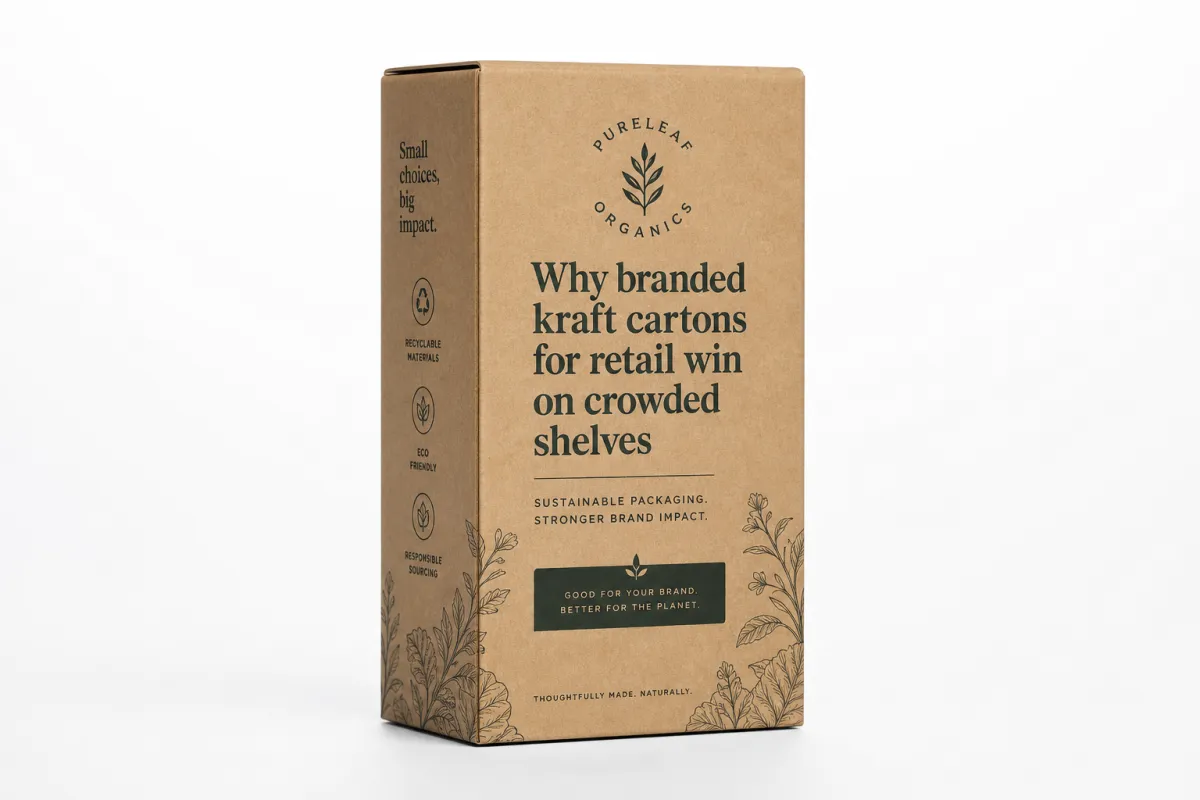
Retail shelves are crowded in a way that rewards clarity. Gloss coatings, saturated graphics, tiny claims, and decorative clutter all compete for the same small patch of attention. In that setting, branded kraft cartons for retail have room to breathe. The paper texture reads as grounded and human, and that quiet surface gives a brand a chance to look confident without shouting for it.
From a packaging buyer's perspective, kraft does several useful jobs at once. It supports natural and sustainability-led positioning, it tends to use material efficiently, and it can sit comfortably between plain utility and a highly customized premium carton. For personal care, supplements, snacks, candles, accessories, and handmade goods, branded kraft cartons for retail often land in exactly the right middle ground.
Retailers usually appreciate that restraint. A carton with too much shine or too many messages can make the product feel louder than it needs to be. Clean kraft layouts, strong typography, one clear benefit line, and a disciplined color palette often read faster from three feet away. That kind of speed matters. Shoppers are not studying packaging like a design panel; they are sorting options in a matter of seconds.
The best branded kraft cartons for retail also handle practical needs that pretty mockups tend to ignore. They have to stack cleanly, fold without fuss, hold the product securely, and still look decent after shipping, shelf stocking, and customer handling. If the carton only behaves in a render, it has not earned its place in production.
Kraft is also honest about its surface, which means the graphics carry more of the load. That is usually a good thing. It forces the brand to sharpen hierarchy, strip away weak copy, and choose only the details that help a shopper make a decision. In practice, that is one reason branded kraft cartons for retail can feel more premium than cartons with more ink and less discipline.
For a new launch or a line extension, the real question is not whether the carton can be printed on kraft. It can. The better question is whether the format, board grade, and print plan support the product price and the shelf story. When those pieces line up, branded kraft cartons for retail usually outperform packaging that looks prettier but carries less coherence.
How branded kraft cartons for retail are made
Branded kraft cartons for retail begin with the substrate. Most projects use kraft paperboard or kraft-lined board in a range of calipers, often around 300gsm to 450gsm for lighter consumer goods, with thicker board or a corrugated element for heavier or more fragile items. The right stock depends on the product weight, the carton format, and the amount of dent resistance the retailer expects during handling.
Once the stock is chosen, the dieline takes over. That file controls the folds, glue flaps, tuck points, lock features, and any window cutouts. It is not the glamorous part of packaging, yet it prevents a lot of expensive mistakes. With branded kraft cartons for retail, the dieline needs to account for fiber behavior because natural stock can show fold stress more clearly than coated whiteboard, especially around tight corners or heavy score lines.
Printing method matters more on kraft than many teams expect. Digital printing is usually the best fit for short runs, fast changes, and low minimums. Offset printing is the cleaner choice for larger quantities and tighter color consistency. Flexo can make sense for simpler graphics and higher-volume efficiency. If your brand color depends on a very specific Pantone match, branded kraft cartons for retail need a test proof on the actual board, not a promise made from a monitor.
Finish choices work best when they stay restrained. Matte varnish can protect the surface without stripping away the paper feel. Embossing can lift a logo or icon in a subtle way that feels refined. Foil can work too, provided it is used sparingly rather than scattered across every available panel. Soft-touch coatings are possible on some jobs, although many buyers prefer to preserve the tactile kraft story. Over-finishing branded kraft cartons for retail usually weakens the very appeal that made kraft attractive in the first place.
Shipping and display requirements belong in the same conversation. A carton that closes beautifully but crushes too easily is not a good carton. A carton that survives transport but opens awkwardly on shelf is not much better. The goal is one structure that prints well, folds correctly, and presents the product clearly once the retailer places it under harsh light and fast hands. Branded kraft cartons for retail need to do all of that at once, not in separate stages.
Testing is worth a straightforward approach rather than a polished guess. A drop check or compression check tells you more than a glossy mockup ever will. ISTA protocols are useful here, especially if the carton moves through standard parcel or mixed freight channels. You do not need to become a lab technician, but you do need a sanity check before production. FSC certification can matter too if a buyer wants chain-of-custody documentation or cleaner sourcing language on the pack. Plenty of brands talk about sustainability. Fewer can show the paper trail that backs it up. See ISTA and FSC for the standards side of that conversation.
Kraft also changes the way color behaves. Warm neutrals can disappear into the substrate. Pale pastel backgrounds can turn muddy. Black can look strong, though only if ink laydown is handled carefully. With branded kraft cartons for retail, the board is not a blank white page. It is part of the design system, and a designer who ignores that usually ends up with a package that feels compromised instead of intentional.
Cost and pricing factors for branded kraft cartons for retail
Pricing for branded kraft cartons for retail usually comes down to five variables: size, board thickness, print coverage, finish complexity, and quantity. A small tuck-end carton with one or two colors lives in a very different cost band from a larger sleeve with spot foil, embossing, and a custom insert. The more the carton is asked to do, the more the quote moves. That is normal, not a vendor being evasive.
Short runs with digital print keep setup lighter, but the unit cost is usually higher. As volumes rise, offset or flexo often becomes more efficient. For a straightforward retail carton, a realistic planning range might land around $0.18 to $0.55 per unit at mid-size volume, while smaller orders often cost more per piece because setup costs are spread across fewer cartons. A more complex carton with specialty finishing can move well beyond that range. If a quote looks unusually low, check what was left out. That part matters.
| Print route | Best fit | Typical unit range | Strengths | Tradeoffs |
|---|---|---|---|---|
| Digital | Short runs, frequent artwork changes | $0.65-$1.50 | Fast setup, flexible quantities, useful for sampling | Higher unit cost, less attractive at scale |
| Offset | Mid to larger volumes | $0.18-$0.55 | Cleaner solids, sharper type, good color control | Plate/setup cost, less friendly for constant changes |
| Flexo | Large runs with simpler graphics | $0.12-$0.32 | Efficient, practical, cost-effective for repeat orders | Less detail, not ideal for highly refined art |
MOQ is the part that makes some buyers smile and others wince. Lower minimums help cash flow and reduce inventory risk, but they usually mean a higher unit price. Larger runs spread tooling and setup across more cartons, which lowers the per-unit cost. For branded kraft cartons for retail, a move from 1,000 to 5,000 units can change pricing more than a small artwork change. A jump from 5,000 to 20,000 can change it again. Tiered quotes make that pattern easier to see.
Hidden costs are the ones that show up late if nobody asks about them early. Dieline revisions, structural sampling, plate or die charges, proofing, freight, warehousing, and rush fees can all enter the budget once a project gets messy. Inserts matter too. A paperboard insert may add only a few cents per carton, while a custom molded insert or multi-part nested tray can alter the whole economics of the order. With branded kraft cartons for retail, line items matter more than broad promises.
The most useful quote questions are usually the least glamorous ones. Ask for pricing at 1,000, 5,000, and 10,000 units. Ask what happens if foil is removed. Ask whether the board is FSC-certified. Ask if proofing, freight, and a spare production allowance are already included. Suppliers can price a carton in several different ways, and a good buyer wants to see the structure of the cost, not just the prettiest number on the page. That is how you make branded kraft cartons for retail fit the business instead of forcing the business to fit the carton.
One practical rule tends to save both money and time: simplify the structure first, then add decoration only where it actually improves sell-through or credibility. That might mean using a cleaner sleeve, removing one color, or replacing full coverage print with a logo and one strong benefit line. The savings can be real, and the pack often looks better too. Branded kraft cartons for retail usually improve once the design team accepts that restraint is not a compromise. It is often the cleaner solution.
Production steps, timeline, and lead time for retail cartons
The production path for branded kraft cartons for retail looks simple on paper and a little less tidy in real life. It usually starts with a brief, then moves into size confirmation, structure selection, dieline setup, artwork placement, proofing, approval, production, finishing, packing, and freight. The clearer the ownership of each stage, the fewer late-night emails the project tends to generate.
A straightforward job with ready artwork can sometimes move through production in about 10 to 15 business days after final approval. Add special finishes, unusual structural shapes, or multiple proof rounds, and the schedule stretches. Custom branded kraft cartons for retail with inserts, windows, or complex glue work can easily take 3 to 5 weeks from approval to ship, and that is before international freight arrives with its own timing and temperament.
Delays usually come from the same handful of places. Artwork lands at the wrong size. A barcode sits too close to a fold. A retailer asks for copy changes after proof approval. The production stock does not match the sample stock. Or marketing decides the front panel needs one more claim because a better line surfaced late in the process. The quickest way to lose time on branded kraft cartons for retail is to keep changing decisions after the carton has already been engineered.
Lead time gets easier to manage once dimensions are locked early. That one move saves a surprising amount of back-and-forth. Confirm the print method before the design is final. Approve proofs quickly, but not carelessly. Drop decorative finishes unless they change shelf presence or durability in a meaningful way. Good branded kraft cartons for retail usually come from disciplined decisions, not creative drift.
Product launch timing creates its own trouble if the schedule is built on optimism. Product fill, retailer receiving windows, photo shoots, and marketing launches do not wait for cartons that are still in transit or waiting on a final revision. The carton should arrive before the product needs to be packed, not after the campaign starts. Beautiful branded kraft cartons for retail have a way of turning into expensive storage if the timeline is built around wishful thinking instead of production reality.
Step-by-step guide to choosing branded kraft cartons for retail
Start with the product, not the artwork. Measure the length, width, height, weight, and any fragile points. If the item stands upright on shelf, the carton face should support that orientation. If the product is small and light, a tuck-end may be enough. If it is heavier or likely to be handled roughly, a crash lock or auto-bottom style may be the better choice. Branded kraft cartons for retail work best when the structure follows the product's behavior instead of a mood board.
- Define the product job. Is the carton protecting, displaying, gifting, or all three? Branded kraft cartons for retail should support that first.
- Choose the structure. Straight tuck, reverse tuck, sleeve, crash lock, or custom insert? Pick the format that balances speed, strength, and shelf appearance.
- Map the visual hierarchy. Logo, product name, variant, benefit line, barcode, and compliance text should each have a clear place.
- Test on real kraft. Do not trust screen color alone. Kraft stock shifts neutrals, lowers saturation, and can make fine details disappear.
- Prototype early. Catch fold issues, panel proportions, and readability problems before the production run.
Hierarchy is where many brands overcomplicate the front panel. A retail carton has a job, and every printed element should either help sell or help comply. If a sentence does neither, it probably belongs somewhere else. For branded kraft cartons for retail, the front panel usually needs the brand mark, the product name, one meaningful claim, and enough whitespace for the eye to rest. That tends to work better than cramming every available message onto the face.
Color testing deserves careful attention. On kraft, beige-on-beige can disappear. Warm gray can look flat. Very pale background washes can get swallowed by the paper tone. Deep black, dark green, and earthy red often perform well, but only if they are tested against the actual board instead of a monitor. If the design depends on a white backdrop, it may need a rethink before the whole concept turns muddy. That is one of the most common turning points in branded kraft cartons for retail.
The best structural choice is often invisible to the shopper, which is exactly how it should be. A good carton closes cleanly, opens without tearing, stacks without leaning, and sits on shelf facing the right way every time. That kind of reliability sounds dull until a production run arrives full of boxes that do not behave. Good branded kraft cartons for retail save money because they reduce handling issues later.
If a quick sanity check would help, compare the proposed structure with a few real examples rather than relying on generic packaging inspiration. The answer often sits in the details of a finished job. That is why practical references matter more than polished mockups. A few well-chosen Case Studies can tell you more about shelf impact, carton performance, and print choices than a long list of design adjectives.
For teams starting from scratch, a simple brief goes a long way. Include product dimensions, target retail price, expected display position, and any retailer compliance requirements. The brief may feel plain, but it is the quickest route to branded kraft cartons for retail that do the job without inflating the budget or the approval chain.
Common mistakes with branded kraft cartons for retail
The first mistake is treating kraft like a blank canvas for every idea in the room. It is not. Some designs depend on a white background, tight color control, and ultra-clean photo reproduction. Put that same design on kraft and the result can look flat or muddy. With branded kraft cartons for retail, the substrate is part of the design, not an afterthought that happens to be brown.
The second mistake is overprinting. Heavy ink coverage can bury the texture that makes kraft interesting in the first place. It also makes the pack feel heavier and less breathable. A lot of brands assume more color equals more premium. Often the opposite is true. The carton starts to lose the natural quality that made branded kraft cartons for retail appealing in the first place.
Another common misstep is underestimating cost because the board is kraft. That assumption falls apart quickly. Special finishes, custom inserts, tight tolerances, low quantities, and complicated die-cutting do not get cheaper just because the stock is brown. Some premium effects cost more because they have to work around the texture. Brands that price branded kraft cartons for retail like generic stock boxes usually get a surprise they did not budget for.
Weak dielines create a different kind of pain. Folds crack. Panels do not align. Glue tabs show. Shelf faces get scuffed. A carton with poor structure looks amateur no matter how good the artwork is. That is why the technical side matters so much for branded kraft cartons for retail. The shopper sees a finished pack, but the buyer has to live through the production choices that built it.
"If the front panel is trying to do six jobs, it is probably doing none of them well."
Clutter is still the most common retail packaging mistake. Brands want the logo, the story, three claims, a sustainability badge, a flavor note, and a giant promotional promise all on the face panel. The result is noise. Clean branded kraft cartons for retail usually perform better with one clear message and one supporting line, while the rest moves to side or back panels where it does not fight the shelf read.
Compliance is the quiet problem that grows into a loud one late in the schedule. Barcode space, ingredient listings, country-of-origin rules, retailer-specific panel requirements, and recycling language all need to be planned before print. A late-stage compliance fix can force layout changes, new die revisions, or a reprint. That risk is real, not theoretical. The safest branded kraft cartons for retail are the ones that leave room for legal, operational, and retail requirements from the start.
Finish choices can go wrong in the name of "premium" too. Foil, embossing, spot varnish, and a complex multi-color background can work together on a luxury launch, but on many retail cartons the result reads confused. Kraft wants hierarchy and confidence. It does not need a costume. A disciplined choice, like one foil mark or a single embossed logo, usually feels stronger than trying to make branded kraft cartons for retail look expensive through sheer accumulation of effects.
Expert tips and next steps for branded kraft cartons for retail
If you want branded kraft cartons for retail to come out right, use a three-sample approach. First, review the structure sample so you know the carton folds and holds correctly. Second, check a print proof on the actual kraft stock so color and contrast are real, not theoretical. Third, test the carton with product inside under lighting that resembles retail conditions. That sequence catches most expensive mistakes before production begins.
Keep the finish list short. Ask whether each upgrade changes sell-through, protection, or brand perception. If the answer is no, leave it out. This sounds obvious, though packaging teams still add effects simply because they are available. The strongest branded kraft cartons for retail usually have one or two deliberate premium cues and a lot of discipline everywhere else.
Tiered quoting is worth the extra email. Ask for 1,000, 5,000, and 10,000 unit pricing so you can see where the price breaks happen. In many projects, the biggest drop shows up once a threshold is crossed and setup cost gets diluted. That helps you decide whether a smaller pilot run or a fuller batch makes more sense. Good branded kraft cartons for retail planning is part design work and part quantity math.
Look at the carton the way a shopper does. Ten feet away, at arm's length, and then inside a display tray. If the logo disappears at distance, the hierarchy is weak. If the carton only looks strong up close, the shelf work is not finished. If it collapses visually once it sits beside neighboring products, the contrast strategy needs work. That blunt review is often the fastest way to improve branded kraft cartons for retail without raising cost.
Keep a clean spec sheet from the start. Product size, board thickness, print method, finish, insert type, target MOQ, timeline, and compliance notes should all live in one place. That sheet saves time whenever revisions are requested or suppliers are compared. It also keeps everyone honest. A clear spec is the difference between buying branded kraft cartons for retail and buying uncertainty with a logo on it.
The last bit of advice is the simplest. Choose the carton that helps the product sell, protects it in transit, and does not create a maintenance problem for the team that has to reorder it. That is the real test. If the pack can handle production, retail, and repeat buying, then branded kraft cartons for retail are doing their job. The most practical next step is to lock dimensions, request a dieline, confirm MOQ and lead time, then compare samples on the actual board under retail lighting before you approve the run.
How much do branded kraft cartons for retail usually cost?
Cost depends on size, board thickness, print coverage, finish complexity, and order quantity. Small runs usually cost more per unit because setup fees are spread across fewer cartons. For branded kraft cartons for retail, ask for tiered quotes at 1,000, 5,000, and 10,000 units so you can see where the price drops hard. Extra inserts, specialty coatings, and rush production can push the number up fast.
Are branded kraft cartons for retail recyclable?
Usually yes, if they are made from recyclable kraft board and do not use heavy plastic lamination. Water-based inks and adhesives are the cleaner choice for recycling compatibility. Ask your supplier what local recycling rules apply, because coatings and add-ons can change the answer for branded kraft cartons for retail.
What print style works best on branded kraft cartons for retail?
Simple typography, bold logos, and limited-color palettes usually work best. High-contrast art reads better than tiny details or pale pastels on natural kraft stock. For branded kraft cartons for retail, a restrained finish like embossing or spot varnish often looks stronger than trying to print everything at full intensity.
How long does the process take for branded kraft cartons for retail?
Basic jobs can move in a short window if artwork is ready and approvals are fast. Custom structures, samples, and special finishes add time to the timeline. The fastest way to miss your launch date is to delay dieline approval or keep changing copy on branded kraft cartons for retail after the proof stage starts.
What should be on branded kraft cartons for retail?
Include the product name, brand mark, size or variant, barcode, and any required compliance text. If space is tight, prioritize what the shopper needs first and move the legal clutter to a panel that does not fight the front face. Clean hierarchy is what keeps branded kraft cartons for retail looking deliberate instead of crowded.


