Buyer Fit Snapshot
| Best fit | custom gable boxes branding design better for packaging buyers comparing material specs, print proof, MOQ, unit cost, freight, and repeat-order risk where brand print, material, artwork control, and repeat-order consistency matter. |
|---|---|
| Quote inputs | Share finished size, material target, print colors, finish, packing count, annual reorder estimate, and delivery region. |
| Proofing check | Approve dieline scale, logo placement, barcode or warning zones, color tolerance, and any recyclable or compostable wording before bulk production. |
| Main risk | Vague material claims, crowded artwork, or missing packing details can create delays even when the unit price looks attractive. |
Fast answer: Custom Gable Boxes Branding Design Better: Dieline, Finish, Proof, and Buyer Review should be specified like a repeatable production item. The safest quote includes material, print method, finish, artwork proof, carton packing, and reorder notes in one written spec.
What to confirm before approving the packaging proof
Check the product dimensions against the actual filled item, not only the sales mockup. Ask for tolerance on folds, seals, hang holes, label areas, and retail display edges. If the package carries a logo, QR code, warning copy, or legal claim, reserve that space before decorative graphics fill the panel.
How to compare quotes without losing quality
Compare board or film grade, print process, finish, sampling route, tooling charges, carton quantity, and freight assumptions side by side. A lower quote is only useful if the supplier can repeat the same color, closure quality, and packing count on the next order.
Custom Gable Boxes Branding: Design That Sells Better is not just a matter of dropping a logo onto a carry box and calling it done. Custom gable boxes branding changes how a package is noticed, carried, photographed, and remembered, which is exactly why this format can pull more weight than many brands expect from a simple paperboard structure.
The handle, the peaked silhouette, and the broad top panel start doing work before anyone reads a single line of copy. The box is already communicating while it is in someone’s hand, tucked into a delivery bag, set on a counter, or passed across a table at an event. That first impression is not subtle, and it usually happens fast.
Takeout, bakery items, gifts, promotional kits, retail handouts, and event packs all benefit from packaging That Travels Well and still looks deliberate when it arrives. That is where custom gable boxes branding earns attention. Done with care, it strengthens brand identity, improves the unboxing moment, and gives product packaging a cleaner visual rhythm without making the presentation feel overdesigned. Done badly, it can look like the brand ran out of time and kinda hoped nobody would notice.
What custom gable boxes branding really changes
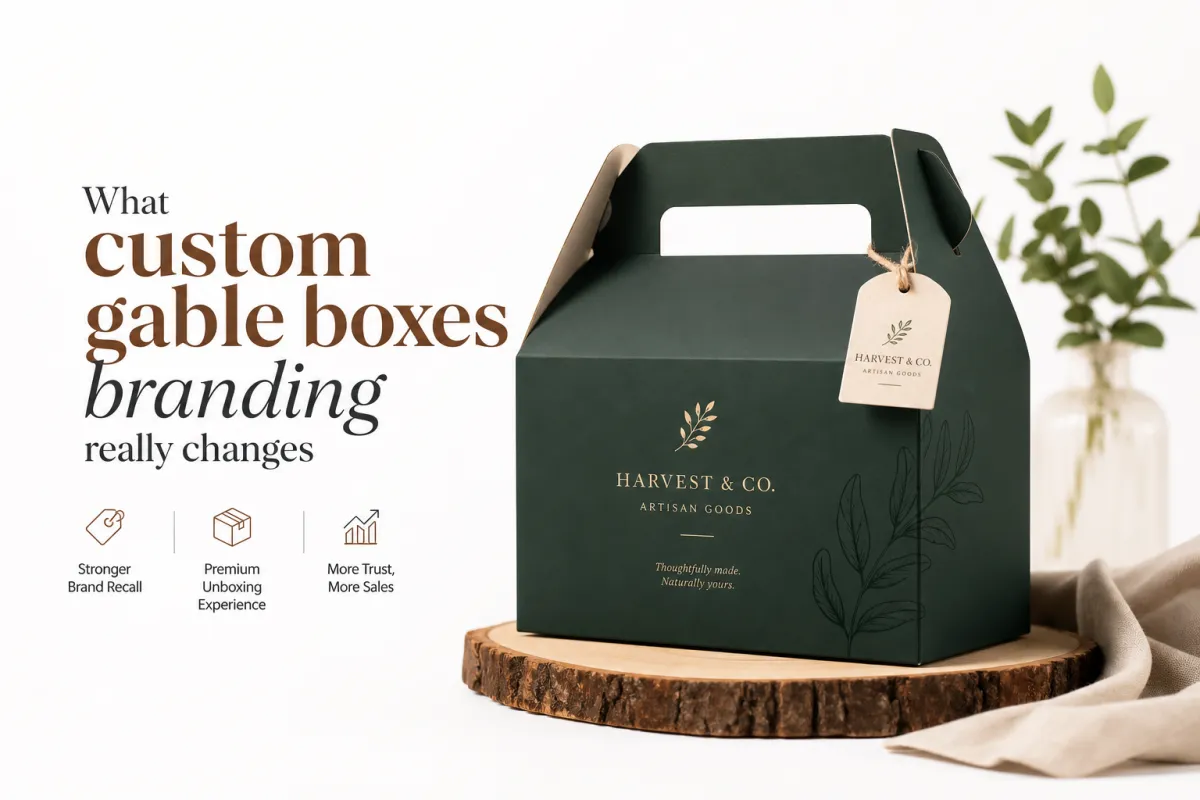
Custom gable boxes branding is more than logo placement. It is a mix of structure, print, color, finish, and handling behavior, and each piece affects the others. When one part is off, the whole package can feel less finished than the brand deserves. Packaging is honest in that way. It exposes weak decisions quickly.
Buyers usually notice the shape before they read the messaging. That works in your favor when the silhouette is strong and the artwork respects the structure. A box with a clear profile can create recognition from across a counter or inside a social post, which means custom gable boxes branding can begin marketing before the customer has time to inspect the details.
The format suits packages that are carried more than stored. Takeout meals, cookie boxes, gift sets, hotel welcome kits, fundraiser packs, product samples, and lightweight retail packaging all fit that use case. The box feels complete in the hand. That feeling matters because people judge branded packaging quickly, and they judge it by texture and balance as much as by color.
People remember the box they carried. Not the file. Not the mockup. The actual object in their hand.
That is why custom gable boxes branding tends to work so well for brands that want the package itself to travel through public space. A clean box in transit becomes a moving sign, and the effect is strongest when the layout is quiet enough to read at a glance. Overworked artwork has the opposite result. It turns a branded box into visual noise. Clear hierarchy, restrained color, and a little breathing room usually do the job better.
There is a practical advantage too. The gable shape gives you a top panel, side panels, and often a front panel that can carry a logo, campaign line, QR code, or short product message. Every panel does not need to be filled. Leaving some quiet space can make the box look more refined, which is one of the less glamorous truths of custom gable boxes branding: empty space is often a design choice, not a missed opportunity.
The format also adapts well to retail and event work. Seasonal gifting, local food brands, launch kits, and branded giveaways use it often because it is easy to carry and easy to recognize. That practical combination is why custom gable boxes branding keeps coming up in packaging planning. It is not flashy by default. It is useful. And packaging that is useful usually outlasts packaging that only chases trends.
For brands building a coordinated packaging system, the box can connect with inserts, tags, and labels so the whole presentation feels intentional. Pairing the box with Custom Labels & Tags or matching inserts keeps the look from feeling assembled at the last minute.
How custom gable boxes branding works from dieline to shelf
The first step in custom gable boxes branding is the dieline. That template controls where folds land, which panels stay visible, where the handle sits, and which areas need to stay quiet so copy does not get broken by a seam. A weak dieline can ruin good artwork fast. Packaging has a way of exposing overconfidence, and it does not really care how nice the logo looks in a presentation deck.
The work makes more sense in layers. Structure comes first, then material, then print method, then finish, then assembly. That sequence matters because each layer changes what the next one can do. A box intended for bakery carryout has different needs from a promo pack or a premium gift box, and custom gable boxes branding works best when the technical choices support the visual choices instead of competing with them.
Print method changes cost, timing, and color behavior. Digital printing usually fits shorter runs, quick revisions, and projects where artwork may still be changing. Offset printing makes more sense for larger runs and lower unit costs once setup is spread across more pieces. For many brands, that difference sits at the center of custom gable boxes branding pricing. Same shape, very different math.
Color management deserves the same care. Files should be built on the proper template with the right bleed and enough safe margin to keep text away from folds. Spot colors can help when brand color accuracy matters, but they still need to be checked against the actual board stock. Paper absorbs ink differently than a screen emits color, which is one of the reasons packaging proofs matter so much. A color that looks perfect on a monitor can print a little flatter, warmer, or darker once it hits the sheet.
Custom gable boxes branding can use more surfaces than many people expect:
- Top panel: best for logo placement, campaign name, or a clean hero graphic.
- Side panels: useful for URLs, short taglines, QR codes, or secondary branding.
- Front panel: good for product cues and fast-read messaging.
- Inner print: useful for surprise moments, care notes, or a stronger unboxing experience.
- Handle area: often left clean so the structure stays readable and uncluttered.
The shelf story is only part of the picture. Transit matters just as much. If the box will be stacked, loaded, or handed across a counter all day, the print and structure need enough durability for real handling. For shipping-heavy projects, it helps to think with the same discipline the packaging industry uses when it talks about ISTA testing. The exact test is not the point here. The point is to treat the box as an object that has to survive abuse, not just as a drawing on a screen.
When sustainability is part of the brief, ask whether the board can be FSC-certified and whether the print and finish still support recycling goals. The resource at FSC helps keep the sourcing conversation grounded. A beautiful box that is difficult to source responsibly is a weak result for brand identity, even if the artwork looks impressive in proofs.
Custom gable boxes branding cost, pricing, and MOQ
Money matters here, because custom gable boxes branding becomes vague fast if no one puts real numbers on the table. The main cost drivers are board stock, box size, print coverage, finish complexity, shipping volume, and whether the structure is truly custom or simply custom printed. That sounds obvious until someone asks for foil stamping, matte lamination, a window cutout, and rush freight on a short run, then wonders why the quote is higher than expected.
As a planning range, smaller runs usually carry a higher unit cost because setup is spread across fewer pieces. Larger runs reduce the per-box price once die setup, press time, and finishing are distributed across more units. That is why custom gable boxes branding often becomes a volume decision as much as a design decision.
| Order size | Typical production method | Approx. unit range | Best fit |
|---|---|---|---|
| 100-250 units | Digital short run | $1.10-$2.40 each | Events, samples, pilot launches |
| 500-1,000 units | Digital or short-run offset | $0.58-$1.35 each | Seasonal packs, small retail batches |
| 2,500-5,000 units | Offset printing | $0.28-$0.82 each | Regular programs, recurring promotions |
| 10,000+ units | Offset with optimized setup | $0.18-$0.55 each | High-volume retail packaging and food service |
Those ranges are broad on purpose. A 6 x 6 x 4 inch box with light coverage will not price the same as a larger box with full-bleed artwork and specialty coating. Board thickness matters too. A 16pt or 18pt SBS stock behaves differently from E-flute or corrugated board. If the box needs extra structure for carry weight, that adds cost, yet it also protects the experience from the kind of failure that makes packaging feel cheap. A low-price box is expensive the moment it collapses in use.
Custom gable boxes branding also has a few hidden cost traps:
- Full-bleed art: more ink, more setup, and more chance of color variation.
- Foil or embossing: premium look, higher setup cost, stricter proofing.
- Window cutouts: extra tooling and assembly steps.
- Special coatings: matte, soft-touch, or spot UV can improve presentation, but they add labor and price.
- Rush freight: the fastest way to spend money on moving cardboard.
If you need a broader format comparison, our Custom Packaging Products page is a useful starting point because it shows how custom printed boxes shift across structure, finish, and use case. Sometimes the right answer is not a gable box at all. Sometimes it is. The real value comes from comparing options instead of guessing.
MOQ depends on print method and plant setup. Digital runs can often stay relatively low, sometimes in the few-hundred-unit range, while offset setups usually make more sense at 1,000 units and above. The better question is rarely “what is the minimum?” It is “what volume gives acceptable unit economics without tying up too much cash in inventory?” That is the practical question behind custom gable boxes branding.
Key factors that make custom gable boxes branding work
Hierarchy is the first thing I look for. The logo should be obvious, yes, but a box that only repeats the logo is wasting its own surface area. Custom gable boxes branding should also communicate the purpose of the package: dessert, gift, event kit, sample pack, retail handout, or promotional item. The message should land in a few seconds, not after a speech.
Contrast matters more on gable boxes than on some other packaging because the box is often seen quickly, under mixed lighting, or while someone is walking with it. Strong type, controlled spacing, and a limited palette usually read better than busy layouts. A clean composition helps the brand identity stay legible from a distance, which is exactly what you want when the package is moving through a crowd.
Make the logo do a job
In custom gable boxes branding, the logo should be visible without being forced into every panel. A logo placed with intention feels confident. A logo jammed into five surfaces feels anxious. One clear mark, well positioned, usually carries more authority than several competing versions of the same idea.
Match structure to product weight
Box size affects how premium the pack feels. If the cavity is too large, the product rattles and the whole package feels underfilled. Too small, and the handle or fold lines start to look stressed before the box even reaches the customer. Good custom gable boxes branding starts with product dimensions, then adds board thickness, closure behavior, and carry comfort after that.
Use finish to support the brand voice
Matte finish usually reads quieter and more premium. Gloss feels brighter and more retail-oriented. Soft-touch has a more tactile, upscale feel, but it needs to match the brand voice instead of being chosen because it sounds luxurious in a quote. Finish is not decoration. It is part of the package branding. A finish that fits the product makes custom gable boxes branding feel deliberate instead of generic.
The practical side of finish selection matters just as much. Food packaging, promo packs, and gift boxes may need surfaces that resist scuffs and fingerprints better than plain board. If the package looks great in proof but marks up the moment it is handled, the finish is working against the project. Packaging has to survive real handling, not just the mockup.
Stacking strength deserves attention too. If the box will travel in cases, sit in a display, or get piled on a table, the walls and handle need enough structure to hold shape. Weak structure strips away the premium feel quickly. Nobody describes a crushed box as polished, and nobody posts a photo of it with pride.
Custom gable boxes branding process and turnaround
The process for custom gable boxes branding is straightforward when the brief is clear. It becomes messy when details are missing, dimensions change after proofing, or “close enough” is treated like a production spec. Better inputs move the job faster.
- Brief the supplier: share box size, product weight, quantity, print coverage, finish, and target delivery date.
- Confirm the dieline: review the template before designing so folds, glue areas, and handle placement are understood.
- Place artwork: build the file on the exact template with safe margins and correct bleed.
- Approve the proof: check color notes, panel placement, and any fine text that sits near seams.
- Request a sample: especially if the box needs a premium feel or exact structure.
- Move to production: once all specs are locked, the line can run without guesswork.
Timing depends on print method and finish. A clean digital run can often move from proof approval to production in about 10-15 business days, sometimes a little faster when the file is final and the spec is simple. Offset work usually needs more lead time, especially when specialty finishing or a larger quantity is involved. Sampling can take roughly 5-10 business days, and freight can add another week or two depending on destination. That is why custom gable boxes branding should be planned backward from the launch date, not forward from the order date.
Delays usually come from predictable places: missing artwork specs, late quantity changes, color corrections after proof approval, and unclear finish instructions. The most expensive delay is the one that begins with “we thought that would be fine.” It usually is not. If speed matters, bring final dimensions, final copy, and a real quantity decision before asking for the quote.
For projects that need recurring structure or a coordinated packaging system, it helps to compare the box against other branded packaging elements early. A kit may need inserts, labels, or outer cartons in addition to the gable box. You can review parallel options through our Case Studies page to see how similar packaging goals were handled with different formats.
Fast turnaround is rarely about hurrying. It comes from removing uncertainty before production starts.
If sustainability or transport performance is part of the brief, use standards language instead of vague promises. Ask whether the box stock aligns with FSC sourcing goals, and whether the package should be evaluated against real handling expectations rather than only visual approval. That keeps custom gable boxes branding grounded in production reality instead of sales language.
Common mistakes that weaken custom gable boxes branding
The first mistake is overcrowding. A small surface area does not become larger because someone has more to say. If the box tries to carry too many messages, the layout gets noisy and the brand looks less confident than it should. Custom gable boxes branding works better when one clear idea leads and everything else supports it.
The second mistake is ignoring the blank areas. Empty space can look intentional, elegant, and premium. It can also look unfinished if the layout is lazy. The difference is balance. Good design uses blank panels to create rhythm. Weak design leaves them blank because no one knew what to do next. Those are not the same thing.
Another common problem is choosing a finish that fights the brand voice. A heavy gloss can work for colorful food packaging or energetic retail packaging, but it can undermine a minimal identity that needs calm and restraint. A soft-touch coating on a short-life promo box may add cost without adding enough value. Custom gable boxes branding should support the brand personality, not just dress it up.
- Do not approve artwork without checking fold lines: important text can disappear into a seam or flap.
- Do not ignore handle load: if the product is heavy, the structure must be sized accordingly.
- Do not overprint every panel: full coverage is not always better than a clean layout.
- Do not skip a sample: screen proofs never show the full story of feel, crease behavior, or color shift.
- Do not overbuy before launch: a seasonal or event box with the wrong spec is just inventory with a problem.
One more mistake deserves its own mention: approving a box that looks good flat but fails once assembled. This happens more often than people admit. Panel proportions can shift the visual balance, and a logo that felt centered on the file may suddenly sit too high or too low on the finished piece. That is why custom gable boxes branding should always include a real sample or, at minimum, a very careful proof review on the actual dieline.
There is also a quiet failure mode. The box arrives fine, but the contents shift too much. The outside may look polished while the inside feels loose and unfinished. Product packaging has to hold the item correctly. If it does not, the outside is just makeup on a poor fit.
Expert tips and next steps for custom gable boxes branding
Start with one goal. Not three. If shelf impact is the priority, the design should be bold and readable at a glance. If gift appeal matters more, the box should feel special in the hand. If social sharing is the goal, the unboxing experience needs one or two memorable details. Trying to force all of those into one weak layout usually waters down custom gable boxes branding instead of improving it.
Ask for pricing in layers. Separate the box cost, print cost, finish cost, and freight cost. That breakdown shows where the budget is going and where savings are possible without damaging the packaging design. A quote with one total number is convenient, sure, but it also makes it easier to lose sight of the expensive part.
When a project includes premium color or a tactile finish, request a physical sample. A screen proof can show layout and text placement, but it will not tell you how the board feels, how the folds behave, or how the color shifts under the lighting where the box will actually be used. That matters even more for custom gable boxes branding that supports retail packaging or direct customer handoff.
A simple pre-production checklist saves a great deal of frustration:
- Size: confirmed against the product, not guessed.
- Board stock: chosen for weight, rigidity, and finish compatibility.
- Print sides: front, back, sides, top, and inner areas clearly specified.
- Finish: matte, gloss, soft-touch, foil, or spot UV locked in.
- Quantity: aligned with budget and sell-through expectations.
- Delivery date: set with room for proofing, sampling, and freight.
- File approval: final dieline and artwork confirmed before press time.
Use the final proof as a consistency check. The logo should match the brand identity system. The type should be readable. The product cue should make sense at a glance. The box should still look good if it is stacked, carried, or photographed from an awkward angle, because that is how these packages are actually used. Good custom gable boxes branding is practical before it is pretty, and that order matters.
If you want more packaging ideas beyond the gable format, the structure choices on our Custom Packaging Products page can help you compare custom printed boxes by use case rather than by guesswork. When a launch needs a fuller system, matching inserts, labels, and tags can tighten the whole presentation without adding clutter.
For brands that need a clean, carry-friendly package with real visual impact, custom gable boxes branding is one of the stronger tools available. It is simple enough to produce efficiently, flexible enough to fit different markets, and visible enough to make a customer remember the package long after the product is gone.
The best next move is usually the plain one: confirm the product dimensions, choose the board stock, decide which panel carries the main message, and request a proof with those details locked. That keeps the whole project grounded, saves a pile of back-and-forth, and gives the box a better shot at doing what it is supposed to do in the real world.
How does custom gable boxes branding differ from regular box printing?
Regular box printing usually focuses on decoration, while custom gable boxes branding has to account for structure, handle placement, fold lines, and how the box looks while it is being carried. The silhouette matters more than it does on a flat carton, so the artwork needs to work with the shape instead of fighting it. That usually means cleaner hierarchy, fewer competing elements, and a more intentional layout overall.
What affects the price of custom gable boxes branding the most?
The biggest cost drivers are size, material, print coverage, finish complexity, and order quantity. Low-volume projects usually cost more per box because setup is spread across fewer units, while larger volumes reduce the unit price. Add-ons like foil, windows, specialty coatings, and rush freight can move the quote quickly, so it helps to separate each line item before comparing suppliers.
What is a realistic turnaround for custom gable boxes branding?
A clean project can often move from proof to production in a few weeks, but sampling, revisions, and shipping can stretch the timeline. Digital short runs are usually faster than offset jobs, especially when the artwork is final and the dimensions are already confirmed. If you have a firm launch date, build in time for proof review and at least one sample round so custom gable boxes branding does not become a last-minute scramble.
What artwork files work best for custom gable boxes branding?
Vector files like AI, EPS, or PDF usually give the cleanest result for logos, type, and line work. Images should be high resolution and placed on the dieline with safe margins so folds and cut lines do not damage the design. Always ask the supplier for the correct template before you start designing, because guessing is a good way to waste time and slow down production.
How do I choose the right finish for custom gable boxes branding?
Pick the finish that matches the brand mood and the product use: matte for calm and premium, gloss for bright retail energy, and specialty coatings for a more tactile feel. Think about handling too, because food, gift, and promo boxes often need a finish that resists scuffs, fingerprints, or moisture better than plain board. If you are unsure, request samples of two finishes and compare them under the lighting where the boxes will actually be used. Done carefully, custom gable boxes branding turns a simple carry box into a package people remember.

