Buyer Fit Snapshot
| Best fit | Branded Kraft Mailers With Logo projects where brand print, material claims, artwork control, MOQ, and repeat-order consistency need to be specified before quoting. |
|---|---|
| Quote inputs | Share finished size, material target, print colors, finish, packing count, annual reorder estimate, ship-to region, and any compliance wording. |
| Proofing check | Approve dieline scale, logo placement, barcode or warning zones, color tolerance, closure strength, and carton packing before bulk production. |
| Main risk | Vague material claims, crowded artwork, missing packing details, or unclear freight terms can make a low unit price expensive after revisions. |
Fast answer: Branded Kraft Mailers With Logo: Sustainable Packaging should be specified like a repeatable production item. The safest quote records material, print method, finish, artwork proof, packing count, and reorder notes in one written spec.
Production checks before approval
Compare the actual filled-product size with the drawing, then confirm tolerance on folds, seals, hang holes, label areas, and retail display edges. Reserve space for logos, QR codes, warning copy, and material claims before decorative graphics fill the panel.
Quote comparison points
Review material grade, print process, finish, sampling route, tooling charges, carton quantity, and freight assumptions side by side. A quote is only useful when the supplier can repeat the same color, closure quality, and packing count on the next order.
Branded Kraft Mailers With Logo: Sustainable Packaging sounds simple until the order has to survive real shipping, real handling, and a real warehouse team that does not care about your mood board. Then the details show up. Fit, seal strength, print clarity, shipping abuse, cost, and fulfillment speed all start competing for attention. That is why branded kraft Mailers with Logo matter more than they first appear to. They are often the first physical thing a customer sees, which gives the outer mailer more influence than most teams want to admit.
For brands that want packaging to feel thoughtful without getting fussy, Branded Kraft Mailers with logo sit in a useful middle zone. They look cleaner than a plain poly bag, feel more deliberate than an unprinted carton, and can support a lower-waste story when the structure is built properly. That balance matters. Packaging is never only about appearance. It is also about how the mailer fits the product, survives the route, and behaves once the warehouse starts moving fast. And yes, the warehouse will move fast. Probably faster than you expect.
That is why branded kraft mailers with logo deserve a full review from print method to carrier handling to end-of-life claims. If you are comparing formats, the broader Custom Packaging Products range can help you figure out where kraft mailers fit and where another structure, such as a carton or a plastic mailer, makes more sense. For moisture-sensitive shipments, Custom Poly Mailers often win. Kraft mailers usually win when the brand wants a paper-based presentation and a more natural look, not a fake-natural look that falls apart the second it gets wet.
Branded Kraft Mailers With Logo: What They Are and Why They Stand Out
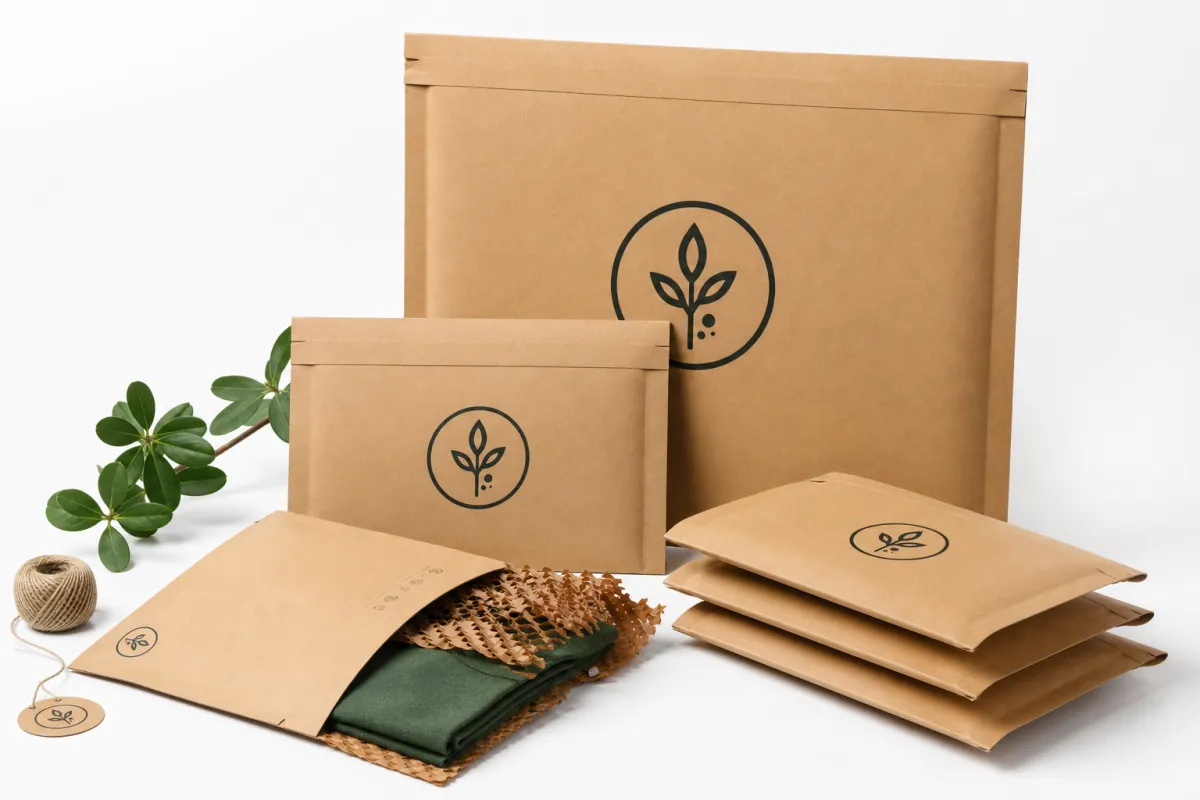
At the simplest level, branded kraft mailers with logo are paper-based shipping mailers made to protect lightweight products while showing a printed brand mark on the outside. The face stock is usually kraft paper or a kraft-style laminate. Many versions include a peel-and-seal strip, a tear feature, or reinforced seams. That mix gives the package a natural feel without turning it into something flimsy.
They work especially well for apparel, books, small retail goods, subscription items, and other ecommerce orders that do not need a rigid box. In practice, branded kraft mailers with logo make the most sense when the item is flat or semi-flat, the shipping lane is fairly controlled, and the brand wants packaging that looks tidy without screaming for attention. A folded T-shirt, a paperback, a candle sleeve, or a small accessory kit can all travel well in the right kraft mailer. A heavy ceramic mug? Not my first pick. That is the kind of order that likes extra protection.
Kraft has staying power because it looks plain in a good way and behaves like paper instead of pretending to be something else. It can include recycled content. It can fit paper recovery systems in many regions. That only works if the structure is built sensibly, though. Mixed layers, awkward coatings, and hard-to-separate adhesives can change the recycling outcome fast. Branded kraft mailers with logo are not recyclable just because they are brown. That would be convenient. Packaging rarely cares what we wish it meant.
From a brand perspective, the printed outside of branded kraft mailers with logo does real work. A sharp one-color logo on warm kraft can signal restraint, care, and a lower-waste mindset without turning the shipment into a billboard. The mailer still has to perform. If it tears at the corner, splits at the seam, or arrives crushed, the design loses. Fast.
"A mailer can feel tiny on the packing table and huge in the customer’s hands. If it fails in transit, every design choice gets judged through that failure."
That is the tradeoff behind branded kraft mailers with logo. Presentation, protection, cost, and shipping environment all need to line up. Miss one of them and the package feels off. Get them aligned and the result is a shipping format that looks intentional, packs efficiently, and supports a cleaner brand story without trying to fake perfection.
How Branded Kraft Mailers With Logo Printing Actually Works
The structure of branded kraft mailers with logo usually begins with the face stock. Sometimes that means a simple kraft paper layer. Sometimes it means a reinforced paper build with an inner liner. Better mailers are designed so the seal area can take repeated flexing during packing and delivery, and the tear feature opens the package without attacking the product inside. Cheap mailers love to look fine right up until the first stack of parcels lands on them.
Printing on kraft is where the material starts telling the truth. Kraft has a brown base and a fibrous texture, so tiny type, pale inks, and delicate gradients can lose clarity. Branded kraft mailers with logo usually look best with bold shapes, strong outlines, and restrained color use. A single black logo, a dark green mark, or a deep navy graphic often reads better than a soft pastel treatment that sinks into the stock and quietly disappears.
Three print paths show up often. Flexographic printing makes sense for longer runs and simple graphics, especially when the artwork does not need photographic detail. Digital printing helps with shorter runs or frequent artwork changes because it cuts down on setup friction. Lithographic or offset-style printing can deliver excellent image quality, but the math only works in the right volume range and on the right construction.
The production flow matters just as much as the press. Artwork gets checked against a dieline, then adjusted for bleed, safe zones, fold areas, seal overlap, and any hidden sections that vanish once the mailer is formed. With branded kraft mailers with logo, placement has to account for how the package sits on the table, how it folds into itself, and whether the front panel shifts once the product is inside. A logo can look perfect in a PDF and still land too close to a seam after conversion. Printing does not care about the design deck. It only cares about where the ink actually lands.
Proofing, manufacturing, and fulfillment can change print quality more than people expect. Mailers are often stored flat, packed fast, sealed fast, and then crushed, rubbed, stacked, and tossed through carrier networks. That means branded kraft mailers with logo should be designed with some forgiveness. Ink that scuffs too easily, coatings that scratch fast, or closures that fail under compression will show up in the field even if the sample on your desk looked sharp.
For teams that want a useful reference point, organizations like ISTA publish test frameworks that simulate vibration, drops, and handling conditions, while the FSC system matters when paper sourcing and chain-of-custody claims are part of the spec. Those standards do not replace an actual shipment trial, but they give the discussion some teeth. They also keep everyone honest, which is handy when a spec sheet starts sounding a little too polished.
The cleanest result usually comes from matching the print method to the stock and finish instead of chasing the fanciest process. Branded kraft mailers with logo should look deliberate, not improvised. When the design, material, and print method all point in the same direction, the package feels premium without trying too hard.
Key Factors That Shape Performance, Look, and Sustainability
Kraft weight and caliper usually come first. A thicker mailer can improve puncture resistance and reduce corner crush, but extra thickness also affects folding, sealing, and total material use. With branded kraft mailers with logo, more paper is not automatically better. A slightly lighter build with a smarter seam can outperform an overbuilt mailer that refuses to fold cleanly. Packaging loves nuance. Buyers usually do not, until the first transit issue lands on their desk.
Size comes next, and it gets underestimated constantly. Oversized branded kraft mailers with logo waste material, let the product shift around, and look sloppy even if the print is excellent. Undersized mailers strain the seal and can warp the product corners. A good sizing process starts with the thickest point of the packed item, then adds room for insertion, closure, and a little warehouse tolerance. Testing two or three candidate sizes before locking the spec is the boring answer. It is also the correct one.
Logo placement and ink coverage add another technical layer. Kraft has a warm, earthy cast, so light colors need strong contrast to stay legible. Fine type can fill in. Thin lines can soften. In many cases, branded kraft mailers with logo work best with one bold mark on a main panel and a secondary message kept very small or left out entirely. A crowded layout can turn a clean package into visual noise, especially if the ink density is uneven across the sheet.
Sustainability claims need discipline. Recycled content, FSC or PEFC sourcing, adhesive choice, and any barrier layer all affect whether branded kraft mailers with logo behave like paper packaging in the recovery stream. A paper face alone is not enough if the inner construction uses mixed films or coatings that do not separate cleanly. I have seen brands call something "recyclable" after checking exactly one part of the structure. That shortcut always comes back to bite somebody.
Shipping conditions are the last piece, and they are often the roughest. Humidity can soften fibers, rough handling can scuff printed areas, and stack pressure in a trailer can flatten weak seams. A mailer that looks crisp in a photo can still fail after a few hours in a hot sortation environment. That is why branded kraft mailers with logo should be tested against the actual lane, not just judged on a desk.
If you want to think like a packaging engineer, keep a short checklist nearby:
- Product fit: enough room for insertion without forcing the seal.
- Strength: seam and corner performance under load and abrasion.
- Print contrast: logo legibility on brown kraft.
- Recyclability: paper structure, adhesive, and coating all reviewed.
- Transit stress: humidity, vibration, compression, and drop risk.
That checklist keeps branded kraft mailers with logo tied to packaging behavior instead of wishful sustainability language. Which is usually where better decisions start.
Branded Kraft Mailers With Logo Cost and Pricing Factors
Pricing for branded kraft mailers with logo usually comes down to quantity, print colors, structural complexity, and whether the design needs extra reinforcement or custom tooling. A simple one-color mailer ordered in a larger quantity can land in a fairly efficient range. A short run with multiple colors, heavier paper, or extra finishing steps can cost noticeably more per unit. Comparing two quotes without the same spec sheet is a great way to fool yourself with numbers that do not mean the same thing.
Setup costs matter more than many buyers expect. Press preparation, plates, file checks, sample approval, and die tooling can take up a meaningful chunk of smaller orders. That is why branded kraft mailers with logo can look expensive at 2,000 pieces and much more reasonable at 10,000 or 20,000. The setup gets spread across more units, so the per-piece cost drops. If the artwork changes often, digital printing can reduce some setup burden, but the unit price still has to survive the math.
For practical budgeting, simple branded kraft mailers with logo might often fall around $0.18-$0.35 per unit at higher volumes, while shorter runs or more complex builds can move into the $0.30-$0.55 range or higher, depending on size, print coverage, and reinforcement. Those are working ranges, not promises. Freight, packaging format, and supplier location can change landed cost quickly, especially if the order needs to ship fast or in split deliveries. If someone hands you a single price with no context, be skeptical. Cheap quotes love fine print.
| Print Method | Best Fit | Typical Strength | Tradeoffs | Relative Setup Cost |
|---|---|---|---|---|
| Flexographic | Longer runs, simple logos, one- to two-color branding | Efficient and consistent on repeat orders | Less ideal for very fine detail or frequent artwork changes | Moderate |
| Digital | Shorter runs, seasonal artwork, test programs | Fast to start and flexible for variable graphics | Unit cost can rise faster at higher volumes | Low to moderate |
| Lithographic / Offset-style | High-detail graphics and strong image control | Excellent visual clarity when the volume supports it | Less economical for many mailer projects | Higher |
There are hidden costs too. Freight from the converter, storage space for flat-packed inventory, pre-production samples, and artwork revisions after proofing all affect the real landed price of branded kraft mailers with logo. If a logo gets resized three times because the dieline was not reviewed properly, the extra proof rounds eat both time and budget. Request one shared spec sheet and compare suppliers on the same terms. That little bit of discipline saves a lot of nonsense later.
That matters even more if you are also comparing other formats, such as Case Studies from previous packaging programs or a different shipping structure altogether. Sometimes a mailer looks cheap until damage risk and replacement shipments enter the conversation. Then the better-built option starts looking a lot less expensive.
Step-by-Step Timeline for Ordering Branded Kraft Mailers With Logo
Good projects start with a packaging brief. Before anyone talks about ink or artwork, define the product dimensions, shipping method, expected order volume, sustainability goals, and the unboxing impression you want. That brief keeps branded kraft mailers with logo from wandering into vague creative territory. If the supplier knows the product weight, the fulfillment method, and the carrier environment, they can suggest a structure that actually works.
Next comes dieline selection and artwork placement. This is where logo scale, safe zones, fold lines, and seal overlap need a careful check. A proof that ignores the structure can be misleading. With branded kraft mailers with logo, the front panel can shorten visually once the mailer is folded, and the closure flap can hide part of the design if it sits too high. Digital proofs should be reviewed by someone who understands packaging geometry, not just brand graphics and hope.
Sampling is where the real learning happens. A screen proof can confirm color intent, but it cannot tell you how the mailer feels once it is filled, how the seal behaves after a few open-close cycles, or how the print survives rubbing in a shipping tote. A physical sample of branded kraft mailers with logo usually exposes the useful problems: a corner that bunches, a logo that sits too close to the edge, or a tear strip that is easy to miss when the line moves fast.
After sample approval, the process moves into production, finishing, packing, and shipment. Depending on quantity and print complexity, simple runs might move in roughly 12-15 business days after approval, while more involved jobs can take longer if plates, die work, or multiple proof rounds are involved. That timing is not fixed. Branded kraft mailers with logo tied to launches or seasonal peaks should always include a buffer, because schedule pressure tends to show up at the worst possible moment.
A realistic planning rule is to add extra time whenever the structure is custom, the artwork is detailed, or the mailer will be tested against a tighter shipping profile. The more decisions you ask the package to make, the more time it needs. For most teams, branded kraft mailers with logo are not hard to order, but they do reward early planning and clear communication.
- Brief: define product size, weight, shipping lane, and brand goals.
- Artwork: place the logo on the dieline and review safe zones.
- Sample: test the loaded mailer by hand and through shipping stress.
- Approval: sign off on color, construction, and closure behavior.
- Production: run, finish, pack, and arrange delivery to fulfillment.
That sequence keeps branded kraft mailers with logo moving with fewer surprises and less last-minute scrambling.
Common Mistakes When Choosing Branded Kraft Mailers With Logo
The first mistake is choosing by appearance alone. Kraft can look warm and responsible, but that does not guarantee puncture resistance, tear control, or a reliable seal. I have seen branded kraft mailers with logo selected because they looked good on a sample board, only for the first packing run to reveal weak corners and sloppy closure behavior. A packaging spec has to survive the route, not just the review meeting and a nice photo.
The second mistake is getting the size wrong. Oversized mailers waste paper and let the contents slide around, while undersized mailers put stress on seams and corners. Both problems show up fast in transit. With branded kraft mailers with logo, a poor fit can also distort the printed panel and make the branding look off-center or stretched. The better move is to test the product at its thickest point, then confirm with a packed sample before placing the order.
The third mistake is assuming every logo prints well on kraft. Light gray marks, pale brand colors, and tiny typography often fade into brown stock or soften just enough to look tired. That gets worse if the artwork is crowded and the ink coverage is low. Branded kraft mailers with logo usually perform better with bold shapes, strong contrast, and a little restraint. On kraft, clarity usually beats cleverness.
The fourth mistake is overstating sustainability. If the mailer includes mixed layers, a hard-to-separate liner, or a coating that changes the recovery path, saying "recyclable" without qualification can be misleading. That is where many teams get into trouble. Branded kraft mailers with logo should be described carefully, with clear language about recycled content, FSC sourcing, and the limits of the finished structure. Honest copy may be less shiny, but it is harder to regret later.
The fifth mistake is ordering too late. Rushing proofing and skipping sampling often leads to compromised quality, and urgent freight can erase any savings from the lower quoted unit price. If a brand launch depends on branded kraft mailers with logo, the order should start early enough to allow for proofing, a physical sample, and a correction cycle if needed. Tight deadlines are where packaging shortcuts get expensive in a hurry.
There is one quieter mistake that deserves a mention: not matching the mailer to the actual warehouse process. If a packing line uses high-speed insertion, a fiddly closure can slow throughput. If parcels get stacked tightly, a softer structure may show scuffing sooner than expected. Branded kraft mailers with logo need to fit the operation, not just the marketing brief. That sounds obvious. It still gets missed.
Expert Tips and Next Steps for Better Mailer Decisions
Ask for a sample with the actual product inside. A flat sample tells part of the story, but a loaded sample shows the truth about fit, bulk, closure tension, and customer perception. That matters even more for branded kraft mailers with logo, because the final look depends on how the product pushes against the face stock and whether the outer panel still reads cleanly once sealed.
Keep the artwork simple and deliberate. Kraft backgrounds reward strong type, clean shapes, and confident spacing. A stripped-back layout often looks more premium than a crowded one, because the paper itself already adds texture and character. For branded kraft mailers with logo, one strong logo and maybe a small support line is often enough. Every square inch does not need a job title.
Test the mailer through the real shipping path. Pack it the way the fulfillment team will pack it, send it through the carrier lane you actually use, and inspect what happens at arrival. Look for edge wear, seam failure, scuffed ink, and customer-facing damage. A package can pass a desk test and still fail after a few hours in carrier hands. Branded kraft mailers with logo should earn their place in the workflow, not just on a mockup.
A practical selection checklist usually includes the following:
- Size: enough room for the product without excess movement.
- Strength: seam, corner, and closure performance under load.
- Print method: flexo, digital, or offset-style based on run size.
- Recycled content: documented clearly, not guessed.
- Closure type: peel-and-seal, tear strip, or another closure that fits the workflow.
- Shipping stress: humidity, compression, abrasion, and drop exposure.
If you need a broader reference point, the most useful next step is often to compare branded kraft mailers with logo against another shipping format using the same product and the same shipping lane. That might mean a carton, a poly mailer, or a hybrid paper bag depending on the item. The goal is not to pick the trendiest packaging. The goal is to pick the package that survives the lane, supports the brand, and keeps the operation efficient.
From a buyer’s point of view, that usually means requesting two or three candidate sizes, getting printed samples, comparing quotes with identical specs, and then approving branded kraft mailers with logo only after a packing test. That takes a little more time up front, and it saves a lot more time later when fulfillment is already under pressure.
For teams building a larger packaging system, it can also help to compare the mailer against related programs documented in Case Studies. Seeing what changed between a first sample and a final production run can clarify where the real risk sits: artwork, closure, material thickness, or shipping conditions.
My honest take is simple. Branded kraft mailers with logo work best when the brand wants a natural look, a lighter packaging profile, and a clear visual handshake before the customer opens the parcel. They are not right for every shipment, and they should never be judged only by the color of the paper. Built carefully, they can be a very solid, very practical choice.
That is the point. The best branded kraft mailers with logo do three jobs at once. They protect the product, they carry the brand, and they support the shipping operation without drawing attention to themselves for the wrong reasons. If you want the short version, choose the smallest size that truly fits, insist on a real packed sample, and verify the structure against the actual shipping lane before you commit.
Frequently Asked Questions
Are branded kraft mailers with logo recyclable?
Often yes, if the mailer is made from paper-based materials and does not rely on troublesome coatings, hard-to-separate liners, or mixed-material layers. The adhesive and any barrier treatment matter as much as the kraft face stock, so the finished structure has to be checked, not guessed. Local recycling rules still decide the final answer.
What is the best print method for branded kraft mailers with logo?
Flexographic printing is often efficient for longer runs and simple brand graphics, while digital printing can be useful for shorter runs or frequent artwork changes. The best method depends on quantity, color count, detail level, and how much contrast the logo needs on kraft stock. For many programs, a clean one-color layout is the most practical choice.
How do I choose the right size for branded kraft mailers with logo?
Measure the product at its thickest point, then allow enough room for insertion and closure without forcing the package. Oversized mailers waste material and can let the product shift, while undersized mailers can stress the seams. A sample packed with the actual product is the most reliable way to confirm the size.
What affects the price of branded kraft mailers with logo?
Quantity, print colors, structural options, and setup work are usually the biggest drivers. Freight, samples, and artwork revisions can also affect the real landed cost. The cleanest comparison method is to request identical specs from each supplier, then review unit cost, setup cost, and shipping together.
How long does it take to produce branded kraft mailers with logo?
Timing depends on artwork approval, sample needs, print complexity, and production capacity. Simple runs can move faster than highly custom structures or multi-step print jobs, but any launch tied to a firm date should include extra buffer. If the order needs to support a seasonal shipping window, start early enough to allow proofing and a real packing test.
Branded kraft mailers with logo work best when they are treated as a real packaging system, not just a printed surface. If you Choose the Right size, confirm the structure, test the printing, and stay honest about sustainability claims, the mailer can do its job cleanly and make the brand feel more considered from the first touch to the final unboxing.


