Buyer Fit Snapshot
| Best fit | Luxury Rigid Boxes with Logo projects where brand print, material claims, artwork control, MOQ, and repeat-order consistency need to be specified before quoting. |
|---|---|
| Quote inputs | Share finished size, material target, print colors, finish, packing count, annual reorder estimate, ship-to region, and any compliance wording. |
| Proofing check | Approve dieline scale, logo placement, barcode or warning zones, color tolerance, closure strength, and carton packing before bulk production. |
| Main risk | Vague material claims, crowded artwork, missing packing details, or unclear freight terms can make a low unit price expensive after revisions. |
Fast answer: Luxury Rigid Boxes with Logo: Board, Finish, Dieline, and Unit Cost should be specified like a repeatable production item. The safest quote records material, print method, finish, artwork proof, packing count, and reorder notes in one written spec.
Production checks before approval
Compare the actual filled-product size with the drawing, then confirm tolerance on folds, seals, hang holes, label areas, and retail display edges. Reserve space for logos, QR codes, warning copy, and material claims before decorative graphics fill the panel.
Quote comparison points
Review material grade, print process, finish, sampling route, tooling charges, carton quantity, and freight assumptions side by side. A quote is only useful when the supplier can repeat the same color, closure quality, and packing count on the next order.
Luxury Rigid Boxes With Logo: What Actually Makes Them Worth the Spend
Luxury Rigid Boxes with logo do something a flimsy carton never quite pulls off: they make the product feel important before anyone even gets to the product. That matters in premium retail, gifting, cosmetics, electronics, and subscription programs, where the package is carrying real weight in the buying decision. A well-built rigid box does not just hold an item. It frames the experience, signals care, and tells the customer the brand understands details.
From a packaging buyer’s side, the real question is not whether luxury rigid Boxes with Logo look good in a rendering. Of course they do. The real test is whether the box protects the product, stays inside budget, supports the brand story, and does not become a disposal mess later. That is the part people skip until the quote lands and suddenly everyone is very interested in board thickness. Funny how that works.
At Custom Logo Things, that balance is the whole game. The strongest luxury rigid boxes with logo usually rely on structure, restraint, and smart material choices. That approach beats piling on every finish in the catalog and pretending the result is premium because it is busy. Busy is not the same thing as polished. Usually it is just busy.
What luxury rigid boxes with logo really do for a brand
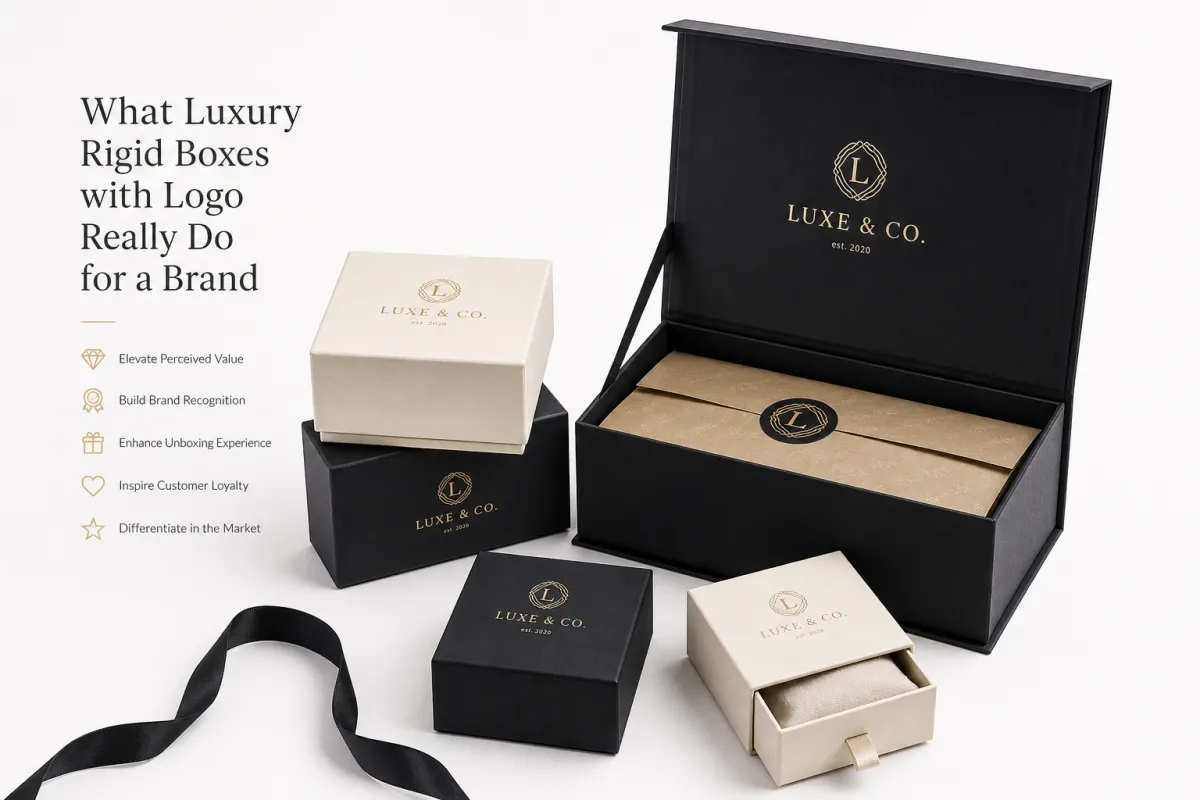
The best luxury rigid boxes with logo do not shout. They communicate through weight, fit, clean lines, and a surface treatment that looks chosen rather than cluttered. Packaging works like a quiet salesperson in that sense. It shapes expectation before the buyer reads a single label or touches the product.
Rigid boxes use thick paperboard cores, usually grayboard or chipboard, so they keep their shape instead of collapsing like folding cartons. That structure gives luxury rigid boxes with logo a gift-ready feel that works well for launches, limited editions, and products meant to be kept. A solid box often signals higher value even if the item inside has not changed at all. Humans are pretty easy to cue that way.
A logo changes the whole effect. A plain rigid box can still look elegant, but luxury rigid boxes with logo turn that elegance into recognition. The mark makes the package feel owned instead of generic. It also helps guide the unboxing sequence, since logo placement tells the buyer where to look, how to orient the box, and which part should stick in memory.
Sustainability belongs in the same conversation. A premium box does not need to be wasteful to feel premium. Luxury rigid boxes with logo can be designed for reuse, built with FSC-certified board, and wrapped in paper-based materials that are easier to recycle than mixed-material setups. If the box is sturdy enough to live a second life on a shelf or in a drawer, that is a better outcome than a dramatic package that falls apart after one opening.
What a lot of brands get wrong is assuming premium means complicated. Usually, it does not. The most effective luxury rigid boxes with logo often use a few clear choices: solid board stock, a clean wrap, one strong logo treatment, and a fit that feels intentional. Add too many effects and the box starts looking decorated instead of designed. That is not luxury. That is a craft fair with a bigger budget.
"The box should feel like it belongs to the product, not like it is trying to outshine it."
That rule matters even more for brands trying to balance presentation with environmental responsibility. Luxury rigid boxes with logo can support a sustainable packaging strategy when the structure is durable, the materials are chosen with end-of-life in mind, and the finish supports the brand without dragging in extra material complexity for no reason.
I have seen teams fall in love with a box because it photographed beautifully and then discover it was a headache in storage, costly to ship, and awkward to recycle. Pretty is nice. Operationally sane is better. You usually want both.
How luxury rigid boxes with logo are constructed
Most luxury rigid boxes with logo begin with a stiff board core, usually grayboard or chipboard in the 1.5 mm to 3 mm range. The thickness depends on the box size and the level of protection the product needs. That core gets wrapped with printed paper, specialty paper, or a laminated sheet. The wrap carries much of the visual identity, and it also affects hand feel, scuff resistance, and how well the box survives transit without looking tired.
There are a few standard formats. Lift-off lid boxes give a classic presentation and work well for apparel accessories, candles, and beauty sets. Magnetic closure boxes create a more deliberate opening moment and suit products that stay on display. Book-style rigid boxes open like a cover and fit curated sets, content-driven branding, or items that need a staged reveal. Drawer boxes bring a different kind of drama, which is useful when the product should feel like it is being presented, not merely stored.
Luxury rigid boxes with logo also vary by insert style. A die-cut paperboard insert is a strong option when paper-based recyclability matters. Molded pulp works well when cushioning is needed and the packaging brief pushes away from plastic. EVA foam still shows up for fragile products, but it can complicate disposal and is not always the right fit if sustainability is part of the real brief instead of a line item somebody tossed in because it sounded good.
Logo application is another major decision. Offset printing gives a clean full-color result for larger runs. Foil stamping adds strong contrast and a metallic finish, especially on darker wraps. Embossing raises the logo from the surface, while debossing presses it inward for a quieter effect. Screen printing can work on certain specialty papers, and digital methods help with shorter runs or variable artwork. The right choice depends on quantity, artwork complexity, and how much tactile detail the brand wants to feel in hand.
Luxury rigid boxes with logo can also include structural features that affect both function and feel. Ribbon pulls help with opening, though they should be used carefully so they do not become stray components that complicate recycling. Paper thumb cuts, hidden magnets, collar wraps, and layered trays each change the user experience. None of these features is automatically better. The goal is to use the parts that serve the product instead of cluttering the box because they sounded nice in a presentation deck.
Here is the practical test I use: if the structure protects the product, shows the logo clearly, and makes the box easy to understand at first touch, then the construction is probably doing its job. If one of those pieces fails, luxury rigid boxes with logo start drifting into decoration instead of packaging.
For teams still sorting out their packaging lineup, it helps to compare rigid formats against other custom options. A quick look at Custom Packaging Products can make the tradeoffs clearer, especially if the project sits somewhere between retail display and shipping durability.
Key factors that shape quality, sustainability, and fit
Quality in luxury rigid boxes with logo usually comes down to a small set of technical decisions, not one magical detail. Board thickness controls how the box holds shape. Wrap paper affects durability and print fidelity. Adhesive choice matters because some glue systems behave better with recycled substrates than others. Insert material changes presentation and end-of-life behavior. Each variable leaves a mark on the final result, whether the supplier mentions it or not.
For sustainable packaging, the most useful choices are often the least flashy. FSC-certified board, recycled-content chipboard, water-based coatings, and paper-based inserts all support a cleaner material story. You can review FSC standards directly at FSC, and that is worth doing if the brand needs a documented forestry chain instead of a vague eco claim that sounds good in a pitch and means very little in practice.
Finish choice deserves careful attention. Soft-touch lamination feels premium, but it can interfere with recyclability depending on the substrate and local recovery system. Matte lamination is often easier to live with than high-gloss film, though not always. Uncoated or lightly coated wraps can create a more natural feel and may suit earthy, artisan, or wellness brands better. Textured papers add character, but they can make fine logo details harder to read if the artwork is too small or too fussy.
Luxury rigid boxes with logo should also match the product they protect. A heavy skincare jar, a fragile bottle, and a retail gift set all ask for different structural behavior from the same basic box family. Weight, breakability, shelf life, and shipping distance matter. A box that will move once from warehouse to store is not the same as a box that will survive ecommerce networks, where compression and drop risk climb fast.
Another factor people underestimate is whether the box will be kept. A design meant to live on after purchase can justify slightly richer construction because the packaging becomes part of the brand experience. A box meant for quick retail turnover should prioritize storage efficiency, stackability, and material clarity. Luxury rigid boxes with logo do not need to be oversized to feel premium. They need to fit the product and the channel without wasting space.
For transport-sensitive products, testing matters. Packaging programs that expect repeated shipping should be checked against procedures such as ISTA methods, which are widely used to simulate distribution hazards. The testing framework at ISTA is a useful reference point when a buyer wants to know whether the box looks good only on a sample table or can actually handle the supply chain.
Brand clarity is the last piece. A busy package can dilute the logo and weaken the message. Strong luxury rigid boxes with logo usually rely on restraint: one focal logo treatment, one dominant surface, and one clear opening motion. That discipline makes the box feel more expensive, not less, because the eye knows exactly where to land.
- Board: 1.5 mm to 3 mm grayboard or chipboard, sized to the product weight and shipping method.
- Wrap: Printed paper, specialty paper, or coated sheet chosen for tactile feel and scuff resistance.
- Logo: Foil, emboss, deboss, offset, or digital, selected based on quantity and finish target.
- Insert: Paperboard, molded pulp, or foam depending on protection and sustainability goals.
- Closure: Lift-off, magnetic, book-style, or drawer format based on user experience and storage needs.
Luxury rigid boxes with logo pricing: what drives the cost
Pricing for luxury rigid boxes with logo comes down to practical variables, not guesswork. Size is one of the first. A larger box needs more board, more wrap, more labor, and usually a more careful assembly process. Board thickness follows close behind, because thicker board improves rigidity but raises material cost and can slow production if the design gets complicated.
Quantity matters just as much. Small runs cost more per unit because setup, tooling, proofing, and finishing labor are spread across fewer boxes. A 500-piece order will almost always feel more expensive per unit than a 5,000-piece order, even if the artwork barely changes. Luxury rigid boxes with logo tend to reward higher volumes when the packaging stays consistent across a product line.
Decorative processes add their own costs. Foil stamping needs dies and setup. Embossing and debossing often require matching tools and careful alignment. Specialty coatings can raise both material and application expense. Even a simple-looking logo can become expensive if the design calls for multiple passes, tight registration, or hand assembly at several points in the process.
There is also a sustainability angle to pricing. Recycled board may be competitively priced, but premium FSC-certified stocks, natural specialty papers, or lower-waste design choices can shift the budget. That does not make them poor investments. It simply means luxury rigid boxes with logo should be quoted with the full component list visible so the buyer can see what is driving the number instead of getting a vague lump sum and a shrug.
For a clearer picture, here is a practical comparison of common rigid-box directions. The prices below are typical planning ranges for mid-size production, not universal quotes, because dimensions, coverage, and finish selection can move the numbers pretty quickly.
| Box style | Typical quantity | Approximate unit price | Best fit | Cost drivers |
|---|---|---|---|---|
| Lift-off rigid box with printed wrap | 1,000-5,000 | $1.40-$3.20 | Beauty, apparel accessories, simple gifting | Board thickness, print coverage, basic insert |
| Magnetic closure rigid box with foil logo | 1,000-3,000 | $2.80-$6.50 | Premium retail, influencer kits, holiday sets | Closure magnets, foil stamping, wrap quality |
| Book-style rigid box with custom insert | 500-3,000 | $3.50-$8.50 | Curated sets, luxury electronics, presentation kits | Complex structure, insert engineering, assembly time |
| Drawer rigid box with specialty paper | 1,000-5,000 | $2.50-$7.00 | Jewelry, cosmetics, high-touch retail | Inner tray fit, pull tab detail, specialty wrap |
Those numbers help buyers think clearly, but they should never replace a real specification review. A cleaner spec often saves money faster than trimming artwork. If a logo can be simplified, if the insert can be made from paperboard instead of foam, or if the closure can move from magnetic to lift-off, the project may become easier on the budget without losing the premium feel. That is the kind of tradeoff worth making.
Rule of thumb: define the one or two premium details that actually matter, then build the rest of the box around them. Luxury rigid boxes with logo usually work best when the package has a clear hierarchy instead of a little bit of everything.
The process and timeline from concept to delivery
The path from idea to finished luxury rigid boxes with logo usually starts with a brief, and the better the brief, the fewer surprises later. A solid brief should include product dimensions, weight, target quantity, shipping method, target market, and any finish requirements. If the package needs to be gift-ready, shelf-ready, or ecommerce-resistant, that needs to be stated early because those three goals do not always point in the same direction.
After the brief comes structure. The supplier will usually propose a dieline or a working drawing so the team can confirm fit, closure, and insert layout. That is the moment to verify not only how the box looks, but how it opens, where the logo lands, and whether the product rattles or sits snug. Luxury rigid boxes with logo should be judged by the hand as much as by the screen.
Sampling is where good projects get saved. A sample can reveal weak closure tension, a lid that sits too loose, a wrap that shows fingerprints too easily, or a logo that disappears on a textured surface. Catching those issues early is cheaper than discovering them after production. If the project uses special inserts, the sample should be tested with the actual product, not an empty cavity estimated from a drawing and optimism.
The timeline varies by complexity, but a simple rigid box with standard materials may move from proof approval to production in roughly 12 to 18 business days. A more complex structure with custom inserts, multiple finishing steps, or repeated sample rounds will take longer. Print-ready artwork speeds things up. Late changes slow everything down. That sounds obvious because it is obvious, and yet it still causes half the missed deadlines in packaging.
For programs that need shipping validation, ask whether the design should be checked against transport criteria before full release. That can mean compression, vibration, or drop testing depending on the channel. Luxury rigid boxes with logo that look perfect on a desk are not automatically ready for distribution, especially if the product is fragile or the route includes multiple handling points.
A realistic production plan usually follows this sequence:
- Brief and product measurement
- Dieline or structural concept review
- Artwork preparation and logo placement check
- Prototype or sample approval
- Final production sign-off
- Quality control and packing
- Shipping and receiving
Brands that schedule luxury rigid boxes with logo early in the launch calendar usually have fewer inventory problems, and that matters more than people think. Packaging delays can hold up photography, retail placement, and fulfillment. A box should support the launch plan, not become the reason the launch plan starts improvising.
Common mistakes to avoid with luxury rigid boxes with logo
One of the biggest mistakes is overbuilding the package. A very thick, very large box can feel impressive at first glance, but if it creates storage headaches, higher freight expense, or a mountain of empty space, the packaging starts costing money in the wrong places. Luxury rigid boxes with logo should feel substantial, not bloated.
Another common problem is designing for the render instead of the material. A logo that looks crisp on a screen may lose clarity on a textured wrap, or a metallic foil may read beautifully in one light and vanish in another. Luxury rigid boxes with logo deserve artwork checks on the real substrate because paper grain, coating, and foil behavior all affect visibility. Screens lie. Paper does not care about your expectations.
Skipping prototypes is an expensive habit. Without a sample, teams often discover that the product fit is too tight, the closure strength is off, or the insert does not restrain the item well enough. On a rigid box, those errors can be harder to fix than on a folding carton because the structure leaves less room for forgiveness once the tooling is set.
Sustainability claims can also get awkward if the material mix is not thought through. Mixed plastics, glued-in foam, oversized magnets, and heavy laminations can make luxury rigid boxes with logo harder to recycle. That does not mean those components are always wrong, but they should be used for a reason instead of by habit. If a feature does not improve protection or user experience, it deserves a hard look.
There is also a merchandising mistake that shows up all the time: the exterior gets all the attention while labeling, product information, and assembly logic are left vague. A beautiful package that slows warehouse work or confuses store staff creates hidden costs. In practical terms, luxury rigid boxes with logo need to function in the supply chain as well as they perform on the shelf.
Here is the blunt version: if a box cannot be assembled consistently, cannot survive the route, or cannot be recycled with reasonable effort, the premium feeling is only half the story. Luxury rigid boxes with logo should hold up to the ordinary realities of warehousing, shipping, and disposal. Fancy is not a substitute for functional.
- Do not size the box around empty space.
- Do not stack too many decorative processes on one surface.
- Do not assume a digital proof is enough.
- Do not add mixed materials unless they solve a real problem.
- Do not let the logo compete with the structure.
Expert tips and next steps for smarter ordering
If I were guiding a buyer through luxury rigid boxes with logo, I would start with the product and work outward. Measure the item carefully, note fragile zones, decide whether the box must ship flat or fully assembled, and choose the structure that protects the product first. That sounds basic because it is basic, but basic is usually what keeps a project from drifting into expensive nonsense.
Next, build a sample board. Put the wrap papers, logo treatments, inserts, and closure options side by side so the team can compare feel, visibility, and cost. Luxury rigid boxes with logo are easier to approve when people can touch the materials instead of arguing over a screen. A simple board often shows which finish feels premium and which one only looks expensive in a render and then falls apart in the real world.
Choose one hero effect. In many cases, that should be foil stamping or embossing, but not both unless the brand genuinely needs the extra distinction. One strong treatment usually gives a cleaner result than three competing ones. Luxury rigid boxes with logo feel more refined when the eye gets a single focal point instead of a crowded surface trying to win a staring contest.
If sustainability matters, ask direct questions about board source, adhesive system, ink coverage, and insert material. Ask whether the components are separable, whether the box contains recycled content, and how the package is meant to be disposed of after use. Better still, ask the supplier to explain the tradeoff between appearance and end-of-life behavior. That conversation tends to produce more honest answers than a broad claim about being eco-friendly.
For buyers comparing formats, the broader Custom Packaging Products range can help clarify whether a rigid box is the right fit or whether another custom structure makes more sense for the product line. Sometimes the best answer is still a rigid box. Sometimes a high-end folding carton or drawer box does the same job with less material and lower cost. There is no prize for overpacking a product.
Luxury rigid boxes with logo work best when the project brief is specific. If you know the product dimensions, the target quantity, the shipping channel, and the visual priority, you can get a more accurate quote and avoid a stack of revisions. Precision usually saves time as well as money, which is refreshing because packaging rarely gives you anything for free.
For teams comparing multiple package directions, it helps to think in this order: protection, brand fit, production ease, and end-of-life. Luxury rigid boxes with logo should satisfy all four if possible, but the first two are non-negotiable. A box that protects poorly or muddies the brand story is not really premium, no matter how attractive the finish might be.
And yes, the logo matters. But the strongest luxury rigid boxes with logo are not just branded surfaces. They are tightly built package systems that make the product feel considered from the first touch to the last reveal. Plan them well, and luxury rigid boxes with logo can support presentation, sustainability, and commercial efficiency at the same time.
Before you request quotes, gather the dimensions, product weight, target quantity, shipping requirements, and finish priorities, then ask for a sample or dieline review. That one step can prevent most of the expensive surprises that show up later. For a premium program, luxury rigid boxes with logo should be specified early, reviewed carefully, and built around how the package will actually live in the market.
One more practical point: do not ask for every premium finish just because the sample room has them. A lot of projects only need one memorable tactile or visual detail. The cleaner the brief, the less likely the final box ends up looking like it is trying to prove something.
FAQ
What makes luxury rigid boxes with logo different from folding cartons?
Luxury rigid boxes with logo use thick board that keeps its shape, so they feel more substantial and usually protect the product better than standard folding cartons. They also support sturdier inserts and higher-impact presentation details. Folding cartons are still useful, especially for lighter products or flatter storage needs, but they do not create the same premium structure.
Are luxury rigid boxes with logo recyclable?
Often yes, if the package is built from paper-based board and wraps with minimal plastic content. The answer depends on finishes, inserts, magnets, and coatings, though, because mixed-material construction can make recycling harder. The cleanest approach is to review each component before final approval so the disposal path is understood in advance.
What affects the price of luxury rigid boxes with logo the most?
Size, board thickness, quantity, and decoration level usually drive the price more than anything else. Foil stamping, embossing, specialty papers, custom inserts, and complex closures add tooling and labor. Smaller orders cost more per unit because setup and finishing costs are spread across fewer boxes.
How long does it take to produce custom luxury rigid boxes with logo?
The timeline depends on approval speed, material availability, and how complex the box structure is. A straightforward project with standard materials can move relatively quickly once artwork is approved, while a more detailed build with custom tooling or multiple samples will take longer. Clear dimensions and print-ready files usually shorten the schedule more than anything else.
What should I prepare before requesting a quote for luxury rigid boxes with logo?
Have product dimensions, target quantity, shipping needs, branding files, and must-have finish details ready. It also helps to know whether the box should be reusable, gift-ready, shelf-ready, or optimized for ecommerce shipping. The more specific the brief, the easier it is to compare quotes and avoid last-minute changes.
What is the smartest way to balance presentation and sustainability?
Pick the structural features that actually protect the product, then keep the finish count low and intentional. A paper-based insert, recyclable wrap, and one strong logo treatment usually go further than a box covered in layered effects. If a detail does not improve function or brand clarity, it probably does not belong.


