Buyer Fit Snapshot
| Best fit | Branded Kraft Product Boxes with Logo projects where brand print, material claims, artwork control, MOQ, and repeat-order consistency need to be specified before quoting. |
|---|---|
| Quote inputs | Share finished size, material target, print colors, finish, packing count, annual reorder estimate, ship-to region, and any compliance wording. |
| Proofing check | Approve dieline scale, logo placement, barcode or warning zones, color tolerance, closure strength, and carton packing before bulk production. |
| Main risk | Vague material claims, crowded artwork, missing packing details, or unclear freight terms can make a low unit price expensive after revisions. |
Fast answer: Branded Kraft Product Boxes with Logo: Board, Finish, Dieline, and Unit Cost should be specified like a repeatable production item. The safest quote records material, print method, finish, artwork proof, packing count, and reorder notes in one written spec.
Production checks before approval
Compare the actual filled-product size with the drawing, then confirm tolerance on folds, seals, hang holes, label areas, and retail display edges. Reserve space for logos, QR codes, warning copy, and material claims before decorative graphics fill the panel.
Quote comparison points
Review material grade, print process, finish, sampling route, tooling charges, carton quantity, and freight assumptions side by side. A quote is only useful when the supplier can repeat the same color, closure quality, and packing count on the next order.
Branded kraft product Boxes With Logo can look more premium than a glossy carton when the structure is disciplined and the branding is deliberate. That surprises people because kraft gets dismissed as the plain option. It really is not. Put a clean logo on the right board and the package feels more grounded, more expensive, and a lot less like it is trying too hard.
The real value of branded kraft product boxes with logo is that they do three jobs at once: protect the product, communicate the brand, and reduce the need for extra packaging layers. That matters for e-commerce, retail shelves, subscription kits, and gift-ready sets. Packaging buyers are usually balancing appearance, shipping performance, and unit cost in the same conversation, so a box that handles all three earns its keep quickly.
There is a practical sustainability angle too. Kraft packaging tends to signal lower waste, fewer coatings, and simpler end-of-life handling, which is why it often fits brands trying to present a more grounded, less overproduced image. Kraft alone does not make a package sustainable. Structure, ink choice, inserts, and coatings all matter. Branded kraft product boxes with logo are a system decision, not a print decoration with a cute backstory.
For Custom Logo Things, that is the part worth paying attention to. A package can look humble on paper and still feel premium in the hand if the caliper is right, the logo reads clearly, and the closure is crisp. If you want a wider view of formats and finishes, it helps to compare the options in our Custom Packaging Products catalog before narrowing the spec.
What branded kraft product boxes with logo actually do
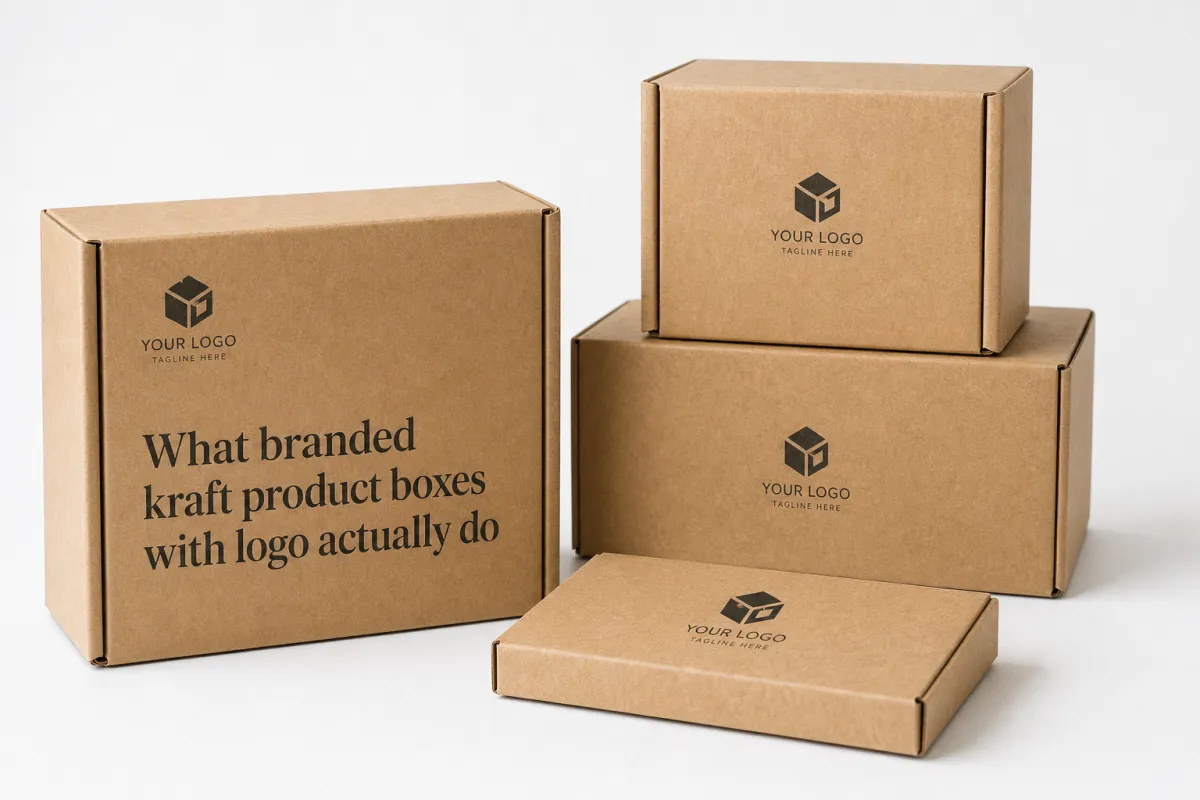
A plain kraft carton can feel more premium than a high-gloss box when the proportions are right and the branding is quiet but sharp. That is one of the odd truths of packaging: restraint often reads as confidence. Branded kraft product boxes with logo work because they let texture, structure, and print discipline carry the message instead of asking coating and shine to do all the work.
At a practical level, branded kraft product boxes with logo are usually made from kraft paperboard or corrugated kraft board and then printed, stamped, foil-pressed, embossed, debossed, or labeled with the logo. The format can support retail presentation, shipping protection, or subscription unboxing. That flexibility is why the same visual language can work for a candle, a skincare set, a T-shirt, or a small electronics accessory without feeling out of place.
From a buyer's point of view, the box has to solve several problems at once. It should keep the item secure, keep the shipping team moving, and still look coherent when the customer opens it. If the box needs tissue, void fill, and a separate sleeve just to feel finished, the system is working too hard. Strong branded kraft product boxes with logo reduce that friction. They do not need to shout. They need to hold up.
Sustainability matters here because kraft has a kind of visual honesty that consumers recognize immediately. Natural brown stock often suggests recycled content, lower print complexity, and less material waste, even though those assumptions should still be checked against the actual spec. The better choice is the one that uses the right board grade, the right amount of ink, and the least complicated structure that still protects the product. If you are comparing suppliers, ask how they source board and whether they can document recycled content, FSC-certified fiber, or other paper standards through the chain.
A kraft box is not automatically a sustainable box. The package only earns that reputation if the board, print, coatings, and inserts all support the same goal.
The business value is easy to miss because it looks small on a spreadsheet. But a well-chosen box can reduce damage claims, reduce repacking time, improve shelf presentation, and make the brand feel more intentional at the first touchpoint. That is a lot of work for one carton. For brands building repeat recognition, branded kraft product boxes with logo are often the quietest way to look established without spending like a luxury label.
If you want a deeper baseline on fiber packaging and material choices, the Packaging Institute is a useful reference point for board and corrugated terminology, while box construction guides from suppliers often translate that language into actual production specs. The important part is not the buzzwords. It is matching the box style to the product load, opening experience, and shipping environment.
How branded kraft product boxes with logo are made
The production path for branded kraft product boxes with logo is more structured than most people think. It usually starts with the product dimensions, then moves to box style selection, dieline creation, logo placement, print method, proofing, and converting. A good supplier will ask about weight, fragility, shipping method, display use, and whether the package needs to open cleanly in a retail setting or survive a parcel network. Those questions are not filler. They decide whether the box actually works.
Material choice comes first because it determines almost everything downstream. Natural kraft paperboard gives a warm, textured look and works well for lighter retail cartons. Recycled kraft can be a strong option if the brand wants a more visibly eco-forward story. Corrugated kraft is better for mailers and Shipping Boxes That need stacking strength and crush resistance. For premium presentation, rigid constructions wrapped in kraft can be used when the unboxing experience matters more than fold-flat efficiency.
Then comes the logo treatment. Flexographic printing is common for simple one- or two-color graphics on corrugated stock. Digital printing can help with shorter runs and more complex artwork. Foil, embossing, and debossing add tactile detail, but each one changes cost and can affect recyclability if the design becomes too layered. A stamp-style one-color logo often performs better on kraft than a busy full-coverage design, especially if the brand wants the paper texture to remain visible.
Structure is where function gets decided. A tuck-end carton suits lightweight products and retail presentation. A mailer box is better for e-commerce because it closes securely and often arrives with a cleaner opening sequence. A sleeve and tray can elevate presentation for gift sets or high-touch items. Foldable cartons save warehouse space. Custom inserts keep the product centered and reduce movement, which is critical for fragile items like glass bottles or ceramic goods.
Proofing is not a formality. It is the step that saves buyers from color drift, alignment issues, and logo distortion. On kraft stock, color behaves differently than it does on coated white board. Earth tones get warmer. Fine type can soften. Dark brand colors can absorb into the paper more than expected. That is why a sample or press proof on the actual board matters so much for branded kraft product boxes with logo.
A good prepress file also does a lot of invisible work. Vector logos prevent pixelation. A 3 mm bleed keeps the print from showing white slivers at the edge. Safe zones protect text from being cut too close to a fold or panel edge. If the design has a light logo on brown kraft, expect the contrast to be lower than on white stock. It may still look better, because the natural background adds character that coated stock cannot fake.
For shipping-focused projects, it is smart to ask whether the box has been considered against an ISTA test profile or a similar distribution method. Transit testing does not guarantee perfection, but it does reduce guesswork. You can review transit and packaging test standards through ISTA if your packaging has to survive parcel drop, vibration, or compression. That matters more than a beautiful render in a deck.
In practice, the best branded kraft product boxes with logo are built from a chain of small choices that all point in the same direction. The logo is sized for the panel, the board matches the product load, the print method respects the material, and the structure supports the real use case. That is what separates a decent box from one that feels deliberately engineered.
Key factors that shape cost, look, and sustainability
Cost is usually where the conversation becomes more honest. Branded kraft product boxes with logo are not expensive for one reason or cheap for another reason. Pricing comes from a combination of board thickness, box dimensions, print coverage, finishing complexity, inserts, and quantity. A large run can absorb setup costs well; a short run cannot. That is why two boxes that look similar on the shelf can land at very different unit prices.
Quantity has a simple economic effect. Plates, prepress setup, machine changeovers, and sampling are fixed or semi-fixed costs. When those costs are spread across 10,000 boxes instead of 1,000, the per-unit price drops. That is one reason a buyer may see an unexpected jump in unit cost when they cut the order size. It is not always a supplier premium. Sometimes it is just math doing its unglamorous thing.
Sustainability tradeoffs are where buyers need to stay alert. Recycled kraft content is helpful, but so are water-based inks, minimal coating layers, and avoiding mixed-material construction that complicates recycling. A plastic window may look attractive on a retail shelf, but it also changes the disposal story. A heavy lamination may protect the box surface, but it can make the package harder to recover cleanly. The best outcome is usually the simplest one that still protects the product and preserves brand quality.
Visual effect matters too. Natural kraft softens color and adds warmth, which is why many brands like it for handmade, organic, or lifestyle products. White-lined kraft creates a brighter print surface and makes logos appear cleaner and more contrasty, but it also changes the emotional tone of the box. A white interior can feel more polished. A brown interior can feel more honest and earthy. Neither is automatically better. The choice should match the product and the brand story behind the box.
Product weight and fragility are often underrated in the early quoting stage. A box that looks fine for a lightweight accessory may fail badly with a glass jar, supplement bottle, or fragile candle tin. Underbuilt packaging creates hidden costs through returns, replacements, and damage claims. Overbuilt packaging creates waste and inflates the freight bill. Good packaging buyers think in terms of protection per dollar, not just visual appeal.
Here is a useful rule of thumb: the more the product needs protection, the more likely you are to move from simple folding carton stock into corrugated kraft or a reinforced insert structure. That decision can add a little to unit cost, but it can save a lot more in breakage and customer service time. A package that arrives intact is not just a shipping outcome. It is part of the brand promise behind branded kraft product boxes with logo.
For brands that want a paper-fiber perspective on materials and recovery, resources from EPA recycling guidance can help frame how coatings, mixed materials, and curbside realities affect end-of-life handling. That matters because the most sustainable package is not the one that sounds green in a meeting. It is the one that still works across production, shipping, and disposal.
Cost, pricing, and lead times for branded kraft product boxes with logo
Buyers usually want a clear number first, so here is the practical version: branded kraft product boxes with logo can range from very economical to surprisingly premium depending on format. A simple mailer or fold-flat carton with one-color printing is often the lowest-cost route. A retail tuck-end carton falls in the middle. A rigid kraft-wrapped box, especially with inserts or specialty finishing, sits at the higher end of the scale.
As a rough planning tool, a low-complexity mailer box at mid-volume may land around $0.45-$1.10 per unit. A retail folding carton with modest print coverage may sit around $0.30-$0.85 per unit, depending on size and quantity. Sleeve-and-tray presentations often run $0.90-$2.25 per unit. Rigid set-up boxes can move into $1.75-$4.80 per unit or more if the board, wrap, or insert package is complex. Those are broad ranges, not promises, because board grade, freight, and finishing choices can move the number quickly.
| Format | Best for | Typical unit range | Cost drivers |
|---|---|---|---|
| Fold-flat mailer box | E-commerce, subscription, small goods | $0.45-$1.10 | Print coverage, corrugated grade, closure style |
| Tuck-end retail carton | Cosmetics, supplements, light accessories | $0.30-$0.85 | Board thickness, cut complexity, surface finish |
| Sleeve + tray | Gift sets, premium kits, presentation packaging | $0.90-$2.25 | Two-part construction, alignment, insert fit |
| Rigid kraft-wrapped box | Luxury items, PR kits, high-touch unboxing | $1.75-$4.80+ | Chipboard thickness, wrap material, inserts, hand assembly |
There are hidden costs too, and these catch new buyers more than they should. Tooling, plates, proofing, dieline revisions, inserts, freight, and last-minute artwork corrections can all change the final invoice. A small text change after proof approval can force another set of revisions. A custom insert can add both material cost and assembly time. A rush shipment can turn a reasonable order into an expensive one in a hurry.
Lead times are usually affected by the same variables. A simple job might move from proof approval to delivery in roughly 12-15 business days if materials are in stock and the print method is straightforward. More complex orders can take 3-5 weeks once sampling, special finishes, or sourcing delays are included. If the job needs multiple proofs or a physical sample round, add more time. Custom structures almost always move slower than stock-style cartons because there is more to validate before production starts.
That is why early planning protects the budget. A buyer who orders too late often loses the ability to compare suppliers, choose a better board, or request a cleaner finish. The result is either a rush fee or a compromise. Usually both. With branded kraft product boxes with logo, timing is part of the economics. The earlier you lock the spec, the more options you keep open.
For brands that need a point of comparison, reviewing sample projects in our Case Studies can make the tradeoffs easier to see. A flat carton photo rarely tells the whole story. The real differences show up in panel strength, opening feel, print contrast, and how the package behaves once it is packed and shipped.
Step-by-step process for ordering branded kraft product boxes with logo
Ordering branded kraft product boxes with logo goes more smoothly when the buyer treats it like a packaging brief, not a design request. Start with the product itself. What are the dimensions, weight, and fragility? Does the box need to survive parcel shipping, stand up on a shelf, or do both? Does the product need an insert, a display window, a tamper seal, or a closure that can be reopened without damage? Those details sound basic until they are missed.
- Measure the product precisely. Record width, length, height, and weight, then add any accessory items that must fit inside.
- Choose the box style. Decide whether you need a mailer, folding carton, sleeve, tray, or rigid structure.
- Pick the logo treatment. Keep it subtle, high-contrast, or tactile depending on the brand goal and the kraft surface.
- Prepare the artwork. Use vector files, set a 3 mm bleed, and leave safe zones around folds, edges, and closures.
- Request a proof or sample. Check fit, color, closure strength, and print alignment on the actual board.
- Approve with all specs in writing. Confirm quantity, finish, delivery window, and acceptable tolerances before production starts.
Artwork setup is often where small mistakes become expensive. On kraft, a logo can disappear if the ink is too close in value to the board color. Thin fonts can blur. Lines under 0.25 pt can break up. If the design uses spot colors, ask how the supplier handles them on uncoated stock. If it uses CMYK, ask for an actual proof on the chosen material, not just a screen rendering. Screen color is a suggestion. The board is the reality.
Sample review is worth the extra time because a flat dieline does not reveal how the box behaves in the hand. A mailer that looks perfect on screen may pinch too tightly at the closure. A carton may bow once the product is inserted. A rigid box may feel beautiful but waste space in shipping. These are the details that separate a serviceable package from a smart one. They also explain why branded kraft product boxes with logo are best handled with a structured approval workflow.
If the box is going through parcel networks, ask for transit assumptions early. A packaging buyer who tests fit only on a desk is missing half the job.
For boxes that must survive distribution, test planning matters almost as much as print planning. A supplier that understands compression, vibration, and drop behavior is usually safer to work with than one that only talks about graphics. That is where standards like ISTA profiles or ASTM-style thinking can help shape the spec. The exact test path depends on product weight and shipment type, but the principle is simple: do not approve a box just because it looks good in a mockup.
One more practical tip: create a simple decision sheet before approval. Put cost, protection, sustainability, and brand impact in columns, then score each option honestly. A brilliant-looking box that damages product is not a win. A cheap box that feels generic is not a win either. The best branded kraft product boxes with logo usually sit in the middle of those extremes, where the spec is deliberate and the tradeoffs are visible.
Common mistakes with branded kraft product boxes with logo
The most common mistake is overprinting. Kraft already has a visual identity. If the artwork covers every surface with heavy ink, the package can lose the warm, natural quality that made kraft appealing in the first place. That is why branded kraft product boxes with logo often look better with one strong logo, a small amount of supporting copy, and clean negative space than they do with dense graphics everywhere.
Another mistake is choosing a box style for appearance alone. A beautiful structure that cannot carry the product weight will fail the moment it enters transit. Weak corners, shallow board thickness, and flimsy closures are expensive problems because they create returns and customer complaints after the order has already shipped. Always ask whether the box can handle compression, stacking, and repeated handling if it will move through a warehouse or parcel network.
Print mismatch is a subtle problem that shows up after the boxes arrive. A logo that looked crisp on a coated proof can appear softer on kraft stock. A color that looked rich on screen can shift warmer or darker in production. A small logo on a brown surface can disappear if the contrast is too low. This is why branded kraft product boxes with logo should be reviewed on the actual board, not just approved from a PDF.
Sustainability mistakes are common too. Adding a plastic window, a heavy gloss lamination, or mixed-material embellishments can make the package harder to recycle. Some brands try to appear environmentally aware while building a package that is actually more complicated to recover. That disconnect is easy for buyers to notice. The cleaner path is usually to reduce unnecessary layers and keep the material story consistent from the outside carton to the inside insert.
Late ordering causes a different kind of problem. It compresses the decision window, which makes suppliers less flexible and buyers more likely to accept compromises. Rush orders can limit material options, remove sampling time, and push the project into more expensive shipping lanes. In practice, the late order is not just an urgency issue. It is a quality issue. A rushed box is much more likely to become a costly revision than a smooth launch.
If you want to see how different specs hold up once they move beyond the first proof, the examples in our Case Studies are a useful reminder that attractive packaging is only part of the story. The other part is how it performs after 200 boxes are packed, stacked, and shipped.
Expert tips and next steps for better branded kraft product boxes with logo
The smartest way to improve branded kraft product boxes with logo is to stop treating every available finish as mandatory. One strong logo treatment is usually better than a stack of effects. Kraft texture already does some of the branding work. A foil stamp, deboss, or one-color print can be enough if the structure is clean and the proportions are right. Too many finishes can make the package feel busy and pull attention away from the product.
Test the box under real conditions. Put it on a shelf. Shake it lightly. Stack it with other cartons. Open it with one hand if that is how your customer will use it. Drop-test it if the journey is rough. If the package is shipping through a parcel network, ask for transit assumptions that align with the actual route. These checks sound basic, but they uncover most of the issues that a render never shows.
A decision matrix helps a lot. Score the sample against four questions: does it protect the product, does it stay within budget, does it support the sustainability story, and does it reflect the brand well? If one option wins all four, you are done. If not, the table makes the tradeoff visible. That is better than approving on instinct and hoping the package performs later.
From a procurement point of view, the best next step is usually simple. Gather your product dimensions, choose a target quantity, shortlist two or three box styles, and ask for a sample build for each. Compare print clarity, closure feel, and shipping strength. Then confirm the final spec in writing before production begins. That process reduces friction and gives you a better answer than a generic quote ever could.
For brands that want packaging to feel coherent across products, boxes, and launch campaigns, branded kraft product boxes with logo are best treated as part of the full brand system, not as a one-off carton order. The first touch, the unboxing moment, the shelf presence, and the disposal path all matter. That is why the right decision often looks simple from the outside and highly intentional once you study the details.
If you are comparing formats, materials, or print treatments, take another look at our Custom Packaging Products and use them as a practical starting point rather than a finish line. The goal is not to buy the fanciest box. It is to choose the box that carries the product, the price point, and the brand story without wasting material or budget.
For Custom Logo Things, that is the real takeaway: branded kraft product boxes with logo should feel natural, durable, and specific to the product they carry. When the structure, board, print, and finish all line up, the box stops being packaging and starts acting like part of the brand memory.
How much do branded kraft product boxes with logo usually cost?
Pricing depends on board type, box size, print coverage, and finishing choices. Simple one-color mailer styles usually cost less than complex retail cartons with inserts, and higher quantities lower the unit price because setup costs are spread across more boxes. If you need a working budget, ask for separate quotes for the box shell, inserts, and freight so the total stays visible.
Are branded kraft product boxes with logo good for sustainable packaging?
Yes, especially when they use recycled kraft, minimal coatings, and water-based inks. They are strongest as a sustainability choice when the design avoids extra plastic layers and unnecessary mixed materials. The most sustainable version is still the one that protects the product well enough to reduce damage returns and replacement shipments.
Can I print full color on kraft boxes with a logo?
Yes, but colors usually look warmer and less bright on natural kraft than on white stock. High-contrast logos often perform better than tiny details or pale pastel artwork. A proof on the actual kraft material is the safest way to judge the final result, because the paper tone changes the way the ink reads.
How long does it take to produce branded kraft product boxes with logo?
Timeline usually includes artwork approval, sampling, production, finishing, and shipping. Simple orders can move faster, while custom structures, specialty inks, or inserts add time. Early approval helps avoid rush fees and gives the supplier enough room to confirm the material and print schedule.
What products work best in branded kraft product boxes with logo?
They work well for cosmetics, apparel, candles, food gifts, supplements, and e-commerce items. Heavier or fragile products may need corrugated kraft or inserts for added protection. The best fit is a product that benefits from a natural look and a sturdy presentation without needing a heavy layer of extra decoration.


