Buyer Fit Snapshot
| Best fit | Branded Mailing Bags Bulk Pricing projects where brand print, material claims, artwork control, MOQ, and repeat-order consistency need to be specified before quoting. |
|---|---|
| Quote inputs | Share finished size, material target, print colors, finish, packing count, annual reorder estimate, ship-to region, and any compliance wording. |
| Proofing check | Approve dieline scale, logo placement, barcode or warning zones, color tolerance, closure strength, and carton packing before bulk production. |
| Main risk | Vague material claims, crowded artwork, missing packing details, or unclear freight terms can make a low unit price expensive after revisions. |
Fast answer: Branded Mailing Bags Bulk Pricing: What Affects Cost should be specified like a repeatable production item. The safest quote records material, print method, finish, artwork proof, packing count, and reorder notes in one written spec.
Production checks before approval
Compare the actual filled-product size with the drawing, then confirm tolerance on folds, seals, hang holes, label areas, and retail display edges. Reserve space for logos, QR codes, warning copy, and material claims before decorative graphics fill the panel.
Quote comparison points
Review material grade, print process, finish, sampling route, tooling charges, carton quantity, and freight assumptions side by side. A quote is only useful when the supplier can repeat the same color, closure quality, and packing count on the next order.
Branded Mailing Bags Bulk Pricing: What Affects Cost
A 10,000-piece order can look expensive until you break it into the parts that actually create the price. Setup charges, print preparation, carton configuration, and freight do a lot of the heavy lifting behind the number on the page. The mailer itself is only one piece of the puzzle, and in bulk packaging that distinction matters more than most teams expect.
For a packaging buyer, the bag has to do more than look decent on a shelf or in a warehouse. It protects the product, carries the brand, and touches margin every time a shipment leaves the building. Miss one of those jobs, and the quote that looked cheapest can become the most expensive decision in the room. That is the real pressure behind Branded Mailing Bags bulk pricing.
It is also why a simple unit-price comparison can be misleading. MOQ, tooling fees, setup charges, delivery method, and the amount of print coverage all sit inside the final number. Leave one out and the comparison stops being real. I have seen buyers get burned by this more than once, and it is usually not because the supplier was hiding anything. More often, the buyer simply did not ask for the same basis across every quote.
Cheap unit price is not the same thing as sound pricing. If the quote skips setup, freight, or a durability requirement, the bill usually grows later.
Used well, branded mailing bags lift presentation without adding much weight or complexity. Used badly, they trigger reprints, delays, and avoidable damage to margin. The difference usually comes down to how carefully the quote is built and how clearly the buyer compares it against other packaging formats such as Custom Poly Mailers.
What Affects Branded Mailing Bags Bulk Pricing Most?
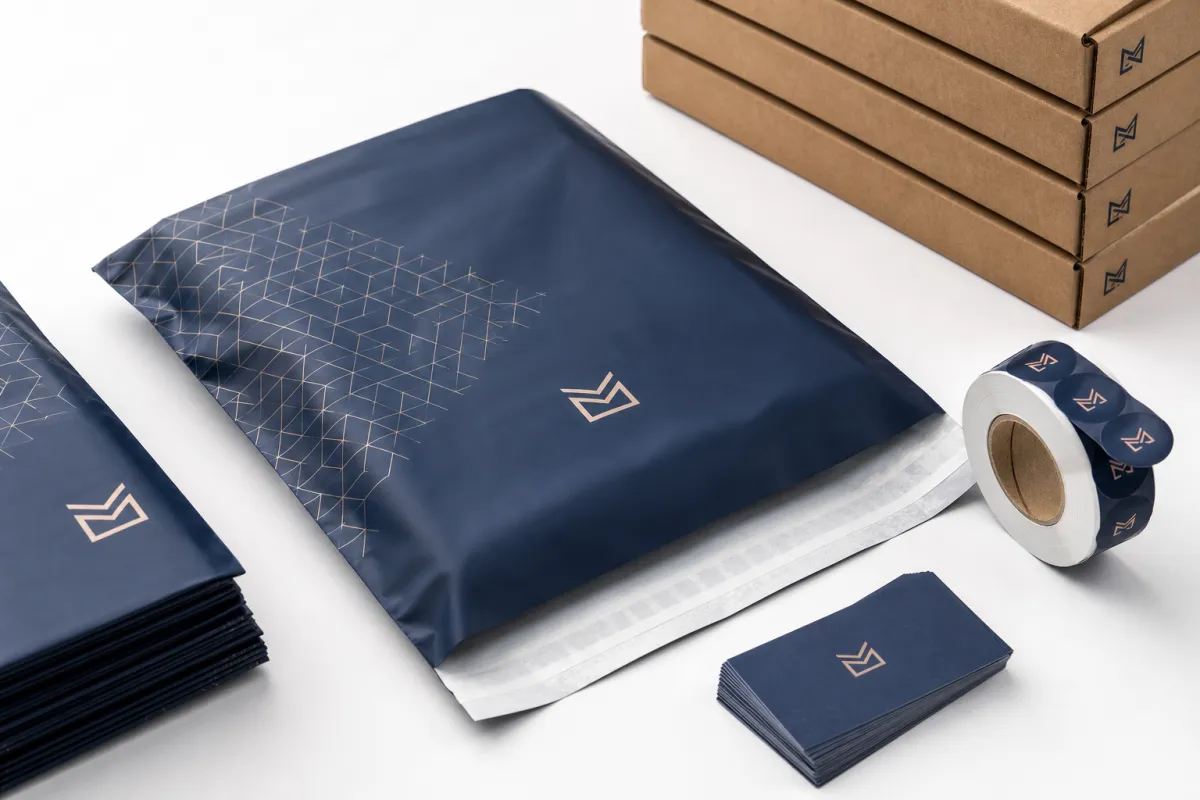
The biggest cost shift in branded mailing bags bulk pricing is often not the film. It is the fixed work around the film. Artwork prep, plate creation, proofing, and press setup are costs that do not shrink just because the order is small. A 1,000-piece run absorbs those costs badly, while a 10,000-piece run spreads them across far more units.
That is why small orders tend to look steep on a unit basis. The bag itself might only be a few cents more than a larger run, yet the setup charges and tooling fees can push the per-piece number upward quickly. Once the run gets larger, those same costs fade into the background and the unit cost starts to look more commercial.
In ecommerce, the mailer is part of the margin story and part of the brand story. A clean printed bag can improve unboxing perception, support repeat orders, and keep the packing line moving without extra label overlays. That is why branded mailing bags bulk pricing should be reviewed alongside fulfillment speed, not separated from it.
Three buyers often miss the same detail: they compare the bag price and ignore the shipment profile. The real quote depends on bag size, material, print coverage, shipping method, and lead time. A larger bag with heavier film and a multi-color logo belongs in a different cost bucket than a slim mailer with a one-color mark. That difference matters even more when the order is part of a wider packaging program.
For background on packaging material choices and market categories, the Flexible Packaging Association publishes useful reference material at packaging.org. For transit stress and shipment testing, ISTA remains one of the clearest benchmarks. Those sources do not set price, but they help define what a bag has to survive before it is fit for purpose.
For buyers, the fairest comparison frame looks like this:
- Same bag dimensions
- Same film gauge or thickness
- Same print count and coverage
- Same finish, such as matte or gloss
- Same freight basis and delivery postcode
- Same lead time assumption
If any of those variables differ, the branded mailing bags bulk pricing comparison is not clean. It is just a spreadsheet with mismatched inputs.
Product Details: Materials, Print Styles, and Daily Use
Most branded mailing bags start with polyethylene film, usually LDPE or LLDPE, because the material balances price, flexibility, and seal reliability. Buyers focused on lower plastic content often move toward recycled-content films, especially when the brand wants a visible sustainability signal without changing the packing line. Higher-opacity film matters too when the product inside should stay hidden. In a warehouse review I sat through last year, a buyer ended up switching to opaque film after customers began complaining about visible folds and shadows. The product was fine. The presentation was not.
That is where branded mailing bags bulk pricing begins to reflect the material itself. A plain film mailer with minimal print is one thing. A recycled-content mailer with strong opacity and a dense printed logo is another. The second option usually costs more, though the difference can narrow fast once the order volume is high enough to absorb setup. Recycled content, film gauge, and opacity are all part of the same commercial equation.
Print style changes the economics as well. A single-color logo is usually the most efficient route. Two-color branding adds press complexity, and full-coverage artwork can increase waste, proof time, and registration sensitivity. If a buyer asks for inside print, outside print, or print on both sides, the quote should show that work immediately. That is especially true in branded mailing bags bulk pricing discussions, where a small artwork change can move the total more than expected.
Finish has more commercial weight than many teams expect. Matte gives a softer, more premium feel. Gloss sharpens color and can make lighter artwork stand out. Neither finish is automatically better; the right choice depends on whether the product is apparel, soft goods, subscription items, or lightweight accessories. A glossy finish can look punchier in photos, while matte often reads as quieter and more premium in hand.
In daily use, the practical details matter just as much as the look. Adhesive strength decides whether the flap stays closed in transit. Tear resistance determines whether a parcel survives a rough carrier network. Tamper evidence builds customer confidence, especially where condition on arrival affects returns. Weather protection starts to matter as soon as the bag leaves a dry warehouse floor.
For brands shipping only soft goods, the mailer may be enough. Products that need firmer structure sometimes point to a different package style, and the comparison with Case Studies can show how that trade-off is handled in practice. If the shipment contains awkward edges, metal fittings, or anything that can punch through thin film, the cheapest option is rarely the safe one.
If you are reviewing branded mailing bags bulk pricing for apparel, the pattern is usually straightforward: low-profile garments, a one-color logo, and moderate opacity. Subscription bundles and mixed accessory sets need a stronger film and better seal security before artwork approval. A cheaper film is not a bargain if the item arrives wrinkled, split, or exposed.
Specifications That Drive Performance and Cost
Specs decide whether a mailer is merely printable or actually fit for use. The most useful figures are dimensions, film thickness, seal style, opacity, printable area, and carton pack count. If those details are missing, branded mailing bags bulk pricing turns into guesswork because the supplier has no way to compare one order against another on the same basis.
Film thickness, usually described in micron or gauge, matters because it affects puncture resistance and stretch. A lightweight mailer in the 50-60 micron range can work well for apparel. A heavier 70-90 micron film is often better for denser parcels or shipments that will pass through several carrier touchpoints. More thickness usually means more material cost, but it can also prevent damage claims and rework. That trade-off is one of the least glamorous parts of procurement, but it is often where the real savings live.
Seal style is another practical line item. Easy-peel adhesive helps warehouse staff move faster and lowers strain during packing. A tamper-evident strip adds security and gives the customer a clear sign that the parcel has not been opened. For high-volume operations, those small workflow differences matter because they affect throughput as much as appearance.
Brand consistency needs its own check. A logo printed on a mailer is not the same as a logo on a coated carton, and the registration tolerances are not identical either. If color accuracy is critical, ask for Pantone guidance, proof expectations, and the acceptable variance between runs. A small shift is normal in many programs; a major shift is not. For branded mailing bags bulk pricing, that level of control can be worth more than a slightly lower quote.
Warehouse handling deserves attention too. Carton pack counts affect storage density. Flat-packed bags stack neatly only if the dimensions work for the pack line. If the box count is too low, pallet space gets wasted. If it is too high, staff spend extra time opening and staging cartons. None of that appears in the headline price, yet it changes the real cost of ownership.
For buyers who use testing language, the common references help. ASTM methods may appear for material strength, and ISTA protocols often guide shipment handling expectations. If a supplier can explain how the bag behaves under distribution stress, that is a stronger signal than a vague claim that the product is "strong enough." A vendor who can talk plainly about puncture risk, seal performance, and carrier handling usually understands the category better than one who only talks about print.
One more detail deserves care: printable area. Many artwork files assume a larger canvas than the bag can support. When the safe print zone is smaller than expected, the logo may need to shrink, shift, or lose a border element. That is a production issue, not a design preference, and it is easier to solve before approval than after the proof is signed.
If a brand is comparing branded mailing bags bulk pricing across several vendors, the spec sheet should be the first filter, not the last. A quote with a low number but a thin film, small print area, and oversized pack waste is not cheaper if it creates more damage or more packing labor. I would rather see a buyer spend an extra cent or two on the right spec than save pennies and then deal with returns, replacements, and bruised confidence from the warehouse team.
Branded Mailing Bags Bulk Pricing: MOQ, Tiered Rates, and Budget Planning
MOQ changes the shape of branded mailing bags bulk pricing. If a line is stock-based or uses a simple print process, the minimum may be relatively low. If the job uses a custom size, multiple print colors, or a special film blend, the MOQ usually rises because the production line needs enough volume to justify setup.
That trade-off is predictable. A lower MOQ works for launches, seasonal programs, or packaging trials. A higher MOQ often produces a better cost per piece, but it only makes sense if the brand can use the quantity before artwork or messaging changes. Nobody wants to sit on a pallet of bags with a campaign line that went stale six weeks later.
Tiered pricing is where volume starts to show its value. The jump from 1,000 to 5,000 pieces can cut unit cost sharply. The jump from 5,000 to 10,000 pieces may still help, though usually by a smaller amount. After a certain point, savings flatten, and freight or warehousing becomes more important than the print line.
| Order Profile | Material / Print | Indicative Unit Cost | Typical MOQ | What Drives the Price |
|---|---|---|---|---|
| Entry bulk run | Standard polyethylene, one-color logo | $0.28-$0.48 | 1,000-2,000 | Setup charges spread across fewer units |
| Main production run | Recycled-content film, one- or two-color print | $0.18-$0.34 | 5,000 | Better tooling efficiency and lower waste per piece |
| Higher-volume program | Opaque film, tighter registration, stronger adhesive | $0.14-$0.27 | 10,000+ | Material efficiency and fixed-cost dilution |
| Premium presentation | Matte finish, heavier gauge, broader print coverage | $0.24-$0.42 | 3,000-5,000 | Finish choice, more ink, and tighter production control |
These are working ranges, not guarantees. A quote with custom dimensions, unusual artwork placement, or special freight terms can move outside them quickly. Even so, they are useful for spotting whether branded mailing bags bulk pricing is competitive or whether one supplier has simply left out key costs. I always tell buyers to treat a suspiciously low quote as a prompt for more questions, not as a win.
The cleanest budget method is to build a like-for-like comparison. Start with bag size. Add film gauge. Confirm print count. Check whether tooling fees are one-time or recurring. Ask whether proofing is included. Then ask whether freight is landed, ex-works, or billed separately. That last point is where many buyers get surprised.
The simplest way to compare offers without getting pulled in by the headline number looks like this:
- Normalize all quotes to the same quantity.
- Match the bag dimensions exactly.
- Check that print coverage and number of colors are identical.
- Separate unit cost from setup charges and artwork prep.
- Add freight to the final number before deciding.
If one supplier quotes a lower unit price but adds higher freight, the comparison is already broken. If another supplier includes proofing, packaging changes, and delivery in one price, that quote may be the better commercial decision even if the printed unit looks higher. That is the real discipline behind branded mailing bags bulk pricing: not chasing the lowest line item, but the lowest credible landed cost.
One budgeting habit pays off quickly. Ask what happens if the artwork changes later. Some vendors charge fresh setup fees, while others can reuse plates or digital files with little friction. If a brand expects seasonal changes, that flexibility can matter as much as a 2-cent shift in unit cost. Honestly, that small-print detail can save a lot of frustration down the road.
Process and Timeline: From Artwork Approval to Delivery
A clean order process starts with the right information. If the buyer sends size, quantity, logo files, print colors, and delivery postcode on the first pass, branded mailing bags bulk pricing can be quoted far more accurately. If the request arrives with only a logo and a rough quantity, the quote will be broad for a reason.
The best workflow usually moves through request, quote, artwork review, proof approval, production, and delivery. Each stage has a risk point. The cheapest time to fix a mistake is during artwork review. The most expensive time is after production has started. That is why better branded mailing bags bulk pricing conversations usually begin with better specs, not just better negotiating.
Artwork files should ideally be vector-based. That keeps the logo sharp and makes scaling easier. If the file is raster-only, the supplier may need to redraw elements, and that can add time. Brand colors should be supplied up front too, especially when the artwork uses multiple shades or a specific Pantone target.
Once the proof is prepared, review it carefully. Check logo placement, spelling, bleed, seam clearance, and print zone limits. If the proof includes a barcode, return mark, or legal line, verify those as well. Ten minutes of proof review can prevent a ten-day delay. I know that sounds obvious, but it is exactly the sort of step people skip when a launch date is breathing down their neck.
For standard production, many bulk orders land in the 12-15 business day range after proof approval. Heavier runs, more complex print jobs, or orders placed during peak production load can stretch that window. Rush schedules do exist, but they usually raise cost and narrow quality control margins. If the delivery date matters, ask early rather than negotiate late.
Shipping changes the arrival date in a way buyers sometimes miss. Air freight is faster but can push landed cost up fast. Sea or road freight may be cheaper, but only if the lead time fits the launch calendar. For bulk orders, carton labeling and pallet configuration matter too, because receiving teams need to locate and store the goods quickly.
Quality control should not be treated as a footnote. A good dispatch check confirms print clarity, adhesive function, carton count, and visible damage before freight leaves. If the order is going into fulfillment, request that outer cartons are labeled with quantity and size so warehouse staff can stage the right SKU faster.
That process discipline matters because branded mailing bags bulk pricing is never just about the manufacturing line. Timing, receiving, and whether the order lands in the building ready to use all affect the real outcome. A quote that looks attractive but arrives late can cost more than a modestly higher quote that keeps the operation steady.
Why Choose Us for Bulk Branded Mailing Bags
Custom Logo Things is built around repeatable bulk supply, not inflated promises. For buyers comparing branded mailing bags bulk pricing, that matters because consistency is where packaging programs either hold together or drift apart. If the bag looks one way on the first run and another way on the second, the customer notices before the internal team does.
The strongest value usually comes from clarity. Clear quotes. Clear artwork expectations. Clear lead times. Clear answers on MOQ. That sounds basic, but it is exactly where many low-price suppliers fall short. Packaging expertise reduces the odds of avoidable reprints, mismatched colors, and hidden freight surprises.
Working with a packaging specialist also brings a practical advantage over a generic reseller. A specialist understands print limits, bag construction, warehouse handling, and the difference between a marketing sample and a production-ready unit. That perspective often saves more money than shaving a few cents off the unit price.
For repeat buyers, Wholesale Programs can create a cleaner supply rhythm, especially where packaging consumption is predictable month to month. If a brand wants to compare order structures or see how similar bulk programs are handled, the Case Studies page is a useful place to review common buying patterns and volume assumptions.
Not every product should be packed the same way. Some ranges need stronger opacity. Others need a lighter build to protect margin. That is where product guidance matters. For some brands, the right answer is still branded mailing bags bulk pricing. For others, a different format fits better. Honest advice beats forcing a match that does not suit the goods.
From a commercial perspective, the real advantage is less waste. Better spec alignment means fewer overordered units, fewer damaged pieces, and fewer emergency reprints. Those hidden costs can do more damage to a packaging budget than the purchase order itself.
Next Steps: How to Request the Right Bulk Quote
The fastest route to an accurate quote is to send complete information first. That means bag size, quantity, print colors, material preference, and delivery postcode. If you already know the package weight range or the type of products being shipped, include that too. It helps the quote reflect the real use case rather than a generic estimate.
Before requesting branded mailing bags bulk pricing, gather the artwork file and decide whether the logo is a simple one-color mark or a fuller brand treatment. If the artwork is still changing, say so. That lets the supplier price the order in a way that reflects likely proofing work and any revisions.
A final comparison checklist should always include:
- MOQ
- Unit price
- Setup charges and tooling fees
- Lead time after approval
- Freight terms
- Print method and finish
- Carton pack count
Ask for the quote in a format that makes comparison easy. If one line includes freight and another does not, ask for both to be normalized. If one supplier uses a thinner film, ask for the gauge in writing. If one quote includes sample proofing, note that too. The goal is simple: compare the same order, not two different interpretations of it.
If you are planning a repeat program, think about how the order will scale. A first run may be conservative. A second run may be larger if sell-through is strong. A supplier that understands that pattern can help you build a more accurate replenishment cadence and avoid emergency buying. That is where branded mailing bags bulk pricing turns from a one-time purchase into a repeatable supply strategy.
If the order details are ready, the next move is straightforward: request a tailored quote, confirm the spec, and lock in the program that fits the product line and the warehouse schedule. For businesses that want branded mailing bags bulk pricing matched to the real job, not a rough guess, the practical takeaway is to compare landed cost on one sheet: size, gauge, print coverage, proofing, carton count, and freight.
FAQs
What affects branded mailing bags bulk pricing the most?
Quantity, print colors, material thickness, and bag size usually have the biggest effect on branded mailing bags bulk pricing. Setup and proofing costs matter more on smaller runs, while bulk orders spread those costs across more units and improve unit cost. Material choice, freight, and finish can also move the number more than buyers expect.
What is the usual MOQ for branded mailing bags bulk orders?
MOQ often depends on the print process, the number of colors, and whether the bag is stock or fully custom. If you need a lower MOQ, expect a higher unit price because the setup charges are being shared across fewer bags. That is a common feature of branded mailing bags bulk pricing, not a vendor-specific quirk.
Can I get a sample before confirming bulk pricing?
Yes, samples or pre-production proofs are commonly available so you can confirm size, finish, and print placement. Ask whether the sample is a blank stock sample, a printed proof, or a production-like sample, since each serves a different purpose for branded mailing bags bulk pricing.
How long does a branded mailing bags bulk order take?
Lead time depends on artwork approval, print complexity, order volume, and current production load. Shipping method also matters, so confirm whether the quoted timeline includes freight transit or only manufacturing before you compare branded mailing bags bulk pricing offers.
What artwork files do you need for bulk custom mailing bags?
Vector files are usually preferred because they scale cleanly and keep logo edges sharp in print. You should also provide brand colors, placement notes, and any text that must appear exactly as approved so the final branded mailing bags bulk pricing quote reflects the real artwork workload.

