Buyer Fit Snapshot
| Best fit | Branded Package Seals Bulk projects where brand print, material claims, artwork control, MOQ, and repeat-order consistency need to be specified before quoting. |
|---|---|
| Quote inputs | Share finished size, material target, print colors, finish, packing count, annual reorder estimate, ship-to region, and any compliance wording. |
| Proofing check | Approve dieline scale, logo placement, barcode or warning zones, color tolerance, closure strength, and carton packing before bulk production. |
| Main risk | Vague material claims, crowded artwork, missing packing details, or unclear freight terms can make a low unit price expensive after revisions. |
Fast answer: Branded Package Seals Bulk: Pricing, Specs, and Ordering should be specified like a repeatable production item. The safest quote records material, print method, finish, artwork proof, packing count, and reorder notes in one written spec.
Production checks before approval
Compare the actual filled-product size with the drawing, then confirm tolerance on folds, seals, hang holes, label areas, and retail display edges. Reserve space for logos, QR codes, warning copy, and material claims before decorative graphics fill the panel.
Quote comparison points
Review material grade, print process, finish, sampling route, tooling charges, carton quantity, and freight assumptions side by side. A quote is only useful when the supplier can repeat the same color, closure quality, and packing count on the next order.
Branded Package Seals Bulk: Pricing, Specs, and Ordering
Branded package seals bulk orders pull their weight fast. One printed seal can close a pack, carry the logo, and give a clean visual cue that the package was finished on purpose, not patched together at the last second. I've seen a two-cent seal do more for the perceived quality of a shipment than a fancy insert ever could. Not because customers sit there and analyze it. They just notice when the pack looks tight and intentional.
That matters on a packing line too. A seal that applies quickly, sticks to the right surface, and prints cleanly across a full run makes the whole package feel more controlled. That's the real point of branded package seals bulk buying. Not decoration for its own sake. A small component that handles branding, closure, and presentation without creating extra work for the team.
For packaging buyers, the math is usually straightforward. Once the same seal design repeats across hundreds or thousands of units, the unit price drops enough to make branding part of the standard pack-out instead of a nice-to-have add-on. That's why branded package seals bulk programs make sense for e-commerce shipments, subscription boxes, retail bundles, and product kits that need a polished finish without another separate label to manage.
Consistency is the other reason teams keep coming back to seals. Customers touch the box, mailer, sleeve, or pouch before they ever see the product inside. That first contact matters. The seal should feel like it belongs there, not like someone slapped it on because the packaging looked a little too bare. Branded package seals bulk ordering works when it gives you repeatable presentation, controlled spend, and a process that keeps up with production instead of slowing it down.
"A seal is doing three jobs at once: it identifies the brand, it finishes the package, and it quietly tells the customer whether the package has been handled. It is a tiny piece, but it carries more weight than most people think."
Why branded package seals bulk orders pay off
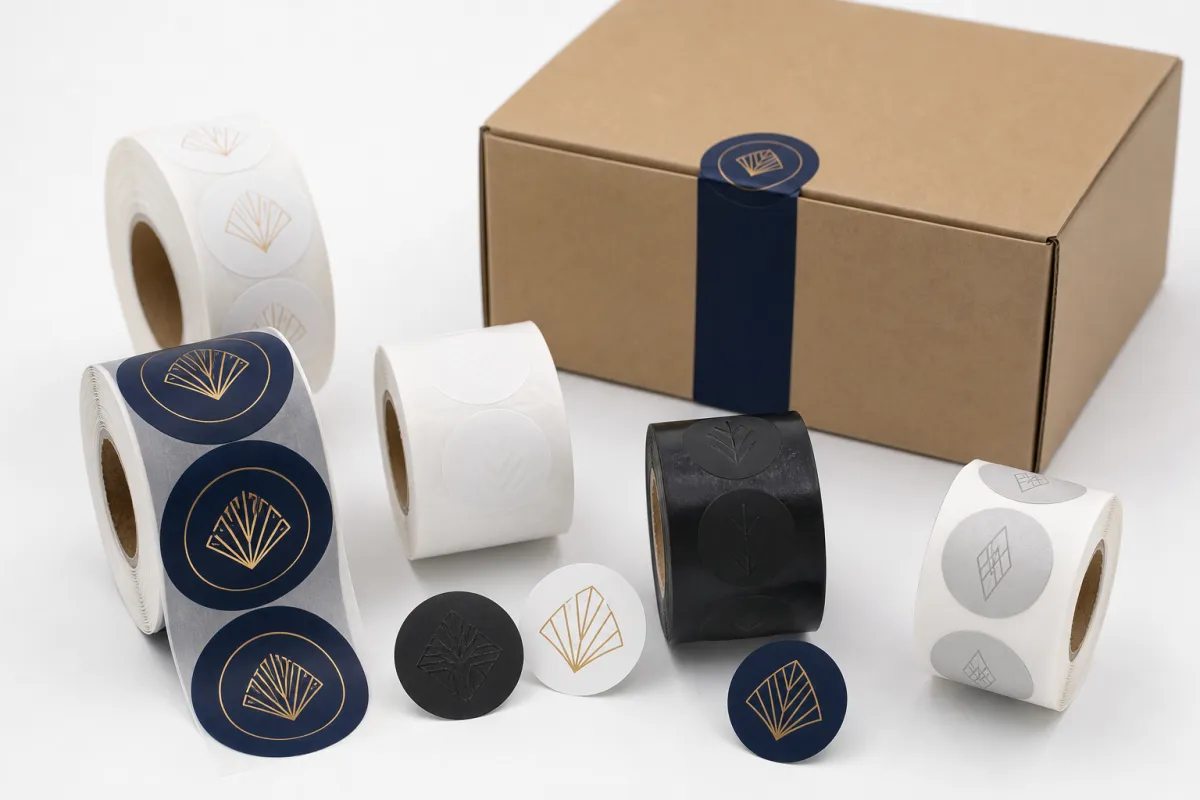
Teams often start with a sticker, a hangtag, or a printed insert and still end up with packaging that feels unfinished. Branded package seals bulk orders close that gap in a cleaner way. A seal can close a carton flap, secure a folded sleeve, bridge tissue wrap, or hold a mailer shut while still carrying a logo, pattern, or short message. Fewer parts. Fewer handoffs. Less chance for the unboxing flow to drift from one batch to the next.
Labor savings show up too. When a fulfillment team applies one component that does the work of two or three, pack time gets easier to predict. That does not mean a seal replaces every other packaging element. It means that, in many branded package seals bulk applications, the seal becomes the visible finishing point after product placement, tissue folding, or carton closure. When order volume spikes, that kind of simplification is not flashy, but it is useful. Honestly, it's kinda the whole point.
Bulk buying changes the economics in a useful way. A custom label run of 500 pieces can feel expensive because setup, proofing, and waste are spread across too few units. Branded package seals bulk orders spread those fixed costs over a larger quantity, so the unit price becomes easier to defend in budget reviews. If the seal goes on every shipment, every retail bundle, or every promo pack, the savings stack up quickly.
Brand recognition is part of the payoff too. Repetition matters. A customer who sees the same seal shape, color block, or Logo Placement on every box starts to connect that small piece with the brand's standard of care. That is not hype. It is the visual version of a clean fold line or a label that lands where it should. Branded package seals bulk programs work best when they support a simple, repeatable visual system instead of trying to cram the whole brand into a tiny footprint.
There is one more reason buyers order in volume: replenishment stays cleaner. If the artwork, substrate, and adhesive are locked in, the next run can match the first with far less back-and-forth. That is why buyers often build a reorder plan around branded package seals bulk purchases, especially when the seal shows up on cartons, kraft mailers, or promotional kits that run year-round.
A good case study can be more useful than a polished mockup because it shows how the seal behaves on a real package, not just on a render. That's the part people actually need before signing off.
Branded package seals bulk: materials, sizes, and finishes
Stock choice matters more than most people expect. Paper, film, and reinforced label stocks behave differently, and branded package seals bulk orders should match the package surface instead of just the logo. A paper seal feels warm and natural on kraft mailers or FSC-certified cartons. Film usually handles scuffing and moisture better on shipping packs that move through a longer chain. For paper sourcing and chain-of-custody context, FSC's standards page at fsc.org is a useful reference.
Common paper options include uncoated label paper, semi-gloss paper, and heavier art paper in the 60# to 80# text range. Those stocks print well and cut cleanly, which is why they show up often in branded package seals bulk work for boxes, sleeves, and tissue wraps. Film options such as BOPP and polyester are better when the seal needs more resistance to handling, rubbing, or limited exposure to humidity. Reinforced label stocks add another layer of durability if the package surface is rough or the seal needs a firmer bite during application.
Size choice changes both the look and the speed of application. Round seals around 1.5 inches to 2.5 inches are common because they place a logo neatly and apply fast. Square seals are useful when the artwork carries a border, icon, or short line of copy that needs a little more room. Die-cut shapes can make branded package seals bulk orders feel more custom, but every unusual contour adds tooling detail and usually increases setup cost. Strip formats, often around 1 x 3 inches or 1.25 x 4 inches, help when the seal must bridge a flap or act like a branded closure tab.
Finish is where the package starts to feel plain or intentional. Matte finishes read more understated and hide fingerprints better. Gloss brightens color and makes dark logos stand out, especially on white stock. Soft-touch adds a velvety feel, though it usually raises cost and can show scuffing differently than a harder gloss. Foil accents create strong contrast on small seals, but registration needs to stay tight or the effect looks sloppy. Clear film with a white ink underprint is another solid option for premium packs where the brand wants the package surface to show through.
Adhesive choice should not be vague. A seal that works on coated carton stock may behave very differently on corrugate, kraft mailers, recycled board, or lightly textured sleeves. Permanent acrylic adhesive is often the safest default for branded package seals bulk use on shipping packs because it holds across a wide range of temperatures. High-tack adhesive helps on rougher surfaces. Removable adhesive can work for temporary closures, but it is the wrong call if the seal is meant to act as a security cue.
If the package will see heat, warehouse dust, or pressure during transit, ask for a surface test on the exact material. That one step saves a lot of frustration later. A seal that looks perfect on a desk sample may lift once the carton is folded, stacked, or rubbed against another pack. In branded package seals bulk projects, those physical details matter more than a polished mockup on a screen.
A simple rule helps narrow the field. Choose paper for dry indoor presentation, choose film for stronger handling or moisture resistance, and choose reinforced stock if the seal has to survive a rougher packing path. That one decision often cuts the options in half before you even request a quote, which makes branded package seals bulk sourcing much easier to compare.
Print specs that keep branded package seals bulk consistent
Good artwork prep saves time on every branded package seals bulk order. The logo should come in as vector artwork whenever possible, usually in AI, EPS, or print-ready PDF format, so the edges stay crisp at small size. Raster art can work if it is high resolution, but anything that will appear tiny on a seal needs more care than a web graphic. For most print work, 300 dpi at final size is a safe baseline, though clean vector art is still the better choice for logos and line work.
Bleed and safe area are not optional. A typical bleed of 0.125 inch gives the cutter room to trim without showing white edges, and a safe zone of at least 0.0625 inch helps keep type from drifting too close to the cut line. That matters even more on branded package seals bulk runs because a small shift becomes obvious when every unit matches. If the artwork includes a fine border, keep in mind that borders near the trim line can look uneven if the die or cut registration moves even a little.
Color control is another place where buyers should ask direct questions. CMYK printing can reproduce a lot of brand colors well enough for everyday packaging, but spot colors give tighter control when the logo must match an established brand standard. Pantone references remove guesswork from the prepress conversation. For exact color needs, a proof is worth approving before the press run starts, especially if the seal carries a brand color that needs to match cartons, inserts, or other printed components in the same kit.
Text should stay short and readable. Small-format seals do not reward crowded layouts. A logo, a short tagline, and maybe a web address is usually enough. Add too much copy and the seal starts to look cramped, which is a common mistake in branded package seals bulk work. If the text cannot be read at arm's length, it probably belongs somewhere else in the package. That is not nitpicking. That is respecting the size of the format.
Special effects such as foil, varnish, and overprint need extra attention because they change how the artwork is built. Foil registration has to line up with the design, which means the file should clearly separate foil elements from process color. Spot varnish should be mapped with precision, since a misplaced gloss patch can make the piece feel off balance. Overprint settings should be checked before production so a logo does not vanish or darken in ways nobody expected. These are small technical details, but in branded package seals bulk production they are exactly the details that separate a polished finish from an expensive reprint.
For buyers comparing transit performance, a little shipping context helps too. If the package will be compressed, dropped, or vibrated in a parcel network, review testing guidance from ISTA. That does not mean every seal needs a formal lab test. It does mean the seal should be chosen with the package's real handling conditions in mind.
One practical detail gets missed all the time: how the seal is applied. A hand-applied seal may tolerate a more forgiving adhesive than a high-speed applicator, while a machine-applied seal may need a very stable roll or sheet format. Tell the supplier how branded package seals bulk units will be placed, because the application method affects adhesive choice, stacking tolerances, winding, and release liner performance.
Pricing, MOQ, and what drives cost for bulk seals
Pricing for branded package seals bulk orders comes down to a handful of levers buyers can actually control: quantity, size, stock, color count, finish complexity, and whether a custom die or special setup is needed. The larger the run, the more setup cost gets spread out. The more complex the design, the more each extra step adds to labor and press time. That is why two seals that look nearly identical on a mockup can land at very different prices in production.
MOQ is easier to understand as a production threshold than a sales trick. A print line has a minimum amount of setup, waste, and run time before the job makes sense. If you need a smaller quantity, the cost per piece rises because the same setup gets divided by fewer units. That is normal in branded package seals bulk manufacturing. It is also why buyers should ask whether a standard shape, simpler color count, or stock change can lower the entry quantity.
For planning, here is a practical comparison of common options:
| Option | Typical Build | Approx. Bulk Price Range | Best Use |
|---|---|---|---|
| Paper round seal | 1-2 colors on uncoated or semi-gloss paper, standard die | $0.08-$0.18 per unit at 5,000-10,000 pieces | Kraft mailers, cartons, tissue wraps |
| Film seal | BOPP or polyester with full-color print | $0.10-$0.22 per unit at 5,000-10,000 pieces | Higher-handling packs, moisture-prone shipping |
| Foil-accent seal | Paper or film with one foil element and clear layout | $0.14-$0.30 per unit at 5,000-10,000 pieces | Premium retail packaging, gift sets, limited campaigns |
| Custom die-cut seal | Non-standard shape with custom tooling | $0.12-$0.28 per unit plus tooling | Brand-specific shapes, signature closures |
Those ranges are directional, not fixed. I cannot promise exact numbers without the spec sheet, and anyone who does is probably guessing. A larger run can push unit price lower, while a job with metallic ink, soft-touch lamination, or unusual cutting requirements can move higher. That is why branded package seals bulk buyers should compare the full landed cost, not just the unit price: proofing, tooling, freight, and any special packaging for the finished product all belong in the calculation.
It also helps to ask for alternate quotes. A standard round or square seal may deliver nearly the same visual impact as a custom die-cut version, but with lower tooling and less waste. A two-color design may perform just as well as a full-coverage artwork piece, especially if the logo is strong and the background stock already supports the brand look. In branded package seals bulk sourcing, small design decisions often move the budget more than people expect.
Bulk pricing is not just about volume. It is also about how efficiently the job moves through prepress, press, finishing, and pack-out. If the artwork is clean, the substrate is standard, and the finish is simple, the quote usually reflects that efficiency. If the job needs handwork or multiple finishing steps, the cost rises in a way that makes sense once you see the production path.
For buyers who want repeat orders, Wholesale Programs are often the cleanest path because they make replenishment easier to plan and compare. That matters if branded package seals bulk runs are part of a monthly shipping cycle or a seasonal packaging program that needs predictable pricing.
Ordering process and production timeline for bulk seals
The cleanest branded package seals bulk orders follow a simple sequence: inquiry, quote, artwork review, proof approval, production, shipment. Basic, yes. Still the place where delays pile up. If the quote is missing size, material, or quantity, the estimate may be too loose to approve. If the file has unresolved fonts, missing bleed, or unclear color references, prepress will stop the job until the details are fixed. If the proof gets approved too fast, the buyer may spot an issue only after the run is already underway.
A realistic timeline for a standard order often looks like this: one to two business days for the quote, one to three business days for artwork review and proof setup, one to two business days for proof approval depending on how fast the internal team responds, and then roughly seven to twelve business days for production on a straightforward branded package seals bulk run. Custom shapes, foil, or more complicated finishing can add time. Freight sits on top of that, and that piece depends on destination and service level.
Late changes are the biggest source of delay. A logo swap, a copy tweak, or a color adjustment after proof approval can push a job back because the file has to be checked again before the press can restart. The safest workflow is to lock the art first and treat proofing as the last correction point, not the first time anyone has seen the design. In branded package seals bulk production, speed usually comes from preparation, not pressure.
A practical checklist keeps the whole process moving:
- Final art files in vector format or high-resolution print-ready PDF
- Exact size, shape, and quantity for the branded package seals bulk order
- Preferred stock type, finish, and adhesive strength
- Surface type the seal must stick to, such as corrugate, kraft, coated paper, or film
- Target ship date and any launch deadline that cannot move
- Application method, whether hand-applied or machine-applied
If the package is part of a shipping program that needs performance validation, matching the seal to the package handling profile is smart. The ISTA testing framework is useful because it ties package design to transit stress, not just shelf appearance. That kind of thinking keeps branded package seals bulk choices grounded in how the pack actually moves through the supply chain.
One more point saves trouble: ask whether the supplier can share a digital proof, a sample on similar stock, or a material swatch before the run begins. A simple proof may be enough for a reprint of an existing design, but a new branded package seals bulk project often benefits from at least one sample application test on the real package surface. That small step can reveal lifting, curling, color shift, or legibility issues that would otherwise show up too late.
Why choose us for branded package seals bulk
Custom Logo Things is built for buyers who want practical packaging support, not vague promises. That matters because branded package seals bulk orders succeed or fail on small details: prepress accuracy, material fit, adhesive behavior, and repeatability from one batch to the next. Our job is to keep those details visible early, before a quote turns into a production problem.
We focus on clear prepress review so artwork issues do not hide until the proof stage. If a logo needs cleaner vector treatment, if the bleed is too tight, or if a color callout needs clarification, we want that resolved before print starts. That approach is especially helpful in branded package seals bulk work, where one overlooked file issue can repeat across thousands of units instead of just a small sample run.
Material guidance matters too. A seal for a smooth retail carton should not be specified the same way as a seal for a textured kraft mailer or a flexible pouch. We help buyers think through adhesion, finish, and application method so the final result holds up in the real pack-out environment. That kind of technical conversation usually saves money because it reduces the odds of ordering the wrong build and having to live with it later.
Flexibility matters as well. Some brands need a short-run test before committing to a larger reorder. Others want a repeat bulk order that matches an earlier job exactly. Others are updating a logo or changing a color system and want the new version to stay close to the old packaging language. Branded package seals bulk programs should handle those shifts without forcing the buyer to rebuild the entire setup from scratch.
We also keep communication practical. Buyers do not need a generic sales deck; they need a clear answer on what stock is likely to hold, what finish makes sense, how much the job will cost at a given quantity, and how long it will take to ship after proof approval. That is the kind of help that makes branded package seals bulk orders easier to approve internally.
If you want a broader view of how similar packaging pieces are handled, our Case Studies page is a useful place to compare applications, and our Wholesale Programs are a sensible fit for buyers who reorder packaging components on a schedule. Both pages help frame the buying decision around real production needs rather than generic product descriptions.
Consistency is the real value. A seal that looks right on one box but peels on another, or prints cleanly in one run but drifts in the next, is not a good purchase no matter how attractive the quote looked. Branded package seals bulk buying should protect the brand as much as it decorates the package, and that balance is what we aim to deliver.
Next steps for branded package seals bulk orders
If you are ready to move forward, start with the basics: gather the artwork, choose the seal size, confirm the substrate and finish, and identify the exact surface the seal must stick to. That list sounds simple, but it removes most of the back-and-forth that slows branded package seals bulk quotes. Once those details are locked, the rest of the process becomes much easier to compare.
A smart buying sequence is to review one proof, test one sample application on the actual package, and compare one bulk quote before placing the full order. That gives you a visual check, a physical check, and a financial check. If all three line up, you are in a strong position to approve the run with confidence. If one of them looks off, you still have room to adjust before production starts.
Also confirm the pack-out details. Ask how the seals will be packed, whether the order ships flat or on rolls, how many units are in each carton, and whether the next reorder can use the same setup. Those details are easy to ignore, but they matter when the team is planning storage, receiving, and replenishment. For branded package seals bulk orders, that operational side is part of the value.
One final check: make sure the approval is based on real use, not only on a screen image. A seal can look great in a mockup and still fail if the adhesive is wrong for the surface or if the text is too small for the chosen size. That is why branded package seals bulk decisions are best made with the package in hand, the proof in front of you, and the budget tied to a clear spec.
The takeaway is simple. Pick the exact surface, test the exact seal, and lock the spec before the run starts. Do that, and branded package seals bulk orders stop being a guess and start behaving like a predictable part of the packaging system.
What is the best material for branded package seals bulk orders?
Paper stocks work well for dry indoor packaging and a natural look, while film or reinforced stocks are better for handling, moisture, or longer shipping chains. The best choice depends on the surface it must adhere to and how much scuff resistance the seal needs after application. For branded package seals bulk orders, the surface test matters as much as the material name.
How much do branded package seals bulk usually cost?
Cost depends on quantity, size, stock, color count, finish, and any die-cut or foil requirements. Per-piece pricing usually drops as quantity increases, but setup-heavy options can still raise the total order cost. A simple branded package seals bulk run is usually priced very differently from a foil-accent or custom-shape version.
What is the typical MOQ for branded package seals bulk?
MOQ varies by material and print method, because each setup has a minimum production threshold. If you need a smaller test run, ask for a standard shape or simpler finish to reduce the entry quantity. That is often the easiest way to make branded package seals bulk ordering workable for a first purchase.
How long does production take for bulk branded package seals?
Turnaround depends on proof approval, file readiness, and whether the order uses standard or custom tooling. Simple jobs move faster, while custom shapes, foil, or complex color control usually add time. In many branded package seals bulk projects, preparation is the fastest way to protect the schedule.
Can branded package seals bulk match our brand colors exactly?
Color matching is possible, but the method matters: spot colors give tighter control than full-process printing in many cases. A proof or sample is the safest way to verify how the color will look on the chosen stock. That is the best way to keep branded package seals bulk output aligned with the rest of the packaging system.