Buyer Fit Snapshot
| Best fit | Branded Packaging Bands with Logo projects where brand print, material claims, artwork control, MOQ, and repeat-order consistency need to be specified before quoting. |
|---|---|
| Quote inputs | Share finished size, material target, print colors, finish, packing count, annual reorder estimate, ship-to region, and any compliance wording. |
| Proofing check | Approve dieline scale, logo placement, barcode or warning zones, color tolerance, closure strength, and carton packing before bulk production. |
| Main risk | Vague material claims, crowded artwork, missing packing details, or unclear freight terms can make a low unit price expensive after revisions. |
Fast answer: Branded Packaging Bands with Logo: Material, Print, Proofing, and Reorder Risk should be specified like a repeatable production item. The safest quote records material, print method, finish, artwork proof, packing count, and reorder notes in one written spec.
Production checks before approval
Compare the actual filled-product size with the drawing, then confirm tolerance on folds, seals, hang holes, label areas, and retail display edges. Reserve space for logos, QR codes, warning copy, and material claims before decorative graphics fill the panel.
Quote comparison points
Review material grade, print process, finish, sampling route, tooling charges, carton quantity, and freight assumptions side by side. A quote is only useful when the supplier can repeat the same color, closure quality, and packing count on the next order.
Branded Packaging Bands With Logo: Uses, Costs, and Tips
A shipping team can move the same product in three box sizes and still make the delivery feel intentional. Plain cartons. Tight pick-and-pack. Same warehouse, same tape, same chaos. That is where branded packaging bands with logo earn their keep. They add visible branding, a campaign message, or a tamper cue without forcing a full box redesign. Once orders start piling up, that kind of flexibility stops being a nice idea and starts looking like common sense.
The appeal is practical, not glamorous. branded packaging bands with logo can turn standard mailers, folding cartons, or corrugated boxes into branded packaging that reads as custom at the doorstep, while the warehouse keeps a simpler inventory. One base pack. One band layer that changes as needed. That is a different kind of package branding: lighter to manage, easier to update, and less likely to leave the stockroom drowning in obsolete SKUs. It also plays nicely across product packaging, retail packaging, and subscription boxes without forcing every item into the same rigid format.
The real value is flexibility. A good band can make a shipment feel premium, carry a launch message, and keep the pack-out system from getting bloated. Seasonal sets, gift bundles, small-batch runs, and collaboration drops all benefit from that. branded packaging bands with logo give brands a custom look without paying for fully printed cartons every time the message changes. That is not magic. It is just better packaging math.
A band is often the cheapest place to buy attention. It is not the whole package, but it is the part most customers notice first.
That is why this format keeps showing up in modern packaging design. It sits between a label and a sleeve, which gives it enough room for a logo, a short brand line, a QR code, or a return note, while staying light on material use. In my experience, the best band programs are not trying to be cute. They are trying to make the pack-out system smarter and the box look like somebody actually cared.
What Are Branded Packaging Bands With Logo?
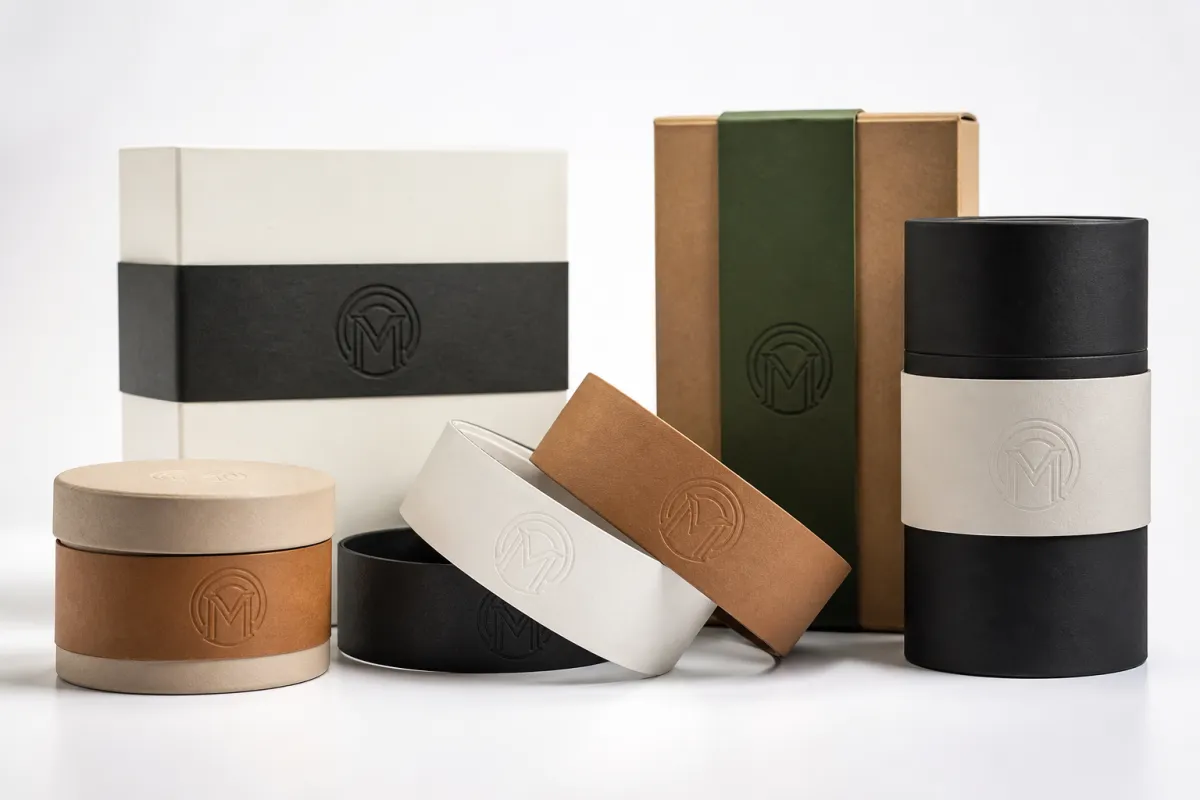
At the simplest level, branded packaging bands with logo are printed wraps, sleeves, or strap-style carriers that sit around a package and add identity to an otherwise standard container. They may be paper, SBS board, recycled stock, or a heavier coated sheet, depending on the shipment weight and the look the brand wants. Widths often land somewhere between 1.5 and 4 inches, though the right size depends on the carton face you want to cover and how much copy needs to live on the band.
The format solves a familiar problem. A brand may need three box sizes for one product line, but printing three separate cartons is expensive and risky when demand is still moving. branded packaging bands with logo make it possible to keep the base box consistent and customize the outer read with one printable layer. That cuts SKU sprawl, reduces the odds of overbuying the wrong box, and keeps the brand look steady across campaigns.
The logistics side matters too. Inventory gets messy fast if every product line needs its own custom carton. Bands absorb that complexity without drama. branded packaging bands with logo are often easier to store, easier to reorder, and quicker to swap in for a short-run promotion than a full box redesign. For brands with multiple fulfillment locations, that matters even more because one printed band spec can support multiple pack stations without changing the primary carton or mailer.
In real terms, the format sits between product packaging and retail packaging. It is visible enough to carry a brand message, but not so permanent that it locks a company into one carton forever. That is why you will see branded packaging bands with logo on apparel, candles, wellness kits, stationery, cosmetics, and lightweight gift sets. Different products. Same operational logic.
It helps to think of the band as a modular branding layer. It can be a full wrap, a belly band, a closure strip, or a carry sleeve. Some designs just reinforce a logo and website address. Others carry handling instructions, a promotion, or a sustainability note. A good supplier will usually ask for box dimensions first, not artwork first, because the physical fit decides whether branded packaging bands with logo look polished or improvised. If the band slips, buckles, or lands on a fold in the wrong place, the whole thing looks cheap in a hurry.
If your packaging system is still taking shape, it helps to review Custom Packaging Products alongside the band concept. The wider the packaging menu, the easier it is to choose a format that matches budget, shipping method, and brand goals instead of forcing everything into one expensive carton spec.
How Branded Packaging Bands With Logo Work in Shipping
The production path usually starts with a brief, not artwork. A buyer defines the use case, the box or mailer sizes, the number of colors, and the job of the band inside the pack-out flow. For branded packaging bands with logo, that job might be simple: identify the package and make it look deliberate. It might also be functional: add a QR code, support tamper awareness, or communicate a return policy without printing inside the carton.
From there, the work moves through proofing, material selection, print method, cutting, and finishing. Digital print is often attractive for short runs because setup is lighter and artwork changes are easier. Offset or flexographic printing may make more sense at higher volumes, especially if the design repeats across a large monthly order. Die-cutting or slitting then turns the sheet into the right band dimensions, and finishing can include matte varnish, gloss, soft-touch coating, or simple uncoated stock. For branded packaging bands with logo, every step changes both cost and appearance, so nobody should treat the spec like an afterthought.
Application matters just as much as print. Some bands are folded by hand around a box and closed with a tuck, adhesive strip, or a small amount of tape. Others slide over a mailer like a sleeve, which speeds pack-out and gives a cleaner visual line. In higher-volume environments, the band may be applied on a semi-automated line, which is where dimensional consistency becomes critical. If a band is even a little off, workers slow down, rework starts, and the whole promise of branded packaging bands with logo starts to fall apart. I have watched a team lose more time to a sloppy band fit than they saved by printing the thing in the first place.
The band can communicate quite a lot, if the layout is disciplined. A logo can sit on the front panel. A short brand statement can run on the reverse. A QR code can send customers to a how-to page, a returns portal, or a campaign landing page. Order details can be encoded through a variable data field if the operation needs it. The key is restraint. The best branded packaging bands with logo do not try to say everything. They carry one clean message and let the rest of the package do its job.
That operational discipline is why the format often beats more elaborate Custom Printed Boxes in fast-moving programs. A box redesign locks artwork to a structural format. A band is easier to update. If the season changes, or a collaboration ends, the team can swap the band without touching the core carton spec. For a brand balancing speed, inventory, and presentation, that kind of modular setup is hard to ignore.
For examples from real packaging programs, it helps to review Case Studies and compare how different companies handle print, speed, and unit economics. The pattern is usually the same: the brand wants impact at the customer doorstep, while operations wants fewer disruptions in fulfillment.
Two standards are worth keeping in mind during this phase. For shipping performance, many teams look at ISTA testing profiles, such as parcel and distribution simulations, because a band that looks fine on a desk may scuff, shift, or loosen in transit. For paper sourcing, FSC certification can help document responsible fiber management if sustainability claims are part of the brief. Neither standard solves everything, but both keep the project tied to measurable expectations.
Branded Packaging Bands With Logo: Cost Drivers and Quality
Pricing for branded packaging bands with logo becomes easier to read once you split the variables apart. Material choice is the biggest one. A simple uncoated paper band can be economical and easy to recycle, while a heavier SBS sheet or coated stock may deliver sharper color, better stiffness, and a more premium hand feel. The broader the color coverage and the more complex the finish, the higher the price usually climbs.
Quantity changes the math quickly. Short runs carry more setup cost per unit because prepress, proofing, and press preparation get spread over fewer pieces. Larger orders usually lower the unit price, sometimes sharply. That is why a 500-piece order of branded packaging bands with logo can look expensive on a per-unit basis, while a 10,000-piece run looks a lot friendlier if the design stays stable. The useful question is not "what is the print price?" but "what is the total packaging cost per shipment?"
There are hidden costs too, and they are usually the ones people forget. Artwork revisions can add time and chargebacks. Specialty coatings may require extra drying or handling. Storage becomes a problem if the run is too large and the band design changes before it is used. Application labor also matters. If the band saves three cents in print but adds eight seconds to each pack, the labor cost can wipe out the savings fast. That is a common blind spot in branded packaging bands with logo programs. Pretty graphics do not pay the packing staff.
The comparison below gives a practical benchmark. Numbers are illustrative, not universal, because print coverage, die complexity, and quantity all move the final price. Still, it helps to see how the cost stack usually behaves across common options for branded packaging bands with logo.
| Band Option | Best For | Typical Unit Cost at 5,000 Units | Quality and Operational Notes |
|---|---|---|---|
| Uncoated paper band | Simple branding, recyclable-focused programs | $0.09-$0.16 | Good for clean print and lower material cost; best when scuff resistance is not critical. |
| Heavy SBS or text stock | Stronger presentation, sharper graphics | $0.14-$0.24 | Adds stiffness and a more premium feel; can hold folds better on larger boxes. |
| Coated paper band | Color-rich branding, retail packaging | $0.18-$0.32 | Better image pop and finish options; may be worth it for launch kits and gift sets. |
| Special finish band | Premium campaigns, limited editions | $0.24-$0.45 | Soft-touch, foil, or specialty textures can elevate the feel but add setup and finishing cost. |
Material tradeoffs deserve a closer look. Paper-based branded packaging bands with logo often win on recyclability and printability, especially if the brand wants a low-friction sustainability story. Heavier or coated stocks can handle rougher distribution better and usually look more controlled under harsh warehouse lighting. If the package is going through parcel networks, the decision should be tied to abuse risk, not just appearance.
Quality is not just about how the band looks off the press. It is about whether the fold lines align with the box, whether the logo sits where the eye expects it, and whether the surface survives rubbing in transit. A band that prints beautifully but tears at the seam is a failed packaging system. That is why teams should look at sample fit, glue performance if used, and carton interaction before ordering any large run of branded packaging bands with logo.
A practical benchmark is to compare the band against the current pack-out. If a plain carton plus tape costs one amount, and a branded carton costs another, then the band should be measured against the full landed package cost, including printing, storage, labor, spoilage, and the carrying cost of extra SKUs. That comparison is often the difference between a smart packaging move and a nice idea that never makes it past finance.
Step-by-Step Process for Branded Packaging Bands With Logo
The cleanest way to launch branded packaging bands with logo is to move in stages. Start by defining the goal in one sentence. Is the band meant to improve unboxing, speed fulfillment, support a promotion, or replace a more expensive carton program? The answer changes everything from materials to print coverage. Once that is clear, measure the exact boxes or mailers the band needs to fit, and decide whether the design must work across one size or several.
Next comes the specification stage. This is where the supplier needs dimensions, board thickness, artwork requirements, and the application method. If the band will be used on three carton sizes, the dieline should be tested against all three. If it carries a barcode or QR code, that data should be placed away from folds, corners, and seam overlap. For branded packaging bands with logo, this is the point where packaging design gets very practical, because a clean concept can still fail if the fold line lands on the logo.
The proofing sequence usually includes a concept proof, a revised proof after comments, and a preproduction sample if the job is complex or the cost of a mistake is high. A simple run can move from approved proof to full production in roughly 10-15 business days, though specialty finishes, larger quantities, or multi-location fulfillment can stretch that timeline. Rush orders are possible in some cases, but they tend to cost more and leave less room for correction. That is especially true for branded packaging bands with logo that need to match a live launch date.
Sampling deserves more attention than it gets. The final production step should be tested on the actual boxes, mailers, or cartons used in shipping, not a substitute. A band may look fine on a desk and still slip on a glossy mailer, rub against a tape seam, or sit too high on the carton face. In other words, the sample should be judged in motion, not under perfect conditions. That is a very different test for branded packaging bands with logo, and it catches real problems early.
Once the sample passes, the production schedule should be locked in with the fulfillment team. If there are multiple warehouses, each site needs the same application instruction sheet, the same stack count, and the same reorder trigger. This is where delays usually show up: not in print, but in coordination. A good rollout plan includes buffer stock, a reorder point, and a simple escalation path if the band starts running low. Many teams forget that branded packaging bands with logo are part of the supply chain, not just part of the design file.
The last step is documentation. Keep the approved dieline, the final artwork, the stock spec, and the packing instructions together so the next reorder does not become a fresh guessing game. That record becomes valuable very quickly if the brand rotates a campaign, adds a new SKU, or changes fulfillment partners.
Common Mistakes That Undercut Branding and Delivery
The first mistake is designing for a screen instead of a shipment. A mockup hides a lot. It can make a band look crisp even if the fold placement is awkward, the seam overlaps the logo, or the artwork sits too close to the edge. branded packaging bands with logo need to survive reality: warehouse hands, tape, friction, and imperfect stacking. If the design only looks good in a render, it is not ready.
The second mistake is choosing a size that slows the line. That one gets expensive fast. If the band is too tight, workers fight it. If it is too loose, it shifts and looks careless. Either way, pack-out time goes up. A small gain in design quality gets wiped out by a few extra seconds per box, especially at high volume. For branded packaging bands with logo, fit is not a detail; it is a labor cost.
Third, some teams overload the band with copy. Too many claims, too many colors, tiny legal text, and a crowded logo lockup all pull attention away from the core message. A band only has a few seconds to earn its keep. The best one usually uses one strong image, one readable brand mark, and one clear line of copy. That is enough. More often than not, restraint makes branded packaging bands with logo feel more premium than clutter ever will.
Fourth, sample testing gets skipped. That habit costs money later. The band should be tested for adhesion if it uses adhesive, for scuffing if it rides against corrugated edges, and for fold memory if the board is heavier. If the product is going through parcel shipping, testing against transit conditions is smart, which is why many brands align the sample phase with ISTA-style distribution checks or similar in-house abuse testing. Skipping that step can make branded packaging bands with logo look strong in procurement and weak in live fulfillment.
Finally, people underestimate reorder lead times. Seasonal art, special finishes, and approved proofs all take time, and the fastest way to miss a launch is to assume the supplier can just "run more" at the last minute. Reorder planning should be built into the program from the start. If not, the warehouse ends up using plain packaging while waiting on the next batch of branded packaging bands with logo, which defeats the point of the exercise.
One more issue shows up in teams with fast-growing SKU counts: they keep changing the band size every time a carton changes by a half-inch. That creates unnecessary complexity. A better approach is to set a standard band family and adjust only where the carton family truly demands it. That keeps branded packaging bands with logo from becoming a custom exception for every small packaging change.
Expert Tips to Make the Band Do More Work
The strongest band designs usually start with one visual decision: what should the customer notice first? A logo, a product name, a campaign headline, or a color block. Pick one hero element and support it. That is especially true for branded packaging bands with logo, because the format is small enough that every extra message competes with the main read. If the layout is crowded, the package starts feeling like a flyer instead of a branded shipment.
Another useful tactic is to make the band multi-purpose. It can brand the package, close the carton, and carry practical information at the same time. For example, one side can hold the logo and visual identity, while the back carries return instructions, a QR code, or a short sustainability note. That makes branded packaging bands with logo work harder without adding another printed component. If the message has to change often, the band is also easier to refresh than the base carton.
Alignment with box dimensions matters more than many teams expect. A band that is deliberately sized to the carton feels engineered. One that floats around the box feels accidental. That is why the best branded packaging bands with logo programs are built around a standard box family, a standard application method, and a clear rule for where the logo should sit relative to the front panel and seam.
Seasonal or campaign-based artwork is another place where the format shines. A holiday illustration, a launch message, or a collaboration graphic can be swapped in without rebuilding the whole packaging system. That lets brands keep their branded packaging bands with logo fresh while holding the underlying logistics steady. The packaging changes; the carton architecture does not. From an operations standpoint, that is a healthy compromise.
Measure performance, too. It is easy to get caught up in how a package looks and forget what it does. Track pack time per unit, damage rates, rework counts, and customer comments about unboxing. If the band helps the team save 2-3 seconds per order, or it reduces the need for custom box inventory, that is real value. If customers mention the packaging in reviews or social posts, that is another sign that branded packaging bands with logo are doing more than carrying ink.
Do not use sustainability language casually. If the stock is FSC-certified, say so only when documentation is in place. If the band is recyclable in common curbside streams, check local guidance before making a broad claim. The packaging industry is full of good intentions and weak claims. A disciplined branded packaging bands with logo program earns trust by being specific, not vague.
Brands that need help balancing visual impact and operating reality can also look at Case Studies to see how other teams approach package branding without overcomplicating fulfillment. The most useful examples are rarely the flashiest ones. They are the ones that stayed in production and kept performing after the launch spike.
Next Steps for Launching a Pilot
If you want a low-risk way to test branded packaging bands with logo, start with one high-volume SKU, one carton style, and one message. Do not try to solve every product line at once. Pick the shipment that moves often enough to produce meaningful data, but not so critical that a test would disrupt the whole operation. That gives you a clean read on labor, appearance, and reorder behavior.
Your pilot checklist should be short and concrete. Confirm the box dimensions, the band width, the print method, the number of colors, the application method, the target pack-out time, and the success metrics. If the objective is presentation, measure customer feedback or unboxing response. If the objective is efficiency, track how long it takes staff to apply the band versus the current setup. Good branded packaging bands with logo programs are measured in operations data, not just opinions.
Before you scale, compare sample costs against the current packaging setup. Look at the full picture: print, shipping, labor, storage, and inventory complexity. A more expensive unit price can still be the better choice if it cuts box SKUs or shortens pack-out time. That is the quiet advantage of branded packaging bands with logo: they can move cost from the structural carton into a lighter, more flexible branding layer.
Then run the live test. Give the warehouse a real batch, collect feedback after a few days, and check for fit problems, scuffing, or slowdowns. If the band performs, scale it deliberately. If it stumbles, adjust the dieline or the stock before ordering more. A controlled pilot is far cheaper than a full rollout that has to be corrected after launch.
Used well, branded packaging bands with logo are not just a design choice. They are a packaging system choice, a fulfillment choice, and a cost-control choice all at once. That is why the format keeps showing up across branded packaging, product packaging, and retail packaging programs. It gives teams a way to look custom without tying the entire operation to custom cartons. For many brands, that is the right balance.
Frequently Asked Questions
Are branded packaging bands with logo cheaper than custom boxes?
Often yes, because they let you keep standard cartons and add branding only where it matters. The biggest savings usually come from lower inventory complexity and fewer box variations. For small runs, compare total pack-out cost, not just the print quote, because branded packaging bands with logo can still lose their edge if labor or spoilage runs high.
What materials work best for branded packaging bands with logo?
Paper stocks are common when you want a clean, recyclable option with good print quality. Heavier or coated stocks help when the band must resist scuffing or support a more premium finish. The best choice depends on box weight, handling conditions, and the look you want at delivery, which is why branded packaging bands with logo should be specified against the actual carton, not in isolation.
How long do branded packaging bands with logo take to produce?
Simple jobs can move quickly once artwork is approved and the spec is final. Delays usually come from revisions, specialty finishes, or changes to size and quantity after proofing. Build in extra time if you need samples, seasonal art, or multiple warehouse locations, since branded packaging bands with logo often depend on coordination as much as print capacity.
Do branded packaging bands with logo fit different box sizes?
Yes, if the design is planned around a standard range of carton dimensions. You can use one band style across multiple packages if the wrap area and fold points are tested first. Very different box sizes may need separate dielines or application instructions, so branded packaging bands with logo work best when the base packaging family is controlled.
How many colors should I use on branded packaging bands with logo?
Use as few as you can while still protecting brand recognition and legibility. One or two colors often keeps costs under control and speeds production. If you need more visual impact, reserve extra color for a single focal area instead of covering the whole band, because branded packaging bands with logo usually look cleaner when the design is focused.
For brands that want a practical path to better unboxing, tighter inventory, and a more intentional customer impression, branded packaging bands with logo are one of the most useful tools in the packaging kit. The right pilot is simple: one SKU, one carton, one message, and a real sample run on actual shipments. Measure fit, labor, damage, and reorder behavior before you scale. If those numbers hold up, you have a packaging move that earns its space instead of just looking good on a mockup.


