Buyer Fit Snapshot
| Best fit | Branded Product Packaging Wholesale projects where brand print, material claims, artwork control, MOQ, and repeat-order consistency need to be specified before quoting. |
|---|---|
| Quote inputs | Share finished size, material target, print colors, finish, packing count, annual reorder estimate, ship-to region, and any compliance wording. |
| Proofing check | Approve dieline scale, logo placement, barcode or warning zones, color tolerance, closure strength, and carton packing before bulk production. |
| Main risk | Vague material claims, crowded artwork, missing packing details, or unclear freight terms can make a low unit price expensive after revisions. |
Fast answer: Branded Product Packaging Wholesale: Costs, Specs, Steps should be specified like a repeatable production item. The safest quote records material, print method, finish, artwork proof, packing count, and reorder notes in one written spec.
Production checks before approval
Compare the actual filled-product size with the drawing, then confirm tolerance on folds, seals, hang holes, label areas, and retail display edges. Reserve space for logos, QR codes, warning copy, and material claims before decorative graphics fill the panel.
Quote comparison points
Review material grade, print process, finish, sampling route, tooling charges, carton quantity, and freight assumptions side by side. A quote is only useful when the supplier can repeat the same color, closure quality, and packing count on the next order.
Branded Product Packaging wholesale is where a product either looks ready for a shelf, a shipment, or a refund pile. There is not much middle ground. The gap usually comes down to three things: price per unit, turnaround, and whether the packaging survives long enough to protect the product and sell the brand. If the box shows up flimsy, the print is off, or the sizing is guessed instead of measured, the product can look private-label in the worst way. Not cheap. Just careless.
The real buying decision is not just “how much does the box cost.” It is how much damage weak packaging does to perceived value, breakage rates, and repeat orders. In practice, Branded Product Packaging wholesale usually makes more sense than piecemeal buying because setup, freight, and rework costs spread across a larger run. You pay for the structure once, the print once, and the mistake rate drops if the spec is locked early. Fancy packaging for the sake of looking fancy is a waste. Packaging that earns its keep is the point.
Buyers comparing branded product packaging wholesale options usually make the same mistake: they reach for vague words like “premium” or “affordable” and hope those words do the work of a spec sheet. They do not. Those labels do not tell you whether a folding carton needs 350gsm SBS, whether a mailer should be E-flute, or whether a rigid box needs a magnetic closure. Concrete choices do. That is what this piece covers.
Branded product packaging wholesale: why it pays off fast
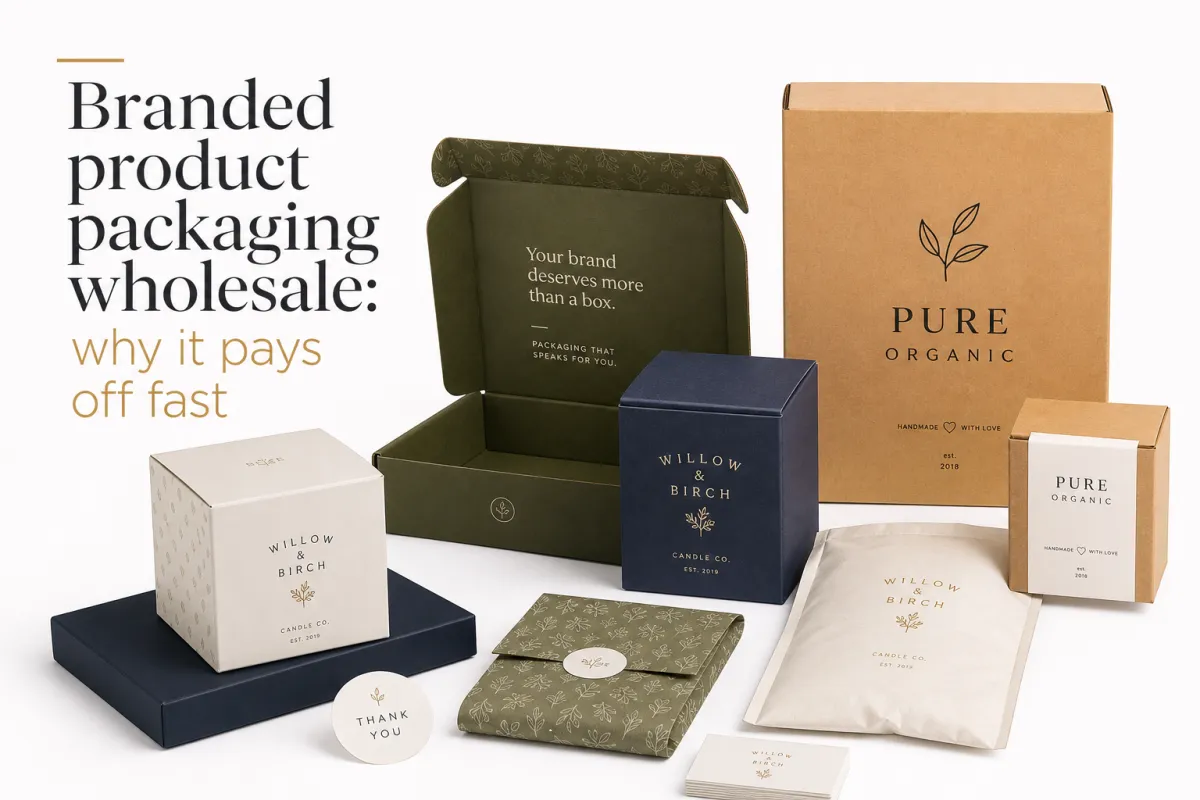
Good packaging does two jobs at once. It protects the product, and it makes the product look worth the asking price. Bad packaging does the opposite. A retail buyer opens the carton and sees crushed corners, poor registration, or thin board that flexes in the hand. The product has already lost value before it hits the shelf. That is why branded product packaging wholesale often pays back faster than buyers expect. It cuts unit cost, sure, but the bigger win is fewer visible mistakes.
Wholesale buying also gives you control over consistency. A small one-off print run can look fine on a sample, then drift across production because the stock, coating, or finishing was changed to save a few cents. That kind of “savings” shows up later as repacks, damaged shipments, and a buyer asking why the second batch looks different from the first. With branded product packaging wholesale, the safer choice is usually the one that keeps every carton, sleeve, or mailer aligned across the full run.
There is another hidden cost people miss: speed. If the packaging is wrong, the product team does not just fix the box and move on. They stop packing, reapprove artwork, reorder, and wait again. That delay can blow a launch window, a retailer reset, or a seasonal promotion. I have seen buyers burn hours chasing a lower quote only to pay more later in labor and rush freight. That is not efficiency. That is just moving the bill around.
Branded product packaging wholesale also matters for channel confidence. Retailers notice when packaging looks engineered instead of improvised. E-commerce teams notice when mailers fail transit tests. Subscription brands notice when the unboxing experience feels inconsistent from month to month. Once those people lose trust, it takes more than a prettier label to win it back. Packaging is part of the product decision, not a decorative afterthought.
If you want a quick way to judge whether a packaging quote is serious, ask one question: what exactly is included? If the answer is vague, the price is probably hiding something. If the quote clearly spells out board grade, print process, finishing, inserts, and freight assumptions, you are closer to a usable number. That is the difference between a quote and a guess.
For a broader look at packaging options, you can compare structure types in our Custom Packaging Products catalog or review how different customers solved similar problems in our Case Studies. Those pages are useful because they show how the same packaging budget can produce very different outcomes depending on the spec.
What branded product packaging wholesale includes
Branded product packaging wholesale is not one product. It is a family of structures and print methods, each with different strengths. Buyers usually compare folding cartons, rigid boxes, mailer boxes, sleeves, inserts, labels, and protective packaging. Each has a job. Folding cartons are common for cosmetics, supplements, and small consumer goods. Rigid boxes work better when presentation matters more than fold-flat shipping. Mailer boxes make sense for e-commerce and subscription kits because they balance protection with a branded opening experience.
Support pieces get ignored until the order is already in motion. Inserts keep a product from shifting. Sleeves can create strong branding without rebuilding the whole package. Labels help when the base container stays the same but the brand needs a different version, flavor, or SKU. Protective packaging, such as corrugated dunnage or molded pulp, becomes important when breakage is expensive. That is why branded product packaging wholesale should be discussed as a system, not as a single box.
Customization usually covers more than print. Buyers can change dimensions, board thickness, coating, insert style, closure type, and shipping format. A cosmetics box might need a soft-touch outer finish with a paperboard insert. A coffee subscription kit might need a corrugated mailer with a sturdy interior layout. A luxury candle may need a rigid setup box with a wrapped lid and foam or paper insert. In each case, branded product packaging wholesale turns the brand into something the customer can hold, open, and remember.
Channel matters too. E-commerce packaging needs drop resistance and predictable fit. Retail packaging needs shelf impact and barcode placement. Subscription kits need a clean opening sequence and repeatable pack-out. Trade show handouts need to travel well and stack neatly. The wrong spec for the channel creates wasted material or a bad customer experience. That is not a minor issue. It is a direct hit to product perception.
The cheapest-looking box is often the most expensive one after the damage is counted. Thin board bends. Weak tabs open in transit. Off-spec inserts require manual adjustment. A low-cost print job can still become high-cost packaging if repacks and replacements start showing up. Good branded product packaging wholesale work is usually boring in the best way. It arrives, fits, prints cleanly, and does not create a crisis.
When buyers ask for options, I usually suggest starting with structure first and decoration second. Pick the box style that fits the product and the shipping method. Then decide how much visual lift you need from print and finish. That order saves time and prevents expensive redesigns later. It also keeps the final packaging honest.
One more thing: if the sample looks great but the finished run suddenly feels flimsy, the spec probably changed somewhere. That happens more than suppliers like to admit. It is why I always ask which stock, coating, and closure details are locked before production starts. Saves everybody from the “wait, why does this feel different?” conversation.
Branded product packaging wholesale specs that change the quote
Pricing in branded product packaging wholesale is driven by a handful of spec choices, and most of them should be locked before you ask for quotes. Start with dimensions. If the box is oversized, you pay for extra board and freight. If it is too tight, you pay later in product damage or awkward pack-out. Next is board grade. SBS, kraft, corrugated, rigid chipboard, and specialty stocks all behave differently. They also print differently, which matters if your brand color has to stay consistent from run to run.
Print coverage is another major driver. A full-bleed, four-color printed surface costs more than a simple one-color mark or a small logo panel. Heavy ink coverage can affect drying, coating choice, and waste rates. Finishing adds more layers. Matte lamination, gloss varnish, soft-touch film, foil stamping, embossing, debossing, and spot UV each push the quote in a different direction. A printed box with a spot UV logo feels very different from a plain kraft carton, and the difference shows up in the unit price. That is normal. Pretending otherwise is how buyers get surprised.
Die-line complexity is another hidden cost. A simple straight-line folding carton is faster to set up than a box with window cutouts, special locking tabs, or unusual folds. More complex structures can raise tooling cost and lengthen proofing time. Custom inserts do the same thing. If the product is fragile, the insert is worth it. If it is not, you may be paying for a feature that looks impressive on paper but does not improve the customer experience.
In production terms, tolerances matter. A half-millimeter may not sound like much, but across a mass run it can mean loose fit, bulging sides, or a lid that will not close cleanly. For branded product packaging wholesale, ask what tolerance range the supplier holds on cut size, print registration, and finished dimensions. If the answer is vague, that is a problem. Good suppliers can usually explain where the tolerances are tight and where the process allows some variation.
Quality control should also be discussed early. Ask whether the supplier checks board thickness, color match, glue strength, and insertion fit before full production. For products that ship through parcel networks, testing against transport abuse is smart. The industry does not need poetry here. It needs proof. Packaging buyers often reference standards such as ISTA transport testing when the order has to survive rough handling. That is a sensible conversation, not overkill.
Here is a simple rule: the more the packaging has to do, the more clearly the spec should be defined. Presentation, protection, and speed do not come free. Branded product packaging wholesale works best when the buyer knows which of those three is the priority.
| Packaging type | Typical use | Approx. MOQ range | Common unit price range | Notes |
|---|---|---|---|---|
| Folding carton | Cosmetics, supplements, small retail goods | 1,000-5,000 | $0.18-$0.75 | Good for shelf presentation; finishing changes price quickly |
| Mailer box | E-commerce, subscriptions, bundled kits | 500-3,000 | $0.65-$2.20 | Corrugated strength matters more than fancy extras |
| Rigid box | Premium gifts, electronics, luxury items | 300-2,000 | $1.80-$6.50 | Higher labor and material cost, but strong presentation value |
| Sleeve with insert | Retail launches, seasonal promotions, multi-SKU sets | 1,000-5,000 | $0.35-$1.40 | Often cheaper than rebuilding the whole package |
| Protective insert system | Fragile bottles, glass, premium devices | 500-3,000 | $0.25-$2.00 | Cost depends on die cutting, material, and fit tolerance |
These ranges are directional, not a promise. Region, material availability, freight, and finishing choices can move the number a lot.
If the order has recycled-content or forestry requirements, ask for documentation early. Buyers in regulated channels often want FSC-certified paper or board, and that can be a smart requirement for brand trust as well as compliance. The point is not to collect badges. The point is to avoid last-minute sourcing problems. For paper-based packaging, the FSC program is one of the clearest reference points buyers use.
Branded product packaging wholesale specs should also consider shipping format. Flat-packed cartons save space and freight. Pre-assembled rigid boxes save labor but raise volume and shipping cost. If a warehouse is doing thousands of pack-outs, labor savings may justify the extra material handling. If a startup is trying to keep cash tight, flat-packed often makes more sense. No single answer fits every brand. That is why quoting by spec, not by guess, matters so much.
Branded product packaging wholesale pricing and MOQ
The biggest mistake buyers make with branded product packaging wholesale is staring at the headline unit price and ignoring the rest of the math. A quote at $0.42 per unit can cost more than a quote at $0.48 if the first one hides a higher die charge, more freight, or a sample process that forces a reprint. Total landed cost is the number that matters. Anything else is just noise.
MOQ, or minimum order quantity, depends on material type, print complexity, and whether custom tooling is needed. Simple corrugated runs can start lower because the production setup is straightforward. Rigid boxes and heavily finished cartons usually require higher minimums because the handwork and setup time are higher. If a supplier says the MOQ is “flexible,” ask what changes when you go lower. Usually the answer is higher price, more limited finishing, or longer lead time. That is normal. It is also useful.
For realistic budgeting, here are the bands I see most often in branded product packaging wholesale:
- Small test run: 250-1,000 units, usually the highest unit cost, often best for validation or seasonal proofing.
- Core launch run: 1,000-5,000 units, where price starts to drop and setup fees become easier to absorb.
- Growth run: 5,000-20,000 units, where the strongest cost efficiency usually appears if the spec is stable.
Those ranges are not magic. They are practical. A buyer who orders 1,200 units may still pay a lot if the box has foil, embossing, a custom insert, and color-critical print. A buyer who orders 8,000 simple mailers may get a much cleaner number because the structure is easy to repeat. Quantity helps, but complexity still has a say.
When comparing quotes, look at these line items side by side:
- Unit price
- Plate or die cost
- Sampling cost
- Freight estimate
- Reprint or remake risk
- Lead time
That last one is where people get burned. If a cheaper quote arrives three weeks late, it may cost more than the higher quote that ships on time. If your sales cycle depends on a launch date, branded product packaging wholesale needs to be judged against calendar risk, not just invoice risk. Time is part of the price. Buyers hate hearing that because it is true.
Bundling can reduce spend. If you have several SKUs with the same size structure, you may be able to reuse the same dieline, board grade, or base construction and only change print. That lowers setup cost and keeps the brand system consistent. A repeatable structure is one of the easiest ways to lower the long-term cost of branded packaging without downgrading the presentation. A messy SKU mix, by contrast, tends to raise everything.
There is also a freight reality here. Large, bulky packaging moves expensively. A quote that looks good ex-factory can look very different once pallet count, carton size, and destination are added. That is why branded product packaging wholesale should always be quoted with shipping assumptions stated clearly. If they are not stated, ask. If the supplier cannot explain the freight logic, the quote is incomplete.
Finally, do not overbuy just because the unit price drops. Cash tied up in boxes is still cash tied up. It is smarter to order enough for the sales window plus a modest cushion than to warehouse a year’s worth of packaging that may need a label update, compliance change, or color revision. Wholesale savings are real, but so is inventory risk.
Branded product packaging wholesale process and timeline
The process for branded product packaging wholesale is usually straightforward when the buyer is organized. It starts with the brief. Size, product type, print method, finish preference, target quantity, and shipping destination should all be clear before the first quote request. If the brief is thin, every other step takes longer. That is not the supplier being difficult. That is the supplier trying to price something that has not been fully defined.
A typical sequence looks like this: quote, dieline approval, artwork prep, proofing, sample approval, production, and freight. Each step can move quickly, or it can drag. Artwork is one of the biggest delays. Missing barcodes, low-resolution logos, unprepared bleed margins, or unclear color targets all create back-and-forth. So does changing the dimensions after the proof is already underway. The cleanest orders are the ones where the buyer hands over final artwork and final measurements together.
Timeline is tied to complexity. A simple branded mailer box might move from proof approval to production in about 10-15 business days, with freight layered on top depending on destination. A more complex rigid box with finishing and inserts may need 18-30 business days, sometimes longer if samples need revision or materials need sourcing. Rush runs are possible, but they usually cost more and leave less room for adjustments. Speed has a price.
What slows orders down most often? Vague specs, late approvals, reworked artwork, and sample changes after the run is already queued. I have also seen delays caused by shipping details that were not nailed down early enough. If the boxes need palletization, specific carton counts, or warehouse labeling, say so up front. That protects the schedule and avoids everyone pretending the problem appeared out of nowhere.
Before requesting quotes for branded product packaging wholesale, have this ready:
- Exact product dimensions and weight
- Target order quantity
- Preferred box style or structure
- Artwork files in usable format
- Brand colors, logo files, and typography notes
- Finish requirements such as matte, gloss, foil, or soft-touch
- Insert or protection requirements
- Shipping destination and delivery window
- Any compliance needs, including recycling or material certification
If the package has to survive parcel handling, ask for the right test plan early rather than trying to patch the spec later. If the package is for retail, ask how the barcode, hang tab, or shelf-facing panel should be handled. If the package is for a premium brand, ask how much budget should go toward tactile finish versus structural upgrades. That is how experienced buyers keep the job under control.
For buyers who are still shaping the order, our Wholesale Programs page is a good place to compare order structures and see how repeat purchasing can lower friction. A smart wholesale setup should make the second order easier than the first. If it does not, something in the process is too loose.
Why choose us for branded product packaging wholesale
At Custom Logo Things, the value is not some magical packaging promise. It is clear communication, accurate specs, and fewer surprises. That matters because branded product packaging wholesale is full of small decisions that can quietly wreck a budget. If the structure is wrong, the print is off, or the shipping assumption is incomplete, the cheap quote becomes an expensive lesson. Buyers do not need theater. They need the job to match the brief.
We focus on the facts buyers care about: size accuracy, consistent production, realistic lead times, and support when the spec needs to be tightened up. That includes dieline guidance, material recommendations, finish selection, and print checks before production moves forward. It also means telling you when a finish looks great but is not worth the cost for the product you are selling. I think that kind of honesty is better than dressing up a weak package as “premium.”
Branded product packaging wholesale should also make repeat orders easier. Once a structure is dialed in, the next run should not require a full rebuild unless the product changes. Reorders should be simple. Multi-location fulfillment should be manageable. Packaging that supports a growing operation should reduce friction, not create a new project every time inventory gets low.
If you need options across custom printed boxes, retail packaging, sleeves, inserts, or mailers, the right supplier should explain tradeoffs without pushing you into one construction. Some brands want presentation first. Others need shipping strength first. Others need both, but only within a strict budget. That is normal. A good packaging partner does not make those tradeoffs disappear; they make them visible so you can choose deliberately.
For brands that want proof, not just promises, our Case Studies show how packaging choices affect presentation, cost, and pack-out behavior in real buying scenarios. That is useful because it keeps the conversation grounded. Packaging design is easier to judge when you can see what happened after the order shipped, not just how the mockup looked on a screen.
Most of all, branded product packaging wholesale should protect margin. That means fewer mistakes, fewer do-overs, and fewer urgent reprints. The lowest headline price is not a victory if the boxes show up late or the product arrives damaged. Fewer surprises. Cleaner handoff. Better results. That is the point.
Next steps for branded product packaging wholesale orders
If you are ready to move on branded product packaging wholesale, start with the basics. Define the product size, expected quantity, shipping method, and target budget. Those four numbers will tell you more than a long wish list ever will. Once those are clear, gather the artwork files, brand guidelines, and any compliance details so the first quote is actually usable.
Do not request one quote and stop there. Ask for two or three scenarios: a lowest-cost build, a best-presentation build, and a fastest-turnaround build. That gives you a real comparison instead of a fake one. You will usually find that one structure is clearly better for the channel, while another is only cheaper on paper. Good buying means comparing the options that matter, not the ones that sound nice.
Then check sample approval before production. A sample can reveal fit problems, color drift, weak closure, or awkward assembly long before a full run is printed. That is especially true for branded product packaging wholesale when the product is fragile, premium, or sold through retail channels where presentation is part of the purchase decision. Skipping samples to save a little time is a habit that tends to cost more later.
Here is the short checklist I would use before signing off:
- Final dimensions confirmed
- Artwork checked for bleed, color, and barcode placement
- Sample approved for fit and finish
- Production timeline written down
- Freight method confirmed
- Reorder plan documented
That is the cleanest path. It keeps the order focused and removes the usual excuses. If you are still narrowing down the structure, our packaging team can help you compare options in a way that makes sense for the product, not just the artwork. The goal is straightforward: branded product packaging wholesale that controls cost, presents the product well, and keeps shipping headaches to a minimum.
And yes, that still matters on reorder. Especially on reorder. That is where well-planned branded product packaging wholesale stops being a one-time purchase and starts being a real advantage. Get the structure right once, document the spec, and future orders stop being a scavenger hunt.
If you want the shortest possible takeaway, here it is: lock the dimensions, confirm the material, approve a sample, and make sure freight is quoted on the same assumptions as the box. Do those four things before you sign off, and the packaging is a lot less likely to bite you later.
What is the typical MOQ for branded product packaging wholesale?
MOQ usually depends on material, size, and print complexity; simple corrugated runs are often lower than rigid or heavily finished boxes. Ask for MOQ by SKU, not just by total order, because mixed designs can change the minimum fast.
How long does branded product packaging wholesale take from proof to delivery?
Standard timelines usually include proofing, production, and freight, so the fastest path is when artwork is final and approvals move immediately. Rush jobs are possible, but they usually cost more and leave less room for sample revisions.
Can I order multiple sizes in one branded product packaging wholesale run?
Yes, but each size may need its own dieline, setup, and MOQ, which can affect pricing. If the structures are similar, you can sometimes reduce cost by reusing materials or print setups.
What drives the price most in branded product packaging wholesale?
The biggest price drivers are quantity, board or stock choice, print coverage, finishing, and whether custom inserts or tooling are needed. Freight and sample costs matter too, especially on large or bulky packaging orders.
Should I request samples before placing a branded product packaging wholesale order?
Yes, especially if fit, print accuracy, or shelf presentation matters to your product. A sample can prevent expensive mistakes like poor sizing, weak closure, or color mismatch.


