Buyer Fit Snapshot
| Best fit | Branded Product Packaging MOQ projects where brand print, material claims, artwork control, MOQ, and repeat-order consistency need to be specified before quoting. |
|---|---|
| Quote inputs | Share finished size, material target, print colors, finish, packing count, annual reorder estimate, ship-to region, and any compliance wording. |
| Proofing check | Approve dieline scale, logo placement, barcode or warning zones, color tolerance, closure strength, and carton packing before bulk production. |
| Main risk | Vague material claims, crowded artwork, missing packing details, or unclear freight terms can make a low unit price expensive after revisions. |
Fast answer: Branded Product Packaging MOQ: Material, Print, Proofing, and Reorder Risk should be specified like a repeatable production item. The safest quote records material, print method, finish, artwork proof, packing count, and reorder notes in one written spec.
Production checks before approval
Compare the actual filled-product size with the drawing, then confirm tolerance on folds, seals, hang holes, label areas, and retail display edges. Reserve space for logos, QR codes, warning copy, and material claims before decorative graphics fill the panel.
Quote comparison points
Review material grade, print process, finish, sampling route, tooling charges, carton quantity, and freight assumptions side by side. A quote is only useful when the supplier can repeat the same color, closure quality, and packing count on the next order.
On more than one launch, I have watched a brand fall in love with a render and then wince at the quote. The culprit is usually the same: Branded Product Packaging moq. That minimum order quantity exists because setup, tooling, material waste, press calibration, and labor all have to be paid before the first finished carton gets packed. It is not a nuisance line on the estimate. It is one of the main numbers that decides whether the packaging plan holds together.
A small run can be surprisingly stubborn. A 500-piece pilot and a 5,000-piece launch may look like cousins on a spreadsheet, then the unit price lands and they stop looking related. The lower Branded Product Packaging moq often carries the higher per-piece cost, especially if the order includes custom dielines, foil, embossing, specialty board, or a press schedule that has to squeeze between larger jobs. That is the economics speaking, not the supplier being difficult.
So the real question is not whether the minimum sounds a little high. The real question is whether the branded product packaging moq fits margin, storage space, and launch timing. Brands that answer that honestly avoid the common trap: ordering too much too early, then spending months with cartons stacked in the corner like a very expensive reminder.
"A lower MOQ only helps if the packaging still protects the product, prints cleanly, and leaves enough margin to matter. Cheap packaging that misses those three points is just expensive with a smaller price tag."
What Is the Branded Product Packaging MOQ?
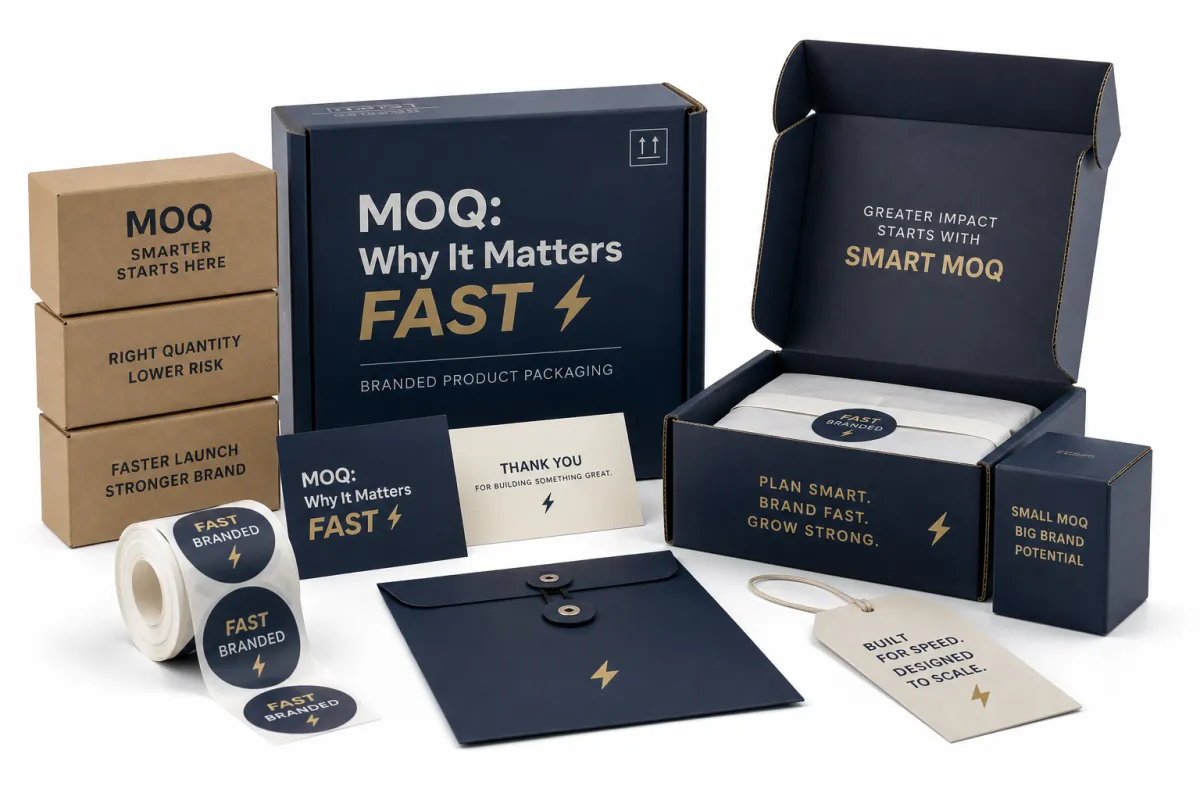
Branded product packaging moq is the minimum quantity a packaging supplier will accept for a custom order. The minimum is usually tied to production math, not taste. A factory still has to prepare tooling, calibrate color, load stock, set the line, and inspect output, even if the order is small. Those fixed costs do not shrink just because the first run is a test.
That is why MOQ matters beyond the quote sheet. It sits at the intersection of structure, print method, and production efficiency. A folding carton, a rigid box, and a mailer may all carry the same product, but they do not demand the same setup or the same minimum. The same is true for a simple one-color run versus a full-coverage box with multiple finishes.
There is a practical upside here. A low branded product packaging moq can help a brand test demand before inventory gets heavy. A higher MOQ can bring the unit cost down enough to protect margin. The right answer depends on how fast the product is expected to sell, how much warehouse space exists, and whether the package has to do retail display, e-commerce shipping, or both. I have seen launch teams choose the wrong side of that tradeoff and pay for it twice: once in production, again in storage.
Buyers should ask for more than one price break. The minimum, the next tier, and a larger run often show the shape of the decision more clearly than a single quote ever will. A supplier who only gives one quantity may be hiding the point where the unit price really improves.
Branded Product Packaging MOQ: Why It Matters Fast
Many buyers assume the minimum order is arbitrary. Usually, it is not. The branded product packaging moq is commonly set by setup economics, not by a vendor trying to be awkward. Presses need plates or digital setup. Dies need tooling. Hand assembly needs enough volume to make labor worthwhile. That is the dull explanation. It is also the accurate one.
A small order can become the expensive order if it requires custom tooling, specialty finishes, or a production slot that interrupts a larger job. A 500-unit launch box with two print colors, a soft-touch coating, and a custom insert can easily cost more per unit than a 5,000-unit run with the same layout. Fixed costs do not care that the brand is new. They show up in full.
The factory still has to source board, cut the dies, run registration checks, trim waste, and pack the finished pieces. Spread those steps across a larger run and the numbers behave differently. The branded product packaging moq becomes a pressure point on unit cost, speed, and cash flow all at once.
The order of operations usually looks like this:
- Prototype for fit and structure.
- Pilot run for a small launch or pre-sale test.
- Production run for wider distribution.
Each stage brings a different branded product packaging moq reality. A pilot run makes sense if demand is still uncertain. A larger run can reduce the unit price, but only if the product actually sells. No one gets points for buying 20,000 boxes and discovering the market wanted 2,000. That happens more often than people admit.
Packaging design changes the equation too. A one-color mailer is easier to approve, easier to repeat, and usually kinder to the budget than a fully decorated rigid box. The first option is often faster and less fragile as a production plan. The second photographs beautifully and costs more in the real world. That split shows up in quotes every day.
For buyers comparing wider packaging formats before they settle the run, Custom Packaging Products is a useful starting point. Choosing the structure early keeps the artwork from wandering into unnecessary complexity.
What Counts as Branded Product Packaging?
Buyers use branded product packaging moq for a wide set of jobs, and that is where confusion starts. A shipping carton, a retail box, and a subscription kit all count as packaging, but they do not behave the same way in production. Some are structural. Some are decorative. Some do both. MOQ and pricing shift depending on which side of that line the order lands on.
In practical terms, branded packaging usually includes Custom Printed Boxes, mailers, sleeves, inserts, tissue paper, labels, and shipper cartons. The main difference is whether the item carries the brand through print, color, or finish, or whether it exists mainly to move the product safely. A plain shipper can still participate in the brand story if it uses printed tape, a branded sticker, or a color system that matches the rest of the line.
Structural packaging changes the equation quickly. A rigid box with wrapped boards, a folding carton with a tuck flap, and a mailer with an internal insert all call for different production methods. Decorative packaging is easier to alter, but it has limits. Foil stamping, spot UV, embossing, and custom shapes add steps, add risk, and usually raise the branded product packaging moq.
Product category matters just as much:
- Retail packaging needs shelf appeal and consistent print quality.
- E-commerce packaging needs transit protection and an unboxing moment that does not feel cheap.
- Subscription kits need repeatable inserts and tight dimensional control.
- Event packaging often needs speed more than heavy finishing.
From a branding and design standpoint, the structure should support the product story instead of fighting it. A heavy cosmetic serum packed in a flimsy sleeve is bad branding. A small accessory buried in an oversized rigid box wastes material and usually pushes the branded product packaging moq higher for no useful reason. Buyers get burned when they fall in love with the mockup and ignore the assembly logic.
Think in layers during launch planning: outer box, inner wrap, insert, and shipper. Not every layer needs a loud logo. A restrained palette, a single strong print pass, and a well-fit insert often do more than an overworked design system. Packaging with a budget can still look sharp; it just needs to respect the economics of the run.
For low-volume buyers, the job is to separate what is essential from what is simply visually loud. The more complex the build, the more the branded product packaging moq tends to climb. A simple printed mailer is often a better first order than a fully decorated rigid box. Upgrading later is easier. The reverse is usually pricier.
One more detail matters: food, cosmetics, and sensitive electronics all raise the bar on material choices. Barrier properties, coating compatibility, and product safety influence the final spec. A supplier should explain the tradeoff in plain language, not packaging jargon soup. If the answer never leaves the buzzwords, keep shopping.
And yes, this is where a lot of newer brands get stuck. They start with what looks premium on a screen, then discover that the package is gonna cost more because the structure is fighting the product. That mismatch is avoidable with a good spec review before the quote goes out.
Specifications That Change MOQ and Cost
Specifications are where the branded product packaging moq stops being theoretical and starts costing money. The biggest drivers are size, board grade, paper stock, print coverage, and coating choices. Each one affects setup, yield, and the number of workable units a factory can produce without wasting material.
Size sounds simple, but it rarely is. A box that fits the product tightly saves shipping space and makes the unboxing look deliberate. That same box may need a new dieline, which increases setup work. Standard sizes are cheaper because the factory can reuse more existing tooling. Custom dimensions look elegant in renderings. They cost more in the actual run.
Board grade and paper stock do the same kind of work on a different axis. A 350gsm C1S artboard behaves differently from a thicker rigid board wrapped in printed paper. A folding carton with moderate ink coverage is easier to run than a rigid box with deep black coverage, foil accents, and soft-touch lamination. That is not a value judgment. It is print production.
Complexity and the branded product packaging moq tend to move together:
- Low complexity: one-color mailer, standard size, no insert, no special finish.
- Medium complexity: full-color carton, custom size, one insert, matte or gloss coating.
- High complexity: rigid box, foil, embossing, multiple components, custom insert, specialty wrap.
Tooling matters too. Any custom dieline, insert layout, or specialty shape adds setup. A simple die-cut sleeve is one thing. A molded tray or multi-panel insert is another. Every separate part adds time to assembly and inspection, which is one reason the branded product packaging moq climbs as the design grows more ambitious.
Print method changes the math as well. Digital printing can be more forgiving for smaller runs, while offset printing tends to shine at larger volumes once setup costs are spread out. Flexographic printing often makes sense for certain corrugated projects. That is why buyers should not ask only for one quote. Ask for the price at 250, 500, 1,000, and 5,000 units. Then the branded product packaging moq becomes a decision instead of a mystery.
Before quoting, lock these details:
- Exact product dimensions, including any inserts or wraps.
- Target quantity and the minimum quantity you can actually use.
- Material preference, such as artboard, kraft, rigid board, or FSC-certified stock.
- Print coverage, number of colors, and whether the back side prints.
- Finish choice, such as matte, gloss, soft-touch, foil, embossing, or spot UV.
- Shipping destination and whether cartons need retail-ready packout.
That list is not busywork. It keeps the quote honest. Without those specifics, the supplier is guessing, and guesswork is expensive in branded packaging. If the project calls for certified material, check FSC-certified paper options early instead of treating certification like a last-minute checkbox.
Branded Product Packaging MOQ Pricing: What Drives Cost
Pricing for branded product packaging moq jobs follows a simple pattern: fixed setup costs get spread across the run. That is why unit price drops as quantity rises. The factory is recovering the same labor, tooling, and machine prep on fewer or more pieces. One hundred boxes will always look expensive next to one thousand boxes if the spec stays the same.
The main cost drivers are setup fees, plate charges, print method, material yield, finishing, and labor time. Setup fees cover press configuration and trial output. Plate charges appear with some print methods. Material yield matters because awkward dimensions waste more sheet space. Finishing costs stack quickly when multiple passes enter the job. A simple branded product packaging moq order can get pricey the moment extras pile up.
Product packaging buyers usually compare three broad tiers:
| Run type | Typical quantity | Approximate unit cost | Best for | Main tradeoff |
|---|---|---|---|---|
| Prototype / sample | 1-20 units | $18-$120 each | Fit checks, mockups, sales approval | Highest unit price |
| Pilot run | 250-1,000 units | $0.80-$4.50 each | Launches, pre-orders, small retail tests | Still carries a lot of setup cost |
| Production run | 2,500-10,000+ units | $0.18-$1.75 each | Scaled e-commerce, retail packaging, repeat orders | More cash tied up in inventory |
Those ranges are directional, not a promise. A plain mailer lands near the low end. A rigid box with a custom insert sits much higher. Add foil, embossing, or specialty coating and the branded product packaging moq may stay the same while the unit price climbs. Buyers often miss that distinction. MOQ and price are related, but they are not the same thing.
There are sane places to trim cost without wrecking the look:
- Reduce finish complexity from three effects to one.
- Use standard dimensions if the product fit allows it.
- Cut color count or print only the visible panels.
- Use an existing insert style instead of a fully custom one.
- Choose a simpler board or paper stock that still protects the product.
That is usually where branded packaging gets smarter. Not cheaper in a desperate way. Smarter. A buyer who trims a foil pass, standardizes the dieline, and keeps the artwork clean can often lower the branded product packaging moq pressure without pushing the box into bargain-bin territory. That matters more than most brands admit.
There is a point where a small order stops making sense. If a 300-unit premium box costs almost the same as a 1,000-unit run after setup, the launch plan needs a harder look. A tiny order may fit the cash flow, or a larger first buy may reduce total cost. That is a strategy call, not a printing call. The answer changes the branded product packaging moq you should accept.
For a clearer sense of how order size changes packaging decisions, browse the examples in our Case Studies. A real production run tells a better story than a polished render ever will.
Transit performance matters too, especially for subscription kits and e-commerce shipments. Quality control should include drop-test thinking. The current methods from ISTA are useful reference points for buyers who want packaging that survives more than a desk photo shoot.
How the Ordering Process and Timeline Actually Work
A well-run branded product packaging moq project follows a clear sequence. Brief, estimate, proof, sample, approval, production, packing, shipment. Skip a step or blur two together and the order tends to get messy later. Packaging work does not improve by being vague. It improves by being exact.
Most delays begin early, not in the press room. They start in the email thread. A client sends an incomplete size, changes the coating after proofing, or decides the insert should hold a different product after sampling. Each change pushes the schedule. That is why a clean branded product packaging moq quote should include a spec sheet everyone can sign off on before production begins.
Typical timing depends on complexity:
- Digital proofs: often 1-3 business days after the brief is complete.
- Physical samples: often 5-10 business days, sometimes longer for complex structures.
- Simple production runs: often 7-12 business days after approval.
- Complex runs with special finishing: often 15-25 business days, sometimes more.
Shipping adds its own clock. Domestic freight may take a few days. International transit can stretch longer, and port congestion can ruin a tidy schedule without much sympathy. The branded product packaging moq itself does not cause every delay. Artwork drift, material shortages, and late approvals do most of the damage.
A buyer should ask for a stage-by-stage timeline rather than a vague promise. That means dates for proof approval, sample delivery, production start, packout, and ship date. If the supplier cannot map those steps, the quote is incomplete. Full stop. A real branded product packaging moq plan needs lead-time visibility because launch windows rarely move for packaging delays.
A simple planning method works well:
- Lock the product dimensions and the packaging format.
- Choose the finish and print method before requesting the final quote.
- Request samples if the product is new or sensitive.
- Approve artwork only after checking fit, color, and assembly.
- Pad the timeline with a buffer for freight and rework.
That buffer matters. A seven-day promise only works when the artwork is final, the material is in stock, and no one changes the insert dimensions on Thursday afternoon. In real life, a better planning window for a modest branded product packaging moq run is often two to four weeks from finalized proof to delivery, depending on structure and shipping mode. Complex premium packaging can take longer.
Buyer-side planning also means thinking about warehouse intake. A 1,000-unit run of folding cartons does not require the same storage as 1,000 rigid boxes with inserts. Bulky packaging carries landed cost in the form of space. That is another reason the right branded product packaging moq is not automatically the biggest one you can afford.
For common pre-quote questions, the general answers in our FAQ can cut down on back-and-forth. That is not glamorous, but neither is paying for a delay because one measurement was wrong.
Why Choose Us for Low-MOQ Packaging Projects
Low-MOQ buyers do not need hype. They need a supplier that explains the tradeoffs without acting like the order is too small to matter. That is especially true for branded product packaging moq work, where a few wrong assumptions can turn a manageable launch into a budget mess. The right partner makes the numbers clearer, not louder.
At Custom Logo Things, the practical value is straightforward: responsive quoting, clear spec guidance, and enough packaging know-how to keep small runs from turning into headaches. A good buyer experience should feel organized. It should tell you what is possible, what is expensive, and what is flat-out unnecessary. Anything less wastes time.
Quality control matters just as much as price. For branded product packaging moq jobs, the key checks are color consistency, material accuracy, structural fit, and packout integrity. A box that looks fine in a mockup but collapses in transit is not premium packaging. It is a return waiting to happen. A supplier worth working with should care about that.
Budget discipline matters too. A packaging partner should not push foil, embossing, specialty board, and a custom insert just because the render looks impressive. Sometimes those upgrades belong in the plan. Sometimes they are just an expensive way to say the same thing. Good package branding is selective. It uses detail where customers notice it and keeps the rest efficient.
A solid low-MOQ process usually feels like this:
- Clear answers on what minimum quantity each format really needs.
- Two or three quote tiers so you can compare structure changes.
- Plain language around finishes, materials, and lead time.
- Proof control so artwork does not drift after approval.
- Realistic production planning so the launch date is not a fantasy.
That is the difference between generic selling and useful selling. In branded packaging, the buyer needs a partner who can balance design ambition with budget reality. A 500-unit pilot run deserves to be treated like a serious order, not a favor. If a project can move to 2,500 units to improve unit price, that should be stated plainly. No drama. No mystery.
For brands that want a tighter view of results, prior work usually tells the story better than promises. Browse the Case Studies to see how product packaging decisions affect fit, finish, and delivery timing in actual orders. That beats vague enthusiasm every time.
Material sourcing still matters too. Sustainability belongs in the same conversation as certification, recyclability, and transit strength. A clean branded product packaging moq plan does not ignore those details. It handles them early.
Next Steps to Lock Your Packaging Order
Accurate branded product packaging moq quotes start with the right information. Product dimensions, target quantity, packaging type, print method, finish, insert needs, and shipping destination should all be in the brief. Dielines, artwork, and reference photos help too. Every missing detail invites a guess, and guesses are expensive.
The smartest move is to request two or three quote tiers. One for the minimum you can launch with. One for the middle ground. One for the volume that truly improves unit price. That is how a buyer sees what branded product packaging moq does to total cost instead of staring at one number and hoping for the best.
Before production starts, make sure these steps are complete:
- Approve the proof with final artwork, size, and finish.
- Confirm the sample if the structure is custom or the product is fragile.
- Sign off on the packout method so the factory knows the assembly order.
- Review the timeline with shipping padding included.
- Check the invoice against the final spec sheet before payment.
That sounds basic because it is basic. Packaging projects get messy when people skip the boring steps. The most painful branded product packaging moq problems usually come from one of three things: unclear specs, late changes, or a buyer who wanted premium output on a discount plan. None of those are rare. All of them are avoidable.
Use the order process to compare tradeoffs honestly. A lower MOQ may help you launch sooner, but it might cost more per unit. A larger run may lower unit cost, but it could tie up cash and warehouse space. A simpler print spec may save the budget, but it may not support the retail story you want. There is no magic answer. There is only the right answer for the project in front of you.
If the basics are still in motion, the FAQ is a useful place to check common edge cases before you send a request. Then send a clean brief, compare the tiers, and move the order forward. That is the fastest route to a useful branded product packaging moq decision, and it keeps product packaging from turning into a surprise expense.
Branded product packaging moq is not just a number to negotiate. It is the point where design, production, cash flow, and launch timing meet. Get that number right, and the rest of the order gets easier. Get it wrong, and you buy inventory anxiety with your own money.
Frequently Asked Questions
What is a normal branded product packaging MOQ?
It depends on the format, but small custom runs often start in the low hundreds and more complex packaging can begin higher. A simple printed mailer can have a very different branded product packaging moq from a rigid box with inserts and special finishing. The useful quote is the one that shows the minimum, the next price break, and the cost change if you increase quantity.
Can I lower branded product packaging MOQ without wrecking the price?
Yes, usually by simplifying the structure, reducing finish complexity, or using standard dimensions. The cheapest low-MOQ option is not always the best one if it creates weak packaging or awkward product fit. Ask for alternate quotes so you can compare a stripped-down version against your preferred premium version before you lock the branded product packaging moq.
Which specs raise branded product packaging MOQ the most?
Custom tooling, unusual box shapes, foil, embossing, and multi-step finishing are the usual offenders. Heavy ink coverage and special inserts also add setup time and material waste, which pushes minimums higher. If you need a lower branded product packaging moq, keep the structure simple and the print spec tight.
How long does branded product packaging MOQ take from proof to delivery?
Simple runs move faster than complex ones, but proofing, sampling, and production all need room in the schedule. Delays usually come from artwork changes, material delays, or waiting on final approvals, not from the actual print run alone. A supplier should give you a stage-by-stage timeline, not a vague promise, especially on a branded product packaging moq order with custom finishes.
What should I send to get an accurate branded product packaging MOQ quote?
Send product dimensions, quantity target, packaging type, print method, finish, insert needs, and destination. If you have dielines, artwork, or reference photos, include them too. The more specific the brief, the faster you get a quote that reflects the real branded product packaging moq and the real cost.


